
Most B2B founders choose the wrong level of support.
Not because they don’t care. Not because they haven’t thought about it. But because they’re answering the wrong question.
They ask: “Can I afford this?” when the question they should be asking is: “What level of involvement do I actually need to get a result?”
Those are completely different questions. And the answer to the second one determines whether any investment in revenue architecture works or becomes another cost with nothing to show for it.
Here’s what I’ve observed after working on deals worth over £1 billion, placing thousands of senior sales professionals into enterprise organisations, and building revenue infrastructure for businesses backed by OpenAI, Amazon, Microsoft, and Boeing: the founders who get the best results aren’t always the ones who spend the most. They’re the ones who are honest about where the gap actually is.
The Real Question Isn’t How Much – It’s How Deep
When a B2B founder comes into a Revenue Diagnosis session with us, the first thing we do is understand the current state of their commercial infrastructure. Not their goals. Not their growth targets. Their infrastructure.
Because the number of businesses that have ambitious revenue targets and no structured pipeline to support them is staggering. The pipeline depends on the founder’s relationships. The follow-up system is a spreadsheet. The sales process lives in someone’s head. Deals close inconsistently because the system that should be producing them doesn’t exist.
That’s not a motivation problem. That’s a systems problem.
Once you understand that, the question of which level of B2B revenue support you need becomes much more straightforward. There are three distinct situations B2B founders find themselves in and each one corresponds to a different level of revenue architecture
B2B Revenue Support Level 1 – You Have the Team. You Need the Playbook.
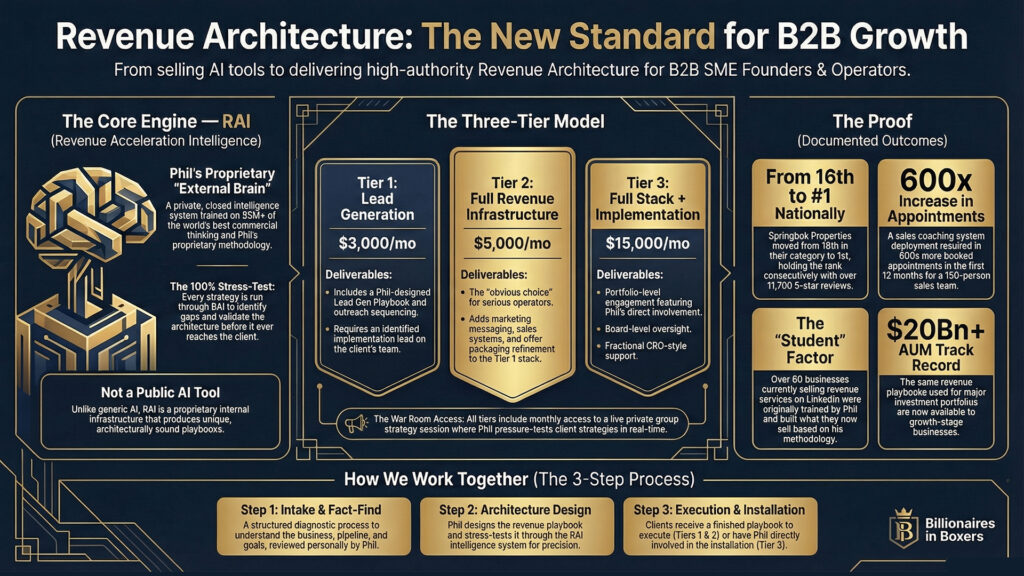
Some founders have a capable implementation person already in place. Someone on their team who can own the execution once the strategy is designed. What they’re missing isn’t the operator – it’s the architecture.
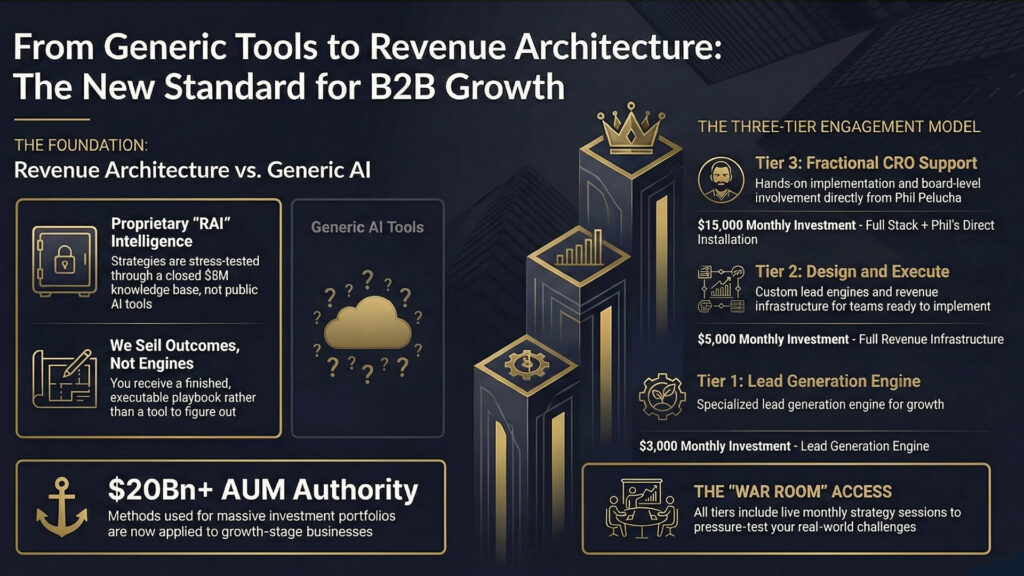
In this situation, the right approach is a Phil-designed Lead Generation Playbook. Outreach sequencing, channel plan, follow-up system, and pipeline hygiene, built specifically for your business, your market, and your ideal client profile. Monthly access to The War Room, where Phil pressure-tests your strategy live.
This is the “we build the lead engine, you run it” model. The playbook is designed. The system is handed over. Your implementation lead executes.
This tier only works if you genuinely have that person.
If you don’t – if execution is going to fall back on you, this isn’t the right level. It becomes a well-designed document that never gets used. We confirm implementation capacity in the intake process for exactly this reason.
B2B Revenue Support Level 2 – You Need the Full Commercial Infrastructure
Most clients who are serious about growth choose this level.
Here’s why. A lead generation system without the supporting commercial infrastructure around it is a half-built engine. You can generate interest, but if your messaging isn’t sharp, your offer isn’t packaged correctly, and your sales process has gaps, the leads don’t convert at the rate they should.
At this level, we design everything. Marketing messaging architecture and positioning. Sales system, process, follow-up sequences, and objection handling. Offer packaging refinement where needed. And a complete Phil-designed Revenue Playbook – the full commercial blueprint for your business.
This is the complete revenue infrastructure, built and handed to you ready to implement. Monthly War Room access is included.
The distinction from Level 1: You don’t need a dedicated implementation lead already in place. The delivery model at this level accounts for the full scope of what needs to exist, not just the lead generation component.
If you’re genuinely committed to building something that works not just generating activity, this is usually where the conversation lands.
B2B Revenue Support Level 3 – You Need Phil in the Room
There’s a specific type of founder for whom knowing what to do isn’t the issue.
They understand the strategy. They can see the gaps. The problem is making it happen inside the business navigating the internal constraints, the team dynamics, the competing priorities, and the day-to-day noise that erodes execution.
This is where Phil’s direct involvement changes everything.
Level 3 is full-stack revenue architecture plus hands-on implementation support from Phil. Board-level involvement. Fractional CRO-style engagement. Phil isn’t designing your playbook and handing it over, he’s involved in making it happen.
This is not for every business. It’s for operators who have already acknowledged that knowing isn’t enough. The methodology is the same one deployed for investment portfolio clients managing $20Bn+ in assets. The access is limited deliberately.
Anything beyond The War Room – direct one-to-one implementation, board-level involvement, hands-on execution – is a Level 3 conversation.
How to Know Which Level of B2B Revenue Support Is Right for You
Three honest questions. Answer them before you do anything else.
- Do you have someone on your team who can own implementation? Not “could probably manage it” – genuinely owns it. If yes, Level 1 is viable. If no, start at Level 2.
- Is your current commercial infrastructure complete messaging, sales process, offer packaging, pipeline or are there significant gaps? If gaps exist beyond lead generation, Level 2 is the right entry point.
- Is execution the constraint, not design? If you can see the strategy clearly but the business keeps defaulting to old patterns, Level 3 is the conversation you need to have.
Most founders who are stuck sit between Level 2 and Level 3. The Revenue Diagnosis session is specifically designed to identify which side of that line you’re on and what the commercial architecture of your business actually needs to move forward.
The One Thing That Doesn’t Change Across All Three Levels
Every playbook is designed by Phil. Every strategy is stress-tested before it reaches you.
We don’t sell templates. We don’t sell access to a tool you operate yourself. You receive finished revenue architecture, built for your specific business, validated against the same methodology used for portfolio clients at the highest level of the market.
The tier determines the depth of involvement and the scope of what gets built. The standard doesn’t change.
Ready to find out which level is right for your business
The Revenue Diagnosis is a live session where Phil reviews your current commercial infrastructure and tells you exactly where the gaps are and what level of architecture your business needs.
It’s not a sales call. It’s a diagnosis.
