
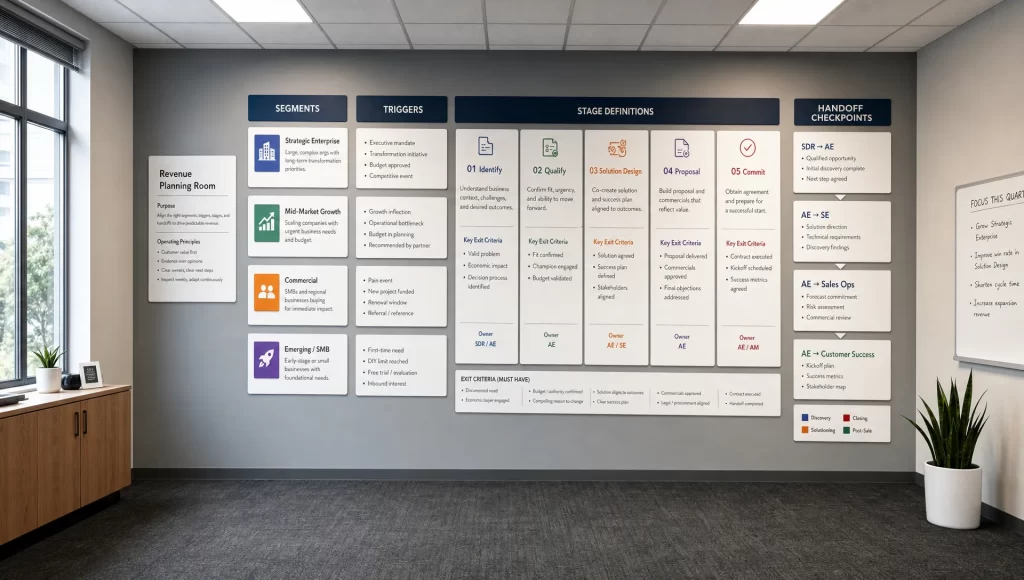
Most founder-led B2B companies do not stall because the team suddenly forgot how to sell. They stall because the revenue system that carried the business from early traction to a few million in revenue was never designed for the next stage.
At first, growth often runs through the founder. The founder knows which prospects are worth pursuing, how to reframe objections, when to discount, which partnership conversations matter and which customer problems signal expansion potential. That intuition is valuable, but it is also trapped in one person.
B2B revenue growth becomes more predictable when that intuition is converted into system design. Not a thicker sales playbook that no one reads. Not another dashboard full of lagging metrics. A real commercial system that defines how the company creates demand, qualifies opportunities, converts buyers, retains customers and learns from the market.
For founder-led businesses in the $3M to $25M range, this is often the difference between adding activity and building enterprise value.
What system design means in B2B revenue growth
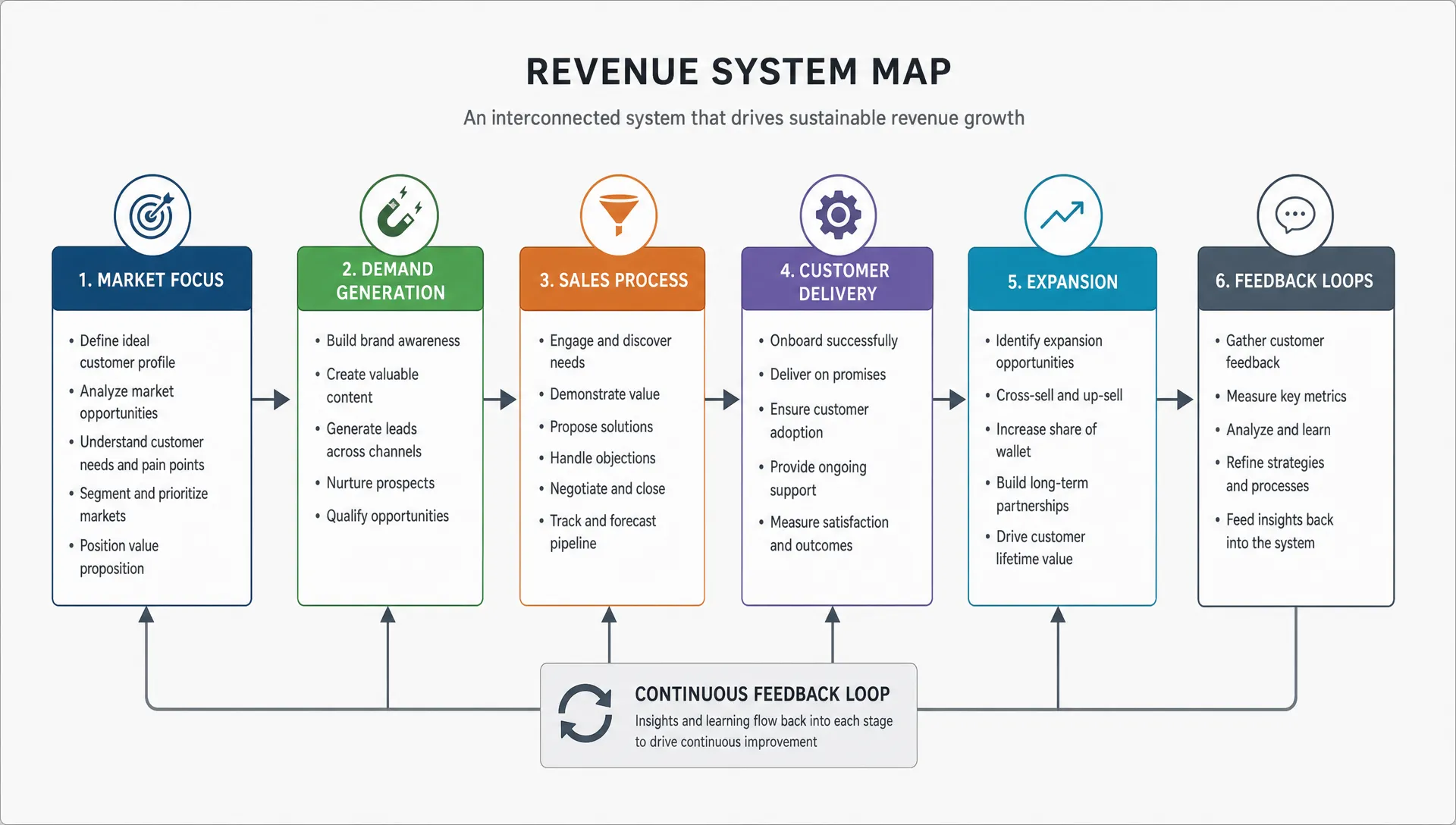
A revenue system is the set of choices, processes, roles, metrics and feedback loops that determine how money moves through the company. It connects strategy to execution.
A well-designed revenue system answers practical questions such as:
- Which accounts should we pursue, and which should we ignore?
- What buying triggers indicate urgency?
- How do prospects move from problem awareness to commercial conversation?
- What must be true before an opportunity enters the pipeline?
- Who owns each stage of the customer journey?
- Which metrics tell us where the constraint actually sits?
Poor system design creates the opposite effect. Marketing celebrates lead volume, sales complains about lead quality, customer success inherits mismatched expectations and the founder keeps stepping in to rescue important deals.
The problem is not effort. It is that the parts of the revenue engine were designed separately, often in reaction to immediate pressure. A CRM was added because pipeline visibility was weak. A new sales hire was added because the founder was overloaded. A campaign was launched because inbound slowed. Each decision may have been rational at the time, but the combined system becomes harder to manage as the company scales.
This is why many B2B tech growth problems are really revenue problems, not isolated failures in marketing, sales or hiring. The symptom appears in one function, but the root cause sits in the design of the whole commercial system.
Why founder-led companies hit a revenue design ceiling
Founder-led B2B companies usually grow through a sequence of adaptations. The founder sells the first deals, then adds delivery capacity, then hires marketing or sales support, then patches the gaps with tools, agencies or new managers. This works until complexity outgrows informal coordination.
The ceiling usually shows up in familiar ways. Pipeline exists, but forecast quality is weak. The sales team is busy, but win rates are inconsistent. The company has a strong product or service, but the market message changes depending on who is speaking. Customer delivery is valued, but expansion is opportunistic rather than designed.
At this stage, adding more pressure can make the system worse. More leads create more qualification noise. More reps create more variation. More tools create more disconnected data. More campaigns create more handoffs that no one fully owns.
The founder then becomes the integration layer. They interpret the market, review key deals, fix messaging, approve exceptions and decide what matters. This creates a hidden dependency that limits scale. The company may have a team, but the real revenue logic still sits in the founder's head.
Better system design removes that dependency by making the logic explicit.
The six design choices that shape revenue performance
B2B revenue growth does not improve equally from every possible intervention. The highest leverage usually comes from redesigning the choices that control flow, quality and learning across the revenue system.
1. Market focus and disqualification logic
Most companies define their ideal customer profile too broadly. They list industries, company sizes and buyer titles, but they do not define the conditions that make a customer commercially attractive.
A stronger system defines both fit and exclusion. It clarifies the signals that indicate urgency, buying capacity, strategic pain, implementation readiness and expansion potential. It also gives the team permission to reject poor-fit opportunities, even when they look tempting in the short term.
This matters because every weak-fit deal consumes sales time, delivery attention and management bandwidth. Revenue growth is not only about winning more. It is about winning the right revenue at a lower cost of complexity.
2. Offer design around the buying trigger
Many B2B offers are described from the seller's perspective. They explain capabilities, deliverables or features. Buyers, however, usually act when a specific business condition becomes painful enough to fund change.
Good system design aligns the offer with that buying trigger. It makes the commercial promise specific, the business case clear and the next step easy to understand. The offer should help the buyer answer a simple internal question: why should this become a priority now?
When offer design is vague, sales cycles stretch. Prospects may agree that the solution is useful, but they struggle to justify urgency. The pipeline fills with interested but inactive opportunities.
3. Demand paths for creation and capture
Demand capture and demand creation are different motions. Capturing existing demand means reaching buyers already searching for a solution. Creating demand means helping the market recognize a problem, reframe it and build urgency.
A common design flaw is expecting one motion to do both jobs. Search content, referrals, outbound, partnerships, events and executive thought leadership can all work, but they operate with different buyer states and time horizons.
A better system defines the role of each channel. It distinguishes education from conversion, early interest from active evaluation and brand familiarity from qualified opportunity.
4. Sales process as a decision system
A sales process should not be a list of rep activities. It should be a decision system that reveals whether a deal is real, what risk remains and what must happen next.
Stage definitions need exit criteria. Qualification should include business pain, decision process, economic impact, stakeholder access and implementation reality. Proposals should not be used as discovery tools. Forecast categories should reflect evidence, not optimism.
When sales process design is weak, pipeline becomes a story rather than an operating asset. Leaders spend forecast meetings debating opinions instead of inspecting evidence.
5. Commercial roles and handoffs
Revenue systems break when roles are defined by job titles instead of ownership. Marketing may own campaigns, sales may own opportunities and customer success may own retention, but no one owns the buyer's progression from problem to outcome.
Designing the handoffs matters as much as designing the functions. The system should define what information must transfer, what expectations were set, what risk signals exist and who is accountable for the next customer milestone.
This is especially important in founder-led companies where early customers may have received a more bespoke experience. As the business scales, the experience must become more repeatable without becoming generic.
6. Feedback loops from delivery back to market
The market teaches the company every day. Sales calls reveal objections. Lost deals reveal positioning gaps. Delivery reveals which promises create margin pressure. Customer success reveals which accounts expand and which accounts drain capacity.
The question is whether that learning reaches the revenue system.
A well-designed system turns frontline evidence into better ICP rules, sharper messaging, stronger qualification, improved pricing and clearer delivery expectations. Without that loop, the company keeps relearning the same lessons one deal at a time.
| Growth symptom | Likely system design flaw | Better design question |
|---|---|---|
| Plenty of leads, weak conversion | Poor qualification or channel mismatch | Which buyer state is this channel actually reaching? |
| Long sales cycles | Weak trigger, unclear urgency or missing stakeholders | What event makes this problem fundable now? |
| Founder involved in too many deals | Sales logic not codified | What judgment is the founder applying that the team cannot yet replicate? |
| Forecast misses | Pipeline stages lack evidence-based exit criteria | What proof must exist before a deal advances? |
| Growth with margin pressure | ICP and offer are attracting costly revenue | Which customer profiles create profitable repeatability? |
Design around the real constraint, not the loudest complaint
A revenue system should not be redesigned by whoever complains most persuasively. It should be redesigned around the current constraint.
Sometimes the constraint is market clarity. The company is pursuing too many segments, which dilutes messaging and wastes sales capacity. Sometimes it is offer design. Buyers understand the service but cannot justify urgency. Sometimes it is conversion. The team creates enough opportunities but loses control of decision process, stakeholder alignment or commercial risk. Sometimes it is retention and expansion. New revenue enters the business, but value leaks after the sale.
The constraint can also move. A company may fix positioning and suddenly expose a sales process problem. It may improve win rate and then discover onboarding capacity limits. This is normal. Growth systems evolve in sequences.
The discipline is to avoid treating every symptom as a separate project. Before adding headcount, launching a new campaign or buying another tool, founders need to identify the bottleneck that most limits revenue flow. That is the logic behind building a strategy around your real revenue constraint instead of reacting to surface-level friction.
Where AI fits in revenue system design
AI can improve B2B revenue growth, but only when the underlying system is clear. If the ICP is vague, AI will help generate more vague prospect lists. If the sales process lacks exit criteria, AI will summarize calls without improving deal quality. If the handoff to delivery is poorly defined, AI will accelerate the transfer of incomplete information.
Used properly, AI can strengthen a well-designed revenue system in several practical ways:
- Researching accounts against defined fit and trigger criteria
- Turning sales call patterns into better objection handling
- Supporting personalized outreach based on segment-specific pain
- Flagging pipeline risk when required evidence is missing
- Summarizing customer handoffs against agreed implementation criteria
- Identifying recurring themes from won, lost and expanded accounts
The principle is simple: AI should reinforce the operating logic of the revenue system, not substitute for it. Automation without design increases activity. Automation with design increases throughput, consistency and learning speed.
For founder-led B2B companies, this is why AI systems should be built after the revenue logic is clarified. The highest return comes when AI codifies proven judgment, reduces manual drag and helps the team execute the system more consistently.
The operating rhythm that keeps the system alive
System design is not a one-time workshop. It needs an operating rhythm that forces the business to inspect reality and make decisions.
Weekly meetings should not become status theater. A strong revenue rhythm separates activity review from constraint review. Activity review asks whether the team did what it committed to do. Constraint review asks whether those actions improved the flow of revenue through the system.
Monthly reviews should go deeper. They should examine conversion quality, sales cycle movement, source performance, win and loss patterns, gross margin by customer type, expansion signals and delivery friction. The goal is not to admire dashboards. The goal is to decide what to adjust.
| Cadence | Core question | Output |
|---|---|---|
| Weekly pipeline review | Which deals are real, stuck or at risk? | Clear next actions and evidence gaps |
| Weekly demand review | Are we reaching the right accounts with the right trigger? | Channel and message adjustments |
| Monthly revenue system review | Where is the current constraint? | Prioritized intervention plan |
| Quarterly strategy review | Has the market, offer or capacity model changed? | Updated growth thesis and resource allocation |
This rhythm helps founders step out of constant firefighting. Instead of personally solving every commercial issue, they manage the system that produces better commercial decisions.
How to redesign the revenue system without disrupting the business
A common mistake is trying to rebuild everything at once. That creates internal fatigue and can damage momentum. Better system design usually happens in focused interventions.
Start with diagnosis. Map how revenue actually moves today, not how it is supposed to move. Look at lead sources, qualification rules, sales stages, proposal patterns, win rates, handoffs, onboarding issues, retention risks and expansion paths. The aim is to find the constraint, not to produce a prettier process map.
Then codify the founder's judgment. Identify the decisions the founder makes repeatedly: which accounts deserve attention, which objections matter, which deals are dangerous, which customers expand and which promises create delivery risk. Convert those decisions into criteria, language and process.
Next, redesign one high-leverage part of the system. That might be ICP and segmentation, offer packaging, sales stage criteria, pipeline governance or customer handoff. Choose the intervention based on constraint impact rather than functional politics.
Finally, instrument the change. Define the metrics that will prove whether the redesign is working. If the intervention is qualification, track opportunity quality and conversion by source. If it is sales process, track stage aging, next-step quality and forecast accuracy. If it is offer design, track urgency, proposal conversion and sales cycle length.
This sequence aligns closely with the principle of revenue architecture before acceleration. Acceleration works best after the architecture can handle more volume, better decisions and repeatable execution.
What better design changes for the founder
The founder's role does not disappear. It changes.
Instead of being the chief deal rescuer, the founder becomes the designer and governor of the revenue system. Their market insight still matters, but it is used to improve the system rather than compensate for its gaps. Their sales intuition still matters, but it becomes teachable. Their strategic judgment still matters, but it is applied through operating cadence and resource allocation.
This shift also changes the quality of growth. Revenue becomes less dependent on heroic effort. Hiring becomes easier because roles have clearer expectations. Marketing becomes more accountable because demand sources are connected to commercial outcomes. Sales becomes more consistent because qualification and stage progression are evidence-based. Delivery becomes more scalable because promises, handoffs and customer fit are cleaner.
For investors, acquirers or future leadership teams, this matters. A business with founder-dependent revenue may be profitable, but it carries key-person risk. A business with a designed revenue system is easier to scale, manage and value.
Frequently Asked Questions
What is B2B revenue growth? B2B revenue growth is the increase in revenue from selling products or services to other businesses. Sustainable growth usually depends on market focus, repeatable demand generation, effective sales conversion, strong retention and expansion.
Why does system design matter more as a B2B company scales? Informal coordination works in the early stage, but complexity increases as the team, customer base and sales motion grow. System design makes the company's revenue logic explicit so growth does not depend on the founder personally connecting every part.
Should a company fix marketing or sales first? The right starting point depends on the current constraint. If the company is attracting the wrong opportunities, market focus or messaging may need work. If it has strong demand but poor conversion, sales process and qualification may be the priority.
Can AI accelerate B2B revenue growth? AI can help when it is built on clear revenue logic. It can support research, personalization, call analysis, pipeline risk detection and customer handoffs. If the commercial system is unclear, AI often amplifies the confusion rather than fixing it.
When should a founder consider outside revenue support? Outside support is useful when growth has plateaued, the founder remains too involved in sales, the team is adding activity without better results or leadership lacks clarity on the true revenue constraint.
Build the system before adding more pressure
If your B2B company is growing through effort rather than design, more activity will eventually create more drag. The next stage of growth requires clearer market focus, sharper commercial logic, better handoffs and an operating rhythm that exposes the real constraint.
Billionaires in Boxers helps founder-led B2B companies design and accelerate PE-grade revenue systems through diagnostics, AI systems buildouts and fractional CRO support. If you want to identify the structural gaps limiting growth, start with the B2B Revenue Diagnostic and use the findings to build a more scalable path forward.
