
Recruitment firms operating in investor-backed environments face an unusually dynamic landscape. Funding cycles, technical innovations, regulatory updates, and talent shortages intersect to create markets that shift more rapidly than traditional hiring sectors. In these contexts, competitive advantage is rarely gained through volume-driven outreach or broader pipelines. Instead, firms that thrive are those that maintain a precise understanding of where hiring demand is emerging, why it is accelerating, and which technical or operational constraints matter most to founders.
This is the type of market intelligence traditionally delivered by consulting teams, not by recruitment providers. Yet founders increasingly expect their recruitment partners to possess intimate knowledge of domain-specific challenges, talent trends, and investment patterns. Market OS enables recruitment firms to access this level of strategic awareness reliably and at scale.
This article provides a detailed analysis framed in a professional and research-driven style of how recruitment firms use Market OS to identify profitable investor-backed niches, cultivate deeper market context, and build more effective long-term strategies.
Table of Contents
- The Realities of Investor-Backed Hiring
- Why Traditional Recruitment Intelligence Falls Short
- How Market OS Builds Strategic Market Context
- Case Example: Mapping Lucrative AI-Driven Markets
- Five Ways Recruitment Firms Use Market OS for Market Advantage
- Strategic Implications for Recruitment Leaders
- Conclusion
The Realities of Investor-Backed Hiring
Recruitment within investor-backed ecosystems is characterized by rapid shifts and compressed decision cycles. A single funding round can trigger sudden hiring surges, and regulatory or technological changes can reshape talent priorities within weeks.
Key market characteristics include:
- Compressed timelines: Hiring needs often intensify immediately after funding events, leaving minimal room for reactive sourcing.
- High technical complexity: Roles frequently involve advanced engineering, machine learning, data science, embedded systems, or cloud architecture.
- Regulatory interdependencies: In niches such as MedTech, climate tech, or fintech, regulatory changes materially influence hiring patterns.
- Burn-rate sensitivity: Founders must balance rapid scaling with prudent capital deployment, resulting in highly selective hiring.
- Talent scarcity: The supply of specialized, high-domain candidates rarely matches the accelerating demand generated by venture investment.
For recruitment firms, successfully navigating this environment requires more than sourcing capability, it requires a consulting-level understanding of market behavior, talent bottlenecks, competitive landscapes, and the strategic priorities of founders.
Why Traditional Recruitment Intelligence Falls Short
Historically, recruitment teams generated market intelligence through manual research, client interactions, candidate conversations, and industry observation. While valuable, this approach is constrained by three core limitations:
1. Information Overload
The volume of relevant data for investor-backed sectors, including market reports, funding analyses, AI trend papers, regulatory updates, and private equity memos, grows faster than any recruiter can absorb.
2. Fragmented Signals
Key insights are scattered across dozens of sources:
- Consulting reports
- Analyst papers
- Industry newsletters
- Technology research
- VC investment notes
- News articles
Synthesizing these manually is impractical.
3. Time Constraints
Recruiters cannot spend hours reviewing white papers while also handling delivery, BD, account management, and talent operations.
As a result, many recruitment firms operate with delayed information, incomplete understanding, or over-reliance on intuition.
Market OS resolves these constraints by consolidating, interpreting, and contextualizing market data automatically, transforming raw information into structured, actionable intelligence.
How Market OS Builds Strategic Market Context
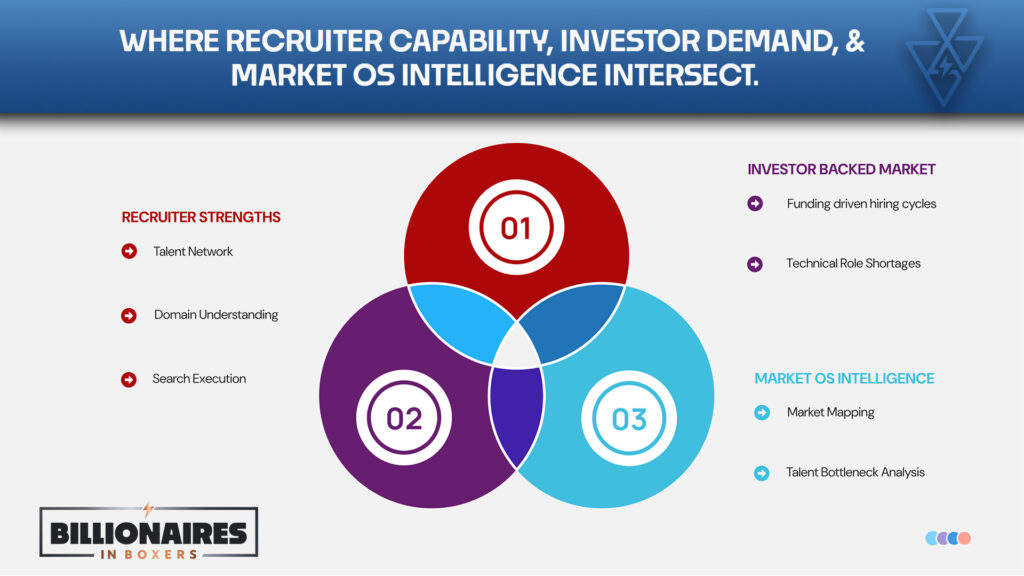
Market OS is built as an external intelligence system designed specifically to map lucrative markets and highlight the most economically viable hiring opportunities.
Its capabilities are rooted in:
- $4 million+ in training and insights
- More than 10 million words of technical, market, and consulting-grade data
- Over 1 billion R&D insights and market references
- 7,500+ white papers and research reports from McKinsey, Accenture, Deloitte, BCG, and other leading consultancies
- Realtime feedback loops
- Monthly intelligence updates
This gives recruitment firms access to a living, continually refreshed market map that reflects the current state of global hiring conditions.
The Process
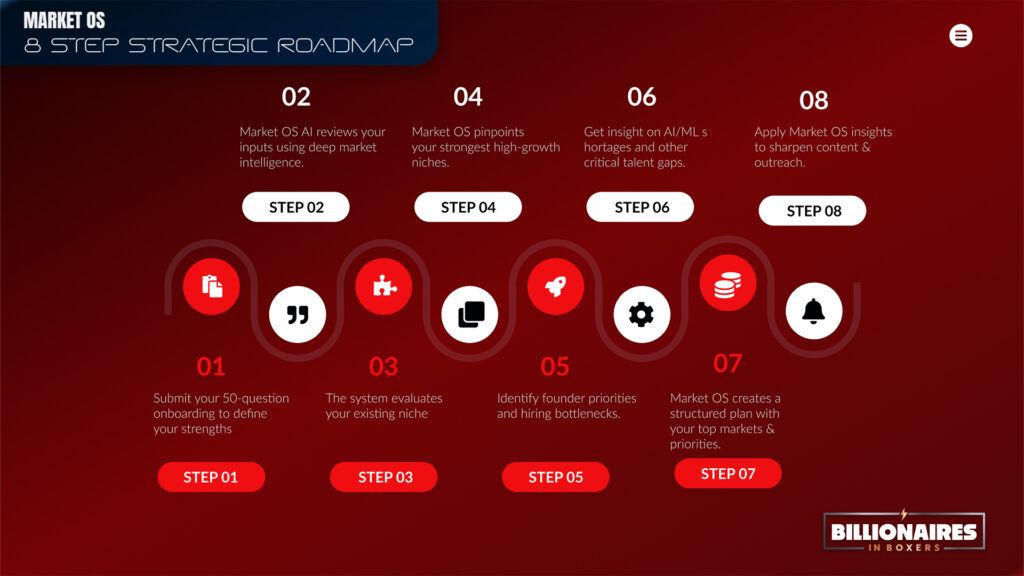
Recruitment leaders begin by completing the FactFinder AI onboarding process, a 50-question assessment that captures:
- Core offers
- Technical capability focus
- Historical placements
- Preferred sectors
- Fee structures
- Geographical preferences
- Candidate specialties
- Competitive advantages
Market OS then processes this document and cross-references it with its extensive intelligence base. In seconds, it produces a detailed market strategy that includes:
- Core market validation
- Emerging markets with high fee readiness
- Market signals indicating near-term hiring surges
- Talent shortages and bottlenecks
- Regulatory factors influencing hiring urgency
- Founders’ current priorities and concerns
- 90-day strategic roadmaps
The effect is the equivalent of having a fully staffed research department producing constant, data-driven insights without the traditional cost or complexity.
Case Example: Mapping Lucrative AI-Driven Markets
Consider a recruitment founder specializing in AI and machine learning talent. After submitting their FactFinder report, Market OS identifies:
Core Market Strength
- Investor-backed AI/ML startups remain one of the strongest hiring verticals.
- Funding availability, engineering talent scarcity, and competitive pressure drive continuous hiring.
- The firm is well positioned to deepen specialization in this space.
Three New Lucrative Markets
Market OS highlights three significant adjacent sectors:
1. AI in MedTech & Software as a Medical Device (SaMD)
Key signals:
- FDA guidance updates accelerating AI adoption
- Data integrity requirements driving ML engineering hires
- Heightened investment in medical imaging, diagnostics, wearables
- Increased demand for ML, FDA compliance specialists, embedded systems engineers
This sector is characterized by higher salaries and premium agency fee acceptance.
SEO Alt Text Recommendation:
“Market OS medtech market analysis showing SaMD demand signals, AI talent bottlenecks, and regulatory-driven hiring trends.”
2. Telco & Cloud AI Infrastructure
Key signals:
- Large-scale AI data center expansion
- Private equity investment in cloud modernization
- Shortages in cloud architecture, data engineering, and network automation roles
- Rapid demand outpacing technical talent supply
This sector exhibits sustained hiring velocity across multiple regions.
3. AI in Finance & Risk (FinTech, Trading, Fraud Detection)
Key signals:
- Increased investment in AI-driven fraud prevention
- Technical risk modeling and quantitative engineering roles expanding
- Regulated financial environments creating sustained demand for compliance and AI/ML specialists
- Institutional pressure to modernize systems
SEO Alt Text Recommendation:
“Market OS finance and risk insights detailing AI hiring trends, FinTech growth, and technical role bottlenecks.”
These insights provide recruiters with a clear understanding of where to focus, why these markets are ready, and how these shifts affect their outreach and positioning.
Five Ways Recruitment Firms Use Market OS to Gain Advantage
The strategic implications of Market OS extend far beyond identifying sectors. Recruitment leaders use the system to build long-term competitive advantage across five critical dimensions.
1. Prioritizing High-Value Niches With Data Instead of Assumptions
Traditional recruitment strategies often rely on anecdotal evidence, a handful of conversations with founders, recent outreach trends, or limited competitor observation.
Market OS provides evidence-based clarity by highlighting:
- Markets with strong investment inflow
- Hiring needs correlated with funding events
- Skill shortages with measurable intensity
- Technical complexity driving premium fees
- Sub-sectors where demand has outpaced supply
This allows recruitment firms to enter emerging markets before they become crowded, securing early-stage client relationships with higher long-term value.
2. Strengthening Domain Expertise and Founder Credibility
Investor-backed founders expect recruitment partners to possess strong contextual understanding. Market OS equips recruiters with:
- Specific pain points founders are currently experiencing
- Key themes dominating industry conversations
- Recent regulatory changes affecting talent compliance
- Technical trends influencing hiring
- Market risks and talent bottlenecks
- Data-driven explanations for hiring urgency
This transforms recruiters into strategic advisors, increasing trust and improving the likelihood of repeat retained engagement.
3. Enhancing Business Development Outcomes Through Precision Targeting
One of the strongest applications of Market OS is its ability to refine business development strategies.
It clarifies:
- The right buyer personas (CTO, VP Engineering, Head of Risk, ML Lead, etc.)
- Their most urgent priorities
- Their hiring constraints
- Messaging angles most likely to resonate
- Conversation topics founders already care about
This leads to more relevant outreach, higher acceptance rates, and improved conversion throughout the sales funnel. Recruiters can initiate conversations with precise market insight rather than generic positioning.
4. Improving Retained and Exclusive Search Win Rates
Retainer conversion improves when recruiters can confidently articulate:
- Why the market is tightening
- Which talent shortages will affect delivery speed
- How hiring delays impact competitive advantage
- What recent market data reveals about similar scaling companies
- Why certain roles require specialized search methodologies
Market OS provides a foundation of objective research that supports these discussions, enabling recruiters to justify their pricing models and secure higher-value engagements.
5. Creating a Structured 90-Day Strategic Roadmap
One of the most powerful outputs from Market OS is its structured 90-day plan, which includes:
- Market sequencing (which to enter first and why)
- Key accounts most likely to require urgent hiring
- Roles with the highest fee potential
- Warm-up content topics that establish expertise
- Areas where candidate shortages create competitive advantage
- Risks to monitor over the next quarter
- Regional or sector-specific hiring triggers
This transforms recruitment teams from reactive operators into proactive market leaders with a clear strategy for pipeline growth.
Strategic Implications for Recruitment Leaders
Recruitment firms operating in fast-moving, investor-backed sectors increasingly compete on expertise rather than volume. Market OS provides the intelligence infrastructure required to meet these expectations.
For Founders: Market OS helps allocate business development resources toward high-yield verticals and reduces risk associated with niche selection.
For Delivery Teams: It enhances contextual understanding, improving candidate engagement and placement accuracy.
For Growth & Strategy Leaders: It enables a repeatable process for identifying new markets, allowing firms to scale across verticals with confidence.
For Client Relationships: Market OS insights become a foundation for advisory-led conversations that strengthen long-term retention and deepen client trust.
Conclusion
Recruitment firms serving investor-backed companies operate in one of the most rapidly evolving environments in the global talent landscape. Success requires more than operational efficiency or sourcing capability, it requires precise, continuously updated market intelligence.
Market OS delivers this through a structured, research-driven, and data-rich approach. By identifying lucrative markets, recognizing emerging hiring signals, and providing detailed strategic insight, it enables recruitment firms to compete at a significantly higher level.
Firms that adopt intelligence-driven methodologies will continue to outperform those relying solely on traditional recruitment techniques. In investor-backed markets, informed positioning is not an advantage, it is a requirement.
