
I grew up playing professional sports alongside two players Andrew and Sandor, who taught me more about the B2B founder mindset than any business book ever has.
Andrew was, without question, the most naturally gifted youth footballer I have ever seen. I’ve run sports academies. I’ve worked with hundreds of talented players, many of whom went on to play professional football at the highest level, including the Premier League. Andrew was better than all of them.
Sandor was a good player. Not exceptional. Not the most talented on the pitch. But he had something Andrew didn’t, and it made all the difference.
The Difference That Actually Matters
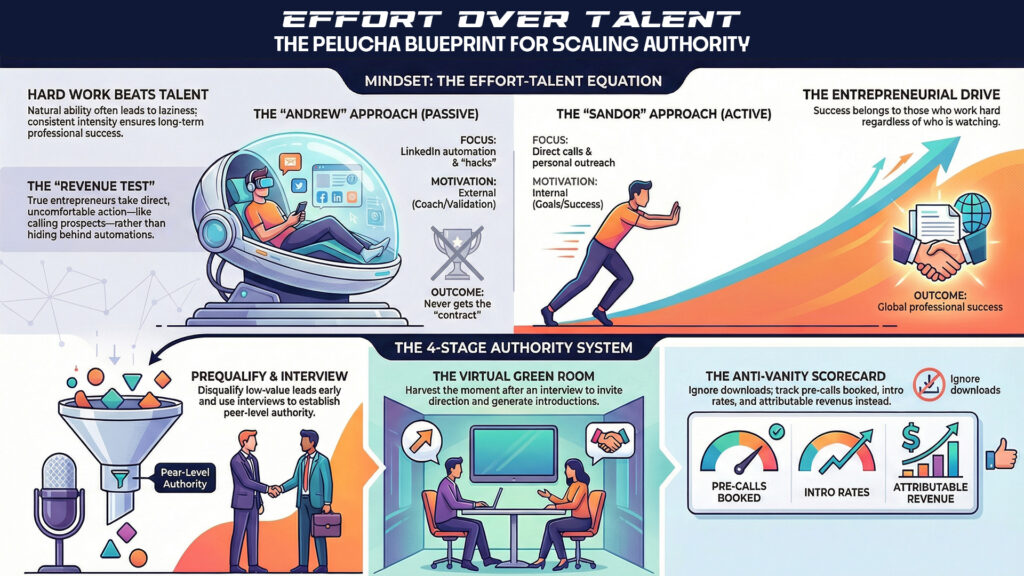
Andrew trained hard when the coach was watching. The moment the coach looked away, he switched off. He knew he was talented. He knew he could step onto any pitch and be the best player there. For him, that was enough.
Sandor was not the most talented player on the pitch. He knew it. And because he knew it, he worked with the same relentless consistency whether one person was watching, a thousand, or nobody at all.
He was the first to arrive at training and the last to leave. Every session. Without exception. Not to impress anyone. Because he had a goal and he was going to do everything required to reach it. At eighteen, Sandor went on to play professional football across Europe, including the UEFA Champions League. Andrew never got his professional contract.
You know the saying:
Hard work beats talent when talent doesn’t work hard.
But what they don’t tell you is the other half of it.
If you have talent and you work hard, nobody can touch you.
Why the B2B Founder Mindset Determines Everything
I’ve spent years working with growth-stage B2B founders across the UK, US, South Africa, and beyond. Across investment portfolios managing over $20Bn in assets. Inside businesses that have grown to exit. And I see the Andrew and Sandor dynamic play out constantly, not on a football pitch, but in commercial performance.
The most successful B2B founders are not necessarily the most talented operators in their industry. They are the most commercially disciplined. They work the system even when no one is watching. They do the unglamorous, consistent, repeatable work that actually moves the needle.
And the founders who stall? They are often extraordinarily talented. Sharp, creative, credible in their field. But they don’t have the commercial infrastructure to convert that talent into consistent, predictable revenue.That is not a talent problem. It is a systems problem.
The Revenue Test: Andrew vs Sandor in a B2B Business
Here is a scenario every B2B founder has faced: the pipeline has dried up and revenue is needed.
An Andrew-type founder responds by getting busy in the wrong ways. He tries a new LinkedIn automation tool. He puts together a content strategy. He chases the latest AI prompt that’s supposedly going to fill the funnel. He looks productive. He isn’t. He’s found sophisticated ways to avoid the actual work.
A Sandor-type founder picks up the phone. He goes through his pipeline, every prospect who hasn’t converted, every past client who went quiet, every warm connection on LinkedIn who has a contact number sitting right there on their profile. He makes the calls. He sends the direct messages. He follows up. Again and again.
Does that make Sandor more talented than Andrew? No. He never was. But there is a reason one of them is successful and the other isn’t.
The same principle applies directly to B2B revenue. The founders who win are not always the brightest or the most charismatic. They are the ones who have built the commercial infrastructure to support consistent output and who show up to work it, every day, whether anyone is watching or not.
The 3 Brutal Truths About B2B Founder Mindset
Truth 1: Talent without commercial infrastructure is wasted.
The most common pattern I see in growth-stage B2B businesses is a founder who is genuinely exceptional at what they do and whose business underperforms dramatically relative to their ability. The capability is there. The revenue architecture is not. Without a structured pipeline, a repeatable sales system, and a clear offer stack, talent generates inconsistent results at best.
Truth 2: Busyness is not the same as commercial activity
Checking your LinkedIn feed, experimenting with the latest AI tool, creating content hoping for inbound these activities feel like work. They are not what moves revenue. According to research from HubSpot, sales reps spend only 34% of their time actually selling. The rest is noise. The founders who scale understand the difference between commercial activity and the appearance of it.
Truth 3: The right work ethic, pointed in the right direction, is unstoppable.
This is the piece most founder advice misses entirely. Work ethic alone is not the answer. Andrew had periods of hard work, but it was unfocused. What separates elite performance, in sport and in business, is disciplined effort applied to a system that works. Sandor didn’t just work hard. He worked hard inside the right structure.
What This Means for Your Business Right Now
Before you invest in more marketing, more headcount, or more tools ask yourself the honest question. Not to me. To yourself.
When you look at the revenue your business is generating relative to your capability and your effort, are you an Andrew or a Sandor?
If the answer is uncomfortable, that’s useful information. It means the issue is not your talent. It is your commercial architecture.
You need a structured pipeline. A repeatable sales system. An offer that is positioned and priced correctly for the market you are actually operating in. You need the infrastructure that makes your natural ability produce consistent, predictable results, regardless of whether you are having a good week or a bad one.
That is what we build at Billionaires in Boxers. Not motivation. Not frameworks you implement yourself on top of an already full schedule. Revenue architecture designed by Phil, built for your specific business, executed with the rigour of someone who has done this across portfolios managing $20Bn+ in assets.If you want to read more on how revenue systems work in practice, this post on why founders hit a revenue ceiling is worth your time.
The Revenue Diagnosis – Phil’s Weekly Live Session
If you’re a B2B founder who shows up and does the work and you just need to know exactly where to point that effort – this session is for you.
45 minutes. Free. Phil identifies the specific revenue mistakes costing your business money and shows you what he would do instead. No pitch. No upsell on the call.
