
Most business consultancy services are designed to make companies smarter. Fewer are designed to make revenue move faster.
For founder-led B2B companies, that distinction matters. If you are already doing $3M to $25M in revenue, you probably do not need another broad strategy deck, generic workshop, or motivational offsite. You need a clear answer to a more urgent question: where is revenue stuck, and what intervention will unstick it fastest without breaking the business?
That is the lens that separates revenue acceleration from conventional consulting. The goal is not to “improve the business” in abstract terms. The goal is to identify the few constraints suppressing growth, sequence the fixes correctly, and install systems that help the company sell, convert, retain, and expand more predictably.
Why many business consultancy services feel too slow
Traditional consulting often starts with discovery, stakeholder interviews, benchmarking, and a long strategic recommendation phase. That can be useful in large enterprises where complexity, politics, and risk management dominate the work.
Founder-led B2B businesses operate differently. The founder is often still close to sales, key accounts, hiring, pricing, delivery, and product direction. Decisions can happen quickly, but the business may lack the commercial architecture to scale those decisions consistently.
The gap is rarely effort. It is usually one of four things:
- The company is selling to too many customer profiles at once.
- Lead generation is active but not producing enough qualified opportunities.
- Sales conversations depend too heavily on founder intuition.
- Reporting exists, but it does not reveal where revenue is leaking.
When consultancy work does not directly address those constraints, it feels slow because it is slow. Revenue acceleration requires a different operating model: diagnose first, prioritize ruthlessly, then build the system around the highest-leverage constraint.
Fast revenue growth starts with diagnosis, not tactics
The fastest way to waste money is to accelerate the wrong thing.
A founder may think the company has a lead generation problem when the real issue is weak conversion. A sales leader may push for more reps when the sales motion is not yet repeatable. A marketing team may invest in content when the offer is not differentiated enough to create urgency.
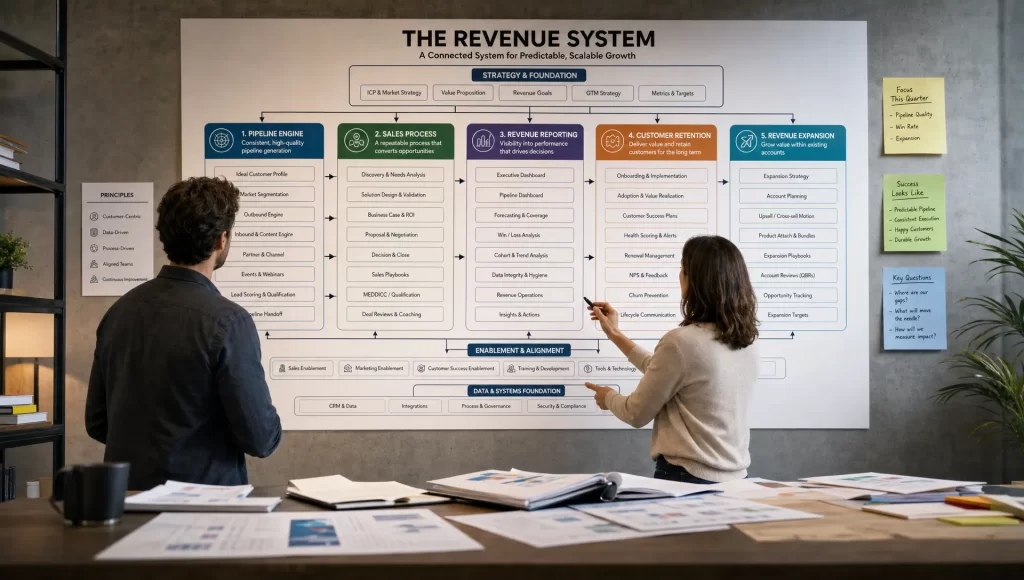
That is why the best business consultancy services begin with a commercial diagnostic. Not a vague SWOT analysis, but a structured assessment of revenue performance across market, offer, pipeline, sales process, systems, team capacity, and expansion potential.
This diagnostic-first approach is especially important when a company is preparing to scale. As Billionaires in Boxers explains in its guide to running a business diagnostic before scaling, growth problems often look tactical on the surface but are rooted in deeper structural issues.
A strong diagnostic should answer practical questions:
| Revenue area | What the consultant should uncover | Why it moves revenue faster |
|---|---|---|
| Market focus | Which customer segments have the strongest pain, urgency, and willingness to pay | Focus increases win rates and reduces wasted effort |
| Offer and pricing | Whether the offer is clear, differentiated, and commercially packaged | Better offers shorten sales cycles and improve margin |
| Pipeline | Where opportunities enter, stall, or disappear | Leak repair often produces faster gains than new demand |
| Sales process | Whether the team can consistently qualify, advance, and close deals | Repeatability reduces founder dependency |
| Systems and data | Whether CRM, reporting, and workflows support decisions | Better visibility improves prioritization |
| Expansion | Where upsell, cross-sell, partnerships, or new markets can compound growth | Existing trust can accelerate revenue faster than cold acquisition |
The point is not to analyze forever. The point is to prevent random acts of growth.
The business consultancy services that move revenue fastest
Not every consulting engagement should focus on the same lever. A company with strong demand but weak close rates needs different help than a company with a great sales team but an underdeveloped market expansion strategy.
The highest-impact revenue consultancy services usually fall into five categories.
Revenue audits that expose the leaks
A revenue audit looks at the full path from market attention to closed revenue and customer expansion. It asks: where is money being lost that should already be captured?
Common leaks include poorly qualified leads, slow speed to lead, unclear handoffs between marketing and sales, weak follow-up discipline, discounting patterns, low proposal conversion, CRM data gaps, and churn signals that appear too late.
This is often one of the fastest consulting interventions because the company may not need a new strategy. It may simply need to recover revenue already flowing through the system. If your team suspects that growth is being constrained by hidden friction, a structured revenue audit can help find and fix the leaks before more budget is poured into acquisition.
Sales optimization that makes winning repeatable
Founder-led companies often grow because the founder, a senior seller, or a small group of high-trust operators know how to win deals. That works until the company tries to hire more salespeople, enter new markets, or reduce founder involvement.
Sales optimization turns individual selling ability into a repeatable commercial system. That may include clearer qualification rules, sharper discovery questions, better deal stage definitions, stronger proposal logic, improved objection handling, and more disciplined pipeline reviews.
The aim is not to script every conversation. In complex B2B sales, that usually backfires. The aim is to make the sales process measurable enough that leaders can see where deals are progressing, where they are slowing down, and what behavior needs to change.
Revenue operations that align people, process, and data
Revenue operations, or RevOps, is where many companies discover how much growth is being limited by internal friction. Marketing may report leads, sales may report opportunities, finance may report revenue, and customer success may report retention, but the numbers do not connect cleanly.
A revenue operations consultant helps align CRM structure, reporting, sales stages, handoffs, forecasting, and accountability. That work can feel less glamorous than launching a new campaign, but it often creates the operating clarity required for faster growth.
If the leadership team is debating numbers instead of making decisions from them, it may be time to understand what a revenue operations consultant actually does and whether the business has outgrown informal systems.
AI systems that remove manual bottlenecks
AI does not replace commercial strategy. It amplifies the parts of the revenue system that are clear enough to automate, augment, or accelerate.
In a founder-led B2B environment, AI systems can support research, lead routing, account prioritization, sales enablement, proposal preparation, customer insight synthesis, and follow-up workflows. The key is to build AI around a defined revenue process, not around novelty.
AI systems create value when they help the team do commercially important work faster and more consistently. They create noise when they are layered on top of a confused offer, messy pipeline, or poorly defined customer profile.

Market expansion planning that does not dilute focus
Many founder-led businesses hit a growth ceiling and assume the next move is a new geography, vertical, partner channel, or product line. Sometimes that is right. Sometimes it spreads the company too thin.
Market expansion planning should identify where the company has the strongest right to win. That includes current customer proof, margin potential, buying urgency, competitive intensity, operational capacity, and sales cycle complexity.
A good consultant will not simply validate the founder’s appetite for expansion. They will pressure-test whether the business has the positioning, systems, team, and delivery model to enter the new market without damaging the core.
What “fast” should mean in revenue consulting
Fast does not mean reckless. It does not mean chasing every channel, hiring too quickly, discounting harder, or demanding unrealistic sales targets.
In revenue consulting, fast should mean three things.
First, the consultant identifies the commercial constraint quickly. The business should not spend months discovering what a focused diagnostic could reveal in weeks.
Second, recommendations are costed and sequenced. A founder should know what to do now, what to defer, what to stop doing, and what each intervention is expected to improve.
Third, implementation is built into the engagement. The most valuable business consultancy services do not end at advice. They help install operating rhythms, systems, messaging, accountability, and leadership support so that the business can execute.
That distinction matters because founder-led companies do not lack ideas. They lack bandwidth and sequencing. The right consultant reduces both problems.
The revenue acceleration sequence
Revenue acceleration works best when the order of operations is clear. Many companies try to accelerate before the underlying revenue architecture is stable. That creates more meetings, more campaigns, more tools, and more pressure, but not necessarily more profit.
A practical sequence looks like this:
- Diagnose the constraint: Identify the highest-impact revenue bottleneck, not every possible improvement.
- Stabilize the architecture: Clarify market focus, offer, sales process, roles, data, and operating cadence.
- Prioritize interventions: Choose the few actions most likely to improve pipeline quality, conversion, deal velocity, or expansion.
- Build systems: Use CRM, AI, reporting, and workflows to make the improved process repeatable.
- Add growth pressure: Increase demand generation, hiring, market expansion, or partnerships only when the system can absorb it.
This is why revenue architecture should come before acceleration. Otherwise, new growth activity can simply create more leakage.
When demand generation is the right lever
Sometimes the constraint really is visibility and demand capture. If qualified buyers cannot find the business, or if the company is losing ground in search and AI-assisted discovery, marketing may need to become the first major intervention.
This is especially true in markets where buyers increasingly ask search engines, AI tools, and local discovery platforms for recommendations before they speak to vendors. In those cases, a specialist in Answer Engine Optimization and search visibility, such as Kell Web Solutions, can be a useful partner when demand capture is the missing link.
For founder-led B2B companies, the important point is integration. Demand generation should not sit apart from revenue strategy. It should connect directly to ideal customer profile, offer positioning, lead qualification, sales follow-up, and reporting.
Traffic without conversion is not acceleration. Visibility without sales alignment is not acceleration. Demand only moves revenue fast when the rest of the system is ready to turn attention into qualified pipeline.
How to choose consultancy services that will actually move revenue
The right consultant should be able to explain how their work will affect commercial outcomes. That does not mean promising a specific revenue number without context. It means showing a clear line between diagnosis, intervention, execution, and measurement.
Before engaging a consultancy, ask these questions:
- What revenue constraint do you believe we need to diagnose first?
- How will you distinguish symptoms from root causes?
- What will we receive besides recommendations?
- How do you prioritize speed versus operational risk?
- What data do you need from our CRM, finance, sales, and marketing systems?
- How will implementation be supported after the diagnostic?
- What should we stop doing if we work together?
The final question is often the most revealing. Consultants who only add more work may not understand the founder-led operating reality. The best ones create focus.
Signs your business is ready for revenue acceleration consulting
A company does not need to be broken to benefit from business consultancy services. In fact, the best time to bring in revenue acceleration support is often when the business is working, but no longer scaling cleanly.
You may be ready if revenue is growing but margins are under pressure. You may be ready if the founder is still too involved in closing important deals. You may be ready if the sales team is busy but forecasting is unreliable. You may be ready if marketing activity has increased but pipeline quality has not. You may be ready if expansion opportunities exist, but the leadership team is unsure which one to pursue first.
The common pattern is this: the business has momentum, but the system behind that momentum is not mature enough for the next stage.
That is exactly where revenue acceleration consulting can create leverage. It helps the founder move from heroic effort to engineered growth.
Frequently Asked Questions
What are business consultancy services? Business consultancy services help companies diagnose problems, improve performance, and implement better strategies, systems, and processes. In a revenue acceleration context, they focus specifically on improving pipeline, sales conversion, operations, market expansion, and scalable growth.
How are revenue acceleration services different from general consulting? Revenue acceleration services are more commercially focused. Instead of broad advice across the whole business, they identify the constraints limiting revenue growth and prioritize interventions that can improve sales performance, deal velocity, forecasting, retention, or expansion.
How quickly can consultancy services affect revenue? It depends on the constraint. Fixing pipeline leakage, qualification, follow-up, or proposal conversion can often produce faster impact than entering a new market or rebuilding the entire revenue operating model. A good diagnostic should clarify which improvements are likely to create the fastest measurable movement.
Do founder-led B2B companies need a consultant or a fractional CRO? Some need a short diagnostic and roadmap. Others need ongoing fractional CRO support to lead execution, improve sales management, align teams, and maintain accountability. The right model depends on the size of the revenue problem, the capability of the internal team, and the founder’s available bandwidth.
What should a revenue consulting engagement deliver? At minimum, it should deliver a clear diagnosis, prioritized recommendations, a costed intervention roadmap, and a practical execution plan. Higher-value engagements may also include AI systems, sales optimization, RevOps support, market expansion planning, or fractional CRO leadership.
Ready to move revenue faster?
If you are a founder-led B2B business doing $3M to $25M in revenue, Billionaires in Boxers helps turn growth ambition into a structured revenue acceleration plan. The work combines PE-grade diagnostics, AI systems, sales optimization, market expansion planning, and fractional CRO support, starting with a Revenue Acceleration Diagnostic from $5K.
To find the constraints holding back your next stage of growth, explore Billionaires in Boxers and start with the diagnostic before adding more tactics, tools, or headcount.
