

When a business consulting firm is hired to build scalable revenue, the job is not to produce a thicker strategy deck. The job is to turn revenue from a founder-dependent activity into a repeatable operating system.
That distinction matters. Many founder-led B2B companies reach $3M to $25M in revenue through force of will, strong relationships, referrals, and a few high-performing people. Then growth gets noisy. Pipeline becomes inconsistent. Forecasts become emotional. Sales hires underperform. Marketing generates activity but not enough qualified demand. The founder stays trapped in key deals because the business still runs on their judgment.
Scalable revenue is built differently. It requires diagnosis, revenue architecture, sales process design, market focus, execution rhythm, and increasingly, smart use of AI. A strong consulting firm does not simply tell the team to sell more. It identifies the constraint, redesigns the system, and helps the leadership team install the operating habits required to scale.
What scalable revenue actually means
Scalable revenue is not just higher revenue. It is revenue that can grow without requiring the founder to personally push every deal, rescue every quarter, or explain the strategy to every new hire.
In a scalable revenue system, growth becomes more predictable because the business has clarity on who it serves, what problem it solves, how demand is created, how opportunities are qualified, how deals are won, and how customer value expands after the first sale.
A founder-led B2B business is moving toward scalable revenue when it can show these characteristics:
- The ideal customer profile is specific enough to guide marketing, sales, partnerships, and product decisions.
- The sales process is documented, coached, and measured rather than improvised by each seller.
- Pipeline quality is visible, not hidden behind optimistic forecasts or vague stage definitions.
- Revenue leadership can identify the next growth bottleneck before the quarter is already at risk.
- The founder can step out of most commercial conversations without conversion rates collapsing.
A business consulting firm creates leverage by making these conditions operational. The work is less about one brilliant idea and more about a sequence of high-impact changes that compound.
Step 1: Diagnose the real revenue constraint
The fastest way to waste money on consulting is to start with the wrong problem. A company may think it has a lead generation issue when the real issue is weak qualification. It may blame sales talent when the actual problem is unclear positioning. It may invest in a new CRM while the team still lacks a shared definition of a qualified opportunity.
This is why serious revenue work starts with diagnosis. Before designing interventions, a consulting firm should map the full revenue engine from market selection to closed revenue and customer expansion. The goal is to locate the constraint that is most limiting growth right now.
For a founder-led B2B company, the diagnostic usually looks at four areas. First, market and customer focus. Second, demand creation and channel performance. Third, sales process, conversion, and deal quality. Fourth, pricing, offer structure, and post-sale expansion.
The important point is sequencing. If the offer is poorly positioned, more lead volume simply creates more low-fit conversations. If the pipeline is full of unqualified opportunities, hiring more salespeople multiplies inefficiency. If pricing is underpowered, growth can increase workload without increasing enterprise value.
A good consulting firm therefore resists the temptation to prescribe before it understands. That is the difference between activity and acceleration.
Step 2: Build revenue architecture, not isolated tactics
Once the constraint is clear, the next move is to design the commercial system around it. This is where revenue architecture becomes essential.
Revenue architecture is the blueprint that connects market focus, positioning, acquisition, sales execution, customer success, leadership cadence, and measurement. It prevents the business from treating marketing, sales, and operations as disconnected functions.
For example, if the company wants to move upmarket, the architecture must change. The ICP may narrow. Messaging may become more outcome-led. Sales cycles may require stronger business cases. The founder may need to transfer executive selling capability to a CRO, sales leader, or senior account executive. Customer success may need to identify expansion triggers earlier.
If you want a deeper breakdown of the concept, Billionaires in Boxers explains the core pillars in its guide to revenue architecture.
The consulting firm's role is to make the blueprint practical. That means choosing the few changes that will create the most leverage, assigning owners, and translating strategy into a costed intervention roadmap. This is especially important for businesses that do not have unlimited capital or management bandwidth.
Step 3: Sharpen the market, message, and offer
Scalable revenue rarely comes from selling to everyone. It comes from becoming highly relevant to a valuable segment.
Many founder-led companies carry too much market ambiguity. They have clients in multiple sectors, several use cases, and a broad value proposition that sounds credible but not urgent. The founder can often overcome that ambiguity in conversation. The rest of the team cannot.
A business consulting firm helps compress the market into a clearer commercial thesis. Which customer segment has the strongest pain, budget, urgency, and lifetime value? Which problem does the company solve better than alternatives? Which proof points make the buyer believe? Which triggers indicate that an account is likely to buy now?
The output should not be a generic positioning exercise. It should change how the company targets accounts, writes outreach, runs discovery, builds proposals, creates content, and prioritizes product or service development.
In some cases, the consulting firm may also coordinate with specialist partners. For example, growth marketing and innovation specialists such as User Story can be relevant when a company needs structured experimentation around acquisition, proposition testing, or new market entry.
The key is alignment. Market strategy, message, and offer must reinforce each other. If they do not, sales teams compensate with effort, discounts, and founder escalation.
Step 4: Productize the founder's sales motion
In many B2B companies, the founder is the best salesperson because they understand the customer, the problem, the product, the economics, and the strategic context. That is powerful in the early stages, but it becomes a ceiling as the company grows.
A consulting firm builds scalable revenue by extracting the founder's implicit sales logic and turning it into a teachable system. This does not mean scripting every conversation. It means defining the decisions, questions, proof points, qualification standards, and deal strategies that consistently move the right opportunities forward.
The work often includes reviewing calls, proposals, lost deals, won deals, pricing conversations, and handoffs. The goal is to identify what the founder does instinctively and make it visible to the team.
| Revenue area | Founder-dependent pattern | Scalable pattern |
|---|---|---|
| Qualification | The founder senses whether a buyer is serious | The team uses clear fit, pain, urgency, authority, and value criteria |
| Discovery | Conversations rely on founder experience | Sellers follow a structured diagnosis of business impact and buying process |
| Proposal | Each proposal is heavily customized by the founder | Proposals follow a modular structure with clear value logic |
| Forecasting | Confidence is based on personal relationships | Forecasts are tied to evidence, buyer actions, and exit criteria |
| Handoff | Delivery depends on informal context | Customer promises, risks, and success metrics are captured before onboarding |
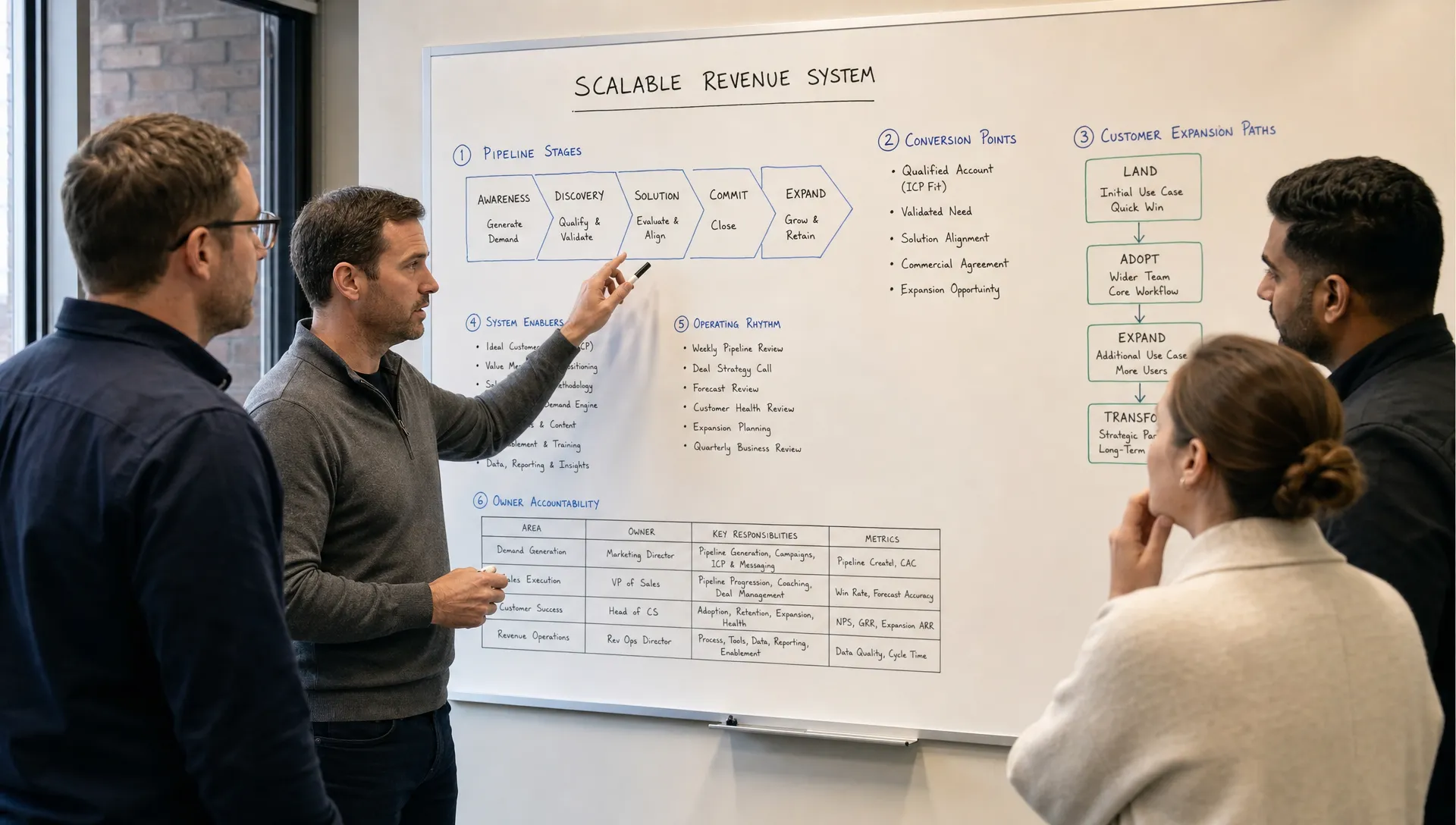
This is one of the most valuable interventions for a founder-led business because it increases commercial capacity without diluting quality. It also reduces founder dependency, which is often a major barrier to scale and valuation. Billionaires in Boxers explores this leadership challenge further in its article on how to scale a B2B business without becoming the ceiling.
Step 5: Install the metrics and cadence that keep growth honest
A scalable revenue system needs a management rhythm. Without it, even a good strategy fades into old habits.
The right cadence gives leadership a clear view of what is happening, why it is happening, and what must change next. It also prevents teams from hiding behind lagging indicators. Revenue is the result, but by the time it is missed, the real problem happened weeks or months earlier.
A consulting firm should help leadership distinguish between activity metrics, conversion metrics, quality metrics, and economic metrics. For example, booked meetings matter only if they convert into qualified opportunities. Pipeline value matters only if stage criteria are real. Win rate matters only if the team is pursuing the right deals. Average contract value matters only if margins and delivery capacity support it.
A practical revenue cadence usually includes:
- Weekly pipeline review focused on evidence, next actions, and deal risk.
- Monthly review of conversion rates, channel performance, and sales cycle movement.
- Quarterly review of ICP performance, offer strength, pricing, and expansion potential.
- Clear ownership for each constraint, so every issue has a decision-maker and deadline.
This cadence turns consulting from advice into execution. It also creates accountability without requiring the founder to micromanage every commercial decision.
Step 6: Use AI to increase leverage, not mask a broken system
AI can help B2B revenue teams move faster, but only when the underlying system is clear. If the ICP is vague, AI produces more vague outreach. If the sales process is weak, AI accelerates weak follow-up. If the data is messy, AI creates confident noise.
A business consulting firm should therefore treat AI as an amplifier, not a substitute for strategy. Once the revenue architecture is clear, AI systems can support research, segmentation, personalization, sales enablement, workflow automation, and management visibility.
For example, AI can help summarize sales calls, surface recurring objections, analyze lost deal patterns, prioritize account research, draft first-pass messaging, and reduce manual admin. These use cases are valuable because they give the team more time for higher-quality selling and decision-making.
The mistake is to start with tools. The better sequence is to define the revenue process, identify the friction, then build or configure AI systems around the operating model. That is how AI becomes part of scalable revenue rather than another disconnected initiative.
Step 7: Sequence interventions by ROI and execution capacity
Not every improvement should happen at once. Founder-led companies often have limited leadership bandwidth, and trying to overhaul the entire revenue engine in one quarter can create confusion.
A strong consulting firm prioritizes interventions by expected impact, speed to value, cost, and dependency. Some fixes create ROI quickly, such as tightening qualification, improving proposal structure, or addressing obvious pipeline leakage. Others take longer, such as entering a new market, building a partner channel, or restructuring the commercial leadership model.
The best roadmap answers five practical questions. What is the constraint? What intervention will address it? Who owns it? What will it cost in time, money, and attention? How will we know it worked?
This is where PE-grade thinking is useful for founder-operators. Private equity teams tend to care about growth quality, not just growth volume. They want to know whether revenue is repeatable, profitable, measurable, and transferable beyond a few key people. Founder-led businesses benefit from the same discipline long before they are preparing for an exit.
Signs you are ready for a business consulting firm
Not every company needs outside help. But if revenue is growing in a way that feels harder than it should, a structured outside view can create clarity quickly.
You may be ready for a consulting firm if several of these are true:
- Revenue has plateaued even though the team is working hard.
- The founder is still required to close or rescue too many deals.
- Marketing activity is increasing, but qualified pipeline is not.
- Sales hires are not ramping as expected.
- Forecasts feel subjective or consistently miss the mark.
- The company has growth ambition but lacks a clear sequence of commercial priorities.
The right firm should not simply bring templates. It should bring pattern recognition, diagnostic discipline, and the ability to translate strategy into execution. For founder-led B2B companies, that combination is often what turns growth from heroic effort into a scalable system.
Frequently Asked Questions
What does a business consulting firm do for revenue growth? A business consulting firm diagnoses the constraints limiting growth, then helps redesign the revenue system. This can include market focus, positioning, sales process, pipeline management, pricing, customer expansion, leadership cadence, and AI-enabled operating improvements.
How is scalable revenue different from ordinary growth? Ordinary growth can depend on more effort, more spending, or the founder personally driving key deals. Scalable revenue is repeatable, measurable, and less dependent on any single person. It allows the business to grow with more predictable systems and clearer accountability.
When should a founder-led B2B company hire a consulting firm? A founder-led company should consider outside help when growth has stalled, revenue depends too heavily on the founder, sales hires are not ramping, pipeline quality is unclear, or the team lacks a practical roadmap for scaling.
Can AI build scalable revenue on its own? No. AI can increase leverage, but it cannot fix unclear positioning, weak qualification, poor sales process, or bad data by itself. AI works best when it is built around a clear revenue architecture and specific workflow problems.
Build revenue that scales beyond the founder
If your B2B company is between $3M and $25M in revenue and growth depends too heavily on founder effort, the next step is not more random tactics. It is a sharper diagnosis and a commercial system designed to scale.
Billionaires in Boxers helps founder-led B2B businesses with PE-grade diagnostics, AI systems, fractional CRO support, sales optimization, market expansion planning, and costed intervention roadmaps. Start with the Revenue Acceleration Diagnostic to identify the revenue constraint and define the highest-leverage path forward.
