
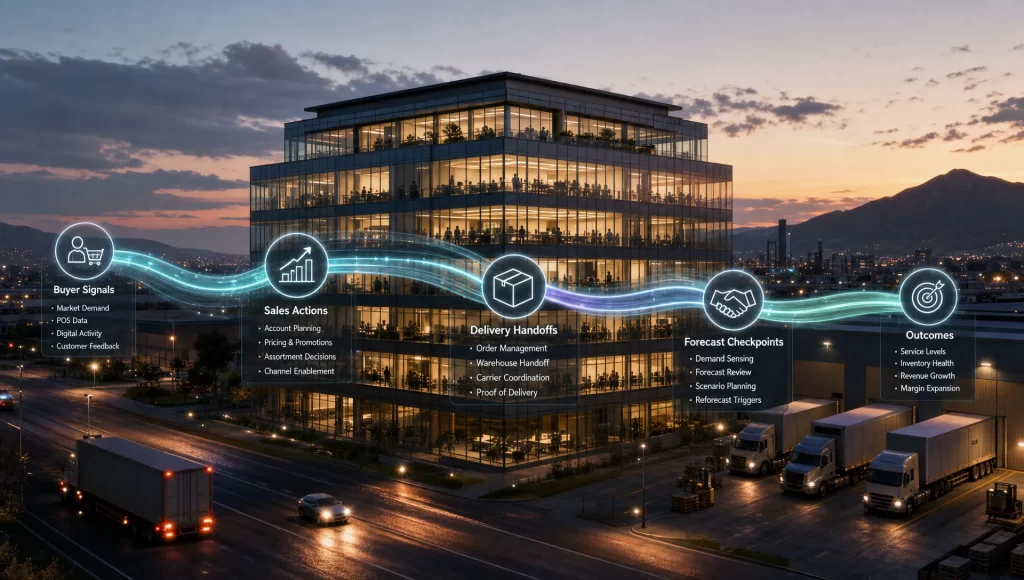
Commercial drag is the silent tax on founder-led B2B growth. It is the delay between buyer intent and the right sales action. It is the rework between sales and delivery. It is the forecast meeting where everyone has opinions, but nobody has clean evidence.
Automated intelligence systems cut commercial drag by turning scattered information, tribal judgment, and manual follow-through into repeatable commercial workflows. They do not create strategy by magic. They make the strategy easier to execute, inspect, and improve every week.
For B2B companies between roughly $3M and $25M in revenue, this matters because growth often becomes heavy before it becomes impossible. The founder is still pulled into too many deals. Sales leaders spend too much time correcting process instead of coaching performance. Delivery teams inherit unclear promises. The CRM exists, but the real commercial truth lives in calls, Slack threads, spreadsheets, and the founder's head.
That is commercial drag. And if you do not remove it, adding more leads, reps, tools, or markets simply gives the drag more places to hide.
What commercial drag looks like in a founder-led B2B company
Commercial drag is the accumulated friction that slows the path from market opportunity to booked, retained, and expanded revenue. It is rarely one obvious failure. More often, it is a set of small delays and ambiguities that compound across the revenue engine.
A founder-led B2B company can have a strong product, credible demand, and a capable team, yet still feel like growth takes too much force. The issue is not always sales talent or marketing volume. Sometimes the issue is that commercial decisions are moving through people rather than through systems.
Common symptoms include:
- Qualified leads waiting too long for the right follow-up.
- Sales reps using different definitions of a good-fit customer.
- Proposals taking days because key context has to be reconstructed manually.
- CRM stages reflecting optimism rather than evidence.
- Delivery teams discovering deal risks only after the contract is signed.
- Founders approving exceptions, pricing, positioning, and next steps because the operating logic is not codified.
Here is how that drag typically shows up inside the revenue engine:
| Drag signal | What it usually means | Commercial impact |
|---|---|---|
| Slow response to high-intent buyers | Ownership, routing, or prioritization is unclear | Lower conversion from existing demand |
| Pipeline volume looks healthy but close dates keep moving | Deal stages are not tied to buyer evidence | Forecast volatility and poor resource planning |
| Founder is involved in most strategic deals | Commercial judgment has not been translated into rules | Bottlenecks, inconsistent coaching, and slower cycles |
| Sales-to-delivery handoffs require extra clarification | Promises, risks, and success criteria are not captured cleanly | Margin leakage, onboarding delays, and client dissatisfaction |
| Reps spend hours on admin after calls | Commercial data is fragmented across tools and notes | Less selling time and lower CRM quality |
This is why automated intelligence systems are not just a technology discussion. They are an operating model discussion.
Why basic automation does not solve commercial drag
Most B2B teams already have some form of automation. The CRM sends reminders. The marketing platform triggers email sequences. A call recording tool creates transcripts. A workflow app creates tasks.
Those tools help, but they often automate fragments rather than decisions. Commercial drag remains because the system still does not understand context. It does not know whether an account is strategic. It does not know which objection matters. It does not know whether a deal has moved forward in substance or only in stage name.
Automated intelligence systems are different because they combine four things:
- Data from commercial systems, conversations, documents, and activity history.
- Business rules that reflect the company's actual strategy and operating model.
- AI analysis that can interpret unstructured inputs such as calls, notes, emails, and proposals.
- Workflow execution that prompts, routes, drafts, updates, escalates, or flags the next action.
The value is not in using AI as a novelty. The value is in embedding intelligence inside commercial work. McKinsey's research on generative AI estimated that the technology could add $2.6 trillion to $4.4 trillion in annual economic value across analyzed use cases, but the gains depend on redesigning workflows, not simply giving teams another tool.
That distinction is critical. A rep with ten disconnected AI tools can still create drag. A revenue team with one well-designed intelligence workflow can remove it.
If you are thinking about the revenue engine as a connected system rather than isolated tools, the same principle applies across sales execution, delivery handoffs, and forecasting.
How automated intelligence systems cut commercial drag
Automated intelligence systems reduce drag by moving repeatable commercial judgment closer to the moment where work happens. They do not remove human expertise. They make expert judgment available at scale, with clearer rules and faster feedback.
1. They standardize qualification without flattening judgment
In many founder-led B2B companies, qualification is inconsistent because the true ICP is partly explicit and partly intuitive. The founder knows the difference between a promising account and a distracting one, but that knowledge may not be fully codified.
An automated intelligence system can help translate that judgment into practical qualification logic. It can analyze firmographic data, engagement signals, prior call notes, deal history, and segment performance to surface which opportunities deserve attention.
The goal is not to let a model decide who matters. The goal is to ensure that reps, marketers, and leadership are using the same commercial logic when they prioritize accounts.
A good system should make the reasoning visible. For example, it should not simply label an opportunity as high priority. It should show the evidence: industry fit, buyer role, pain intensity, urgency signals, use case match, and similarity to previous wins.
2. They compress the sales cycle by removing administrative latency
Sales cycles are often slowed by the time between a commercial event and the next useful action. A discovery call happens, then notes must be cleaned up, CRM fields updated, follow-up drafted, internal questions answered, and proposal inputs assembled.
Every delay weakens momentum.
Automated intelligence systems can reduce this latency by turning commercial events into structured next steps. After a call, a system can summarize buyer priorities, identify risks, draft a follow-up, update required CRM fields for review, and flag whether the opportunity meets the next-stage criteria.
The human still reviews and approves. The difference is that the human is editing and deciding, not rebuilding context from scratch.
This matters because sales productivity is often lost in non-selling work. Salesforce has reported in its State of Sales research that reps spend a minority of their workweek actively selling. Whether your exact number is higher or lower, the operating point is the same: every administrative loop you remove gives the team more time for buyer-facing work.
3. They prevent revenue leakage between sales and delivery
A deal is not won when the contract is signed. It is won when the customer receives the outcome they bought, trusts the process, and sees a reason to expand.
Commercial drag often appears at the boundary between sales and delivery. The sales team may understand the buyer's urgency, political context, promised outcomes, and hidden risks, but delivery receives only a short handoff note or a generic kickoff form.
An automated intelligence system can create a structured handoff from the actual sales process. It can extract success criteria, decision drivers, stakeholder concerns, implementation risks, promised scope, and expansion clues from calls, proposals, and CRM notes.
This reduces margin leakage because delivery does not have to rediscover what sales already learned. It also improves the customer experience because the buyer does not feel like they are starting over after signing.
4. They improve forecast quality by separating evidence from optimism
Forecasting creates drag when leaders spend more time debating opinions than inspecting evidence. A rep says a deal is likely to close. A manager asks why. The answer may depend on confidence, relationship strength, or a vague sense that the buyer sounded positive.
Automated intelligence systems can make forecasts more evidence-based. They can flag missing next steps, stale activity, no executive sponsor, weak business case, unresolved objections, procurement uncertainty, or close dates that have shifted multiple times.
This does not replace forecast judgment. It improves the quality of the conversation. The question changes from, do we feel good about this deal, to, what evidence has changed since last week?
That shift alone can remove hours of executive drag.
5. They turn market feedback into sharper positioning
Many B2B companies collect useful market feedback but fail to operationalize it. Win/loss reasons live in call recordings. Competitor mentions sit in notes. Buyer language appears in proposals, then disappears. Marketing creates new campaigns without seeing the full pattern of sales conversations.
Automated intelligence systems can aggregate those signals and feed them back into positioning, segmentation, sales enablement, and market expansion planning.
This is especially valuable when a company is considering a new vertical, geography, or buyer segment. Instead of relying only on anecdote, leadership can inspect the recurring patterns across real commercial interactions.
The fastest places to remove drag
Not every workflow deserves automation first. The best starting point is usually a high-frequency, high-friction commercial moment where better speed or consistency creates visible revenue impact.
| Commercial drag point | Manual pattern | Automated intelligence intervention | Expected business effect |
|---|---|---|---|
| Lead routing and prioritization | Reps or managers manually decide what matters | Score and route opportunities based on ICP, intent, and fit evidence | Faster response to the right accounts |
| Discovery follow-up | Notes, emails, and CRM updates are rebuilt manually | Summarize calls, draft follow-up, tag objections, and prepare next-step fields | Shorter sales cycles and cleaner data |
| Proposal creation | Teams search old decks, pricing notes, and founder input | Generate structured proposal inputs from approved positioning and deal context | Faster turnaround and less founder dependency |
| Deal inspection | Forecast calls rely on rep confidence | Flag deal risks, missing evidence, and stage inconsistencies | Better forecast discipline |
| Sales-to-delivery handoff | Delivery receives incomplete context | Produce a handoff brief from CRM, calls, proposal, and scope notes | Less rework and better onboarding |
| Win/loss analysis | Feedback is anecdotal and inconsistent | Cluster reasons, objections, competitors, and buyer language | Sharper positioning and market focus |

The highest-value use case is usually where three conditions overlap: the work happens often, the current process depends on tribal knowledge, and the delay directly affects revenue quality.
The architecture: intelligence inside the workflow
Automated intelligence systems should not become another dashboard that leaders check once a week. They should sit inside the daily flow of commercial work.
A practical architecture has four layers.
First, the system needs a commercial context layer. This includes CRM data, call transcripts, email activity, marketing engagement, proposal content, customer segment data, delivery notes, and historical win/loss patterns. Without context, AI outputs become generic.
Second, it needs a decision logic layer. This is where the company's strategy is translated into rules: what makes an account attractive, when a deal is stage-ready, which risks require escalation, what qualifies as a delivery red flag, and when founder involvement is required.
Third, it needs a workflow layer. This is where intelligence turns into action. The system drafts, routes, updates, flags, summarizes, or escalates work inside the tools the team already uses.
Fourth, it needs a governance layer. Humans need clear control over approvals, exceptions, data privacy, and changes to commercial logic. AI should not invent pricing, promise outcomes, or make uncontrolled commitments to customers.
This is where many companies go wrong. They buy AI tools before defining the commercial operating system. If the founder is still the hidden router for judgment, an AI tool may accelerate the wrong behaviors. If your main constraint is founder dependency, start by examining the workflows that create that dependency and the AI integrated workflows that remove founder bottlenecks.
Governance keeps intelligence from becoming noise
Automated intelligence systems are only useful if the team trusts them. Trust comes from accuracy, transparency, and clear boundaries.
The National Institute of Standards and Technology's AI Risk Management Framework emphasizes governance, mapping, measurement, and management of AI risk. For revenue teams, that translates into a practical operating question: where can AI safely recommend or prepare action, and where must a human approve?
In commercial workflows, strong governance usually means:
- The system cites source evidence, such as call moments, CRM fields, or approved documents.
- Sensitive actions require human approval, especially pricing, legal language, contractual scope, and customer commitments.
- Outputs are reviewed against performance data, not team preference alone.
- AI-generated recommendations are monitored for bias, drift, and overconfidence.
- Commercial rules are owned by revenue leadership, not buried inside a tool configuration nobody understands.
This is the difference between AI as acceleration and AI as chaos. The system should create fewer debates, not more. It should make commercial work more legible, not more mysterious.
How to measure whether drag is actually decreasing
If you cannot measure drag, you will mistake activity for progress. The goal is not to say the company is using AI. The goal is to prove that revenue work is moving with less friction and better control.
Start with operational metrics that show whether work is faster, cleaner, and more consistent.
| Area | Metric to track | What improvement indicates |
|---|---|---|
| Speed to lead | Time from buyer signal to relevant follow-up | Demand is being acted on faster |
| Qualification | Percentage of opportunities meeting defined ICP and stage criteria | The team is pursuing better-fit pipeline |
| Sales admin | Time from call completion to CRM update and follow-up | Reps are spending less time reconstructing context |
| Proposal velocity | Time from qualified need to approved proposal | Buyer momentum is being preserved |
| Forecast quality | Slippage, stale-stage deals, and forecast variance | Leadership has better visibility into reality |
| Handoff quality | Delivery clarification requests and scope disputes | Sales context is transferring cleanly |
| Market learning | Frequency and consistency of win/loss themes | Feedback is shaping positioning and segmentation |
Revenue leaders should also inspect qualitative signals. Are managers coaching from better evidence? Are reps clearer on what good looks like? Is delivery asking fewer basic questions after handoff? Is the founder pulled into fewer routine decisions?
These indicators matter because commercial drag is not only a metric problem. It is a management attention problem. When systems remove low-value friction, leadership attention can move toward strategy, talent, and market expansion.
A practical rollout for founder-led B2B teams
The mistake is trying to automate the whole revenue engine at once. A better approach is to identify the drag points that constrain growth now, then build intelligence workflows around those moments.
Phase 1: map the drag before choosing tools
Start by mapping the path from first signal to closed revenue and successful delivery. Look for delays, rework, exceptions, repeated founder involvement, and moments where team members interpret the same situation differently.
Ask a simple question for each stage: what decision or action slows down here, and what information would make it faster or more reliable?
This keeps the project commercial rather than technical.
Phase 2: codify judgment into rules
Before AI can help, leadership needs to define the commercial logic. That might include ICP criteria, qualification thresholds, stage exit requirements, escalation rules, proposal standards, delivery risk signals, and forecast evidence.
This does not need to be perfect. It needs to be explicit enough to test. A rough but visible operating rule is better than a brilliant rule that only exists in the founder's head.
Phase 3: build one controlled intelligence workflow
Choose one workflow where the impact is easy to observe. Discovery follow-up, proposal preparation, lead prioritization, deal inspection, and sales-to-delivery handoff are common starting points.
Build the workflow with human approval at the right points. Measure speed, quality, adoption, and error patterns. Improve the logic before expanding.
Revenue operations is often the right control room for this work because it connects data, process, technology, and accountability. If that function is currently overloaded or underdeveloped, it may be worth reviewing how artificial intelligence solutions improve revenue ops before scaling use cases across the team.
Phase 4: expand only after the system changes behavior
A system is not working because it produces outputs. It is working when it changes commercial behavior.
The team should respond faster, qualify more consistently, update the CRM with less friction, inspect deals with better evidence, and hand off customers with clearer context. Once those behaviors are visible, the system can expand to adjacent workflows.
When automated intelligence systems create the most leverage
Automated intelligence systems create the most leverage when a company already has some demand, some sales process, and enough complexity that human coordination is becoming expensive.
They are especially useful when the founder-led business is moving from heroic growth to managed growth. In the heroic stage, the founder can personally interpret market signals, guide major deals, rescue proposals, and smooth customer handoffs. In the managed stage, that approach becomes a ceiling.
The company does not need more hustle. It needs an operating model that converts commercial knowledge into repeatable action.
That is the real promise of automated intelligence systems. They reduce the amount of force required to grow.
Frequently asked questions
What are automated intelligence systems in B2B revenue? Automated intelligence systems are workflows that combine company data, commercial rules, AI analysis, and automated execution to improve revenue work. They help teams prioritize accounts, prepare follow-ups, inspect deals, improve handoffs, and learn from market feedback.
How are automated intelligence systems different from normal automation? Normal automation usually follows fixed rules, such as sending a reminder or creating a task. Automated intelligence systems interpret context, use evidence from multiple sources, and recommend or prepare the next best action for human review.
Do automated intelligence systems replace salespeople or revenue leaders? No. In a well-designed B2B revenue engine, they support people by removing admin, surfacing evidence, and standardizing repeatable judgment. Humans still own relationships, strategy, negotiation, approvals, and accountability.
Where should a founder-led B2B company start? Start where drag is frequent, costly, and visible. Good first use cases include lead prioritization, discovery follow-up, proposal preparation, deal inspection, and sales-to-delivery handoff.
How quickly should commercial drag improve? Teams can often see operational improvements quickly when the use case is narrow and well-defined, such as faster follow-up or cleaner handoffs. Larger revenue impact depends on deal cycle length, adoption, data quality, and how well the workflow reflects the company's commercial strategy.
Cut the drag before adding more fuel
If revenue growth feels harder than it should, the answer may not be another campaign, another rep, or another software subscription. The first move may be to identify where commercial drag is slowing the system you already have.
Billionaires in Boxers helps founder-led B2B companies diagnose growth constraints, design revenue systems, and deploy AI-enabled workflows with fractional CRO support where needed. If your company is between $3M and $25M in revenue and the founder is still carrying too much commercial judgment, a Revenue Acceleration Diagnostic can help identify the highest-leverage interventions and turn them into a costed roadmap for scalable growth.
