
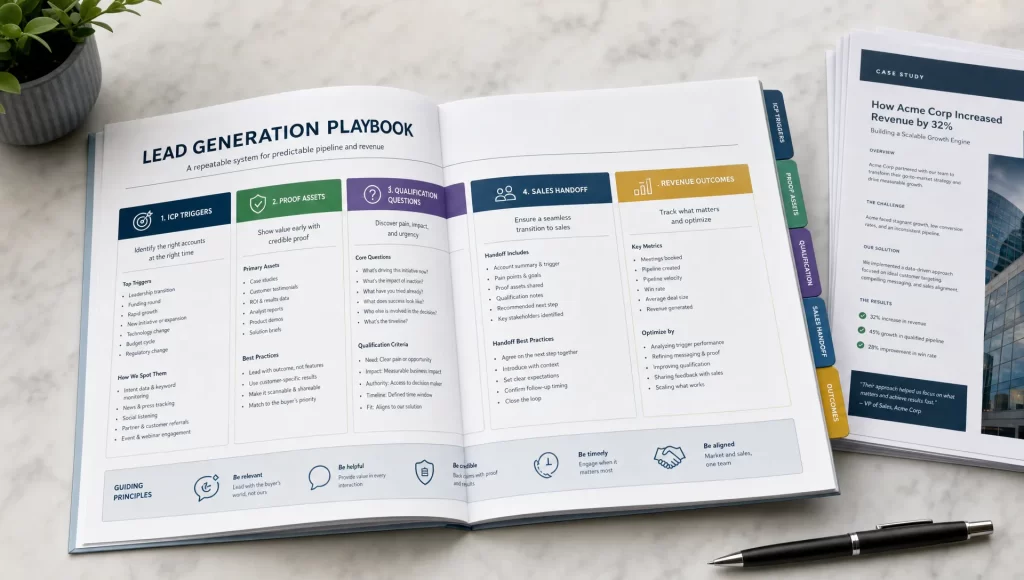
Most founder-led consulting and expertise-based B2B firms do not feel their lead generation break all at once. The first signs look harmless: referrals still arrive, the founder still closes important deals, and the team can point to a few campaigns that “almost worked.”
Then growth stalls.
The problem is rarely that the business forgot how to generate interest. Consulting lead generation breaks at mid-market because the buying environment changes faster than the revenue system does. What worked through reputation, personal networks, and founder charisma does not automatically translate into a repeatable engine for larger accounts, longer sales cycles, and multi-stakeholder buying committees.
At the mid-market stage, the question shifts from “Can we get more leads?” to “Can we create the right demand, convert it without founder heroics, and prove commercial value before the buyer takes a meeting?”
The mid-market shift most founders underestimate
Early growth in a consulting business is often trust-led. A past client introduces the founder. A strategic partner sends a warm opportunity. A prospect already knows the firm’s reputation before the first call. The sales process feels efficient because much of the persuasion happened before the conversation started.
Mid-market buyers behave differently. They have more internal stakeholders, more scrutiny, and more alternatives. Gartner notes that a typical buying group for a complex B2B solution can include six to ten decision makers. Even when one executive likes your firm, that person still has to justify the decision to finance, operations, procurement, technical leaders, or the CEO.
That is where founder-led lead generation starts to strain. The founder may still create confidence in a room, but the system around the founder often fails to equip the buyer for the internal sale.
A mid-market prospect is not just asking, “Do I like this firm?” They are asking:
- Is this problem urgent enough to fund now?
- Can this firm solve our specific version of the problem?
- Will the implementation risk be manageable?
- Can I defend this spend internally?
- What changes if we do nothing for another quarter?
If your lead generation only creates surface-level interest, it will underperform in that environment.
Where consulting lead generation breaks first
The break usually appears in the metrics before it appears in the boardroom. Founders see activity, but not enough qualified pipeline. Marketing reports engagement, but sales does not trust the leads. The team adds tools, campaigns, or agencies, yet revenue remains inconsistent.
| Symptom | What it looks like | Likely underlying constraint |
|---|---|---|
| More leads, fewer serious opportunities | Content downloads, webinar attendees, or inbound forms increase, but few buyers advance | Weak qualification and unclear buying triggers |
| Referral volume flattens | The founder’s network no longer produces enough new demand | No scalable demand creation beyond relationships |
| Sales cycles stretch | Prospects show interest, then stall after the first or second call | Buyer risk is not being addressed early enough |
| Close rates vary by founder involvement | Deals move when the founder leads, but slow down with the team | Sales narrative and proof are not systemized |
| Campaigns create noise | Ads, outbound, or content generate meetings that do not fit | ICP and offer positioning are too broad |
This is why adding more campaigns often makes the problem louder, not better. If the revenue architecture is misaligned, more lead volume simply pushes more unqualified prospects into a leaky system.
Why the old playbook stops working
The ICP gets too broad
Many consulting firms reach mid-market with an ICP that is really a description of who has bought before. That can be useful history, but it is not always a precise growth strategy.
At early stages, broad positioning feels safe because the founder can adapt the pitch in real time. At mid-market, broad positioning creates confusion. Sales cannot prioritize accounts. Marketing cannot write sharp messages. Prospects cannot immediately see why the firm is relevant to their specific constraint.
The fix is not just demographic segmentation by revenue, headcount, or industry. A stronger mid-market ICP includes business triggers, urgency signals, operational pain, and economic consequences. For example, “B2B SaaS companies with 100 to 300 employees” is much weaker than “founder-led B2B SaaS companies expanding from founder-led sales to a managed sales organization after pipeline conversion has dropped.”
The offer sounds valuable, but not necessary
Consulting firms often describe themselves through capabilities: strategy, transformation, operations, marketing, sales enablement, leadership, or growth. Those categories may be accurate, but buyers rarely fund categories. They fund outcomes that are tied to risk, growth, cost, speed, or competitive pressure.
A mid-market buyer needs to understand what problem is being solved, why it matters now, and what commercial upside or downside is attached to action. If the offer is framed as expertise rather than business impact, it becomes easier to postpone.
That is why generic lead magnets and broad thought leadership often lose power at this stage. The content may be intelligent, but it does not create urgency.
Referrals are not translated into a system
Referrals are a strength, not a weakness. The mistake is treating them as the entire growth engine.
A strong referral often works because the referrer transfers trust. They explain the problem, validate the firm, and reduce perceived risk. When consulting lead generation moves beyond referrals, your assets and process must do that work instead.
That means the website, case studies, diagnostic offers, outbound messaging, and sales conversations must all recreate the confidence that a warm referral used to provide. If they do not, cold or low-warmth prospects will appear less qualified, even when the real issue is that they have not been educated or de-risked properly.
Marketing and sales define quality differently
At mid-market, “lead” becomes a dangerous word unless the team defines it precisely. Marketing may count anyone who fills out a form. Sales may only care about accounts with budget, authority, urgency, and strategic fit. Both teams can be right within their own frame and still fail as a revenue system.
This is especially common in founder-led firms where the founder has historically acted as the bridge between marketing intuition and sales judgment. Once the business tries to scale, that judgment has to be codified.
A useful lead definition should include fit, trigger, problem severity, stakeholder access, and next-step clarity. Without those criteria, the business ends up debating lead volume instead of pipeline quality.
Proof is too general for the risk level
Early buyers may accept broad credibility. Mid-market buyers need proof that maps to their situation.
A case study that says “we helped a client grow revenue” is weaker than one that explains the starting constraint, the intervention, the implementation path, and the measurable business result. The buyer wants to know whether your firm has solved a similar problem under similar conditions.
This matters because consulting is an intangible purchase. The buyer cannot inspect the finished product in advance. Specific proof reduces the perceived risk of choosing you.

What a mid-market lead generation system has to prove
A mature system does more than create attention. It moves the right accounts from problem awareness to commercial confidence.
| Buyer question | What your system must provide |
|---|---|
| “Do they understand our situation?” | Clear ICP language, industry context, and trigger-specific messaging |
| “Is this problem expensive enough to solve?” | Commercial framing, cost of inaction, and outcome-based education |
| “Can they solve our version of it?” | Relevant case studies, diagnostics, and problem-specific insights |
| “Can I get internal buy-in?” | Executive-ready proof, simple business case language, and risk reduction |
| “What happens after we engage?” | A clear process, defined next steps, and implementation expectations |
This is the point where lead generation becomes inseparable from sales architecture. If the marketing message creates one expectation and the sales process reveals another, trust erodes. If the content educates but does not create urgency, prospects linger. If the sales call inspires confidence but follow-up lacks proof, deals stall.
For many founder-led B2B companies, the fastest path forward is not another channel test. It is a constraint-led review of the whole revenue system. A structured business diagnostic before scaling helps identify whether the real blockage sits in positioning, offer design, lead quality, sales process, pricing, or delivery confidence.
How to rebuild consulting lead generation for mid-market
Start with the revenue constraint, not the campaign
Before changing channels, diagnose where revenue is actually breaking. A campaign problem looks different from a conversion problem. A conversion problem looks different from an offer problem. An offer problem looks different from a market selection problem.
If the firm is attracting the wrong accounts, better nurture will not fix it. If the right accounts are engaging but not converting, more traffic will not fix it. If the founder is required to rescue every late-stage deal, more sales headcount may only add cost.
This is why effective consulting lead generation starts with constraint identification. Once the constraint is clear, the next intervention becomes far easier to prioritize.
Rebuild the ICP around triggers and pain intensity
A mid-market ICP should clarify who is most likely to buy now, not just who could theoretically benefit.
Strong trigger signals might include a leadership transition, a stalled growth target, a new funding event, margin compression, expansion into a new market, sales team underperformance, or a major operational change. These signals give marketing and sales a reason to reach out with relevance.
The sharper the trigger, the easier it becomes to create messaging that feels timely rather than generic.
Turn founder judgment into repeatable assets
Founders often carry the best sales language in their heads. They know which objections matter, which stories build trust, and which questions expose urgency. At mid-market, that knowledge has to become an operating system.
Useful assets include diagnostic questions, qualification criteria, objection responses, proof libraries, discovery call structures, follow-up templates, and account-specific business case materials. The goal is not to remove the founder from strategic sales entirely. The goal is to stop making founder involvement the only reason deals progress.
The operating principle is similar to building a sales pipeline that generates leads without you: document the repeatable parts of trust creation so the business is not dependent on one person’s network, instincts, or availability.
Align marketing promises with sales reality
Marketing should not be judged only on attention, and sales should not be judged only on effort. Both should be accountable to qualified pipeline and revenue progression.
That requires shared definitions. What makes an account a fit? What trigger events matter? What content should a prospect consume before a call? What questions must be answered before an opportunity is created? What proof is required to move a buying committee forward?
When these answers are explicit, the team can improve the system. When they remain implicit, every missed deal becomes a matter of opinion.
Add AI after the motion is clear
AI can improve research, segmentation, personalization, content repurposing, CRM hygiene, and follow-up speed. But it cannot compensate for unclear strategy.
If the ICP is vague, AI will scale vague outreach. If the offer is generic, AI will produce more generic messaging. If sales stages are poorly defined, AI will automate confusion.
The right sequence is strategy first, system second, automation third. Once the motion is clear, AI can help increase speed and consistency across the lead generation process.
The metrics that matter more at mid-market
Lead volume still matters, but it becomes less useful on its own. Mid-market growth depends on progression quality.
Watch metrics such as qualified account engagement, meeting-to-opportunity conversion, opportunity-to-proposal conversion, sales cycle length, average deal size, stakeholder coverage, source-to-revenue performance, and founder involvement by deal stage.
One especially revealing metric is “pipeline created from non-founder sources.” If the founder remains the primary originator, qualifier, and closer of meaningful opportunities, the company may have demand, but it does not yet have a scalable lead generation engine.
Another useful measure is “proof asset usage by stage.” If deals stall after discovery, the issue may be that buyers lack the internal materials needed to justify action. If proposals stall, the issue may be business case clarity or risk reduction. These are not marketing problems or sales problems in isolation. They are revenue system problems.
Frequently Asked Questions
Why does consulting lead generation get harder at mid-market? It gets harder because buyers become more complex. Larger accounts usually involve more stakeholders, longer evaluation cycles, greater risk scrutiny, and a stronger need for proof. Referral-led growth can still help, but it is rarely enough on its own.
Is the problem usually lead volume or lead quality? At mid-market, the problem is often lead quality, qualification, and conversion architecture rather than pure volume. More leads can help only if the ICP, offer, proof, and sales process are already aligned.
Should a consulting firm invest in ads, outbound, or content first? The channel should come after the diagnosis. If your positioning is unclear, ads will waste spend. If your ICP is too broad, outbound will create low-fit meetings. If your proof is weak, content may educate without converting. Fix the constraint first, then choose the channel.
How do you know if the founder is still too central to lead generation? Look at how many qualified opportunities originate, progress, or close without the founder’s direct involvement. If important deals depend on the founder at every stage, the business needs stronger sales assets, clearer qualification, and a more repeatable revenue process.
Can AI fix consulting lead generation? AI can accelerate a clear system, but it cannot replace one. It is most useful once the firm has a defined ICP, strong messaging, clean sales stages, and clear proof requirements.
Diagnose the break before you scale the spend
If consulting lead generation is breaking at mid-market, the answer is not always a bigger marketing budget or another sales hire. The answer is often a sharper revenue diagnosis.
Billionaires in Boxers works with founder-led B2B companies from $3M to $25M in revenue to identify growth constraints, design revenue systems, and build costed intervention roadmaps through PE-grade diagnostics, AI systems, and fractional CRO support.
If you are seeing more activity than qualified pipeline, or more conversations than closed revenue, start with the constraint. A Revenue Acceleration Diagnostic can show where the system is breaking and what to fix next.
