

When B2B technology sales slows down, hiring feels logical. More SDRs should create more conversations. More account executives should run more demos. A sales leader should bring process. On paper, headcount looks like capacity.
In practice, more headcount often multiplies the problem that already exists.
Founder-led technology and software companies usually do not stall because the team is lazy or the market has disappeared. They stall because the commercial system has outgrown the way it was originally built. The founder is still carrying too much of the narrative. Sales calls are too product-led. Qualification is inconsistent. Pipeline reviews track activity instead of probability. Good reps spend too much time creating custom materials, chasing weak opportunities or trying to decode what the founder would say.
Fixing B2B technology sales without more headcount starts with a different question: where is the current sales capacity being wasted?
Headcount is not the constraint, it is the amplifier
A new seller does not automatically create repeatability. They inherit the market definition, messaging, pricing logic, qualification habits, proof assets, CRM hygiene and handoff process that already exist. If those elements are weak, adding people adds cost before it adds revenue.
This is especially true in B2B technology sales because the buying process is rarely simple. The buyer may need technical validation, economic justification, internal consensus, implementation confidence and risk reduction before they move. Gartner describes B2B buying as a set of jobs completed by a buying group rather than a neat linear funnel, which matches what most founder-led tech companies experience in real deals.
That complexity punishes vague sales systems. If your team cannot clearly answer who buys fastest, what problem they are trying to solve, why they should act now, who else must approve and what proof reduces perceived risk, another rep will simply run more inconclusive conversations.
The pattern is familiar. Marketing says the leads are good. Sales says the leads are not ready. The founder says the reps are not commercial enough. Customer success says expectations were set badly. Finance says the pipeline looked stronger than the cash result. At that point, the issue is not one function. It is the revenue system, which is why many B2B tech growth problems are really revenue problems.
Diagnose the leak before you add capacity
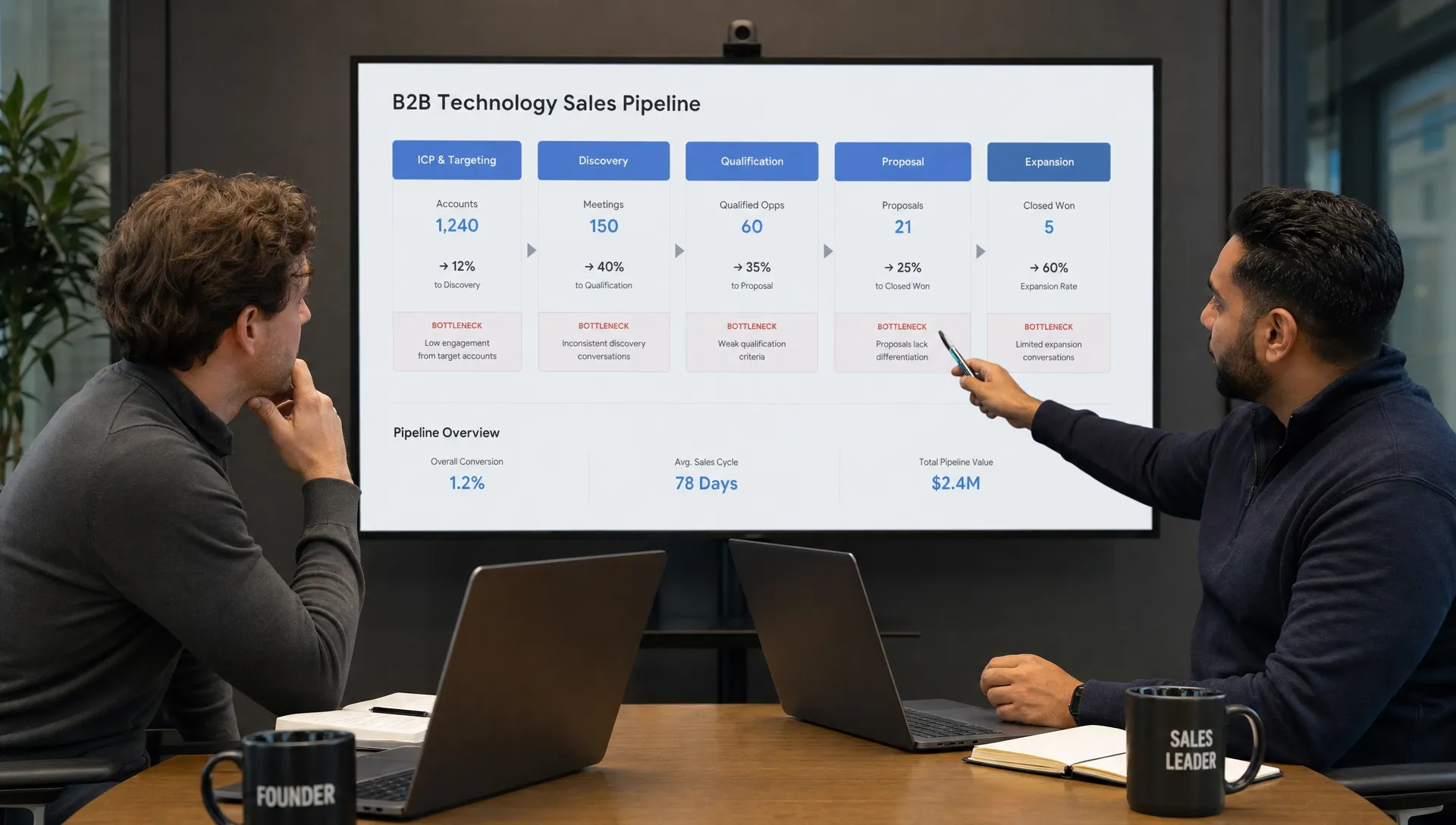
Before hiring, map the sales constraint in plain commercial language. The goal is to identify the point where revenue momentum breaks down, not to produce a theoretical funnel model no one uses.
| Symptom | Likely constraint | What happens if you hire first |
|---|---|---|
| Lots of demos, few serious opportunities | Weak ICP, weak qualification or product-led discovery | More demos with buyers who were never likely to buy |
| Founder closes most meaningful deals | Founder-owned narrative or trust gap | Reps create pipeline the founder must rescue |
| Deals stall after proposal | No business case, weak decision mapping or unclear urgency | More late-stage pipeline that ages without closing |
| Forecast is regularly wrong | CRM stages reflect seller hope, not buyer commitment | More reporting noise and less management confidence |
| New customers churn or under-expand | Poor fit, overselling or weak handoff | More revenue enters and leaks out |
| One segment wins repeatedly but is not prioritized | ICP discipline is missing | Hiring spreads attention instead of concentrating force |
This table is deliberately simple. If the company cannot point to the constraint, more people become a bet. If the company can name the constraint, you can fix the system and then decide whether headcount is still needed.
Fix 1: Narrow the ICP around sales physics, not market size
Many tech companies define their ideal customer profile by industry, employee count, geography and technology stack. That is a start, but it is not enough for sales execution. A workable ICP must explain sales physics: where deals move fastest, where urgency is strongest, where the pain is already budgeted and where your proof is most credible.
A broad total addressable market can be useful for fundraising or strategic planning. It is less useful for a rep deciding which account deserves a tailored outbound sequence, which discovery thread to pursue or which opportunity should receive leadership attention.
For each major segment, examine the actual economics of the last 20 to 50 opportunities if you have enough data. If not, start with the last 10 won deals and 10 lost deals. Look for patterns in speed, fit and effort.
| ICP factor | What to inspect | Why it matters |
|---|---|---|
| Pain intensity | The business problem that triggered the conversation | Strong pain creates urgency without sales theatrics |
| Buying event | Funding, regulation, leadership change, system migration or growth target | Events explain why now |
| Proof match | Similar case studies, integrations, use cases or operating environments | Relevant proof reduces perceived risk |
| Sales cycle | Time from first serious conversation to signed agreement | Shorter cycles increase capacity without hiring |
| Deal effort | Founder involvement, custom work, security reviews and proposal complexity | Low-effort revenue scales more easily |
| Expansion path | Additional teams, modules, regions or use cases | Expansion improves account economics |
The fix is not to make the market tiny. The fix is to create priority tiers. Tier 1 accounts receive the best research, strongest messaging and fastest follow-up. Tier 2 accounts can stay in nurture. Tier 3 accounts should usually be disqualified or automated until there is a clear buying event.
That one decision can release a surprising amount of sales capacity. Reps stop treating every conversation as equally valuable and start focusing on the accounts most likely to convert.
Fix 2: Replace product-led demos with problem-led diagnosis
B2B technology sales breaks down when the product is explained before the buyer’s problem is ranked. A demo can create interest, but it rarely creates urgency by itself. Buyers need to see why the current state is expensive, why delay is risky and why your approach is better than both competitors and doing nothing.
A stronger sales conversation follows a diagnostic arc. It clarifies the current operating problem, the commercial consequence, the buying event, the internal decision path and the risk the buyer is trying to reduce. Only then should the product be shown, and the demo should be limited to the parts that connect directly to the buyer’s stated problem.
This does not require a larger team. It requires a tighter sales motion. A good discovery call should leave the seller with clear answers to five questions:
- What business outcome is the buyer trying to improve?
- What is the cost of the current way of working?
- Why is the issue active now rather than later?
- Who must agree before a decision can be made?
- What proof would make the buyer confident enough to act?
If those answers are missing, the deal is not qualified just because a demo happened. It is only an engaged conversation. Treating engaged conversations as pipeline is one of the easiest ways to overestimate sales capacity.
Fix 3: Make qualification a capacity protection system
Qualification is not a formality. It is how a founder-led company protects scarce commercial energy.
Many teams qualify too softly because they do not want to lose pipeline. The CRM fills with opportunities that have interest but no urgency, pain but no owner, budget but no decision process or a champion with no authority. Sellers then spend weeks producing proposals, follow-ups and internal updates for deals that were never real.
A better qualification system defines what must be true for an opportunity to move forward. For example, a deal should not enter committed pipeline unless the team can identify the business problem, the buying event, the decision process, the economic owner, the next buyer-side action and the reason the buyer would choose you over the status quo.
Disqualification should also be explicit. If an account is outside the ICP, lacks a meaningful pain, cannot name a decision process or wants a heavily customized version of the product that does not fit strategy, the seller should have permission to slow down or exit. That is not negative. It is capacity management.
The best sales teams do not win by chasing everything. They win by knowing what deserves pursuit.
Fix 4: Use AI to return selling time, not replace sales judgment
AI can help fix B2B technology sales without more headcount, but only when it is attached to a clear commercial process. Buying a tool because the team is busy usually creates another system to manage. Building AI around known bottlenecks can return hours to sellers and improve consistency.
The highest-leverage AI use cases are usually not glamorous. They remove friction from work that sellers already have to do. Account research can be summarized before outbound. Call notes can be structured against your qualification criteria. Proposals can be drafted from approved language. Objections can be captured and turned into coaching material. Expansion signals can be flagged from customer conversations and account activity.
The point is not to let AI decide strategy. The point is to make the best version of your current strategy easier to execute every day. If your sales process is unclear, AI will scale the confusion. If your process is clear, AI can make the team faster and more consistent. For a deeper look at this operating logic, Billionaires in Boxers has covered how AI business solutions fix bottlenecks at scale.
A practical AI sales system might support:
- Pre-call briefs based on ICP, trigger events and known account context
- Discovery summaries mapped to qualification fields
- Follow-up emails tied to the buyer’s stated business problem
- Proposal drafts using approved proof, pricing logic and implementation language
- Objection libraries built from real calls and win-loss notes
- Pipeline risk summaries before weekly reviews
Human review still matters. Pricing, legal commitments, product promises and strategic concessions should not be left to automation. The goal is to remove low-value manual work so your existing people can spend more time on judgment, trust and deal strategy.
Fix 5: Turn founder judgment into reusable sales assets
In founder-led B2B companies, the founder often carries invisible sales assets in their head. They know which buyer comments matter. They can sense when a prospect is serious. They know how to frame the category, handle a skeptical CFO or reposition the product when a technical buyer gets stuck in features.
That judgment is valuable, but it does not scale if it stays personal.
Instead of asking reps to become founder clones, codify the founder’s patterns into tools the team can use. This is where sales enablement becomes more than a slide deck. It becomes an operating system for commercial judgment.
Useful assets include a clear point-of-view narrative, segment-specific discovery questions, demo paths by use case, proof libraries, objection responses, decision-process questions and proposal templates. The language should come from real customer conversations, not generic positioning exercises.
This also reduces the founder’s need to join every important deal. The founder can still be used strategically, especially in enterprise or high-value opportunities, but they should not be the reason the deal moves at all. If revenue depends on founder heroics, the sales team is not underperforming as much as it is under-equipped.
Fix 6: Run pipeline reviews on buyer evidence
Pipeline meetings often waste time because they review seller activity instead of buyer evidence. A rep says the prospect liked the demo, procurement is next or the deal should close this month. None of those statements are forecastable unless they are connected to observable buyer behavior.
A stronger pipeline review asks what changed on the buyer’s side. Did the economic owner attend? Did the prospect share internal decision criteria? Did they confirm the business case? Did they introduce security, finance or implementation stakeholders? Did they agree to a mutual action plan with dates and responsibilities?
This shift improves sales without hiring because it makes management time more useful. Leaders stop debating vibes and start coaching the real gap. One opportunity may need a stronger business case. Another may need multithreading. Another may need to be downgraded because the buyer has not taken a meaningful action in three weeks.
Pipeline stages should also be tied to exit criteria. A stage is not where the seller feels the deal is. It is what the buyer has done that justifies the stage. That distinction alone can improve forecasting, reduce wasted follow-up and create better coaching moments.
Fix 7: Expand customer revenue before overfeeding the top of funnel
Many B2B technology companies over-focus on net-new acquisition while under-systematizing expansion. This is understandable. New logos are visible and emotionally rewarding. Yet existing customers often contain the fastest route to efficient growth, especially when the product solves problems that can spread across teams, regions, workflows or use cases.
Expansion does not happen reliably just because customers are happy. It needs triggers, ownership and a commercial rhythm. Customer success should know which adoption patterns signal expansion potential. Sales should know when to re-enter the account. Product should understand which use cases create the strongest path to broader deployment. Leadership should review expansion pipeline with the same seriousness as new business.
This does not mean forcing upsells onto customers. It means identifying where additional value already exists and making the path easy. If customers are achieving measurable outcomes, the sales system should capture those outcomes, turn them into proof and use them to support both retention and expansion.
A company that improves expansion can raise revenue per account without adding more sellers. It can also sharpen acquisition because the team learns which customers create long-term value, not just quick signatures.
A 90-day plan to improve sales without hiring
You do not need a year-long transformation to create momentum. A focused 90-day sprint can expose the constraint, fix the highest-friction parts of the sales motion and give leadership a cleaner view of whether headcount is truly required.
| Timeframe | Focus | Output |
|---|---|---|
| Days 1 to 14 | Diagnose the sales constraint | Funnel review, win-loss patterns, ICP quality, stage conversion and founder involvement map |
| Days 15 to 30 | Tighten ICP and qualification | Priority account tiers, disqualification rules and stage exit criteria |
| Days 31 to 45 | Rebuild discovery and demo flow | Problem-led call structure, use-case demo paths and buyer evidence checklist |
| Days 46 to 60 | Codify founder judgment | Objection library, proof bank, proposal templates and deal review rules |
| Days 61 to 75 | Add targeted AI support | Call summaries, account briefs, follow-up drafts and pipeline risk signals |
| Days 76 to 90 | Review commercial impact | Conversion movement, cycle length, forecast accuracy, seller capacity and next constraint |
The important discipline is sequencing. Do not automate before the process is clear. Do not coach before you know which behavior matters. Do not hire before you know whether the bottleneck is demand quality, conversion, founder dependency, pipeline management or expansion.
When hiring becomes the right move
The argument is not that founder-led B2B technology companies should never hire salespeople. The argument is that hiring should come after repeatability, not before it.
Headcount becomes a good investment when the company can show that a defined segment converts predictably, reps can run discovery without founder rescue, pipeline stages are based on buyer evidence, onboarding assets exist and managers know which metrics predict revenue. At that point, a new hire is not being asked to invent the system. They are being added to a system that already works.
That is when headcount becomes acceleration rather than experimentation.
If the team is already stretched, this discipline may feel slower than hiring. It is usually faster in economic terms because it avoids months of ramp, salary, management time and opportunity cost spent proving that the real problem was never headcount.
Frequently Asked Questions
Can B2B technology sales really improve without hiring more reps? Yes. If the current team is losing time to weak qualification, unclear ICP, founder dependency, poor sales assets or messy pipeline management, fixing those issues can increase effective capacity before headcount is added.
When should a founder-led tech company hire another salesperson? Hire when the sales motion is repeatable enough for a new person to execute. That means clear ICP tiers, proven messaging, defined qualification rules, usable enablement assets and pipeline stages based on buyer evidence.
What is the biggest mistake companies make when sales slow down? The biggest mistake is treating every slowdown as a capacity issue. Sometimes the real constraint is conversion, deal quality, sales process, offer clarity, pricing, customer expansion or founder dependency.
How can AI help B2B technology sales teams without replacing people? AI can reduce admin and improve consistency through account research, call summaries, follow-up drafts, proposal support, objection capture and pipeline risk analysis. It works best when connected to a clear sales process.
Should sales or marketing own the fix? Neither function can fix the whole system alone. Founder-led B2B technology sales usually improves fastest when leadership aligns ICP, messaging, qualification, sales process, customer proof and expansion into one revenue architecture.
Fix the system before you fund more capacity
If your sales team is working hard but revenue is not moving the way it should, more headcount may not be the cleanest next move. The better first step is to identify the revenue constraint and build the system around it.
Billionaires in Boxers helps founder-led B2B technology and software companies do exactly that through PE-grade diagnostics, AI systems and fractional CRO support. If you want a structured outside view of where sales capacity is being wasted, explore the Revenue Acceleration Diagnostic for technology and software and start with the constraint before you scale the team.
