
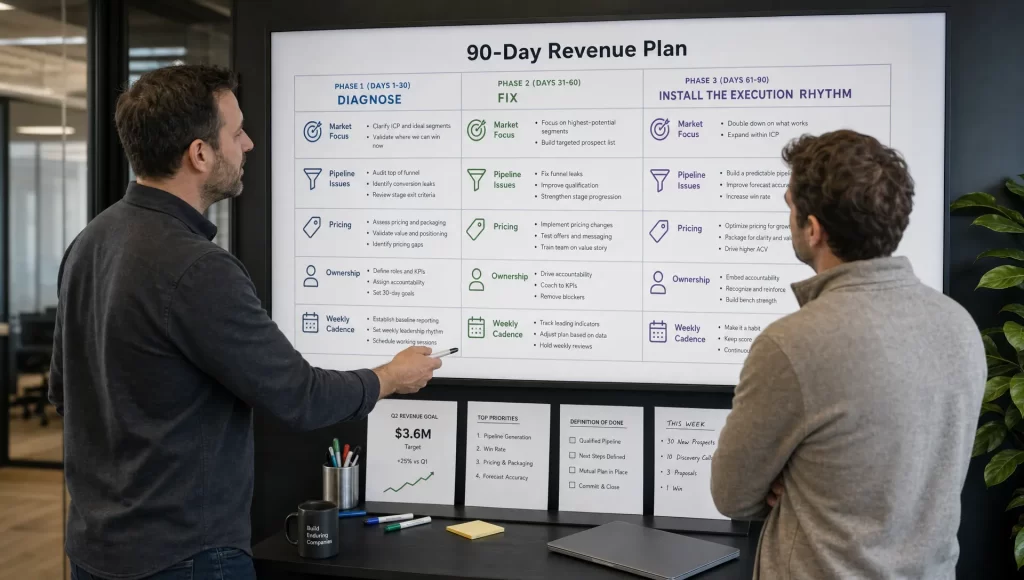
By the time a founder-led B2B company hires a strategy consultant, the problem is rarely a lack of ideas. It is usually too many ideas, too many disconnected initiatives, and not enough proof that any of them will create durable revenue.
That is why the first 90 days matter so much. A strong strategy consultant should not spend that window building an elegant slide deck that lands three months too late. They should use it to turn ambiguity into a practical growth system: clearer market focus, fewer revenue leaks, sharper sales execution, and an operating rhythm the leadership team can actually sustain.
For B2B companies between roughly $3M and $25M in revenue, the first 90 days should answer one commercial question: what must be fixed first to accelerate revenue without adding unnecessary complexity?
The real job of a strategy consultant in the first 90 days
A strategy consultant is not there to validate every assumption the founder already has. They are there to pressure-test the business model, identify the constraints slowing growth, and convert strategic choices into execution.
In the first 90 days, the consultant should create:
- A shared fact base on what is really happening across market, pipeline, sales, pricing, delivery, and retention
- A clear diagnosis of the few constraints that are actually limiting growth
- A prioritized set of trade-offs, including what the company should stop doing
- A costed intervention roadmap that explains what to fix, who owns it, and what the expected business impact is
- A management rhythm that keeps the strategy alive after the consultant leaves the room
The key word is fix. The first 90 days should produce visible improvements in how the company makes revenue decisions, not just a more sophisticated vocabulary for the same problems.
Days 1 to 30: diagnose before prescribing
The first month should be about finding the truth. Many founder-led B2B companies have grown through instinct, relationships, referrals, or founder-led selling. That can work beautifully up to a point, but it often leaves the business with hidden dependencies and weak visibility.
A strategy consultant should begin with a structured diagnostic, not a generic workshop. That means looking at revenue data, customer segments, sales calls, win-loss patterns, deal economics, team capacity, positioning, pricing, and delivery constraints. A useful starting point is the kind of business diagnostic consultants should run before scaling, because it forces the conversation away from opinions and toward evidence.
The first 30 days should not become analysis paralysis. The consultant should be able to produce a clear view of where growth is leaking and which bottlenecks deserve immediate attention.
| Area to diagnose | Question the consultant should answer | Useful output by day 30 |
|---|---|---|
| Market focus | Which customer types are most profitable, easiest to win, and most likely to retain? | Ranked ICP and segment analysis |
| Demand generation | Which channels produce qualified opportunities, not just leads? | Channel performance and pipeline quality review |
| Sales process | Where do deals stall, discount, or disappear? | Stage conversion and sales friction map |
| Offer and pricing | Is the offer easy to understand, price, sell, and deliver? | Offer clarity and margin assessment |
| Delivery capacity | Can the company fulfill more demand without damaging quality? | Delivery bottleneck and scalability review |
| Leadership cadence | Are decisions made with data, rhythm, and ownership? | Operating rhythm gap analysis |
The best consultants also spend time with the people closest to the revenue. That includes sales reps, account managers, customer success, delivery leads, finance, marketing, and the founder. The point is not to collect every anecdote. The point is to compare what leadership thinks is happening with what customers, data, and frontline teams reveal.
By the end of the first month, the founder should have a short list of constraints. Not 27 recommendations. Not a strategy map with every possible initiative. A practical diagnosis that says: these are the three to five issues preventing the next stage of growth.
Days 31 to 60: fix the constraints that block revenue
Once the diagnostic is complete, the consultant should shift from discovery to decision. This is where many engagements succeed or fail. Strategy is not only about choosing what to do. It is also about choosing what not to fund, not to hire for, not to automate, and not to chase.
In founder-led B2B companies, growth often slows because the business keeps adding more. More verticals. More offers. More campaigns. More sales activity. More tools. More meetings. A good strategy consultant helps the founder reduce noise and concentrate resources where the business has the highest probability of profitable growth.
Fix 1: ICP and market focus
If the company sells to too many customer types, the first fix is focus. The consultant should identify which segments create the best combination of win rate, contract value, margin, sales cycle length, retention, and expansion potential.
This is not an academic exercise. ICP clarity affects every revenue motion. It changes outbound targeting, website messaging, sales qualification, case study selection, pricing conversations, partner strategy, and product roadmap decisions.
A strong day-60 outcome is a sharper answer to: where should we compete now, and which opportunities should we deliberately ignore?
Fix 2: offer and pricing clarity
Many B2B companies do not have a demand problem. They have an offer clarity problem. Prospects may understand the category, but not why this company is the obvious choice, why now, and why the investment is worth it.
A strategy consultant should test whether the offer is packaged around a painful business outcome, whether pricing reflects value, and whether the sales team can explain the commercial case simply. This is especially important for service-led, expertise-led, and complex B2B businesses where the founder has historically carried the sale through personal credibility.
The fix may be a clearer offer architecture, tighter qualification rules, stronger business case materials, or a pricing model that better connects scope, value, and delivery cost.
Fix 3: pipeline quality and sales conversion
If the company is complaining about lead volume, the consultant should be careful. More leads rarely fix a weak revenue system. The real issue may be poor-fit demand, inconsistent follow-up, weak discovery, unclear next steps, low urgency, or late-stage discounting.
This is where strategy overlaps with revenue execution. As explained in the article on how a marketing consultant fixes pipeline, not just ads, pipeline performance is rarely solved by media spend alone. The consultant should look across the full journey from market message to qualified opportunity to closed-won revenue.
A practical fix might include clearer sales stages, stronger qualification criteria, call coaching, better proposal structure, cleaner handoffs, or a tighter definition of what counts as a real opportunity.
Fix 4: accountability across the revenue team
In founder-led companies, accountability is often informal. People know what they are generally responsible for, but not always what decision rights they hold, which metrics they own, or how their work connects to the revenue plan.
By day 60, the consultant should clarify ownership. Who owns pipeline creation? Who owns conversion? Who owns customer expansion? Who owns pricing discipline? Who owns CRM hygiene? Who decides when a segment is no longer a priority?
Without this clarity, strategy turns into recurring debate.
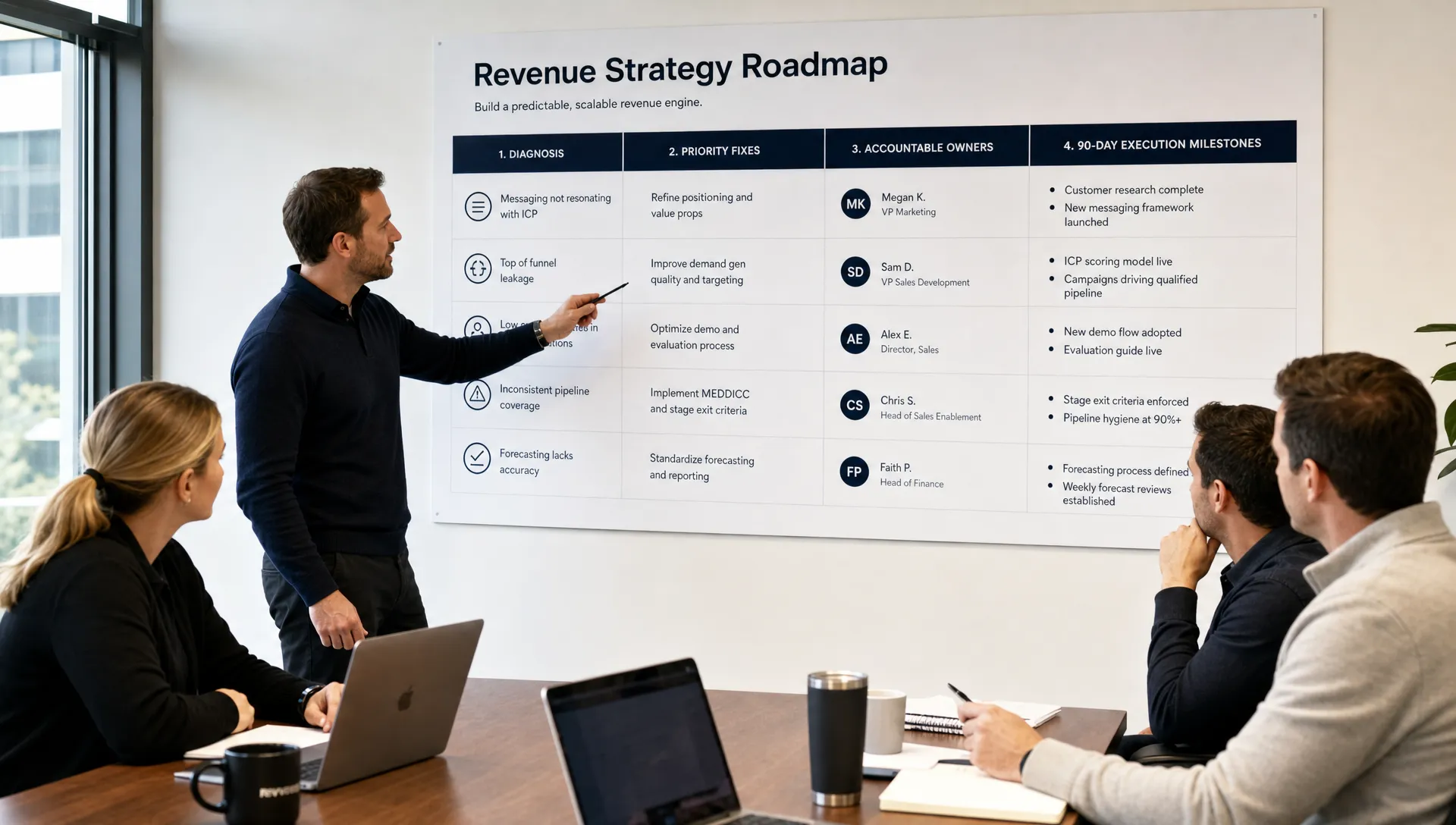
Days 61 to 90: install the execution system
The final 30 days should focus on making the strategy operational. This is where the consultant proves whether the work can survive contact with the business.
A good strategy does not need to be complex, but it does need a cadence. Harvard Business Review has written extensively about why strategy execution breaks down when teams lack coordination, commitment, and clear resource allocation, especially in its piece on why strategy execution unravels. In mid-market B2B companies, the same problem shows up in practical ways: meetings without decisions, dashboards nobody trusts, sales targets without leading indicators, and strategic priorities that compete with daily firefighting.
A strategy consultant should fix that by installing a management rhythm that includes:
- A weekly revenue meeting with a fixed agenda, clear numbers, and named decisions
- A simple dashboard that tracks leading indicators and lagging results
- A 30-day execution plan for each priority initiative
- Clear owners for every intervention, not just departments
- A process for escalating blockers quickly instead of rediscovering them every month
The dashboard should not be a vanity reporting pack. It should help the founder see whether the business is moving toward the chosen strategy.
| Revenue area | Leading indicator to track | Why it matters |
|---|---|---|
| Market focus | Percentage of pipeline from priority ICP | Shows whether focus is changing behavior |
| Demand generation | Qualified opportunities by source | Separates activity from commercial intent |
| Sales execution | Stage conversion and sales cycle length | Reveals friction inside the buying process |
| Pricing discipline | Discount rate and gross margin by deal type | Protects profitable growth |
| Customer expansion | Expansion pipeline and retention risk | Connects growth strategy to account health |
| Execution cadence | Actions completed by owner and due date | Shows whether strategy is becoming operating reality |
By day 90, the founder should not need to ask what the strategy is. It should be visible in pipeline reviews, sales conversations, hiring decisions, pricing discipline, and leadership meetings.
What a strong day-90 deliverable should include
A strategy consultant can still produce a deck, but the deck should not be the main asset. The real deliverable is a working growth architecture.
At the end of 90 days, the founder should expect the following:
| Deliverable | What it should contain | What it proves |
|---|---|---|
| Revenue constraint diagnosis | The few bottlenecks most responsible for stalled or inefficient growth | The consultant found the real problem, not just symptoms |
| Strategic focus decisions | Priority ICP, offers, channels, and markets, plus explicit deprioritized areas | The business has made trade-offs |
| Costed intervention roadmap | Initiatives, owners, cost, expected impact, sequencing, and timing | The strategy can be funded and managed |
| Sales and pipeline fixes | Qualification rules, stage definitions, conversion improvements, and follow-up standards | Revenue execution is improving |
| Operating cadence | Meeting rhythm, scorecard, decision process, and escalation rules | Strategy is embedded in management behavior |
| Measurement model | Leading and lagging indicators tied to revenue goals | Progress can be tracked without guessing |
The most important part is sequencing. A founder may want to fix everything at once, but that often creates more drag. The consultant should identify the order of operations. For example, it may be pointless to increase lead generation before tightening qualification, or premature to hire sales reps before proving a repeatable sales motion.
What should not be the priority in the first 90 days
A strategy consultant should be ambitious, but not reckless. Some initiatives are tempting because they feel strategic, even when they are not the immediate constraint.
In most founder-led B2B companies, the first 90 days should not be consumed by:
- A full rebrand unless positioning is clearly blocking revenue
- A CRM migration before the sales process and reporting needs are defined
- A hiring spree before the current revenue motion is proven
- Expansion into new verticals before the current ICP is understood
- AI automation before the underlying workflow is clear
- A compensation overhaul without reliable data on sales behavior and economics
AI systems, new tools, and market expansion can absolutely accelerate growth, but only when attached to a clear revenue strategy. Automating a broken process just helps the business make the same mistake faster.
How founders should judge the consultant by day 90
The simplest test is whether the leadership team is making better decisions. If the business is still debating the same issues in the same way, the engagement has not gone far enough.
By day 90, the founder should be able to answer these questions with more confidence:
- Which customer segments should we prioritize for the next stage of growth?
- Where are we losing revenue inside the current system?
- Which fixes create ROI first?
- What should we stop doing because it distracts from the strategy?
- Who owns each revenue priority?
- What numbers will tell us whether the strategy is working?
If you are still deciding who to hire, it is worth using a clear evaluation process for choosing a strategy consulting firm that delivers. The right partner should be able to explain how they will diagnose, prioritize, and operationalize growth before you sign the engagement.
A credible strategy consultant will not promise that every revenue problem will be solved in 90 days. They should promise something more useful: the business will know what is true, what matters most, what to fix first, and how to execute with discipline.
Frequently Asked Questions
What should a strategy consultant do first? A strategy consultant should begin with diagnosis. Before recommending a plan, they should understand the market, customer segments, pipeline, sales process, offer, pricing, delivery capacity, and leadership cadence. The first output should be a clear view of the constraints limiting growth.
How quickly should a company see results from a strategy consultant? Some improvements can appear within the first 30 to 60 days, especially around focus, sales process, qualification, and decision-making. Larger revenue results may take longer, depending on sales cycle length, team capacity, and how quickly the company implements the recommended fixes.
Should a strategy consultant implement the plan or only advise? For founder-led B2B companies, advice without implementation support often loses momentum. The consultant should at least help translate the strategy into owners, metrics, cadence, and a sequenced roadmap. In many cases, fractional revenue leadership or execution support may be needed.
What data should a founder prepare before hiring a strategy consultant? Useful data includes revenue by customer type, deal sizes, win rates, sales cycle length, pipeline by stage, lead sources, churn or retention data, gross margin, pricing history, customer feedback, and team capacity. The data does not need to be perfect, but it should be available enough to reveal patterns.
Is 90 days enough to fix a growth strategy? Ninety days is enough to diagnose the core issues, make strategic trade-offs, fix immediate revenue leaks, and install an execution rhythm. It is not always enough to fully transform the business, but it should create clarity and momentum.
Build a revenue strategy that turns into action
If your founder-led B2B company is between $3M and $25M in revenue, the first 90 days with a strategy consultant should create more than insight. It should create movement.
Billionaires in Boxers helps founder-operators accelerate revenue through PE-grade diagnostics, AI systems buildouts, sales optimization, market expansion planning, and fractional CRO support. The Revenue Acceleration Diagnostic starts from $5K and is designed to identify the constraints, interventions, and roadmap needed to scale with more discipline.
Explore how Billionaires in Boxers can help turn strategy into a revenue system your team can actually execute.
