

Table of Contents
1. What is revenue acceleration?
2. Revenue acceleration vs revenue operations
3. What revenue acceleration is not
4. The Revenue Acceleration Framework: five commercial dimensions
5. The Revenue Acceleration Diagnostic (RAD)
6. Who needs revenue acceleration?
7. How to build a revenue acceleration strategy
8. Frequently asked questions
What is revenue acceleration?
Revenue acceleration is the structured process of identifying and closing the specific gaps in a business’s commercial model that prevent revenue from compounding. It operates at the architecture level: the positioning, pipeline structure, conversion processes, pricing design, and founder-dependency patterns that determine whether a business grows predictably or stalls.
The phrase is used broadly across B2B software marketing. Vendors like Demandbase and Revenue.io apply it to platforms that align marketing, sales, and customer success to shorten the sales cycle. That is one application of the concept. It describes a technology category, not a methodology.
The Revenue Acceleration methodology, as practised at Billionaires in Boxers, starts with a diagnostic question: where exactly is this business leaking revenue? The answer shapes everything that follows. Before any strategy is built, before any hire is made, before any technology is deployed, the specific gaps must be identified. Architecture before acceleration.
Phil Pelucha, Revenue Architect and founder of Billionaires in Boxers, describes the framing directly: “Sell them what they want, give them what they need. Founders come to us looking for more leads or a better funnel. We give them the architectural diagnosis first, because that’s what actually moves the number.”
Revenue acceleration vs revenue operations
Revenue Operations (RevOps) and revenue acceleration are frequently grouped together. They serve different purposes.
| Factor | Revenue operations | Revenue acceleration |
|---|---|---|
| Primary focus | Process alignment across existing GTM functions | Commercial architecture diagnosis and redesign |
| Starting point | Existing systems and data | Diagnostic — mapping what is broken before fixing it |
| Typical output | Unified CRM, shared KPIs, forecasting alignment | 45-page commercial blueprint with sequenced action plan |
| Best for | Businesses with a defined GTM motion that needs optimising | Businesses with a stalled commercial model that needs diagnosing |
| Role involved | RevOps Manager or Consultant | Revenue Architect |
RevOps makes the existing commercial function more efficient. Revenue acceleration diagnoses whether the existing commercial function is built on the right architecture in the first place.
A well-run RevOps function installed on a broken commercial model is a faster engine in the wrong direction. This describes the situation of many founder-led B2B businesses that have invested in operations tooling without first diagnosing why growth stalled.
What revenue acceleration is not
Three things are routinely conflated with revenue acceleration:
More outbound. Sending more prospecting messages, automating LinkedIn connection requests, or running cold email sequences is outbound activity. It may generate pipeline volume, but it does not change the commercial architecture. If the conversion rate is broken, more pipeline reveals the broken conversion rate faster and more expensively.
A new hire. Bringing in a sales director, head of growth, or fractional executive without a prior diagnostic is a common and expensive mistake. The hire inherits the broken system. A capable person inside a broken commercial model gets blamed for the model. The diagnostic should precede the hire, not follow it.
A technology decision. Revenue intelligence platforms, conversation analytics tools, and sales engagement software are useful inside a working commercial architecture. Inside a broken one, they generate more data about a failing process. The architecture decision comes first.
The principle behind all three: architecture before acceleration. Doing more of the wrong thing, faster, on a cracked foundation does not produce better outcomes. It produces more expensive failure, sooner.
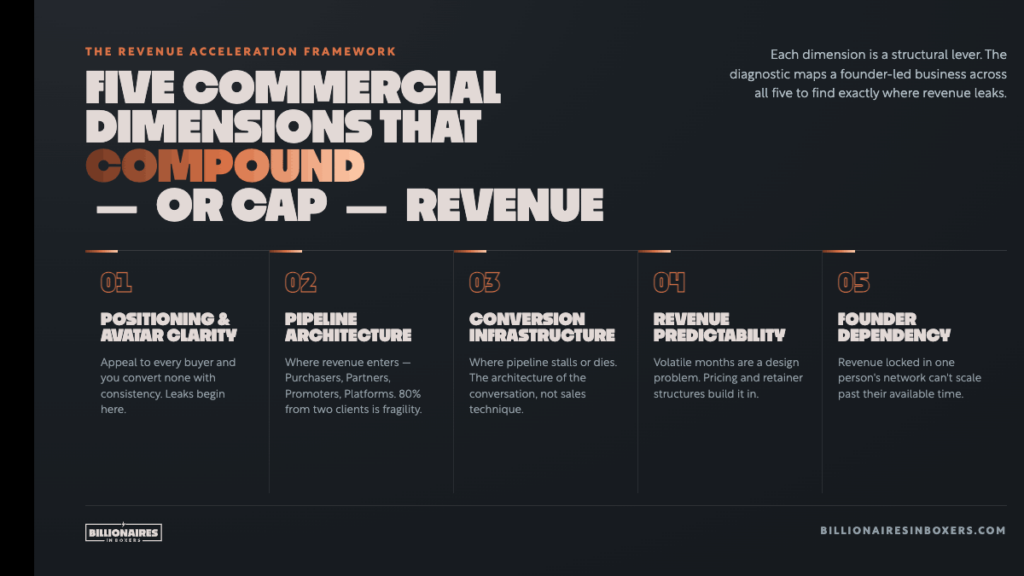
The Revenue Acceleration Framework: five commercial dimensions
The Revenue Acceleration framework maps a business across five dimensions. Each represents a structural lever that either compounds or limits revenue growth. The framework was developed by Phil Pelucha and applied across PE-backed portfolios representing over $20 billion in assets under management.
1. Positioning and avatar clarity
Revenue leaks begin in positioning. A business that attempts to appeal to all buyers in a market attracts none of them with consistency. The diagnostic maps whether the positioning speaks to a specific commercial problem, whether the language matches the buyer’s internal vocabulary, and whether the offer is set against the right competitive alternatives. A positioning problem shows up as long sales cycles, low conversion from qualified meetings, and price sensitivity that should not exist given the offer’s actual value.
2. Pipeline architecture
How does revenue enter the pipeline, and from where? Phil’s Four P’s framework maps this systematically: Purchasers (direct buyers), Partners (non-competitive businesses serving the same avatar), Promoters (media, content, referral), and Platforms (channels with distributable reach). A business generating 80 percent of revenue from two clients has pipeline fragility embedded in the model. The diagnostic identifies the concentration risk and blueprints a path to diversification.
3. Conversion infrastructure
Where does pipeline stall or die? Conversion analysis works backwards from closed deals and lost deals to identify the specific moments where value fails to transfer. This is not about sales technique or objection-handling scripts. It is about the architecture of the conversation: what is said, in what order, with what evidence, and what decision the buyer is asked to make at each stage. Fixing conversion infrastructure changes the output of the existing pipeline without increasing the volume going in.
4. Revenue predictability
Volatile month-to-month revenue is a structural problem, not a market problem. Building predictability requires specific architectural choices: pricing design, retainer versus project structures, recurring versus one-time engagement models, and the mechanisms that produce renewal without founder intervention. Without these choices built in, every month begins at zero. That is not a cash-flow problem. It is a design problem.
5. Founder dependency
Key-person dependency is one of the most common and most damaging structural failures in founder-led businesses. When revenue flows through one person’s relationships, reputation, and direct activity, the business cannot scale past the ceiling of that person’s available time. Gartner’s 2024 B2B Buyer research found that 75 percent of B2B buyers now prefer a rep-free research experience before engaging any vendor — a shift that concentrates competitive advantage in positioning, content authority, and systematic pipeline. A business with revenue locked inside the founder’s personal network is more exposed to this shift than at any earlier point in the recent B2B buying cycle. The diagnostic identifies where dependency exists and blueprints the specific changes required to systemise it.
The Revenue Acceleration Diagnostic (RAD)
The entry point to the Revenue Acceleration methodology at Billionaires in Boxers is the Revenue Acceleration Diagnostic.
The RAD is a 45-page commercial audit delivered in five business days. It maps the business across all five dimensions of the Revenue Acceleration framework, identifies the specific gaps costing revenue, and delivers a sequenced action plan for closing them.
The methodology is not advisory opinion. It is the same diagnostic framework Phil Pelucha applies across PE-backed portfolio companies representing over $20 billion in assets under management across the US, UK, European, Middle Eastern, and African markets. A PE firm pays $15,000 per portfolio company for this diagnostic. BIB’s founder-tier RAD is $5,000, with two revision rounds included and delivery in five business days.
The Revenue Acceleration Intelligence (RAI) system, which underpins the diagnostic process, draws on 87 million pages and over 20 terabytes of commercial data, tested playbooks, and competitive intelligence from five global markets, built from $5 million in R&D investment.
Results from engagements supported by the RAI system:
- Springbok Properties: 600 times improvement in measurable sales team performance via the Million Dollar Biller Mentor AI, a coaching product built within the RAI system from top-performer call transcripts
- Stealth AI Recruitment: 5 times revenue growth in six months, followed by a 6 times EBITDA exit
Phil Pelucha is ranked #16 on Clutch’s Global B2B Sales Influencer list and named one of New York Magazine’s 40 Under 40. The diagnostic methodology is the foundation of both recognitions — not a profile or a personal brand, but a systematic approach to commercial architecture that produces documented results.
Clients who complete the RAD and move into an ongoing retainer enter the implementation phase with a specific, prioritised blueprint rather than a general direction.
Who needs revenue acceleration?
Revenue acceleration is built for founder-led B2B businesses. The following patterns indicate a commercial architecture problem rather than an effort problem:
- Revenue has plateaued despite increased headcount, outbound activity, or marketing budget
- Month-to-month revenue is volatile with no predictability pattern
- The majority of revenue depends on one or two anchor clients
- New business depends primarily on the founder’s personal network and relationships
- Sales cycles are lengthening without a clear explanation
- Marketing or advertising spend is not producing measurable qualified pipeline
- A previous hire — sales director, head of growth, or external agency — did not move the revenue number
When three or more of these patterns are present simultaneously, the issue is structural. More activity will not resolve a structural problem. It will reveal it faster and more expensively.
How to build a revenue acceleration strategy
A revenue acceleration strategy is not a marketing plan or a sales playbook. It is a sequenced response to a specific commercial diagnosis. Without the diagnosis, it is a guess about which problems to fix and in which order.
Step 1: Run the diagnostic. Before any strategy is built, the specific gaps must be identified. The RAD eliminates assumption by mapping the exact commercial gaps in a specific business. Strategies built on assumptions about where the problem is fix the wrong things at the wrong cost.
Step 2: Sequence by commercial impact. The diagnostic ranks gaps by their current revenue impact and by the effort required to close them. High-impact, low-effort fixes come first. They create momentum and fund the structural changes that follow.
Step 3: Fix architecture before adding volume. Reposition before scaling outbound. Fix conversion infrastructure before expanding pipeline. Systemise delivery before expanding the team. Each structural fix unlocks the next layer of growth without requiring proportional increases in effort or headcount.
Step 4: Build predictability mechanisms. Every durable revenue acceleration outcome produces recurring revenue structures. The diagnostic identifies where retainer models, subscription pricing, or renewal mechanisms can replace one-time project engagements. Predictable revenue is an architectural outcome, not a sales target.
Step 5: Reduce founder dependency. The terminal phase of acceleration is systemisation. Revenue that compounds without the founder’s direct involvement in every transaction is the product of architecture. Revenue that requires the founder’s direct involvement for every deal is fragile and not scalable.
Phil Pelucha describes this plainly: “We win when you need less, not more.” The objective of revenue acceleration is a commercial model that performs without demanding more from the founder.
Frequently asked questions
What does it mean to accelerate revenue?
Accelerating revenue means identifying and closing the specific gaps in a commercial model that prevent revenue from compounding. It starts with a diagnostic, not a tactical plan. Revenue acceleration is distinct from increasing outbound volume, hiring more salespeople, or deploying new software. It addresses the commercial architecture first, before adding speed to a system that may be broken.
What is the difference between revenue acceleration and revenue operations?
Revenue operations aligns existing sales, marketing, and customer success processes to improve efficiency. Revenue acceleration diagnoses whether the commercial model itself needs to change before efficiency is optimised. RevOps makes a working system faster. Revenue acceleration determines whether the system is worth investing in further before more resource is committed to it.
What is the revenue acceleration model?
The Revenue Acceleration model is a five-dimension commercial framework developed by Phil Pelucha at Billionaires in Boxers: positioning and avatar clarity, pipeline architecture, conversion infrastructure, revenue predictability, and founder dependency. It was developed from PE-grade commercial diagnostics applied across portfolios representing over $20 billion in assets under management.
How long does revenue acceleration take to produce results?
The Revenue Acceleration Diagnostic is delivered in five business days. Implementation of the architectural changes identified depends on the scope of the gaps. Positioning and messaging changes can be applied within two to four weeks. Structural changes to pipeline or conversion infrastructure produce measurable revenue impact within 60 to 90 days. Reducing founder dependency is a longer programme — six to twelve months.
What is the Revenue Acceleration Diagnostic (RAD)?
The Revenue Acceleration Diagnostic is a 45-page commercial audit that maps exactly where a founder-led business is leaking revenue across the five dimensions of the Revenue Acceleration framework. It delivers a sequenced blueprint for closing each gap. Priced at $5,000 for founder-led businesses, it is delivered in five business days with two revision rounds included. Institutional pricing is $15,000 per portfolio company.
Conclusion
Revenue acceleration is a diagnostic-first methodology. It identifies the specific commercial gaps in a business before adding effort, headcount, or technology. For founder-led B2B businesses, those gaps are structural: in positioning, pipeline architecture, conversion infrastructure, predictability design, or founder dependency.
The term gets applied broadly to software platforms and outbound tools. The methodology itself is more specific: a structured process for diagnosing and fixing the commercial model before speed is applied to it. Architecture before acceleration.
If the revenue number has stalled despite increased effort, the question is not how to do more. It is where the model is leaking. The Revenue Acceleration Diagnostic answers that with a 45-page commercial blueprint in five business days.
Book a Revenue Acceleration Diagnostic
