
Founder-led B2B companies rarely stall because the founder stopped caring, the product got worse, or the market suddenly disappeared. More often, business growth slows because the company outgrows the informal operating system that made it successful in the first place.
At $3M to $25M in revenue, the problem is usually not ambition. It is translation. The founder can still sell the vision, spot the best opportunities, rescue deals, make instinctive tradeoffs, and see around corners. But the team cannot reliably reproduce that judgment without the founder in the room.
That is the real growth constraint.
Sustainable growth in founder-led B2B is not driven by one silver bullet: more leads, a new CRM, a larger sales team, a better pitch deck, or a burst of paid ads. Those can help, but only when they plug into a revenue system that is clear, measured, and built around the right market. Without that system, more activity often creates more noise.
The founder-led growth paradox
Founder-led companies have an advantage that mature corporations often envy: conviction. The founder knows why the company exists, why customers buy, where the product is strongest, and which opportunities matter most. That closeness to the customer creates speed.
But the same advantage becomes a liability when growth depends on the founder’s personal involvement in every important revenue moment.
You can see the pattern clearly:
- The founder is pulled into late-stage sales calls to “add credibility.”
- The best deals close when the founder shapes the commercial narrative.
- The sales team struggles to explain value without leaning on features or discounts.
- Marketing generates activity, but not enough qualified pipeline.
- Forecasts are optimistic because the real buying dynamics are poorly understood.
- Customer expansion happens opportunistically rather than by design.
None of this means the team is weak. It usually means the company has not yet converted founder intuition into operating infrastructure.
The next phase of growth requires a shift from founder-led heroics to founder-led architecture. The founder does not disappear from revenue. Instead, their insight becomes codified into positioning, qualification, sales process, management cadence, customer expansion motions, and decision rules.
What really drives business growth in founder-led B2B
The most durable growth comes from the interaction of five drivers: market clarity, a repeatable revenue motion, operating discipline, customer economics, and leadership leverage. Each one reinforces the others.
| Growth driver | What it solves | What it looks like when mature |
|---|---|---|
| Market clarity | Wasted effort across too many segments | A precise ICP, clear pain triggers, and confident disqualification |
| Repeatable revenue motion | Founder dependency in sales | A documented process the team can execute without improvising every deal |
| Operating discipline | Activity without accountability | Weekly metrics, pipeline inspection, ownership, and fast course correction |
| Customer economics | Growth that is expensive or fragile | Strong retention, expansion paths, and acquisition channels matched to deal value |
| Leadership leverage | Founder bottlenecks | Decisions and standards embedded into the team’s rhythm |
Most stalled B2B companies are not missing all five. They are usually over-reliant on one or two while underbuilding the others. For example, a company may have strong customer retention but weak pipeline creation. Another may generate leads, but lack sales conversion discipline. Another may have an excellent founder-led close rate, but no scalable way to transfer that capability to the team.
Growth accelerates when the system is diagnosed as a system, not as a collection of isolated problems.
Driver 1: A sharper market, not a bigger market
A common mistake in founder-led B2B is confusing optionality with opportunity. When revenue is still founder-driven, it is tempting to say yes to every adjacent segment, custom requirement, and “strategic” prospect. This can produce short-term revenue, but it often damages scalability.
Business growth becomes easier when the company is clear about where it has the highest right to win.
That clarity starts with a practical ideal customer profile, not a generic persona exercise. A strong ICP should identify where the company creates urgent, measurable value and where the buying process can be repeated. It should answer questions such as:
- Which customers reach value fastest?
- Which segments have the strongest pain and budget?
- Which deals create margin, referrals, and expansion potential?
- Which customers drain delivery capacity or demand excessive customization?
- Which trigger events make buying more likely right now?
This is where many founder-led companies discover that their stated ICP is too broad. “Mid-market companies” is not an ICP. “B2B service firms with 50 to 250 employees expanding into a new region and struggling to standardize sales management” is closer to an actionable market definition.
The sharper the market, the sharper everything else becomes: messaging, outbound targeting, partner strategy, sales qualification, product roadmap, and customer success priorities.
Driver 2: Positioning that turns expertise into urgency
Many B2B companies have strong expertise but weak commercial translation. They describe what they do accurately, but not in a way that makes the buyer feel the cost of inaction.
That distinction matters because B2B buying is complex. Gartner has reported that 77% of B2B buyers describe their most recent purchase as very complex or difficult, largely because buying groups must reconcile competing information and internal priorities. In that environment, a company does not win by explaining more. It wins by making the problem clearer and the decision easier.
Effective positioning does three things:
- It names the customer’s problem in language they already recognize.
- It connects that problem to business consequences the buyer cares about.
- It explains why the company’s approach is meaningfully different from alternatives.
Founder-led companies often have this narrative inside the founder’s head. The founder can hear a prospect’s situation and instantly reframe the problem. The challenge is turning that instinct into messaging the entire revenue team can use.
A practical test is simple: if a new salesperson, marketer, or customer success lead cannot explain why customers buy from you in under two minutes, the positioning is not yet operational.
Driver 3: A repeatable sales system
In early growth, sales often works because the founder is exceptional at pattern recognition. They know when a prospect is serious, when procurement is a distraction, when a champion is weak, and when a deal needs a different angle.
At the next stage, that judgment has to become a system.
A repeatable sales system does not mean turning every conversation into a rigid script. Complex B2B sales still require judgment. But the team needs shared standards for how opportunities are created, qualified, advanced, and closed.
At minimum, the system should define:
- The buying problems that qualify a real opportunity.
- The stakeholders typically involved in a decision.
- The evidence required before an opportunity enters the forecast.
- The commercial narrative used to create urgency.
- The next-step standards that prevent vague pipeline movement.
- The exit criteria for each stage of the sales process.
This is where revenue acceleration often comes from. Not from asking salespeople to “work harder,” but from removing ambiguity. When qualification improves, forecast quality improves. When stage definitions improve, coaching improves. When the narrative improves, conversion improves.
The founder’s role changes from chief deal rescuer to architect of the sales standard.

Driver 4: Revenue architecture across the full customer journey
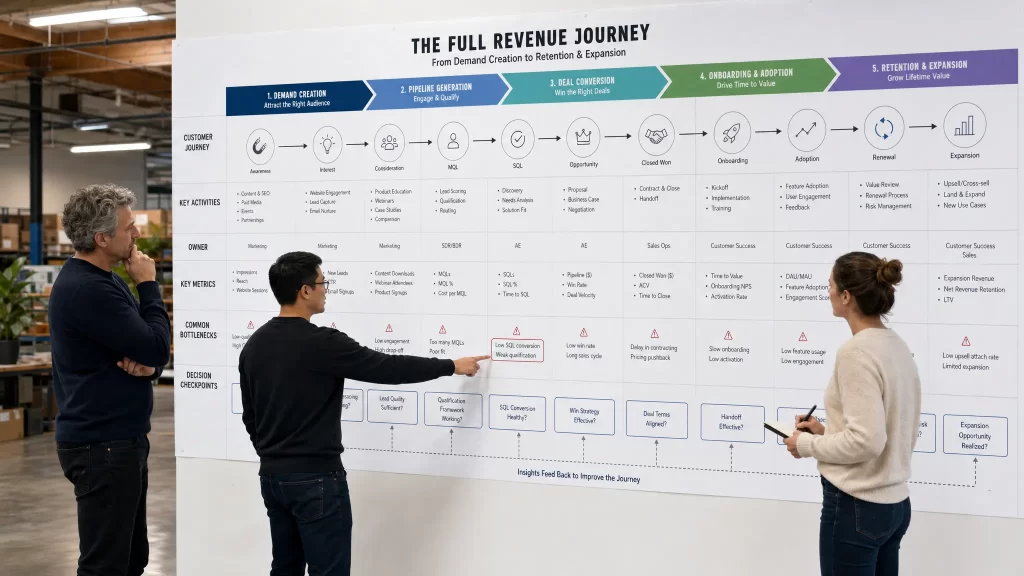
Many founder-led B2B businesses think about growth mainly as new logo acquisition. That is understandable, but incomplete. Real business growth comes from the entire revenue architecture: demand creation, sales conversion, onboarding, retention, expansion, and referrals.
A company with leaky retention must acquire aggressively just to stand still. A company with weak onboarding delays value and creates churn risk. A company with no expansion motion leaves revenue inside its existing customer base. A company with poor segmentation spends too much to acquire customers that were never likely to become profitable.
The right question is not “How do we get more leads?” It is “Where is the revenue system constrained?”
For one company, the constraint may be pipeline quality. For another, it may be slow sales velocity. For another, it may be low win rates against a specific competitor. For another, it may be inconsistent account expansion after the first year.
This is why diagnostics matter. A surface-level fix can make the wrong part of the system busier while leaving the real constraint untouched. If sales conversion is poor, adding more leads simply increases waste. If the ICP is wrong, hiring more reps compounds the problem. If retention is weak, faster acquisition hides a structural issue until it becomes expensive.
A strong revenue architecture identifies the highest-leverage constraint and sequences interventions accordingly.
Driver 5: Customer economics that support the growth model
Not all revenue is equal. Founder-led companies often learn this the hard way after several years of saying yes to difficult deals.
Some customers expand, renew, refer, and produce insight that improves the business. Others consume disproportionate delivery capacity, require heavy customization, negotiate aggressively, and distract the team from better-fit opportunities.
Sustainable growth depends on understanding the economics behind different customer segments. That includes acquisition cost, sales cycle length, gross margin, implementation effort, retention likelihood, expansion potential, and strategic value.
This is especially important when choosing growth channels. A high-touch enterprise motion can work beautifully when deal sizes, margins, and retention justify it. It becomes dangerous when applied to customers that cannot support the cost of acquisition. Likewise, low-cost inbound or partner channels may be excellent for one segment but insufficient for a more complex buying committee.
McKinsey’s B2B research has shown that modern B2B buyers increasingly use multiple channels across the buying journey, including digital self-service, remote interactions, and in-person engagement. The implication is not that every company must be everywhere. It is that channel strategy must match how the target customer actually buys.
For founder-led B2B, the best growth model is usually not the flashiest. It is the one where customer value, buying motion, acquisition cost, and delivery capacity fit together.
Driver 6: An operating cadence that makes growth manageable
Strategy without cadence becomes intention. Cadence is what turns growth priorities into behavior.
Founder-led companies often have plenty of meetings, but not always the right operating rhythm. A useful revenue cadence creates visibility and accountability without burying the team in reporting.
The core rhythm usually includes weekly pipeline review, sales coaching, marketing performance review, customer risk review, and leadership decision-making around constraints. The point is not to inspect every metric equally. The point is to identify whether the company is on track, where the system is breaking, and who owns the next action.
Good cadence also reduces founder anxiety. When the founder cannot see the truth of the revenue system, they tend to jump into details, challenge random deals, or override decisions. When the operating system produces reliable information, the founder can lead through priorities rather than interventions.
This is a major inflection point. Growth becomes less dependent on emotional intensity and more dependent on disciplined execution.
Driver 7: AI systems that remove drag, not judgment
AI is now part of the B2B growth conversation, but it is often misunderstood. AI does not fix unclear strategy. It amplifies whatever system already exists.
If the ICP is vague, AI can help generate more irrelevant outreach. If the sales process is poorly defined, AI can summarize calls without improving conversion. If messaging is generic, AI can produce more generic content faster.
Used well, however, AI can create meaningful leverage. It can help analyze sales calls, cluster customer pain points, personalize outreach, accelerate research, identify patterns in lost deals, and reduce manual work across the revenue team. The key is to build AI around the company’s revenue logic, not bolt it on as a novelty.
For founder-led B2B companies, the highest-value AI systems often codify the founder’s judgment. They help the team ask better discovery questions, qualify opportunities more consistently, create more relevant account plans, and spot risks earlier.
In other words, AI should not replace the founder’s commercial intelligence. It should distribute it.
What does not drive sustainable growth
It is worth naming the traps because they are common, expensive, and often disguised as action.
Hiring more salespeople does not drive growth if the sales motion is not proven. Rebranding does not drive growth if the company has not clarified its market and message. More marketing spend does not drive growth if the offer does not create urgency. A new CRM does not drive growth if the team has no shared sales discipline. Founder hustle does not drive growth if every important deal still requires founder rescue.
These moves can be useful at the right time. But they are accelerants, not foundations.
The sequence matters. Diagnose the constraint. Clarify the market. Codify the sales motion. Build the operating cadence. Then add people, tools, and spend where they can multiply a working system.
A practical growth diagnostic for founder-led B2B
If you are trying to understand what is really limiting growth, start with a blunt assessment. The following questions reveal where the revenue system needs attention:
- Can your leadership team clearly name the segments where you win most profitably?
- Can your sales team create urgency without the founder joining the call?
- Do pipeline stages reflect buyer evidence, or just seller optimism?
- Do you know which acquisition channels produce the best long-term customers?
- Is customer expansion managed proactively, or left to chance?
- Do weekly revenue meetings produce decisions, or just updates?
- Can your team explain why you win and lose against competitors?
- Are AI tools reducing real bottlenecks, or just adding more activity?
If several answers are unclear, the business probably does not need another disconnected initiative. It needs a revenue acceleration roadmap.
That roadmap should identify the constraint, quantify the opportunity, prioritize interventions, and define ownership. This is the logic behind a PE-grade approach to growth: not more opinions, but better diagnosis and sequenced execution.
Why founder leverage is the ultimate growth multiplier
At a certain stage, the founder’s greatest contribution is no longer being the best salesperson, strategist, product expert, or customer whisperer. It is building a company where those capabilities are embedded into the system.
That does not mean becoming detached. The best founders remain deeply connected to customers, market shifts, and strategic decisions. But they stop being the workaround for every revenue weakness.
Founder leverage shows up when the team can make better decisions without waiting for permission. It shows up when sales calls improve because the narrative is clear. It shows up when marketing knows which pains to emphasize. It shows up when customer success knows where expansion is likely. It shows up when leaders can inspect the business through shared metrics rather than anecdotes.
This is the point at which growth becomes scalable.
Frequently Asked Questions
What is the biggest driver of business growth in founder-led B2B? The biggest driver is usually converting founder intuition into a repeatable revenue system. That includes a clear ICP, strong positioning, disciplined sales process, customer expansion motion, and operating cadence.
Why do founder-led B2B companies often plateau? They often plateau because growth depends too heavily on the founder’s personal involvement. The company may have demand, talent, and product-market fit, but lacks the systems needed to scale decision-making and sales execution.
Should a founder-led company hire more salespeople to grow faster? Only if the sales motion is already proven and repeatable. Hiring before clarifying the market, message, qualification standards, and sales process can increase costs without improving revenue quality.
How does AI support B2B revenue growth? AI can support growth by reducing manual work, analyzing customer and sales data, improving personalization, and codifying best practices. It works best when built around a clear revenue strategy.
What should a founder do first when growth slows? Start with diagnosis. Identify whether the constraint is market focus, pipeline creation, conversion, retention, expansion, leadership cadence, or team capability before investing in new tools, hires, or campaigns.
Build the revenue system your next stage requires
If your founder-led B2B company is doing $3M to $25M in revenue, the next phase of growth will not come from more random activity. It will come from a clearer market, a sharper sales motion, stronger operating discipline, and better leverage across the leadership team.
Billionaires in Boxers helps founder-led B2B businesses apply PE-grade diagnostics, AI systems, and fractional CRO support to engineer scalable growth. The Revenue Acceleration Diagnostic, available from $5K, is designed to identify the highest-leverage constraints and turn them into a costed intervention roadmap.
If growth feels harder than it should, the answer may not be to push harder. It may be to build the system that lets the business scale beyond the founder.
