
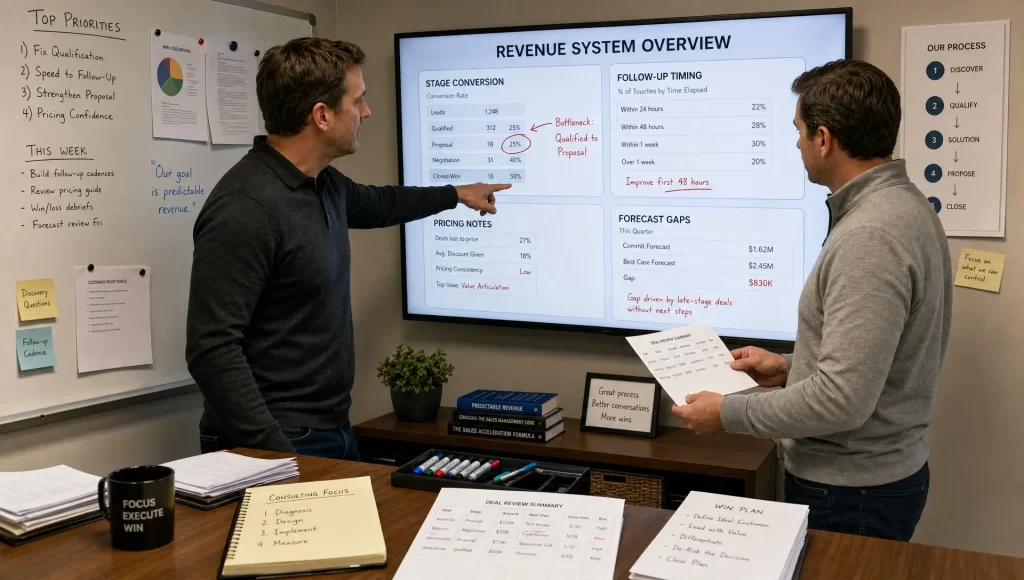
Ask ten consultants where a business should start, and you may get ten different answers: strategy, brand, systems, sales training, AI, operations, leadership, finance, pricing, or market expansion. The better question is simpler and more commercial: which consulting services for business create ROI first?
For founder-led B2B companies, the first ROI usually comes from consulting that is closest to revenue already in motion. That means diagnosing the revenue system, improving sales conversion, tightening offers and pricing, fixing RevOps visibility, and removing execution bottlenecks with targeted systems. Broader strategy, brand, culture, and transformation work can matter, but they rarely pay back first unless they are directly tied to a current revenue constraint.
The goal is not to buy more advice. It is to identify the shortest path between expert intervention and measurable gross profit.
The ROI-first rule for business consulting
The fastest-returning consulting work has three traits: proximity to revenue, speed of implementation, and clear accountability. If a consulting engagement cannot show where money is currently leaking, how the fix will be implemented, and which metric should move, it is probably not the first place to invest.
This matters even more in B2B because buying journeys are complex. Gartner's research on the B2B buying journey has long highlighted how many stakeholders and nonlinear steps are involved in business purchases. A founder-led company does not need vague recommendations layered on top of that complexity. It needs sharper targeting, cleaner conversion, and a system that helps the team make better decisions faster.
Use this filter before approving any consulting spend:
| ROI-first criterion | What it means | Good sign | Warning sign |
|---|---|---|---|
| Proximity to revenue | The work touches leads, conversion, deal size, retention, or expansion | The consultant can name the revenue metric expected to improve | The work is framed only as alignment, clarity, or best practice |
| Speed to implementation | The recommendation can be tested without waiting for a full transformation | Changes can be piloted in the current quarter | The work requires months of internal restructuring before impact |
| Diagnostic quality | The consultant investigates the actual constraint before prescribing | They review data, calls, pipeline, pricing, customer segments, and capacity | They sell a prebuilt solution before understanding the business |
| Measurability | Impact can be tracked through leading and lagging indicators | Metrics include conversion, win rate, cycle length, average contract value, margin, or retention | Success is measured mainly by deliverables produced |
| Founder leverage | The work reduces dependency on the founder as bottleneck | It improves delegation, operating rhythm, and decision quality | It creates more meetings and more founder approval points |
Consulting services for business ranked by first ROI potential
There is no universal ranking because every business has a different constraint. But for B2B companies between roughly $3M and $25M in revenue, this is a useful default order.
| Consulting service | Where ROI usually appears first | First metric to watch | Best fit |
|---|---|---|---|
| Revenue diagnostic or audit | Finding and prioritizing revenue leaks | Pipeline quality, conversion by stage, lost revenue by source | The founder feels growth is harder than it should be, but the cause is unclear |
| Sales optimization | Converting more of the existing pipeline | Win rate, sales cycle length, proposal-to-close rate | There is enough demand, but deals stall, discount, or disappear |
| Offer and pricing consulting | Increasing value captured from demand | Average contract value, gross margin, discount rate | The company wins work but undercharges, over-customizes, or protects weak offers |
| RevOps consulting | Improving visibility and execution reliability | Forecast accuracy, follow-up compliance, stage aging | Sales activity exists, but the team lacks clean data and operating discipline |
| AI systems consulting | Removing repeatable bottlenecks | Hours saved, response speed, sales support throughput | Manual research, follow-up, reporting, or content production slows revenue work |
| Retention and expansion consulting | Growing customer value after the sale | Net revenue retention, expansion rate, churn risk | The business has a customer base but weak upsell, renewal, or success motions |
| Market expansion consulting | Opening new revenue pools | Qualified opportunities in new segments, early win rate | The core engine works and the company is ready to enter adjacent markets |
| Brand or broad strategy consulting | Improving long-term positioning | Share of qualified demand, enterprise credibility, strategic focus | The business has a strong commercial engine but needs clearer category presence |
The first four categories tend to produce earlier ROI because they improve money already in the system. The later categories can produce significant value, but they generally require more time, more assumptions, and more cross-functional execution.
Revenue diagnostics: the best first move when the constraint is unclear
A revenue diagnostic is often the highest-ROI starting point because it prevents the company from solving the wrong problem. Many founder-led B2B companies do not have one isolated issue. They have a chain of small leaks: unclear ICP, uneven lead quality, inconsistent qualification, weak discovery, custom proposals, poor handoffs, low follow-up discipline, and limited visibility into what is really happening.
A good diagnostic does not start with the consultant's favorite tactic. It maps where revenue is created, delayed, discounted, or lost. That includes market selection, demand sources, sales process, offer design, pricing, delivery capacity, customer expansion, and leadership cadence.
If you suspect revenue is leaking but cannot see exactly where, a structured revenue audit is often the most commercially rational first engagement. It turns vague symptoms into a prioritized intervention roadmap.
The ROI can come from what you stop doing as much as what you start doing. Cutting a poor-fit acquisition channel, narrowing the sales team's focus, changing proposal rules, or fixing a qualification gap can release cash and capacity quickly.
Sales optimization: fastest ROI when pipeline already exists
Sales optimization is often the first visible ROI driver when the business has conversations in motion but does not convert enough of them. This is common in founder-led companies where the founder can still close complex deals, but the team struggles to replicate that judgment.
The work should go deeper than generic sales training. High-ROI sales consulting examines the actual buying process, the quality of discovery, the language used in calls, the decision criteria customers apply, the point where deals slow down, and the reasons proposals fail.
Common early fixes include sharper qualification, better discovery questions, clearer stage definitions, tighter next-step discipline, improved proposal structure, and stronger business-case messaging. None of these require a complete rebrand or new technology platform. They require focus, coaching, and operating discipline.
Sales optimization creates ROI first when three conditions are present: there is enough pipeline to improve, the team is willing to change behavior, and leadership tracks conversion by stage rather than only total revenue.
Offer and pricing consulting: high leverage when demand is not the problem
Sometimes the company does not need more leads. It needs to capture more value from the leads it already has.
Offer and pricing consulting can create fast ROI because small improvements in price, packaging, and scope control can drop directly into gross profit. This is especially true for B2B services, SaaS-enabled services, agencies, consultancies, and specialist firms where founders often underprice expertise or allow too much customization.
The first ROI opportunities usually sit in four places: minimum engagement size, discount logic, package structure, and value communication. If customers frequently ask for custom scopes, deals require heavy founder involvement, margins vary wildly, or the team discounts to create urgency, pricing and offer work may pay back before any marketing investment.
The danger is treating pricing as a spreadsheet exercise. In B2B, pricing must connect to market positioning, buyer urgency, proof, delivery capacity, and sales confidence. A price increase without better value communication can stall deals. A better offer architecture can improve both conversion and margin.
RevOps consulting: ROI from control, visibility, and follow-through
Revenue operations consulting creates ROI by making the revenue engine visible and manageable. It is rarely glamorous, but it often unlocks performance that is already trapped inside the business.
A RevOps consultant may help clean CRM data, define pipeline stages, standardize handoffs, improve reporting, build forecasting discipline, and align marketing, sales, and customer success around one operating rhythm. The first ROI usually comes from fewer missed opportunities, better prioritization, and faster corrective decisions.
RevOps is especially valuable when the founder hears conflicting versions of the truth. Marketing reports lead volume, sales complains about lead quality, customer success sees churn risk too late, and finance cannot trust the forecast. In that environment, growth decisions become opinion battles.
The payback is strongest when RevOps work is tied to revenue decisions, not just CRM hygiene. Clean data matters because it changes what the team does next.
AI systems consulting: ROI when automation targets a real bottleneck
AI systems can produce early ROI, but only when they are aimed at a specific revenue bottleneck. Generic AI adoption rarely pays back quickly. Targeted AI systems can.
In a B2B revenue environment, useful AI buildouts may support account research, call summarization, proposal drafting, follow-up sequencing, sales enablement, customer insight extraction, reporting, and internal knowledge retrieval. The point is not to replace human judgment. It is to remove repetitive work that slows down revenue-generating people.
The best AI systems consulting starts with workflow analysis. Where does the founder still act as the memory of the business? Where do salespeople waste time recreating similar assets? Where does customer information disappear after calls? Where does reporting take hours but still fail to guide action?
If those questions reveal repeatable work, AI can create ROI through saved time, faster response, better consistency, and improved decision quality. If the company has no clear workflow owner, no data discipline, and no adoption plan, AI consulting may become an expensive experiment rather than a revenue accelerator.
Fractional CRO support: ROI from turning diagnosis into execution
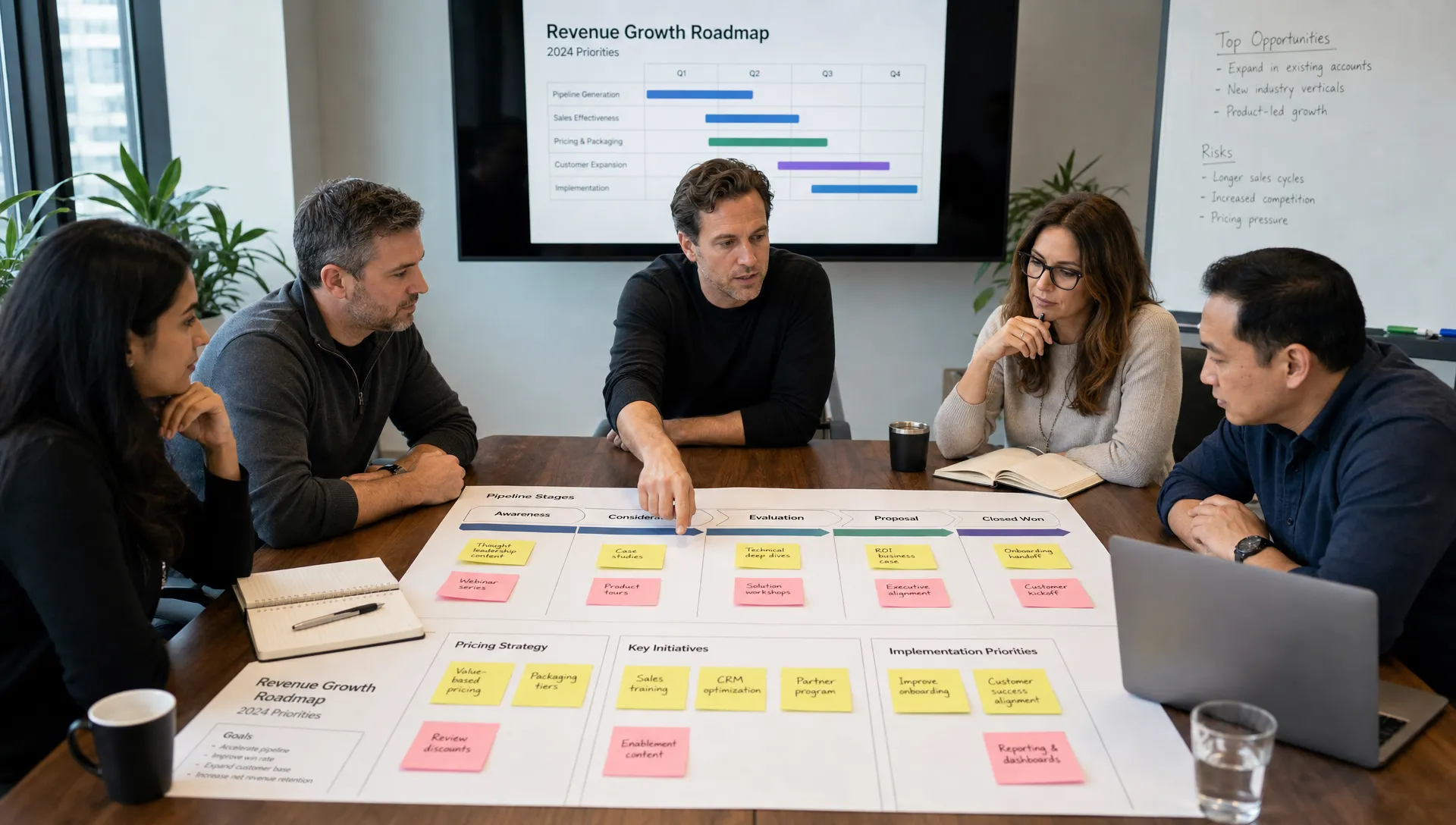
A diagnostic identifies the constraint. Sales, pricing, RevOps, and AI interventions fix parts of the system. Fractional CRO support can create ROI when the business needs senior commercial leadership to orchestrate those moving pieces.
This is often the right step when the founder is still the de facto head of revenue, but the company has outgrown founder-only decision-making. The issue is no longer knowing that sales needs improvement. The issue is creating the cadence, accountability, and cross-functional alignment to make improvement happen every week.
The ROI from a fractional CRO for B2B growth usually comes after the highest-priority constraints are identified. Used too early, it can become another leadership layer. Used after a strong diagnostic, it can convert the roadmap into operating rhythm, sharper decisions, and sustained execution.
Market expansion consulting: powerful, but rarely first
Market expansion can create major ROI, but it is usually not the first consulting service to buy if the existing revenue engine is inconsistent. Entering a new segment, geography, vertical, or channel multiplies complexity. If qualification, conversion, pricing, delivery, or reporting are already weak, expansion often amplifies those weaknesses.
Market expansion consulting should come after the company has proof that its core revenue architecture works. That means clear ICP, repeatable conversion, strong economics, reliable delivery, and enough leadership capacity to support new motion.
When those foundations exist, expansion consulting can help assess market attractiveness, define beachhead segments, adjust positioning, build partner or channel strategy, and create a go-to-market plan. The ROI may be substantial, but the time-to-impact is typically longer than fixing leaks in the current engine.
Consulting that creates ROI later, but still matters
Some consulting services are valuable, just not usually first in line for ROI. Brand strategy, culture transformation, leadership development, enterprise technology implementation, and full operating model redesign can all support growth. The issue is sequencing.
A rebrand may be necessary if the company is losing qualified deals because buyers do not understand its value. Leadership consulting may be urgent if the executive team cannot make decisions. Technology transformation may be essential if current systems cannot support scale.
But if the company has current pipeline leakage, poor qualification, weak pricing, or founder-dependent sales, those issues often deserve attention first. Otherwise the business risks creating a better-looking version of the same underperforming system.
How to sequence consulting spend when cash and attention are limited
Founder-led companies do not just have limited budgets. They have limited executive attention. Every consulting engagement consumes time, decisions, meetings, data, and implementation capacity. The right first engagement is the one that creates evidence and momentum without overloading the team.
Use symptoms to choose the starting point:
| Business symptom | Start with this consulting service | Avoid starting with |
|---|---|---|
| Growth has slowed and the cause is unclear | Revenue diagnostic or audit | A large transformation program |
| Leads exist but deals stall or go quiet | Sales optimization | More top-of-funnel marketing |
| Revenue is growing but margins feel weak | Offer and pricing consulting | Hiring more salespeople |
| Forecasts are unreliable and pipeline reviews are subjective | RevOps consulting | A new CRM before process clarity |
| The founder is the bottleneck for proposals, decisions, or follow-up | AI systems and fractional revenue leadership | More founder-led selling |
| Current segment is working and capacity exists | Market expansion consulting | Broad brand work without a go-to-market thesis |
| Buyers misunderstand the category or value proposition | Positioning and brand strategy | Sales training alone |
This sequencing is not rigid. A company with a severe positioning problem may need market messaging before sales optimization works. A company with chaotic data may need RevOps before leadership can trust any diagnostic. The point is to match the consulting service to the constraint that is costing the most money now.
How to calculate consulting ROI without fooling yourself
The cleanest way to measure ROI is to use gross profit, not vanity revenue. Revenue can rise while margins fall. A consulting engagement that increases low-margin revenue may look successful while weakening the business.
A practical formula is:
Consulting ROI = (incremental gross profit attributable to the engagement – total cost of engagement and implementation) / total cost of engagement and implementation
Total cost should include the consulting fee, internal time, software, implementation support, and any hiring or training required to make the recommendation work. Attribution should be conservative. If revenue improved because of a seasonal demand spike or a large deal already in motion, do not credit the consultant for all of it.
Because B2B sales cycles can be long, track leading indicators before lagging outcomes arrive.
| Metric type | Examples | Why it matters |
|---|---|---|
| Leading indicators | Qualified opportunity rate, discovery-to-proposal conversion, follow-up speed, stage progression | Shows whether behavior and pipeline quality are improving early |
| Commercial outcomes | Win rate, sales cycle length, average contract value, gross margin, expansion revenue | Shows whether the engagement is changing business performance |
| Operating indicators | Forecast accuracy, CRM completeness, meeting cadence, founder approval load | Shows whether the system is becoming more scalable |
| Strategic indicators | ICP concentration, segment profitability, channel performance | Shows whether growth is becoming more focused and efficient |
The best consultants will welcome this level of measurement. It protects both sides. The client gets clarity on value, and the consultant gets a fair way to prove impact.
Red flags that a consulting service will not create ROI first
Some consulting work fails because the consultant is poor. More often, it fails because the engagement is badly sequenced or poorly defined.
Watch for these red flags before signing:
- The consultant prescribes the solution before diagnosing the revenue constraint.
- Success is defined by workshops, decks, or frameworks rather than changed metrics.
- The scope is broad, but no one can name the first commercial decision it will improve.
- The engagement depends on major internal change before any measurable benefit appears.
- The recommendation adds complexity without reducing founder dependency.
- The consultant cannot explain how implementation will be owned after the advice is delivered.
A useful consulting engagement should make the business simpler to operate, not just more sophisticated to describe.
Frequently Asked Questions
Which consulting services for business create ROI fastest? Revenue diagnostics, sales optimization, offer and pricing consulting, and RevOps work often create ROI fastest because they improve revenue already in motion. The right first choice depends on the specific constraint inside the business.
Should a business hire a consultant before knowing the problem? Yes, if the consultant is hired to diagnose rather than prescribe. A diagnostic engagement can be the highest-ROI first step when the founder knows growth is underperforming but does not know which part of the system is responsible.
Is AI consulting a fast ROI service? AI consulting can create fast ROI when it removes a specific workflow bottleneck, such as manual research, proposal drafting, reporting, or follow-up. It tends to underperform when it is treated as a general technology initiative without a revenue use case.
When should a founder-led B2B company consider fractional CRO support? Fractional CRO support is most useful when the founder is still carrying too much revenue leadership and the company needs senior commercial operating cadence. It works best after the core revenue constraints have been identified.
What consulting services usually take longer to show ROI? Brand strategy, broad corporate strategy, culture transformation, large technology implementations, and market expansion can be valuable, but they often take longer to convert into measurable gross profit unless they address the immediate revenue constraint.
Build the ROI case before buying more consulting
The first consulting service should not be the most fashionable. It should be the one most likely to improve gross profit, reduce revenue leakage, and increase founder leverage.
If your founder-led B2B business is between $3M and $25M in revenue and you want to identify which intervention should come first, Billionaires in Boxers helps founder-operators apply PE-grade diagnostics, AI systems, and fractional CRO support to engineer scalable growth. Explore the revenue acceleration approach at Billionaires in Boxers.
