
Most strategy businesses do not fail because the founder lacks intelligence, experience, or ambition. They fail because the offer is built around internal conviction instead of external demand.
A founder sees a market opportunity, packages expertise, hires talent, builds a website, and starts selling. The logic feels sound. The problem is that buyers do not pay for your logic. They pay to remove a painful constraint, capture a meaningful upside, or reduce a risk that is already visible inside their business.
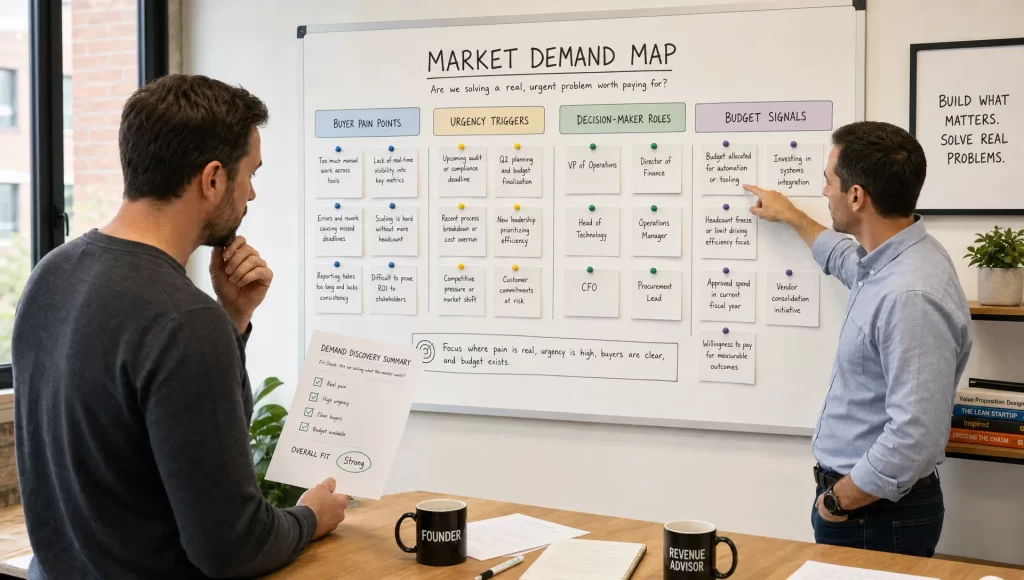
That is the central discipline of building a strategy business around real demand. You are not asking, What can we sell? You are asking, What problem is the market already trying to solve, who owns it, what is it costing them, and why now?
For founder-led B2B companies, this distinction matters. At $3M to $25M in revenue, growth usually depends less on new ideas and more on sharper market focus, repeatable sales execution, better operating discipline, and clearer customer economics. Those are the same fundamentals behind what really drives business growth in founder-led B2B, and they apply just as strongly when the business sells strategic advice, transformation, consulting, or revenue leadership.
What Real Demand Actually Means
Real demand is not a compliment. It is not a like, a download, a vague introduction, or a prospect saying the idea is interesting.
Real demand exists when a specific buyer has a specific problem, understands the cost of leaving it unresolved, has enough urgency to act, and can access budget or authority to make change happen.
In a strategy business, demand usually hides behind symptoms:
- Revenue has plateaued despite more sales activity.
- The founder is still the main source of deals.
- A market expansion is underperforming.
- Sales cycles are too long and inconsistent.
- The team has tools, campaigns, and meetings, but no coherent growth system.
- Leadership knows something is broken, but cannot isolate the constraint.
Those symptoms are commercially useful because they point to moments when buyers are already motivated. A demand-led strategy business does not educate the entire world from scratch. It finds the part of the market already feeling the pressure and builds an offer around that pressure.
This is why lack of market need has appeared repeatedly in startup postmortem research, including CB Insights' analysis of startup failure reasons. Even smart teams lose when they build around assumption instead of need.
Start With the Pain, Not the Methodology
Many strategy businesses lead with their framework. They describe their model, their workshop, their philosophy, or their proprietary process. Those things may matter later, but they are rarely what creates urgency.
Buyers start with pain.
A founder does not wake up thinking, I need a new strategic framework. They wake up thinking, Why did three good opportunities stall this month? Why is every deal still coming through me? Why did our new segment fail to convert? Why is revenue growing but margin getting worse?
Your job is to translate those painful questions into a focused commercial proposition.
A useful demand discovery process asks:
- What expensive problem is the buyer already aware of?
- What event made the problem urgent now?
- Who is accountable for the outcome?
- What have they already tried?
- What happens if they do nothing for another six months?
- What budget, team, or initiative could be redirected toward solving it?
The answers reveal whether you have a marketable strategy business or just an attractive idea.
Separate Demand Signals From Market Noise
Founders often confuse activity with demand. A webinar with good attendance feels like demand. A popular LinkedIn post feels like demand. A positive networking conversation feels like demand.
Those signals are not useless, but they are incomplete. The closer a signal gets to time, money, authority, and repeated behavior, the more seriously you should take it.
| Market signal | What it might mean | Demand strength |
|---|---|---|
| A prospect says the idea is interesting | Curiosity, politeness, or early awareness | Low |
| Several buyers describe the same painful problem unprompted | A recurring market pattern may exist | Medium |
| Buyers ask how soon you can help after a problem diagnosis | Urgency is present | High |
| Prospects pay for a diagnostic, pilot, or advisory session | Willingness to pay is proven | High |
| Deals are lost to internal delay rather than competitors | Pain may not be urgent enough | Mixed |
| Buyers switch from an incumbent provider to solve the issue | The problem is valuable enough to disrupt existing behavior | High |
A strong strategy business is built on high-signal evidence. If people repeatedly pay to understand, solve, or reduce a specific problem, you are closer to real demand. If they only applaud the idea, keep testing.
Choose a Narrow Wedge Before You Widen
Broad positioning feels safer because it keeps more doors open. In practice, it usually slows growth.
A strategy business that says it helps companies grow, scale, transform, innovate, optimize, and expand is difficult to buy. The buyer has to do too much work to connect the offer to their own situation.
A narrow wedge creates traction because it names the buyer, the problem, and the moment of need more precisely.
For example, there is a major difference between:
We help B2B companies grow.
And:
We help founder-led B2B companies that have outgrown founder-led sales but have not yet built a repeatable revenue system.
The second version is narrower, but it is also easier to recognize. The right buyer can immediately see themselves in it.
To define your wedge, look for overlap across four factors: pain, budget, access, and repeatability. The best initial segment is not always the largest market. It is the segment where you can hear the same problem repeatedly, reach decision-makers efficiently, and prove value fast.
Build the Revenue Architecture Before You Accelerate
Once demand is visible, the next mistake is rushing into tactics. Founders start hiring salespeople, launching campaigns, building content engines, buying AI tools, or expanding into new channels before the core revenue architecture is clear.
That sequence is backwards. As explained in Revenue Architecture Before Acceleration, acceleration only works when the market, offer, message, sales process, and operating rhythm fit together.
For a strategy business, revenue architecture answers practical questions:
| Architecture question | Why it matters |
|---|---|
| Which buyer segment has the strongest demand right now? | Prevents wasted effort across too many markets |
| What problem are they already trying to solve? | Keeps messaging grounded in buyer urgency |
| What outcome is valuable enough to fund? | Shapes pricing and offer design |
| What proof reduces perceived risk? | Improves conversion and trust |
| What sales motion matches the buying process? | Avoids forcing buyers through the wrong funnel |
| What delivery model creates repeatable outcomes? | Protects margin and scalability |
Without this architecture, growth becomes personality-driven. The founder closes deals through force of will, every engagement becomes custom, and the business struggles to scale beyond the founder's direct involvement.
Design the First Offer Around a Measurable Transition
A demand-led offer is not a list of services. It is a transition from a painful current state to a more valuable future state.
That transition should be specific enough for the buyer to understand and measurable enough for both sides to evaluate.
Weak offer: Strategy consulting for growing companies.
Stronger offer: Diagnose the revenue constraints preventing a founder-led B2B company from building repeatable growth, then prioritize the interventions with the fastest commercial impact.
The stronger offer works because it names the buyer, the problem, the mechanism, and the outcome. It also creates a natural entry point. Before a buyer commits to a major transformation, they often need clarity on what is broken, what matters most, and what to fix first.
This is why diagnostics are powerful in strategy businesses. A diagnostic converts uncertainty into a costed roadmap. It helps the buyer understand the business case for action and helps the provider avoid generic recommendations.

Validate With Behavior, Not Opinions
Before scaling the business, validate the offer through buyer behavior. Opinions are easy to collect and easy to misread. Behavior is harder to fake.
Useful validation includes sales conversations where buyers reveal the same problem without being led, paid diagnostics, pilot engagements, win-loss analysis, proposal feedback, and repeatable inbound questions around the same issue.
You are looking for patterns such as:
- The same buyer segment uses similar language to describe the problem.
- Prospects can quantify or clearly explain the cost of inaction.
- The decision-maker is identifiable and reachable.
- Buyers have already tried partial solutions.
- Paid discovery or diagnostic work converts into larger engagements.
- Delivery produces outcomes that can become case studies or proof points.
The goal is not to prove that everyone wants the offer. The goal is to prove that a specific group wants it enough to act.
This matters because B2B buying is rarely individual. Gartner has long described complex B2B purchases as involving buying groups, not just single decision-makers, through its research on the B2B buying journey. If your offer cannot survive internal scrutiny, it is not yet demand-ready.
Price Against the Cost of Inaction
Strategy businesses often underprice because they sell time. They think in days, workshops, decks, or deliverables. Buyers think in risk, upside, lost revenue, delayed growth, failed expansion, inefficient teams, and missed valuation milestones.
Price should reflect the value of the problem being solved, the urgency of the situation, the complexity of the intervention, and the credibility of the provider.
This does not mean inflating fees without proof. It means avoiding the trap of charging like a contractor when the buyer is asking for commercial judgment.
A useful pricing test is simple: if the buyer does nothing, what is the likely cost over the next quarter or year? If the cost of inaction is unclear, your value proposition is unclear. If the cost is material and your solution is credible, low pricing can actually reduce trust.
For founder-led B2B businesses, the highest-value strategic work often sits close to revenue constraints: market selection, sales motion, conversion, expansion, margin, operating cadence, and leadership capacity. These are not cosmetic issues. They affect the company's ability to grow without making the founder the ceiling.
Build Pipeline Around the Demand Pattern
Once the wedge and offer are validated, pipeline should be designed around the same demand pattern. Too many strategy businesses separate marketing from the actual buyer problem. They publish thought leadership on broad topics, run generic outreach, and hope the right people interpret the relevance.
A demand-led pipeline is more direct.
Your content should name the symptoms buyers already recognize. Your outbound should target companies showing trigger events. Your referral partners should understand the precise situation you solve. Your sales process should diagnose before pitching.
For example, if your strongest demand comes from founder-led B2B companies with stalled pipeline and inconsistent sales execution, then your pipeline should revolve around that problem. Articles, webinars, private briefings, outreach, and diagnostic calls should all reinforce the same commercial thesis.
If the founder is still manually creating most opportunities, the next step is to systematize. The principles in how to build a sales pipeline that generates leads without you are especially relevant for strategy businesses that need to move beyond relationship-only growth.
Install a Demand Review Rhythm
Demand is not static. Markets mature, buyer priorities change, competitors reposition, and economic pressure shifts. A strategy business built around real demand needs a regular operating rhythm to keep the offer aligned with the market.
A simple monthly demand review can track:
| Metric | What it reveals |
|---|---|
| Most common buyer problem mentioned in sales calls | Whether the pain is consistent |
| Segment with highest conversion | Where demand is strongest |
| Time from first conversation to paid commitment | How urgent the problem feels |
| Most common objection | What risk or confusion must be reduced |
| Lost deals by reason | Whether pricing, timing, authority, or value is the constraint |
| Delivery outcomes by client type | Which customers are most likely to succeed |
This rhythm prevents the business from drifting back into assumption. It also helps the founder make cleaner decisions about messaging, hiring, partnerships, and delivery capacity.
Common Mistakes When Building a Strategy Business
The first mistake is starting with the methodology. Your framework may be excellent, but buyers do not buy the framework first. They buy relief from a problem and confidence in a result.
The second mistake is mistaking market size for demand. A large total addressable market does not matter if you cannot reach buyers with urgency and budget.
The third mistake is customizing everything. Custom work may win early revenue, but it can destroy scalability if each engagement requires a new model, new language, and new delivery process.
The fourth mistake is hiring or automating before the revenue architecture is clear. More sales activity, more AI tooling, and more content will not fix unclear positioning. They usually amplify the confusion.
The fifth mistake is ignoring delivery proof. A strategy business grows through trust. Case studies, testimonials, before-and-after metrics, and credible diagnostics reduce risk for the buyer and make the offer easier to buy.
The Practical Sequence
If you want to build a strategy business around real demand, the sequence is straightforward, but not always easy.
Identify a painful commercial problem in a reachable market. Validate that the problem is repeated, urgent, and attached to budget. Narrow the buyer segment until the message becomes obvious. Design an offer around a measurable transition. Prove the offer through paid behavior. Build pipeline around the demand pattern. Review the market regularly and refine based on evidence.
The businesses that win are not always the ones with the cleverest strategy language. They are the ones that get closest to the buyer's real constraint and build the operating system to solve it repeatedly.
Frequently Asked Questions
What is a strategy business? A strategy business sells strategic expertise, advisory support, diagnostics, transformation planning, or executive-level guidance to help clients make better commercial decisions and execute them more effectively.
How do I know if there is real demand for my strategy offer? Real demand exists when a specific buyer repeatedly describes the problem, recognizes the cost of inaction, has urgency, can access budget, and takes action such as booking a diagnostic, requesting a proposal, or paying for initial work.
Should a strategy business start broad or narrow? Start narrow. A focused buyer segment helps you learn faster, speak more clearly, build stronger proof, and create repeatable delivery. You can widen after the first wedge is proven.
Can AI help build a strategy business around demand? Yes, AI can support research, pattern recognition, sales enablement, workflow automation, and content production. It should support the commercial strategy, not replace the hard work of choosing where to compete and how to win.
When should a founder-led B2B company get outside help? Outside help is useful when growth has stalled, sales depend too heavily on the founder, the team cannot isolate the revenue constraint, or the business needs a sharper roadmap before investing in more hires, tools, or market expansion.
Build Around Demand Before You Scale Around Ambition
A strategy business becomes scalable when demand, offer, pipeline, and delivery all point at the same commercial problem. Until then, growth depends too heavily on founder instinct and personal selling.
Billionaires in Boxers helps founder-led B2B businesses diagnose revenue constraints, build scalable revenue systems, and prioritize the interventions most likely to move growth. If your company is between $3M and $25M in revenue and you want a clearer path from demand to execution, explore how Billionaires in Boxers supports revenue acceleration for founder-led B2B companies.
