

Most founder-led B2B companies reach a point where adding people stops adding speed.
At $3M to $25M in revenue, the team is usually smart, busy, and well-intentioned. The problem is not effort. The problem is that decisions, context, and execution standards are still trapped in human bottlenecks: the founder, the head of sales, the best account manager, or the one operations person who knows how everything actually works.
An artificial intelligence operating system changes that dynamic. It does not replace the team. It gives the team a shared commercial brain, a set of repeatable workflows, and a faster way to turn strategy into action. Done well, it helps every hire become more productive without forcing the founder to personally inspect, explain, and approve every meaningful decision.
That is the real scaling unlock: not more dashboards, not more software subscriptions, and not more meetings. The unlock is a system that distributes judgment, removes low-value work, and keeps the team aligned around revenue outcomes.
Scaling teams is an operating problem before it is a hiring problem
When a team is small, informal execution can work. The founder can jump into deals, fix messaging, correct bad assumptions, remember customer details, and redirect people in real time. The business runs on proximity.
But as the team grows, proximity breaks down. Sales hires interpret the ICP differently. Marketing optimizes for leads that sales does not want. Customer success hears expansion signals that never reach the revenue team. Managers spend more time asking for updates than improving performance. The founder becomes the central processor for decisions that should have been systemized months earlier.
This is why many founder-led companies feel slower after hiring. Headcount increases, but throughput does not. The company has more hands, but no stronger operating system.
An artificial intelligence operating system helps solve this by making the company’s revenue logic explicit. It turns pattern recognition into workflows, turns scattered data into usable intelligence, and turns tribal knowledge into shared execution standards.
If you are still working through the broader architecture, this companion piece on what an AI operating system should do for a B2B company explains the strategic role of AI across data, workflows, and accountability. This article focuses specifically on how that system scales teams.
What an artificial intelligence operating system actually is
In a revenue context, an artificial intelligence operating system is not a literal computer operating system. It is the connective layer between strategy, data, workflows, and human decision-making.
A useful AI OS helps answer practical questions like:
- Which accounts or markets should the team prioritize?
- What does a qualified opportunity look like in this business?
- What should a rep, marketer, or account manager do next?
- Which deals, customers, or segments need leadership attention?
- Where is execution breaking down across the revenue engine?
That makes it different from simply buying AI tools. A tool performs a task. An operating system coordinates the work.
For example, a note-taking AI can summarize calls. A sales engagement platform can send sequences. A CRM can store pipeline data. But none of those tools automatically create organizational leverage unless they are connected to your commercial strategy, your definitions of quality, and your management cadence.
The operating system is what ties those parts together.
How an AI operating system scales teams
It captures founder judgment as reusable decision logic
In many founder-led B2B companies, the founder is still the best salesperson, strategist, and market interpreter in the business. That is an asset, until it becomes the ceiling.
The founder often knows, instinctively, which prospects are worth pursuing, which objections matter, which buying committees are real, and which opportunities are likely to waste months of effort. The issue is that this judgment lives in conversations, Slack messages, deal reviews, and the founder’s head.
An AI OS can help convert that judgment into reusable decision logic. It can support qualification frameworks, call review prompts, account prioritization models, proposal guidance, objection handling, and deal-risk signals that reflect how the best people in the company already think.
The result is not robotic standardization. It is better replication of what already works.
Junior team members make fewer random decisions. Managers coach against a visible standard. The founder is pulled into fewer basic questions and more high-value exceptions. This is one of the key differences between scaling with people and scaling with systems.
It creates one commercial source of truth
Team growth exposes data fragmentation. Finance has one view of revenue. Sales has another. Marketing has campaign metrics that do not map cleanly to pipeline quality. Customer success knows which accounts are at risk, but that context does not always influence forecasting or expansion planning.
An artificial intelligence operating system helps teams scale by connecting the data that matters and making it easier to interpret. This does not require perfect data before you begin. In fact, AI can often help surface gaps, inconsistencies, and missing fields that are slowing execution.
| Scaling symptom | Common operating cause | AI OS contribution |
|---|---|---|
| Teams ask the same questions repeatedly | Knowledge is trapped in people and scattered documents | Centralizes answers, playbooks, and decision criteria |
| Handoffs break between sales and delivery | Teams use different definitions of a good customer | Aligns qualification, onboarding, and success signals |
| Forecasting feels subjective | CRM data is incomplete or inconsistently interpreted | Flags risks, missing next steps, and pattern anomalies |
| New hires ramp slowly | Training depends on shadowing busy people | Provides role-specific guidance and examples of good execution |
| Managers spend meetings collecting updates | Performance signals are not visible until too late | Surfaces exceptions, bottlenecks, and coaching priorities |
The most important phrase here is source of truth. Scaling teams need fewer competing narratives and more shared facts.
It removes low-judgment work that drains team capacity
A large portion of team capacity disappears into work that is necessary but not strategically valuable: summarizing calls, updating records, searching for context, drafting routine follow-ups, preparing meeting notes, checking whether next steps exist, and manually compiling reports.
McKinsey has estimated that generative AI and related technologies could automate activities that take up a significant share of employee time, especially work involving communication, coordination, and information processing. The practical implication for B2B teams is simple: if skilled people are spending hours on administrative drag, AI can often give that time back.
For revenue teams, this usually shows up in areas such as CRM hygiene, call summaries, account research, proposal first drafts, customer handoff notes, pipeline inspection, meeting preparation, and knowledge retrieval.
This is not just a productivity win. It changes the economics of team scale. When AI removes repetitive coordination work, each person can manage more complexity without burning out or waiting for another hire.
For a deeper look at the RevOps layer, this article on how artificial intelligence solutions improve revenue operations covers practical use cases like CRM cleanup, forecasting support, and workflow improvement.
It improves management leverage without adding meetings
Many companies try to manage growth by increasing meeting volume. More pipeline reviews. More standups. More reporting. More check-ins. The intention is accountability, but the result is often slower execution.
An AI OS can increase management leverage by shifting leaders from update collection to exception management.
Instead of asking every rep to explain every deal, managers can see which opportunities have no next step, which accounts have gone quiet, which proposals are stuck, which segments are converting below expectations, and which activities are not tied to pipeline progress.
That allows managers to spend their time where judgment is needed. They can coach the risky deals, inspect the weak handoffs, challenge the poor assumptions, and reinforce the behaviors that are working.
This matters because management capacity is one of the hidden constraints in founder-led scale-ups. You can hire more people, but if every hire creates more oversight burden than output, the organization becomes heavier instead of faster.
It accelerates onboarding and role clarity
Hiring does not scale a business unless new hires can become productive quickly. In many B2B companies, onboarding still depends heavily on informal shadowing, scattered documents, and the availability of senior people.
An artificial intelligence operating system can make onboarding more systematic. It can help a new salesperson understand the ICP, review examples of strong discovery, prepare for common objections, and learn what makes an opportunity worth pursuing. It can help a marketer understand market narratives, campaign history, and lead quality patterns. It can help customer-facing teams understand what was promised during sales and what success should look like after onboarding.
This reduces the time it takes for people to understand the business. More importantly, it reduces interpretation drift. When every new hire learns the company through a different person, standards vary. When the operating system carries the core logic, people can adapt their style without reinventing the model.
The AI OS should be built around the work, not around the tools
The biggest mistake is starting with software selection. Tool shopping feels productive, but it often creates more fragmentation. A founder buys one AI tool for sales, another for marketing, another for operations, and another for reporting. Six months later, the company has more automation but no clearer operating model.
A scalable AI OS starts with the work the team must perform consistently.
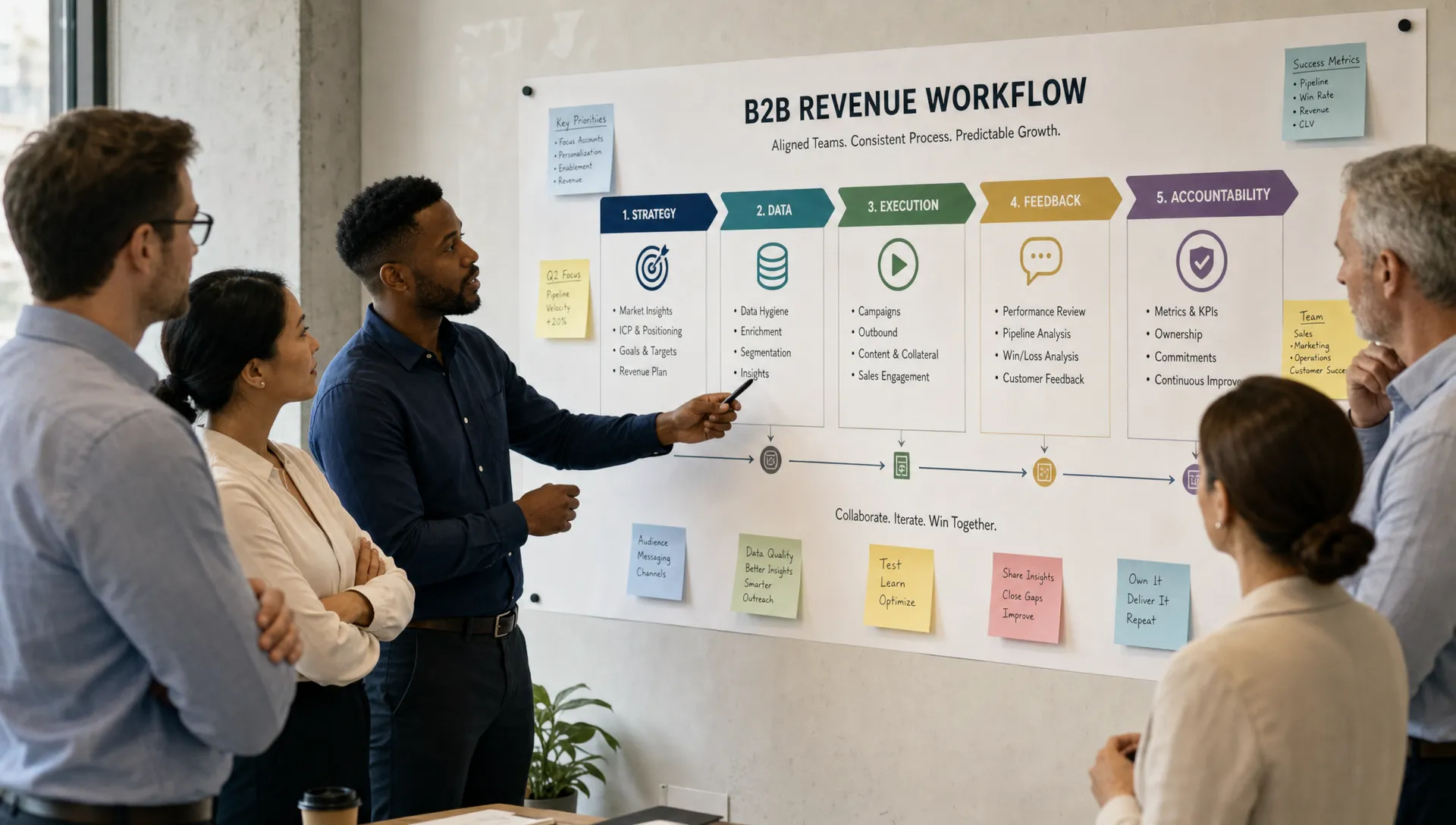
The core layers usually include:
- Strategy layer: Defines ICP, segments, offers, positioning, revenue goals, and market priorities.
- Data layer: Connects CRM, customer, financial, market, and activity data into a usable commercial view.
- Workflow layer: Maps the repeatable actions that move prospects and customers through the revenue engine.
- Decision layer: Encodes rules, prompts, scoring criteria, and escalation triggers that support better judgment.
- Accountability layer: Tracks whether the work is happening, whether it is working, and where leadership attention is needed.
This is where founder-led companies need to be especially careful. AI should not become a novelty layer sitting on top of a broken operating model. It should be part of the revenue architecture.
If the founder is still the approval point for every meaningful customer, pricing, hiring, or market decision, AI alone will not fix the constraint. The business needs to redesign how decisions flow. That is why scaling requires more than automation, as explained in this article on how to scale a B2B business without becoming the ceiling.
A practical 90-day path to scaling teams with AI
You do not need to rebuild the entire company at once. In fact, trying to deploy AI everywhere usually creates confusion. The better approach is to start with one revenue-critical workflow where better coordination will produce measurable leverage.
| Timeline | Focus | Practical outcome |
|---|---|---|
| Days 1 to 30 | Diagnose the constraint | Identify where team scale is breaking: qualification, handoffs, forecasting, onboarding, customer expansion, or management visibility |
| Days 31 to 60 | Build the first operating layer | Create the data connections, prompts, workflow rules, and human review points for one high-value use case |
| Days 61 to 90 | Operationalize and measure | Train the team, embed the system into meetings and workflows, track adoption, and refine based on results |
A good first use case is often one where the team already feels pain every week. For example, if sales and delivery disagree about customer fit, start with qualification and handoff intelligence. If the founder is constantly pulled into deal reviews, start with opportunity scoring and risk flags. If new hires take too long to ramp, start with onboarding guidance and role-specific knowledge retrieval.
The goal is not to showcase AI. The goal is to remove a real scaling constraint.
Governance matters: AI should support judgment, not hide it
As AI becomes more embedded in team workflows, governance becomes part of the operating system. This is especially important in revenue functions, where AI may influence customer communication, prioritization, pricing discussions, market analysis, and performance management.
The NIST AI Risk Management Framework is a useful reference point because it emphasizes governance, measurement, transparency, and risk management. For founder-led B2B companies, the practical version is straightforward: define what AI can do, what humans must review, and who owns the outcome.
AI should not have unchecked authority over sensitive customer communication, legal commitments, final pricing decisions, hiring decisions, or strategic positioning. It can draft, analyze, flag, summarize, and recommend. Humans still need to approve decisions where context, ethics, commercial judgment, or brand trust matter.
A strong AI OS makes this visible. It should be clear which data sources are trusted, which workflows are automated, which outputs require review, and which roles are accountable for acting on recommendations.
Metrics that show whether the AI OS is really scaling the team
The wrong metric is how many AI tools the company has adopted. The right metric is whether the team can produce better outcomes with less founder intervention and less operational drag.
Useful indicators include:
- Founder escalation rate for routine decisions
- Time to productive ramp for new hires
- CRM completeness and accuracy on critical fields
- Sales cycle time by segment or offer
- Handoff completion between sales, delivery, and customer success
- Percentage of opportunities with clear next steps
- Manager time spent coaching versus collecting updates
- Win rate and retention by ICP fit
- Speed from market signal to campaign, offer, or sales response
The best signal is compounding leverage. If the company can hire, onboard, manage, and improve execution without the founder personally translating the business every day, the operating system is working.
Frequently Asked Questions
What is an artificial intelligence operating system in a B2B company? An artificial intelligence operating system is a connected layer of data, workflows, decision rules, and AI-enabled processes that helps a team execute revenue strategy consistently. It is not one tool. It coordinates how people, systems, and decisions work together.
How does an AI operating system help a team scale? It helps scale by capturing founder judgment, reducing repetitive work, improving data visibility, standardizing key workflows, accelerating onboarding, and helping managers focus on exceptions instead of chasing updates.
Does an AI OS replace employees? No. In a healthy B2B operating model, AI supports employees by removing low-value work and improving decision quality. People still own customer relationships, strategic judgment, creative thinking, and final accountability.
Where should a founder-led company start? Start with the biggest revenue constraint, not the most exciting tool. Common starting points include qualification, CRM hygiene, sales-to-delivery handoffs, pipeline inspection, onboarding, or market prioritization.
How do you know if the system is working? The system is working if the team makes faster, more consistent decisions, new hires ramp sooner, managers have better visibility, and the founder is less involved in routine execution without losing control of quality.
Build the operating system before adding more complexity
If your team is growing but execution still depends on founder memory, manual coordination, and inconsistent workflows, the next hire may not solve the problem. It may simply add more complexity to an already overloaded system.
Billionaires in Boxers works with founder-led B2B companies to diagnose revenue constraints, design scalable growth systems, and support execution through PE-grade diagnostics, AI systems buildouts, and fractional CRO support.
If you are ready to understand where your team is losing leverage, start with the Revenue Acceleration Diagnostic. The goal is simple: identify the constraint, cost the right intervention, and build the operating system your next stage of growth requires.
