

Most founder-led B2B companies do not need one more AI tool. They need a way to make AI useful inside the commercial operating rhythm of the business.
That distinction matters. A chatbot can answer questions. An automation can move a task from one app to another. A dashboard can show a number after the fact. But an AI operating system should do something more valuable: connect strategy, data, decisions, workflows, and accountability so the revenue engine improves week after week.
For a B2B company, especially one scaling beyond founder-led selling, the real promise of AI is not novelty. It is leverage. It should help the business choose better markets, qualify better accounts, shorten decision cycles, improve sales execution, and reduce the founder bottleneck without flooding the team with generic outputs.
An AI Operating System Is the Layer Between Strategy and Execution
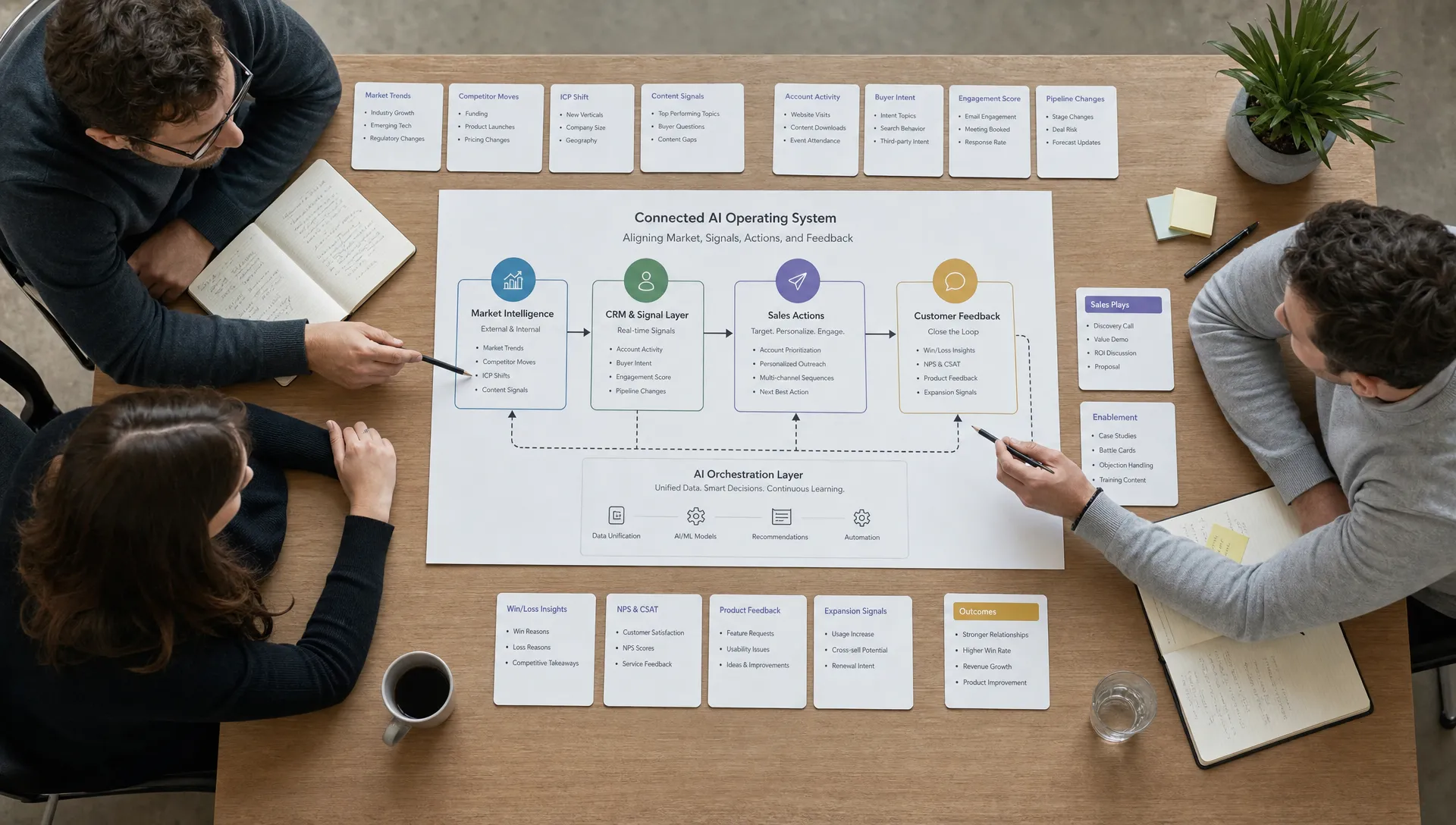
An AI operating system is not a single app, a model, or a prompt library. It is the connective layer that helps the company turn commercial intent into repeatable action.
In a B2B context, it should answer practical questions such as:
- Which accounts are most likely to buy, expand, or churn?
- Which opportunities are stuck, and why?
- Which market segments are showing the strongest signal?
- What should sales, marketing, and customer success do next?
- What evidence supports that recommendation?
- Where is revenue leaking from the current motion?
This is why the operating system metaphor is useful. The value is not in one feature. The value is in orchestration. Even outside B2B, a high-touch service business such as Stories by DJ has to coordinate inquiry, planning details, creative direction, logistics, and delivery into one coherent client experience. A B2B AI operating system applies a similar orchestration principle to revenue: context is captured once, decisions are guided by evidence, and execution becomes easier to repeat.
The goal is not to make humans irrelevant. The goal is to make the company less dependent on memory, heroics, and disconnected tools.
Why B2B Companies Need More Than AI Tools
AI adoption has moved from experimentation to mainstream business reality. McKinsey reported that regular use of generative AI nearly doubled in less than a year in its 2024 global survey. By 2026, the differentiator is no longer whether a company has tried AI. It is whether AI is embedded into the way the business actually runs.
This is where many B2B companies struggle. They buy point solutions for sales outreach, content generation, CRM enrichment, note taking, support automation, or reporting. Each tool may be useful, but the company still lacks an operating model. Data stays fragmented. Teams use different definitions. Leaders get more activity, but not necessarily better decisions.
For founder-led companies, the problem is sharper. The founder often carries the clearest judgment about ideal customers, weak-fit deals, market positioning, pricing sensitivity, and buyer nuance. As the business grows, that judgment becomes a bottleneck. An AI operating system should help codify that judgment so the team can execute without waiting for the founder to inspect every deal, message, or decision.
The first mistake is treating AI as a shortcut around strategy. If the commercial logic is unclear, AI will only scale the confusion. That is why it is worth understanding the common B2B AI strategy mistakes that burn budget before investing in another layer of technology.
1. Build a Shared Revenue Truth Layer
A B2B AI operating system should begin by improving the quality of commercial truth. Most revenue teams have plenty of data, but not enough usable truth. CRM fields are incomplete. Call notes are inconsistent. Marketing attribution is contested. Customer success insights live in Slack threads. Finance sees margin reality that sales may never see.
The AI OS should pull the most important signals into a shared layer, normalize them, and make them usable for decisions. This does not mean every system has to be rebuilt at once. It does mean the company needs a clear view of which data matters, who owns it, and how it informs action.
| Input | What it reveals | How the AI OS should use it |
|---|---|---|
| CRM data | Pipeline stage, deal source, owner activity, close history | Identify conversion gaps, aging deals, and pipeline quality issues |
| Sales calls and emails | Objections, buying committee dynamics, urgency, competitor mentions | Surface deal risks, coach messaging, and update account context |
| Marketing and website data | Intent signals, source quality, content engagement, lead behavior | Prioritize follow-up and connect campaigns to revenue outcomes |
| Finance and order data | Revenue quality, margin, payment patterns, customer value | Refine ICP, pricing, and expansion priorities |
| Support and customer success data | Friction points, adoption issues, expansion signals, churn risk | Trigger retention and expansion workflows |
| Market intelligence | Segment movement, hiring trends, funding events, competitor activity | Guide account selection and market expansion bets |
The key is not data volume. It is decision relevance. A clean operating system should help the business know what is true enough to act on, what is uncertain, and what needs validation.
2. Diagnose Revenue Leaks Before Automating Anything
The fastest way to waste AI budget is to automate a broken revenue motion. If the company is targeting the wrong segment, no amount of automated outreach will fix the economics. If discovery is weak, faster follow-up will not solve poor qualification. If customer handoff is messy, AI summaries may simply document the mess more efficiently.
An AI operating system should diagnose revenue leaks before recommending automation. It should look across the full revenue journey, from market selection to acquisition, conversion, onboarding, retention, and expansion.
Common leak points include weak ICP definition, inconsistent qualification, low proposal conversion, over-reliance on founder-led closing, unclear next steps, slow response times, margin-eroding discounting, and missed expansion triggers. The operating system should not just show that a metric is down. It should connect the metric to likely causes and recommended interventions.
For example, a declining win rate may be a sales skill issue, but it may also be a market focus issue. A longer sales cycle may reflect weak urgency, but it may also reveal that the company is selling too high, too low, or to buyers without budget authority. A useful AI OS helps leaders separate symptoms from causes.
3. Convert Strategy Into Workflow, Not Slideware
Many companies have strategic documents that look sensible and operating rhythms that ignore them. The AI operating system should close that gap.
If the strategy says the company should focus on mid-market SaaS firms in a specific buying trigger, the system should help reps identify those accounts, research them, prioritize them, tailor messaging, log activity, and learn from outcomes. If the strategy says the company should reduce low-margin deals, the system should flag weak-fit opportunities before they consume sales capacity.
In practical terms, a B2B AI operating system should support workflows such as account scoring, prospect research, first-pass messaging, call preparation, call summarization, CRM updates, deal risk alerts, proposal support, renewal prompts, and expansion recommendations.
The point is not to automate everything. The point is to automate the repeatable, evidence-based parts of execution while leaving judgment, trust building, negotiation, and final accountability with humans. For deeper tactical examples, the article on artificial intelligence solutions that improve revenue ops breaks down how AI can improve CRM hygiene, forecasting, follow-up, and operational consistency.
4. Codify Founder Judgment Without Freezing It
In many B2B companies between $3M and $25M in revenue, the founder is still the most important pattern-recognition engine in the business. They know which prospects are serious, which requests are distractions, which competitors matter, and which deals are likely to become painful customers.
That judgment is valuable, but it is often undocumented. It lives in call reviews, private messages, quick corrections, and decisions made under pressure. An AI operating system should help capture this tacit knowledge and turn it into usable rules, examples, and prompts.
This could include extracting patterns from founder-led sales calls, mapping won and lost deals against ICP criteria, building approved messaging principles, summarizing recurring objections, and creating decision guides for qualification. The system should also keep learning. Founder judgment should be codified, not fossilized.
5. Improve Decisions With Evidence, Confidence, and Guardrails
A serious AI operating system should not behave like an overconfident assistant. It should show its work. When it recommends an account, flags a risk, or suggests a next step, it should make the supporting evidence visible.
Good decision support includes the source data used, the confidence level, the missing information, the commercial implication, the recommended next action, and the owner responsible for acting. This is what separates an operating system from a content generator.
Governance matters here. The NIST AI Risk Management Framework emphasizes trustworthy AI principles such as validity, reliability, safety, security, accountability, transparency, and fairness. B2B companies do not need to turn every AI workflow into a compliance project, but they do need guardrails around sensitive data, customer claims, pricing, legal language, and automated decisions.
The best AI operating systems make humans faster and better informed. They do not hide judgment behind a black box.
6. Make Market Expansion Less Speculative
Market expansion is one of the areas where an AI operating system can create real leverage. Many founder-led B2B companies expand opportunistically. A customer appears in a new vertical, a partner suggests a niche, or a competitor moves into an adjacent market. The team senses potential, but the decision is often based on anecdotes.
An AI OS should bring structure to that decision. It should help compare segments based on buying triggers, accessible accounts, competitive density, sales cycle, margin potential, customer pain, existing proof, and delivery fit. It should also help run small tests before the company commits significant spend.
This is especially important because market expansion is not just a marketing question. It affects product packaging, sales messaging, pricing, hiring, implementation, customer success, and cash flow. A good AI operating system helps leadership see those dependencies before chasing a shiny new segment.
7. Close the Feedback Loop Across Revenue
The most valuable AI operating systems get better because the company gets better at learning. Every call, deal, campaign, renewal, churn event, and expansion should improve the next decision.
In many B2B companies, feedback loops are slow. Sales hears objections that marketing never sees. Customer success sees adoption risk that sales never learns from. Finance sees margin issues after the deal is already closed. Leadership sees lagging metrics after the quarter is nearly over.
An AI operating system should compress those loops. If a recurring objection appears in sales calls, it should inform messaging and enablement. If a segment produces poor-fit customers, it should influence targeting. If a campaign creates meetings that rarely convert, it should be treated differently from a campaign that produces fewer but better opportunities.
| Operating rhythm | What the AI OS should surface | Commercial decision it improves |
|---|---|---|
| Weekly pipeline review | Deal risk, stage aging, missing next steps, ICP fit | Where managers should coach and intervene |
| Monthly growth review | Segment performance, source quality, conversion patterns | Where budget and capacity should shift |
| Quarterly strategy review | Market signals, win-loss patterns, customer economics | Which markets, offers, and channels deserve focus |
The system should make learning operational. If insights do not change behavior, they are just reporting.
What an AI Operating System Should Not Do
An AI operating system should not become another dashboard that leaders admire and teams ignore. It should not create a parallel workflow outside the CRM, project management tools, or communication channels the team already uses. It should not reward activity volume over revenue quality.
It should also avoid the temptation to generate more generic content. In B2B markets, buyers are already surrounded by automated noise. A company that uses AI to send more low-context outreach may damage trust faster than it grows pipeline.
Most importantly, the system should not replace ownership. AI can recommend, summarize, score, and trigger. But leaders still need to decide the strategy, managers still need to coach, salespeople still need to build trust, and customer teams still need to deliver outcomes.
How to Implement an AI Operating System Without Burning Budget
The safest implementation path starts with the revenue problem, not the technology stack. A company does not need to build a perfect end-to-end platform on day one. It needs to identify the highest-value decision or workflow where AI can improve quality, speed, or consistency.
A practical sequence looks like this:
- Define the commercial objective: Choose a measurable outcome such as better-fit pipeline, faster qualification, improved forecast accuracy, or stronger expansion detection.
- Map the decision points: Identify who makes the decision, what data they use, what slows them down, and what happens when the decision is wrong.
- Audit the data reality: Check whether the needed inputs exist, whether they are reliable, and who owns their quality.
- Build one high-value workflow: Start with a narrow use case such as account prioritization, deal risk alerts, call intelligence, or renewal prompts.
- Add human approval: Keep people in the loop for customer-facing claims, pricing, legal language, strategic decisions, and high-impact recommendations.
- Measure behavior change: Track whether the workflow changes what people do, not just whether the AI produces outputs.
- Expand only after proof: Connect the next workflow once the first one creates measurable commercial value.
The business and technical sides must work from the same plan. If AI, CRM, data, and sales process decisions sit in different roadmaps, the operating system will fragment. This is why business and IT consulting must share one roadmap when AI becomes part of the revenue engine.
How to Know Whether It Is Working
An AI operating system should be measured by commercial improvement, not AI usage. The question is not how many prompts the team ran. The question is whether the business is making better decisions and executing them more consistently.
| Question | Leading measure | Lagging measure |
|---|---|---|
| Are we targeting better accounts? | Share of opportunities matching ICP criteria | Win rate and revenue by target segment |
| Are reps executing more consistently? | Follow-up speed, next-step completion, CRM completeness | Sales cycle length and conversion rate |
| Are managers coaching the right deals? | Number of risk signals reviewed and acted on | Forecast accuracy and pipeline slippage |
| Are we learning from the market faster? | Objections, loss reasons, and segment signals captured | Improved messaging and offer performance |
| Is the founder less of a bottleneck? | Fewer escalations for routine decisions | More leadership time for strategy and key relationships |
The right metrics depend on the company’s current constraint. A business with weak pipeline quality should not judge the OS by content output. A business with strong demand but inconsistent conversion should focus on qualification, sales process, and manager intervention. A business pursuing expansion should measure market signal quality and experiment velocity.
The Founder-Led B2B Standard
For a founder-led B2B company, an AI operating system should feel like an increase in organizational intelligence. It should not feel like a new administrative burden.
The founder should gain clearer visibility into where growth is constrained. The leadership team should gain a shared language for markets, pipeline, customer quality, and execution. Sales and marketing should gain better guidance on where to focus. Customer success should gain earlier signals about risk and expansion. Finance should gain a stronger connection between revenue activity and revenue quality.
That is the standard. If the system does not improve focus, speed, consistency, or accountability, it is not really an operating system. It is another tool.
Frequently Asked Questions
What is an AI operating system for a B2B company? An AI operating system is the commercial layer that connects data, strategy, workflows, decisions, and performance feedback. It helps the company act on revenue intelligence rather than leaving AI trapped in disconnected tools.
Is an AI operating system the same as a CRM? No. A CRM is usually the system of record for accounts, contacts, opportunities, and activities. An AI operating system should use CRM data, enrich it with other signals, and turn it into recommendations, workflows, and management insight.
Should a B2B company build or buy an AI operating system? Most companies should start by composing an operating system around existing tools rather than building everything from scratch. Custom buildouts make sense where the company has proprietary data, unique workflows, or a revenue model that generic tools cannot support.
What data is needed to start? Start with the data that affects the target commercial outcome. For pipeline quality, that may be CRM, call notes, source data, and win-loss patterns. For retention, it may include customer success notes, usage signals, support tickets, and renewal history.
How quickly should an AI operating system create value? A focused workflow can often show value before a full operating system is mature, but timing depends on data quality, process clarity, team adoption, and the complexity of the use case. Start narrow, prove behavior change, then expand.
Turn AI Into a Revenue Operating System
AI becomes valuable when it is tied to the way revenue is actually created. For founder-led B2B companies, that means starting with market focus, sales execution, customer economics, and operating discipline before choosing tools.
Billionaires in Boxers helps founder-led B2B companies use PE-grade diagnostics, AI systems buildouts, and fractional CRO support to engineer scalable growth. If you want to know whether your current tools can become a true AI operating system, start with the revenue system first.
