
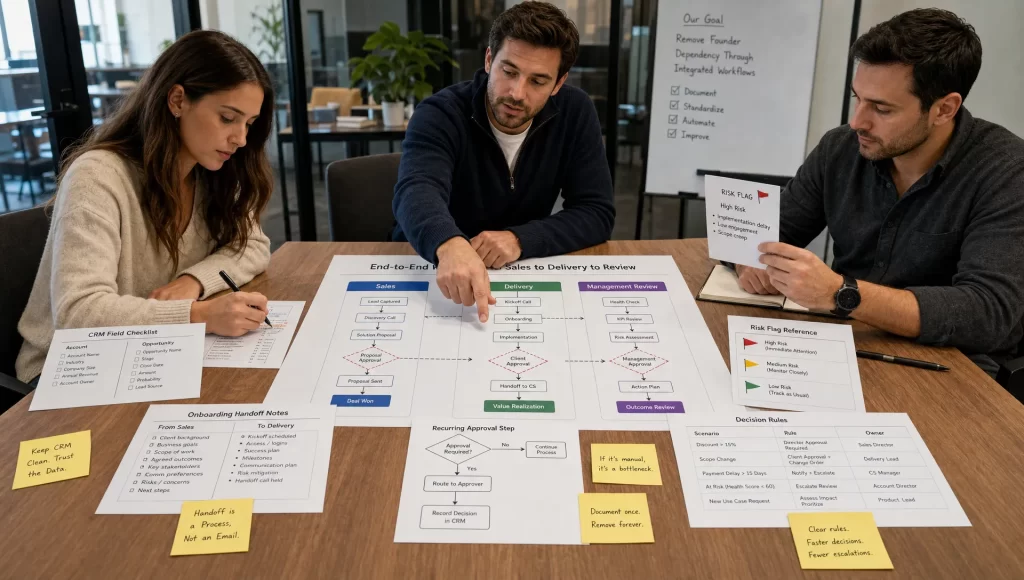
Founder bottlenecks rarely appear all at once. They start as innocent habits: the founder reviews every proposal, joins every important sales call, approves every discount, rewrites every follow-up, and answers every “quick question” from the team.
At $3M to $25M in revenue, those habits stop feeling like quality control and start behaving like a growth ceiling. The company has demand, talent, and opportunity, but too many decisions still queue behind one person.
This is where AI integrated workflows become commercially useful. Not AI as a novelty, not another disconnected tool, and not a chatbot pasted on top of a broken process. The real value comes when AI is embedded into the workflows that already drive revenue, decision-making, customer delivery, and team accountability.
For founder-led B2B companies, the goal is simple: move repeatable judgment, routine coordination, and data-heavy analysis out of the founder’s head and into the operating system of the business.
Why founder bottlenecks become a revenue problem
Founder dependency is often mistaken for founder excellence. In the early stages, that is understandable. The founder knows the market, the buyer, the offer, the sales narrative, the delivery nuances, and the edge cases better than anyone else.
But as the business scales, that same advantage becomes a constraint. If the founder remains the primary source of commercial judgment, the team cannot move at the pace the market requires.
Common symptoms include:
- Sales opportunities waiting for founder input before progressing
- Account managers escalating routine client issues too early
- Marketing creating content or campaigns that do not match the sales reality
- Revenue meetings dominated by anecdotes instead of clear pipeline signals
- Hiring decisions delayed because role outcomes are not well defined
- CRM data becoming unreliable because no one trusts the process
The issue is not that the founder is doing too much work. The issue is that too much of the company’s operating logic still depends on founder interpretation.
That distinction matters. Delegation alone does not solve the problem if the team lacks the context, standards, data, and decision rules needed to act well without the founder.
AI integrated workflows solve this by turning recurring founder judgment into structured, repeatable workflows supported by data, prompts, automations, and human accountability.
For a deeper look at the risk itself, Billionaires in Boxers has covered how founder dependency creates a hidden ceiling for B2B revenue, especially when revenue generation depends too heavily on one person’s attention.
What “AI integrated workflows” actually means
An AI integrated workflow is not simply using ChatGPT to write emails or summarize meetings. Those can be useful, but they are not enough.
A workflow becomes AI integrated when AI is built into a defined business process with clear inputs, outputs, decision points, owners, and performance measures.
For example, a founder-led company may currently handle strategic sales opportunities like this: the salesperson asks the founder for help, the founder reviews the notes, the founder suggests positioning, the salesperson updates the proposal, and the founder checks it again before it goes out.
An AI integrated version looks different. The salesperson enters discovery notes into a structured format. AI compares those notes against ideal customer criteria, past win patterns, objection libraries, pricing logic, and case study relevance. The system drafts a recommended deal strategy, identifies missing information, and flags whether founder review is genuinely needed.
The founder is no longer the first line of processing. They become the escalation point for truly strategic exceptions.
That is the shift.
AI integrated workflows do not replace leadership. They reduce the number of low-leverage decisions that require leadership attention.
The founder bottlenecks AI should remove first
Not every workflow deserves AI integration on day one. The best starting points are workflows where founder involvement is frequent, repetitive, commercially important, and slowing the team down.
Sales qualification and deal strategy
In many founder-led B2B companies, the founder is still the best qualifier in the business. They can hear a prospect’s context and quickly identify whether the deal is real, whether the pain is urgent, whether the buyer has authority, and whether the company can win profitably.
The problem is that this judgment often remains undocumented.
AI can help structure qualification by analyzing discovery notes, call transcripts, CRM fields, and historical outcomes. It can surface patterns like weak economic buyers, vague pain, poor timing, or misalignment between prospect needs and delivery capacity.
The workflow should not let AI make the final decision blindly. Instead, it should provide a consistent first pass so sales leaders and founders spend less time extracting basic information and more time coaching strategy.
Proposal creation and commercial positioning
Founders often become proposal bottlenecks because they know how to frame value better than the rest of the team. They understand which proof points matter, which objections will surface, and which language resonates with specific buyer types.
An AI integrated proposal workflow can convert that expertise into reusable assets. Discovery summaries, buyer pain points, industry context, case studies, pricing principles, and delivery constraints can be combined into a guided proposal process.
The result is not generic automation. The result is a stronger first draft that reflects the company’s commercial logic before the founder touches it.
This matters because proposal delays are not just administrative friction. They reduce buyer momentum. In complex B2B sales, speed and relevance often influence trust.
CRM hygiene and revenue visibility
Founders frequently mistrust the CRM. That mistrust creates another bottleneck because revenue decisions revert to founder intuition instead of shared data.
AI can support CRM workflows by identifying incomplete fields, inconsistent stage movement, stale opportunities, missing next steps, and deals that do not match the stated forecast category.
This is one of the most practical applications of AI in revenue operations. Instead of asking managers to manually inspect every record, AI can flag the records that need attention and produce a cleaner view for pipeline meetings.
Billionaires in Boxers explores this broader theme in its article on artificial intelligence solutions that improve revenue ops, including the importance of cleaner data and better forecasting discipline.
Customer onboarding and delivery handoff
Founder bottlenecks do not stop after the sale. In many B2B companies, the founder is pulled into onboarding because delivery teams lack context from the sales process.
The usual cause is a weak handoff. Sales knows what was promised. Delivery knows what must be implemented. The customer expects continuity. The founder becomes the translator.
An AI integrated handoff workflow can summarize the sales journey, extract commitments, identify risks, highlight stakeholder expectations, and create an onboarding brief for the delivery team.
This reduces rework, prevents expectation gaps, and allows the founder to step away from routine client transitions.
Hiring, training, and role enablement
Another common bottleneck is people development. The founder wants to delegate, but new hires lack the context needed to perform at the expected level.
AI can help turn tribal knowledge into enablement workflows. Call recordings, sales playbooks, customer FAQs, objection handling, delivery principles, and internal decision rules can be converted into training assets and role-specific guidance.
This does not remove the need for management. It gives managers better infrastructure.
A practical map of AI integrated workflows
The best way to identify AI opportunities is to map where founder judgment repeatedly enters the business. The table below shows how common bottlenecks can be converted into integrated workflows.
| Founder bottleneck | AI integrated workflow | Founder’s new role |
|---|---|---|
| Reviewing every qualified opportunity | AI-assisted qualification using CRM data, discovery notes, and win criteria | Review exceptions and coach edge cases |
| Rewriting proposals | Guided proposal workflow using approved positioning, proof points, and pricing logic | Approve strategic or unusual deals |
| Running pipeline inspection manually | AI flags stale deals, missing next steps, and forecast risk | Lead higher-quality revenue conversations |
| Joining onboarding calls to transfer context | AI-generated handoff briefs from sales notes and call summaries | Step in only for high-risk accounts |
| Answering repeated team questions | Internal knowledge workflow trained on approved company materials | Update standards and clarify decisions |
This is the operating principle: AI handles pattern recognition, summarization, drafting, comparison, and escalation signals. Humans remain accountable for judgment, relationships, ethics, and final decisions.

Why integration matters more than tools
Many companies waste money on AI because they buy tools before defining the workflow. The result is a stack of disconnected experiments: one tool for call notes, another for email drafts, another for analytics, another for chat, and no shared commercial operating model.
That rarely removes founder bottlenecks. In some cases, it creates new ones because the founder now has to interpret conflicting outputs from multiple systems.
The better approach is to start with the revenue process and then decide where AI belongs.
Ask these questions before adding any AI layer:
- What decision or task is currently waiting on the founder?
- What information does the founder use to make that decision?
- Which parts of that decision are repeatable?
- Which parts require human judgment or relationship context?
- What output would let the team move forward without founder involvement?
- How will quality be reviewed and improved over time?
This is also why AI should connect to business strategy, not sit inside IT as a technical side project. If your AI work does not improve speed, conversion, margin, retention, or management clarity, it may be interesting but not commercially important.
Billionaires in Boxers has written more on what an AI operating system should do for a B2B company, especially when AI needs to connect strategy, workflows, data, and accountability.
How to build AI integrated workflows without creating chaos
The safest implementation path is not to automate everything. It is to systemize the most expensive bottleneck first.
Start with one revenue-critical workflow
Choose a workflow that directly affects revenue velocity or quality. Sales qualification, proposal development, pipeline hygiene, customer onboarding, and renewal risk are strong candidates.
Avoid starting with a workflow simply because it is easy to automate. Easy does not always mean valuable.
A good first workflow has three qualities: it happens often, it affects commercial outcomes, and the founder is currently involved too much.
Capture the founder’s decision logic
Before AI can support a workflow, the company must understand how the best decision is currently made.
This means documenting the founder’s standards. What makes a deal attractive? What makes a client risky? What discounts are acceptable? Which industries are strongest? Which buyer signals matter? What language should the team avoid? What promises should never be made?
AI performs better when the business gives it clear commercial context. Without that context, it produces polished noise.
Define human approval points
AI integrated does not mean fully autonomous. In founder-led B2B, the highest-value workflows often require a human-in-the-loop model.
For example, AI may prepare a deal strategy, but the sales leader approves it. AI may generate a proposal draft, but the account owner validates accuracy. AI may flag churn risk, but customer success decides the intervention.
Clear approval points prevent two bad outcomes: blind automation and founder overcontrol.
Connect the workflow to measurable outcomes
If an AI workflow cannot be measured, it cannot be managed.
Track simple commercial metrics before and after implementation. Depending on the workflow, these may include proposal turnaround time, CRM completeness, sales cycle length, forecast accuracy, onboarding delays, renewal risk identification, or manager review time.
The purpose is not to prove that AI is impressive. The purpose is to prove that the business is less dependent on founder intervention while maintaining or improving quality.
Industry-specific workflows matter
AI integrated workflows should reflect the economics and operating model of the business. A recruitment firm, SaaS company, industrial services provider, consulting business, and technical infrastructure company do not have the same bottlenecks.
For example, a company operating in a specialized, asset-heavy market such as crypto mining infrastructure may need workflows that coordinate equipment sales, hosting availability, repair capacity, and consultation requests. Providers like Dahab Miners in the UAE crypto mining market illustrate how multiple operational promises can sit behind one commercial conversation, which makes clean handoffs and integrated workflows especially important.
The same principle applies across founder-led B2B. The workflow must match the business model. A generic AI implementation may save time, but a commercially designed workflow protects margin, improves conversion, and reduces escalation.
The hidden benefit: better management layers
When founders think about AI, they often think about automation. But one of the biggest benefits is management leverage.
Middle managers in founder-led companies often struggle because they are asked to own outcomes without having the founder’s context. AI integrated workflows can give them better visibility, better prompts, better standards, and better review mechanisms.
A sales manager can coach from cleaner call summaries. A customer success leader can identify onboarding risk earlier. A marketing lead can see which objections sales actually faces. An operations lead can identify recurring delivery friction before it becomes a founder-level issue.
This is how the company starts to scale beyond the founder. Not by removing the founder’s intelligence, but by distributing it through workflows the team can actually use.
What not to automate
Some founder involvement should remain. The point is not to disappear from the business. The point is to reserve founder attention for decisions where it has the highest enterprise value.
Do not rush to automate:
- Strategic relationship building with major accounts
- Final judgment on unusual commercial risk
- Sensitive people decisions
- Major positioning shifts
- Complex negotiations where trust and nuance matter
- Ethical decisions or commitments that affect the company’s reputation
AI should remove unnecessary dependency, not responsible leadership.
The best founder-led companies create a clear distinction between repeatable decisions and strategic exceptions. AI belongs heavily in the first category and carefully in the second.
A simple implementation sequence
If you want to remove founder bottlenecks with AI integrated workflows, use a staged approach.
First, identify the top five moments where work waits for founder input. Use calendar data, Slack or Teams patterns, CRM delays, proposal review cycles, and management meeting agendas to find the real bottlenecks.
Second, rank those bottlenecks by commercial impact. A workflow that improves qualified pipeline movement is usually more valuable than one that saves a small amount of admin time.
Third, document the current decision logic. Interview the founder and key team members. Extract the rules, standards, examples, and exceptions that shape good decisions.
Fourth, design the AI-assisted workflow. Define inputs, outputs, review steps, escalation triggers, and success metrics before choosing tools.
Fifth, pilot with one team or one segment. Measure quality, speed, adoption, and founder time saved. Improve the workflow before expanding it.
This sequence prevents the most common mistake: installing AI before the company understands the operating problem.
Frequently Asked Questions
What are AI integrated workflows? AI integrated workflows are business processes where AI is embedded into the steps, data, decisions, and outputs of the workflow. Instead of using AI as a standalone tool, the company uses it to support repeatable execution inside sales, marketing, operations, customer success, or management.
How do AI integrated workflows reduce founder bottlenecks? They move repeatable tasks and decision support out of the founder’s head and into structured processes. AI can summarize information, flag risks, draft outputs, compare data, and guide teams so the founder only handles strategic exceptions.
Should AI replace founder decision-making? No. In founder-led B2B companies, AI should support decision-making rather than replace accountable leadership. The best workflows use AI for speed, consistency, and analysis while keeping humans responsible for judgment and final approval.
Which workflow should a founder-led B2B company automate first? Start with the workflow where founder involvement is frequent, repetitive, and commercially expensive. Sales qualification, proposal creation, CRM hygiene, pipeline review, and customer onboarding are often strong first candidates.
How do you know if an AI workflow is working? Measure business outcomes, not novelty. Useful metrics include founder time saved, proposal turnaround time, CRM completeness, sales cycle speed, forecast accuracy, onboarding quality, and reduction in unnecessary escalations.
Build a business that does not wait on the founder
Founder bottlenecks are not solved by telling the founder to “let go.” They are solved by building the systems, workflows, data, and accountability that allow the team to make better decisions without constant founder intervention.
AI integrated workflows are one of the most practical ways to do that, but only when they are tied to commercial priorities and implemented with discipline.
Billionaires in Boxers helps founder-led B2B companies diagnose revenue constraints, design scalable growth systems, and build AI-enabled operating infrastructure around the real bottlenecks in the business. If your company is between $3M and $25M in revenue and growth still depends too heavily on founder involvement, a Revenue Acceleration Diagnostic can identify where to intervene first and what it will take to scale with less dependency.
