
A scaling team rarely breaks all at once. It slows down first.
Deals take longer to move. Department heads interpret strategy differently. New managers ask the founder for decisions they should be making themselves. Senior hires look capable on paper, yet execution still feels uneven. The company is growing, but the operating rhythm that worked at $3M, $8M, or $15M revenue is starting to creak.
That is usually when founders start wondering whether they need a leadership consultant.
The right answer is not “hire one when people problems appear.” Scaling teams always create people problems. The better question is whether those leadership gaps are now constraining revenue, execution speed, customer experience, or the founder’s ability to lead at the right level.
For founder-led B2B companies, a leadership consultant can be valuable when the organization has outgrown informal management but is not yet mature enough to justify a full executive transformation program. The risk is hiring one too early, too vaguely, or for the wrong problem.
What a leadership consultant actually does in a scaling company
A leadership consultant helps improve how leaders make decisions, communicate priorities, manage teams, and execute strategy. In a scaling B2B company, that usually means helping the founder and leadership team move from founder-dependent execution to a more distributed operating model.
That work can include clarifying roles, building management routines, improving executive alignment, coaching functional leaders, diagnosing team friction, and helping leaders operate with better accountability.
It should not be confused with motivational training or generic management workshops. Those can be useful, but they rarely fix structural leadership constraints on their own. In a scaling company, leadership work must connect to the commercial system: pipeline, sales capacity, delivery quality, retention, hiring, and profitability.
Research from Gallup has consistently shown that managers have an outsized effect on employee engagement, including its widely cited finding that managers account for much of the variance in team engagement. For scaling companies, that matters because engagement is not just a culture metric. It influences execution quality, customer experience, and retention of high performers.
A good leadership consultant should therefore help answer practical questions such as:
- Who owns which decisions now that the founder cannot be in every room?
- Are senior leaders aligned on the strategy, or simply polite in meetings?
- Do managers know how to translate company goals into team priorities?
- Are revenue problems being caused by market issues, sales process issues, or leadership bottlenecks?
- Is the operating cadence strong enough to create accountability without constant founder intervention?
If the consultant cannot connect leadership behavior to business outcomes, the work may feel good but fail to change the company’s trajectory.
The clearest signs it is time to hire a leadership consultant
The best time to hire a leadership consultant is not when the team is in crisis. It is when growth has exposed repeatable leadership constraints that the founder and team cannot solve with more effort.
Here are the most common signs.
The founder has become the escalation path for everything
In an early-stage company, founder involvement is often an advantage. The founder sells, solves, motivates, recruits, and closes gaps. As the business scales, that same involvement can become the ceiling.
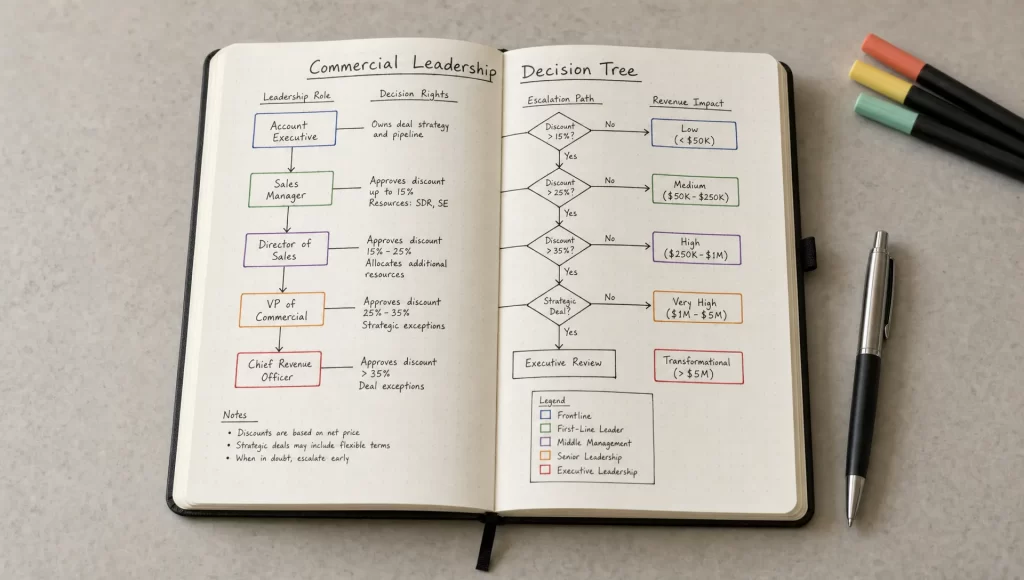
If every strategic customer issue, pricing exception, hiring call, product decision, or sales conflict still lands on the founder’s desk, the leadership system is underdeveloped. The team may be staffed, but authority has not truly been transferred.
This is one of the most important moments to intervene. A leadership consultant can help clarify decision rights, define escalation rules, and coach leaders to own outcomes instead of waiting for founder approval. If this sounds familiar, it may also be worth looking at how founder dependence creates a broader growth ceiling in scaling a B2B business without becoming the bottleneck.
Your leadership team agrees in meetings but misaligns in execution
A common scaling symptom is “meeting alignment.” Everyone nods in the executive meeting, then goes back to their function and interprets the plan differently.
Sales believes the priority is new logo acquisition. Delivery believes the priority is service quality. Marketing believes the priority is category visibility. Finance believes the priority is margin discipline. None of these are wrong, but without a shared hierarchy of priorities, the company fragments.
A leadership consultant can help surface the real disagreements, create a common operating language, and establish a cadence for making trade-offs. This is especially useful when the founder feels like the only person holding the whole business model in their head.
Strong individual performers are struggling as managers
Many scaling teams promote top performers into management roles because they understand the work and have earned trust. The problem is that doing the work and leading the work are different jobs.
A top salesperson may struggle to coach reps. A brilliant operator may avoid difficult conversations. A technical expert may become a bottleneck because they cannot delegate. A loyal early employee may resist the structure required at the next stage.
This is not a character flaw. It is a capability gap.
A leadership consultant can help new managers understand role expectations, communication norms, performance management, and delegation. That can prevent the company from losing strong people simply because they were promoted without a leadership system around them.
Revenue execution is inconsistent across teams
Leadership issues often show up as revenue symptoms. For example, the company may have enough leads but poor follow-up discipline. Sales may close deals that delivery struggles to fulfill. Customer success may hear objections that never make it back to marketing or product. Account expansion may depend on one senior person’s relationships.
At this point, the issue is not just “people need to communicate better.” It is that leadership routines are not strong enough to coordinate the revenue engine.
Before hiring any consultant, founders should identify whether the constraint is leadership, strategy, sales process, market positioning, or operating systems. The article on consulting services founders should audit before hiring explores this distinction in more detail.
Your senior hires are not integrating well
Scaling companies often hire experienced leaders from larger organizations. Sometimes they thrive. Sometimes they struggle because the company lacks the structure they expected, or because their enterprise playbook does not fit a founder-led environment.
If multiple senior hires have underperformed, the issue may not be hiring quality alone. It may be unclear authority, poor onboarding, founder overreach, weak cross-functional norms, or a mismatch between company stage and leadership style.
A leadership consultant can help define what leadership needs to look like in your specific stage of growth, not in theory.
When not to hire a leadership consultant
A leadership consultant is not always the right first move. In some situations, hiring one can create activity without solving the real constraint.
| Situation | Why a leadership consultant may not be the first hire | Better first step |
|---|---|---|
| Pipeline is weak and the ICP is unclear | The core issue may be positioning or demand generation, not leadership behavior | Diagnose go-to-market strategy and market focus |
| Win rates are falling due to poor sales process | Managers may need better systems before leadership coaching helps | Audit sales process, qualification, and deal management |
| Delivery is unprofitable | The issue may be pricing, scope control, or capacity planning | Review offer design, margins, and delivery model |
| The founder wants someone to “fix the team” | Consultants cannot replace hard decisions about people and structure | Clarify roles, expectations, and accountability first |
| There is no executive commitment to change | Leadership consulting requires active participation from the founder and senior team | Align on outcomes before starting |
This distinction matters because leadership consulting can become a socially acceptable way to avoid a harder commercial diagnosis. If the real issue is that the company is selling the wrong offer to the wrong segment, no amount of leadership coaching will fix it.

How to decide if the problem is leadership, systems, or strategy
Founders often experience scaling problems as a blur. The team feels stretched, performance is uneven, and the founder’s calendar is full of decisions that should not require them. But different constraints require different interventions.
A simple diagnostic lens can help.
If decisions are slow, look at leadership clarity
Slow decisions usually indicate unclear ownership, low trust, or unresolved strategic tension. A leadership consultant may help if leaders are capable but lack a shared decision framework.
Common symptoms include repeated revisiting of the same issues, excessive founder approvals, and leaders avoiding trade-offs until a meeting forces the conversation.
If work is duplicated or dropped, look at operating systems
When teams are busy but execution is messy, the issue may be systems. The company may need clearer workflows, better handoffs, improved data visibility, or an operating rhythm that connects strategy to weekly execution.
This is where leadership consulting and systems work can overlap. In modern B2B companies, leadership effectiveness increasingly depends on the quality of the operating system around the team. For example, an artificial intelligence operating system can help scaling teams by turning workflows, data, and judgment into a more consistent way of working.
If growth is stalling, look at revenue constraints first
If revenue has plateaued, do not assume the leadership team is the root problem. It might be, but it might also be a weak offer, poor segmentation, limited sales capacity, low conversion, churn, pricing leakage, or market expansion risk.
This is where a revenue diagnostic is often more useful than a standalone leadership engagement. Leadership may still be part of the solution, but it should be tied to the specific constraint blocking growth.
What outcomes should you expect from a leadership consultant?
Leadership consulting should produce observable changes in how the company operates. It does not need to promise instant revenue growth, but it should create the conditions for better execution.
Useful outcomes include clearer decision rights, stronger executive alignment, better management cadence, improved accountability, faster issue resolution, more effective delegation, and reduced founder dependency.
The work should also create artifacts the team can keep using, such as role scorecards, meeting rhythms, decision frameworks, leadership principles, performance expectations, or cross-functional operating agreements.
The most valuable consultants avoid abstract leadership language. They translate it into operating behavior. For example, instead of saying “the team needs more accountability,” they help define who owns pipeline creation, who owns sales conversion, who owns onboarding quality, and how those owners review progress.
How to hire the right leadership consultant
When evaluating a leadership consultant, look for fit with your company stage, business model, and growth constraint. A consultant who works well with enterprise executives may not be right for a founder-led B2B company where the founder is still deeply involved in revenue, product, and key relationships.
Ask questions that reveal whether the consultant can operate commercially, not just interpersonally.
- How do you diagnose whether the issue is leadership or something else?
- What business outcomes do you typically tie the work to?
- How do you work with founders who are still central to sales or delivery?
- What artifacts or operating routines will remain after the engagement?
- How do you handle conflict within a senior team?
- What do you need from us for the work to succeed?
You should also be cautious of any consultant who offers a fixed leadership program before understanding your business context. Scaling teams do not need generic content. They need targeted intervention around the behaviors and systems that are constraining performance.
Leadership consultant vs. fractional CRO vs. business consultant
Founder-led B2B companies often compare several types of help. The right choice depends on the constraint.
| Type of support | Best for | Watch out for |
|---|---|---|
| Leadership consultant | Improving leadership alignment, decision-making, management capability, and accountability | May not solve revenue architecture, offer, or sales process issues alone |
| Fractional CRO | Building and leading the revenue engine, including sales strategy, pipeline, conversion, and commercial execution | Requires authority and access to revenue data to be effective |
| Business consultant | Diagnosing broader business constraints and designing improvement plans | Can become too general if not tied to measurable outcomes |
| Executive coach | Supporting individual leader behavior, mindset, and performance | May not address team-wide operating problems |
These categories overlap, which is why diagnosis matters. A founder who thinks they need a leadership consultant may actually need a revenue leader. A founder who thinks they need a sales fix may actually have a leadership alignment problem. If you are weighing those options, the comparison of a business advisor, consultant, fractional CRO, and specialist support can help clarify the decision.
The best timing: before the next growth push, not after the team burns out
The highest-leverage moment to hire a leadership consultant is usually before a major growth push, market expansion, senior hiring wave, or operating model change.
At that point, the team has enough complexity to benefit from structure, but not so much dysfunction that the engagement becomes remedial. The consultant can help the company prepare leaders for the next stage rather than clean up avoidable damage later.
Good trigger points include crossing into a new revenue band, adding a second management layer, expanding into a new market, moving from founder-led sales to a sales team, integrating new senior hires, or preparing for investor scrutiny.
The worst timing is when the founder is already exhausted, trust has eroded, and the team expects an outsider to impose accountability the founder has avoided. A consultant can still help in that situation, but the work will be harder and more political.
How to make the engagement commercially useful
To get real value, define the engagement around business-critical questions. For example, instead of “improve leadership,” the scope might be “reduce founder involvement in sales decisions,” “align the leadership team around market expansion,” or “build an operating cadence that improves revenue accountability.”
The best engagements start with diagnosis, then move into practical design and implementation. That might include leadership interviews, operating rhythm review, role clarity mapping, decision-rights design, team workshops, and coaching around live business issues.
For B2B founders, the commercial link is essential. Leadership work should help the company sell, deliver, retain, expand, and scale more effectively. If it does not, it risks becoming an expensive conversation.
Billionaires in Boxers works with founder-led B2B companies at $3M to $25M revenue through PE-grade diagnostics, AI systems, and fractional CRO support. If the leadership question is tied to revenue acceleration, starting with a diagnostic can help separate symptoms from constraints and build a costed intervention roadmap.
Frequently Asked Questions
When should a startup or scaleup hire a leadership consultant? A scaling company should consider hiring a leadership consultant when growth is creating repeated leadership constraints, such as slow decisions, founder dependency, executive misalignment, weak management capability, or inconsistent cross-functional execution.
What is the difference between a leadership consultant and an executive coach? A leadership consultant typically works on team-wide leadership systems, decision-making, alignment, and management routines. An executive coach usually focuses on the behavior and effectiveness of an individual leader.
Can a leadership consultant improve revenue growth? Indirectly, yes. A leadership consultant can improve the conditions for revenue growth by strengthening accountability, alignment, delegation, and execution. However, if the real constraint is positioning, sales process, pricing, or pipeline, revenue-focused consulting may be needed first.
How long should a leadership consulting engagement last? The right length depends on the scope. A focused diagnostic and operating design project may take weeks, while deeper leadership development and implementation support may take several months. The key is to define outcomes before setting the timeline.
Should the founder be involved in the leadership consulting process? Yes. In founder-led companies, the founder’s behavior, decision-making style, and willingness to transfer authority are central to the outcome. A leadership consultant cannot create lasting change if the founder stays outside the process.
The bottom line
Hire a leadership consultant when the way your team leads, decides, and executes has become a constraint on scale. Do not hire one simply because growth feels hard or because the team needs a morale boost.
For founder-led B2B companies, the strongest leadership work is practical, commercial, and connected to the operating model. It helps the founder stop being the default answer, helps leaders own outcomes, and helps the business grow without adding chaos at every stage.
If you are unsure whether your constraint is leadership, revenue strategy, sales execution, or systems, start with diagnosis. A clear diagnosis will tell you whether a leadership consultant is the right move, or whether another intervention will create faster, cleaner growth.
