
In 2026, the question is no longer whether B2B companies should use AI. The sharper question is whether their AI services are actually improving revenue, or simply making existing work happen faster.
That distinction matters. A founder-led B2B company can automate follow-up emails, meeting notes, CRM updates, proposal drafts, lead research, and reporting. But if the wrong accounts are being targeted, the sales process is unclear, the offer is under-positioned, or the founder is still approving every important deal, automation just scales the bottleneck.
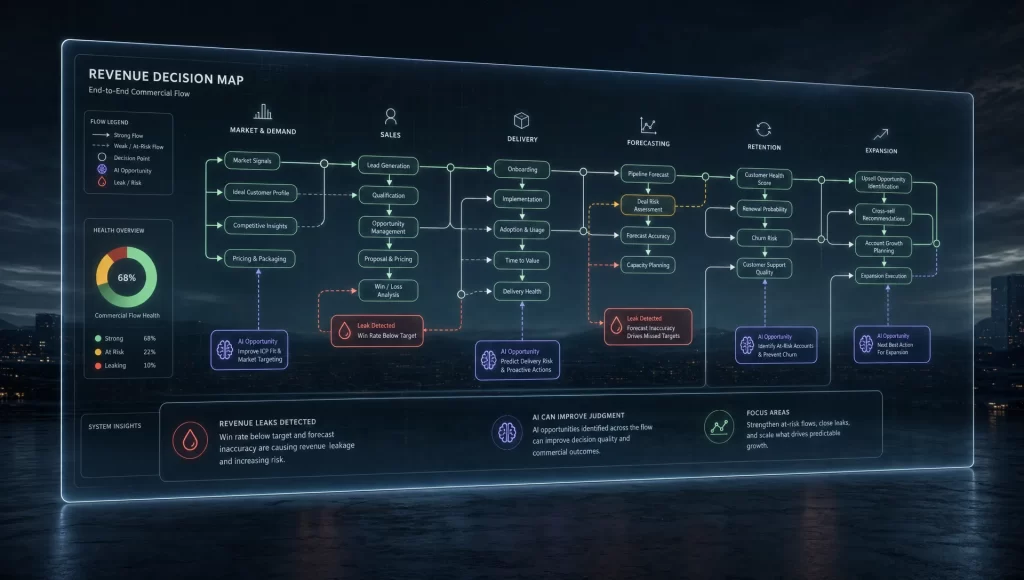
Revenue-first AI services are different. They start with the commercial system, not the tool stack. They ask where growth is leaking, which decisions need better intelligence, which workflows slow sales down, and where a human team needs leverage. Then they build AI into the parts of the revenue engine that influence pipeline quality, conversion, sales velocity, retention, and expansion.
McKinsey has estimated that generative AI could add trillions of dollars in annual economic value. But that value does not appear because a company bought software. It appears when AI is applied to high-value work, inside a clear operating model, with accountability for commercial outcomes.
For founder-led B2B companies, that is the real opportunity.
Automation is useful, but it is not the same as revenue creation
Automation removes manual work. Revenue creation improves the performance of the business model.
Both matter, but they are not interchangeable. If a sales team spends hours copying notes into a CRM, automating that task is useful. If the CRM still contains weak qualification criteria, unclear next steps, and inflated deal probabilities, the automation will not improve forecast accuracy or win rate.
The same is true across the funnel. AI can create more outbound emails, but if the positioning is generic, the extra volume may only create more noise. AI can summarize customer calls, but if nobody turns those insights into offer refinement, onboarding improvements, or expansion plays, the summaries become another archive.
The best AI services understand this sequence: first diagnose the revenue constraint, then design the workflow, then apply AI where it creates measurable leverage.
| Automation-first AI | Revenue-first AI |
|---|---|
| Starts with tasks to reduce | Starts with growth constraints to solve |
| Measures time saved | Measures pipeline, conversion, velocity, margin, or retention impact |
| Adds tools to existing workflows | Redesigns workflows around better decisions and execution |
| Often lives in disconnected apps | Connects to sales, delivery, CRM, and leadership rhythms |
| Makes work faster | Makes the revenue engine smarter and more scalable |
This is why AI services should not be evaluated only by how impressive the demo looks. They should be evaluated by whether they can change the commercial math.
What revenue-focused AI services should actually do
For a founder-led B2B company between $3M and $25M in revenue, the biggest growth constraints are rarely caused by a lack of software. They usually come from a few recurring issues.
The founder is still the best salesperson. The CRM is treated as a record-keeping system rather than a decision system. Sales and delivery teams interpret the ideal customer profile differently. Forecasting depends on optimism instead of evidence. Account expansion is reactive. Marketing generates activity that sales does not fully trust. Customer insights live in call recordings, Slack threads, notebooks, and memory.
AI services that create revenue help convert those scattered signals into a more disciplined commercial operating system.
At a practical level, that means they should support five outcomes.
1. Sharper market and account prioritization
Revenue growth starts with choosing the right market, segment, and account targets. AI can help analyze patterns across past wins, losses, sales calls, CRM notes, website behavior, industry data, and customer feedback.
The goal is not to create a theoretical ideal customer profile. The goal is to identify which types of accounts are most likely to buy, expand, move quickly, and produce profitable delivery outcomes.
A revenue-focused AI service might help answer questions like:
- Which segments produce the strongest gross margin and shortest sales cycle?
- Which buyer triggers tend to precede high-quality opportunities?
- Which lost deals were poor fit, and which were winnable with better positioning?
- Which accounts resemble the company’s best customers but are not yet being prioritized?
This kind of analysis can improve where the sales team spends its time, which is one of the highest-leverage revenue decisions a founder can make.
2. Better qualification and pipeline discipline
A bloated pipeline is not a revenue asset. It is a management liability. Many founder-led B2B companies carry too many deals that are not truly qualified, not properly next-stepped, or not connected to a clear buyer pain.
AI services can improve qualification by helping teams capture and interpret deal evidence consistently. This can include call summaries, buying committee mapping, pain point extraction, objection tracking, next-step recommendations, and CRM hygiene.
The important part is not the AI summary itself. It is the standardization of judgment. If every rep evaluates opportunities differently, leadership cannot trust the pipeline. If AI helps enforce the same qualification logic across the team, forecast quality improves and coaching becomes more specific.
For companies already thinking about this operational layer, the distinction between tools and systems is important. Billionaires in Boxers has written more specifically about how AI systems strengthen sales, delivery, and forecasting when they are designed around the revenue workflow instead of isolated tasks.
3. Sales execution that compounds learning
Every sales conversation contains data. Most companies waste it.
A buyer explains why they are evaluating vendors now. A CFO questions implementation risk. A champion reveals how the business case will be judged. A prospect uses language that is more compelling than the company’s own messaging. A lost deal exposes a positioning gap.
AI services can help turn these moments into repeatable sales assets. Instead of sales learning being trapped in individual calls, AI can help extract patterns and feed them back into scripts, discovery questions, objection handling, proposal language, onboarding expectations, and expansion messaging.
This is where revenue creation begins to compound. The team gets better because the system learns from real buyer interactions.
The service provider’s job is not simply to deploy call recording summaries. It is to define what should be extracted, where it should go, who should act on it, and how it will improve commercial behavior.
4. Faster handoffs between sales and delivery
Many founder-led B2B companies lose revenue after the contract is signed. The sales team sells a promise. Delivery inherits partial context. Onboarding repeats questions the buyer already answered. Scope risk appears late. Expansion potential is missed because the delivery team is focused only on fulfillment.
AI can reduce this leakage by making the sales-to-delivery handoff more structured. It can summarize commercial context, success criteria, buyer concerns, stakeholder expectations, promised outcomes, and expansion signals.
When this workflow is designed well, delivery begins with clearer context and customer trust increases. It can also protect revenue by reducing misalignment, rework, and avoidable churn risk.
This is not glamorous automation. It is commercial discipline.
5. Forecasting based on evidence, not hope
Founder-led companies often outgrow founder intuition before they outgrow founder involvement. In the early stage, the founder knows every major deal personally. As the team scales, that level of direct visibility becomes impossible.
AI services can help create a more evidence-based forecasting rhythm. Instead of relying only on rep opinion or CRM stage, AI can analyze deal signals such as stakeholder engagement, recent activity, objection severity, meeting progression, proposal status, procurement friction, and historical conversion patterns.
The goal is not to replace leadership judgment. The goal is to give leadership better inputs.
This matters because forecasting is not just a finance exercise. It affects hiring, cash planning, delivery capacity, marketing spend, and founder focus. Poor forecasts create operational drag across the company.

High-value AI service use cases for B2B revenue teams
Not every AI use case deserves investment. A simple rule helps: if the workflow does not influence a revenue lever, it should not be prioritized in a revenue acceleration program.
The table below shows where AI services can create commercial value when they are scoped correctly.
| AI service use case | Revenue problem it addresses | Metric to watch |
|---|---|---|
| ICP and account analysis | Sales time spread across weak-fit prospects | Qualified pipeline, conversion rate, average sales cycle |
| Lead and opportunity scoring | Reps prioritizing based on recency or instinct | Speed to lead, opportunity quality, win rate |
| Sales call intelligence | Buyer insights trapped in recordings and notes | Discovery quality, objection resolution, stage conversion |
| Proposal and business case support | Slow or inconsistent late-stage sales execution | Proposal turnaround time, close rate, deal size |
| CRM hygiene and next-step enforcement | Inaccurate pipeline and unreliable forecasting | Forecast accuracy, slipped deals, stage aging |
| Sales-to-delivery handoff automation | Lost context after close and onboarding friction | Time to value, retention risk, delivery margin |
| Expansion signal detection | Customer growth opportunities noticed too late | Expansion pipeline, net revenue retention, account growth |
The most effective use cases usually combine workflow redesign, AI enablement, and management rhythm. For example, opportunity scoring is much more valuable when the team also agrees on what a qualified opportunity means, how reps should act on the score, and how leadership will review exceptions.
That is why AI services should be treated as part of revenue operations, not as a side project owned by technology enthusiasts. If you want a deeper look at the revenue operations layer, this breakdown of artificial intelligence solutions that improve revenue ops explores how CRM data, pipeline forecasting, and team execution can be improved when AI is connected to the commercial system.
How to scope AI services around revenue outcomes
A useful AI services engagement should begin with commercial diagnosis. Before selecting models, integrations, prompts, dashboards, or automations, the provider should understand how the company makes money.
That includes the offer, buyer, sales process, delivery model, margin structure, current pipeline, conversion points, retention dynamics, and founder involvement. Without that context, the project risks becoming a collection of disconnected automations.
A revenue-first scope typically includes the following steps.
Diagnose the revenue constraint
Start by identifying the constraint that most limits growth right now. It may be pipeline quality, sales conversion, slow deal progression, founder dependency, poor expansion motion, delivery capacity, or forecasting uncertainty.
The narrower the constraint, the better the AI solution can be designed. “Use AI in sales” is too broad. “Improve stage two to stage three conversion by standardizing discovery insights and next-step discipline” is actionable.
Map the workflow before adding AI
AI should be inserted into a workflow that has a clear owner, trigger, input, output, and success metric. If the workflow is unclear, AI will produce more activity without accountability.
For example, if the goal is better expansion, the workflow must define which customer signals matter, where those signals are captured, who reviews them, what qualifies as an expansion opportunity, and what action happens next.
Connect AI to management rhythms
AI outputs should not sit in dashboards nobody uses. They should appear in the meetings and decisions that already run the business: pipeline reviews, sales coaching, forecast calls, customer success reviews, delivery handoffs, and leadership planning.
This is one of the most overlooked parts of AI adoption. The output has to change behavior. If it does not change what the team does next, it will not change revenue.
Build for adoption, not novelty
A technically impressive AI system can still fail if the team does not trust it or use it. Adoption improves when the service provider designs around the realities of the team: current tools, existing data quality, sales culture, leadership cadence, and the founder’s role.
The best systems feel practical. They reduce friction for the team while giving leadership better visibility and control.
Measure commercial impact
Time saved is a valid metric, but it is not enough. Revenue-focused AI services should also be measured against commercial indicators.
Useful metrics include qualified pipeline created, win rate, sales cycle length, average deal size, forecast accuracy, stage conversion, proposal turnaround time, retention risk, expansion pipeline, and gross margin impact.
Not every project will affect all of these metrics. It should, however, be clear which metric the work is designed to move.
Red flags when buying AI services
The AI services market is crowded, and many providers sound convincing. Founder-led B2B companies should be especially cautious because a poorly scoped AI project can consume leadership attention without creating commercial value.
Watch for these red flags:
- The provider leads with tools before understanding the revenue model.
- The scope focuses on automation volume instead of business outcomes.
- There is no clear owner for the workflow after implementation.
- The AI output does not connect to CRM, sales reviews, delivery handoffs, or leadership decisions.
- The provider cannot explain how the project will affect pipeline, conversion, velocity, retention, or margin.
- The engagement ends at implementation with no adoption plan or performance review.
Another common mistake is treating AI as a replacement for commercial strategy. It is not. AI can improve research, analysis, execution, and consistency, but it cannot compensate for unclear positioning, poor offer design, weak sales management, or misaligned incentives.
That is why AI strategy needs to be grounded in commercial reality. If you are evaluating where AI fits and where it can burn budget, this article on costly B2B AI strategy mistakes is a useful companion.
What a strong AI services partner should bring
A strong AI services partner should not behave like a software installer. They should operate more like a revenue architect.
They need enough commercial experience to understand how B2B revenue actually works, enough technical fluency to build useful systems, and enough operational discipline to drive adoption across the team.
Look for a partner who can answer these questions clearly:
- What revenue constraint are we solving first?
- Which workflow will change?
- What data is needed, and how reliable is it?
- Who owns the workflow after launch?
- How will the team use the AI output each week?
- Which metric should improve if the system works?
- What should we stop doing because AI now gives us better leverage?
The last question is important. AI should not simply add another layer of work. It should help the company simplify, focus, and scale the behaviors that create revenue.
Frequently Asked Questions
What are AI services for B2B companies? AI services for B2B companies include advisory, workflow design, system buildout, integration, training, and optimization that apply artificial intelligence to business functions such as sales, marketing, revenue operations, delivery, forecasting, and customer expansion.
How do AI services create revenue instead of just saving time? AI services create revenue when they improve commercial outcomes such as lead quality, win rate, sales velocity, forecast accuracy, retention, or expansion. Saving time is useful, but the bigger value comes when AI changes decisions and execution inside the revenue engine.
Should a founder-led company buy AI tools or hire an AI services partner? It depends on the company’s internal capability. If the team already knows the revenue constraint, workflow design, data requirements, and adoption plan, a tool may be enough. If those pieces are unclear, an AI services partner can help diagnose the problem and build the system around commercial outcomes.
What is the biggest mistake companies make with AI services? The biggest mistake is starting with technology instead of strategy. When companies automate broken workflows, they often make inefficiency faster. Revenue-first AI services begin with the business constraint and then apply AI to the workflows that can move measurable commercial metrics.
Which revenue metrics should AI services improve? Relevant metrics may include qualified pipeline, stage conversion, win rate, sales cycle length, average deal size, forecast accuracy, proposal turnaround time, customer retention, expansion pipeline, and delivery margin. The right metric depends on the use case.
Build AI around the revenue engine, not around novelty
AI services should not be a technology experiment disconnected from growth. For founder-led B2B companies, the real prize is a more scalable revenue engine: sharper targeting, stronger sales execution, cleaner handoffs, better forecasting, and less dependency on the founder as the central decision-maker.
Billionaires in Boxers helps founder-led B2B businesses at $3M to $25M revenue apply PE-grade diagnostics, AI systems, and fractional CRO support to revenue acceleration. The work starts with the commercial system, then identifies where AI can create measurable leverage.
If you want AI tied to revenue outcomes rather than random automation, explore the Revenue Acceleration Diagnostic and start with a costed roadmap for the interventions most likely to move growth.
