
Growth in a professional services firm usually breaks at the exact moment the business looks healthiest. Revenue is up, referrals are steady, the team is busy, and the founder is still the person prospects want in the room.
That model can work for a while. It can even create a respected, profitable firm. But it does not create a scalable growth engine. In most professional services businesses, growth depends on relationships, reputation, and individual judgment long before it depends on systems. The constraint is not talent. It is the lack of a repeatable way to create demand, convert opportunities, deliver consistently, and expand accounts without everything flowing through the founder.
The firms that scale beyond founder-led hustle do not simply hire more people or spend more on marketing. They build growth systems that turn expertise into predictable revenue behavior.
Why professional services firms stall
Professional services firms sell trust, judgment, and outcomes. That makes growth structurally different from SaaS, ecommerce, or transactional B2B. Buyers are not just comparing features. They are asking whether your team understands their context, whether your advice will reduce risk, and whether your firm can deliver without creating more work for them.
This is why generic growth tactics often disappoint. More content does not help if the positioning is vague. More sales activity does not help if qualification is weak. More hiring does not help if delivery depends on undocumented expert intuition.
The common stall points are easy to recognize:
- The founder still drives most new business.
- Referrals create pipeline, but not enough predictability.
- Proposals are custom every time, which slows conversion and compresses margins.
- Marketing creates visibility, but sales conversations still feel inconsistent.
- Delivery quality is high, but capacity is limited by senior people.
- Existing clients like the firm, yet account expansion is reactive.
A growth system fixes the operating pattern underneath those symptoms. It gives the business a way to repeatedly turn market insight into pipeline, pipeline into revenue, and revenue into profitable delivery.
What a real growth system includes
A growth system is not a CRM, a funnel diagram, or a folder of sales templates. Those may be components, but they are not the system itself.
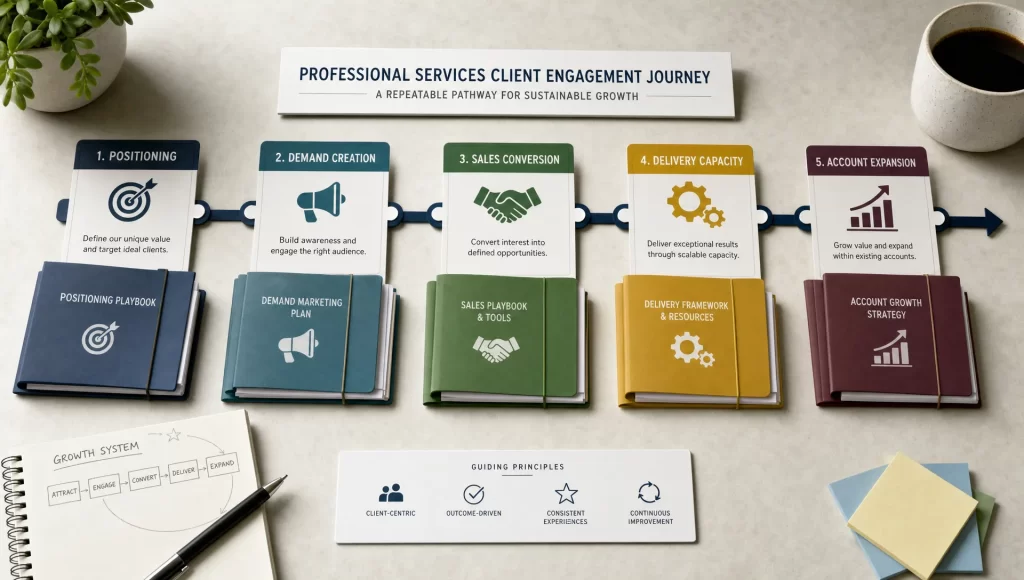
A working growth system connects five parts of the business:
| System component | Purpose | What changes when it works |
|---|---|---|
| Market focus | Defines who the firm is built to win | Better-fit opportunities and clearer messaging |
| Demand creation | Produces qualified conversations | Less dependence on referrals and founder networks |
| Sales conversion | Turns expertise into a repeatable buying journey | Higher win rates and shorter decision cycles |
| Delivery capacity | Protects quality while increasing throughput | Less senior-team bottlenecking and better margins |
| Expansion cadence | Grows existing accounts intentionally | More revenue from trusted client relationships |
The key is integration. If marketing says one thing, sales diagnoses another, and delivery solves a third problem, the firm leaks trust at every step. The goal is one commercial system that gives buyers a consistent experience from first impression to renewal or expansion.
That is also why growth systems should not be built as theoretical strategy projects. They need to be grounded in buyer behavior, sales reality, delivery economics, and the founder’s practical growth ambition. As we explain in our thinking on what really drives founder-led B2B growth, the breakthrough usually comes from converting founder intuition into a repeatable revenue system.
System 1: Sharpen market focus and positioning
Professional services firms often resist focus because they fear it will shrink the market. In practice, focus usually expands commercial performance. A clearly defined market makes the firm easier to understand, easier to refer, and easier to choose.
This does not always mean serving one narrow industry. It may mean specializing by buyer type, business stage, operational problem, regulatory environment, or strategic trigger. The test is whether your team can quickly answer three questions:
- Who do we help best?
- What expensive problem do we solve?
- Why are we a safer or sharper choice than alternatives?
Positioning must also carry commercial weight. It should shape your offers, your proof, your sales narrative, your thought leadership, and the way clients describe you when you are not in the room. For firms reaching a new stage of growth, brand should make the business easier to understand and choose, not merely more polished. This is where guidance on what growing companies prioritize when selecting a business branding agency can be useful, especially when positioning, proof, and go-to-market alignment need to work together.
A strong positioning system includes a narrow definition of the best-fit buyer, a clear economic problem, a point of view about why that problem exists, and credible proof that the firm can solve it. Without those ingredients, demand generation becomes expensive persuasion.
System 2: Build demand around expertise, not noise
Professional services firms do not need to act like media companies. They need to create enough trust with the right buyers before a sales conversation begins.
That means demand creation should be built around expertise that maps to commercial triggers. Instead of publishing broad educational content, the firm should focus on the questions buyers ask when they are close to change. Examples include why a transformation is underperforming, how to evaluate a specialist partner, what risks appear during a growth phase, or how to justify investment internally.
A practical demand system usually combines a few channels rather than chasing every trend. Executive referrals, partner relationships, outbound thought leadership, events, webinars, niche research, founder-led content, and account-based campaigns can all work. The right mix depends on deal size, buying committee complexity, and the urgency of the problem solved.
The mistake is measuring demand only by impressions or website traffic. A professional services growth system should measure commercial movement: qualified conversations, target-account engagement, referral source quality, sales-accepted opportunities, and the percentage of pipeline coming from non-founder sources.
The best demand systems make sales easier before sales begins. Buyers arrive with a clearer understanding of the problem, a stronger reason to act, and more confidence that the firm has seen their situation before.
System 3: Turn sales into a diagnostic process
In many professional services firms, sales is treated as relationship management plus proposal writing. That underestimates the complexity of the buying decision.
A strong sales system is diagnostic. It helps the buyer understand the cost of inaction, the root cause of the problem, the options available, the tradeoffs of each path, and the commercial logic for choosing your firm. This is especially important when the service is high-value, strategic, or difficult to compare.
The sales process should create consistency without making conversations robotic. At minimum, the firm needs a shared way to qualify opportunities, run discovery, identify decision criteria, map stakeholders, frame the business case, and present recommendations.
Proposals should not be beautiful documents that restart the sale. They should be written confirmation of a diagnosis the buyer already accepts. When the proposal introduces new logic, new scope, or new assumptions, the firm has skipped work earlier in the process.
A healthier conversion system often improves margins as much as win rate. Better qualification reduces wasted effort. Clearer diagnosis reduces discounting. Stronger value framing makes premium pricing easier to defend.
System 4: Scale delivery without diluting expertise
Professional services growth fails when the firm sells more work than it can deliver well. This is the hidden reason many firms resist growth. They know, consciously or not, that more revenue may create more chaos.
Delivery systems solve that problem by codifying the parts of expertise that should be repeatable while protecting the judgment that makes the firm valuable. The aim is not to commoditize the service. It is to stop reinventing the wheel every time.
Useful delivery assets include diagnostic frameworks, onboarding sequences, client meeting rhythms, decision logs, quality-control checkpoints, standard deliverables, escalation rules, and reusable insight libraries. These tools reduce variability, shorten ramp time for new team members, and help senior experts focus on the work where their judgment matters most.
This is where growth and operations become inseparable. A firm cannot scale revenue if every new client increases complexity linearly. It needs delivery architecture that preserves client outcomes while improving throughput, margin, and team capacity.

System 5: Create an account expansion cadence
Existing clients are often the most underdeveloped growth asset in a professional services firm. Not because the team ignores them, but because expansion is usually left to goodwill and timing.
A deliberate expansion system starts with understanding the client’s next problem before they formally ask for help. That requires structured account reviews, stakeholder mapping, outcome reporting, and periodic strategic conversations that are separate from day-to-day delivery.
The firm should know which accounts have expansion potential, which services logically follow the initial engagement, which stakeholders need more visibility, and which client outcomes can become proof for future opportunities.
Expansion should never feel like opportunistic upselling. In professional services, the best expansion conversations are a continuation of trusted advisory work. The client sees that the firm is paying attention to their evolving risks and ambitions.
The operating cadence that keeps systems alive
A growth system only works if it is inspected. Otherwise, it becomes a set of documents that slowly drift away from reality.
Founder-led firms need a simple revenue operating cadence. Weekly commercial reviews should look at pipeline quality, stuck deals, upcoming proposals, channel performance, and key account risks. Monthly reviews should examine win-loss patterns, margin by service line, delivery capacity, and expansion opportunities. Quarterly reviews should revisit positioning, market focus, pricing, and resource allocation.
This cadence is not bureaucracy. It is how the firm learns faster than competitors. It also helps remove founder dependency from growth by distributing commercial intelligence across the leadership team instead of keeping it in the founder’s head.
AI and automation can strengthen this cadence when used responsibly. For example, firms can summarize sales calls, identify recurring objections, analyze proposal patterns, surface at-risk accounts, and make knowledge easier for teams to access. But AI is not a substitute for commercial judgment. It is infrastructure that helps the team apply judgment faster and more consistently.
A 90-day roadmap for installing growth systems
Professional services firms do not need to rebuild everything at once. In fact, trying to do so often creates internal resistance. The better path is to identify the highest-leverage constraint, fix it, and then connect the next system.
| Timeline | Focus | Practical outcome |
|---|---|---|
| Days 1 to 30 | Diagnose the constraint | Clear view of where revenue is leaking, such as targeting, conversion, pricing, or delivery capacity |
| Days 31 to 60 | Build the first operating system | New qualification process, positioning architecture, demand engine, or delivery playbook |
| Days 61 to 90 | Install cadence and accountability | Weekly revenue review, leading indicators, owner assignments, and iteration rhythm |
The right first move depends on the business. A firm with plenty of leads but poor close rates should not start with more marketing. A firm with strong close rates but no predictable pipeline should not start by rewriting delivery playbooks. A firm with high demand and strained delivery should not keep selling custom work until capacity breaks.
This is why diagnostics matter. Growth systems work when they are sequenced around the real constraint, not the loudest symptom.
Metrics that show whether the system is working
Revenue is the ultimate outcome, but it is a lagging indicator. Professional services leaders need a balanced scorecard that shows whether the growth system is improving before revenue fully catches up.
The most useful metrics include qualified pipeline created, source of pipeline, opportunity-to-proposal conversion, proposal win rate, average sales cycle, average deal size, gross margin by service line, utilization of senior experts, client retention, account expansion revenue, and referrals generated by active clients.
The exact dashboard should be simple enough that leadership actually uses it. A complex dashboard that no one trusts is worse than a short scorecard that drives decisions every week.
The question is not whether every metric is perfect. The question is whether the firm can see cause and effect. If positioning changes, does the quality of opportunities improve? If discovery improves, does discounting fall? If delivery assets improve, does senior capacity increase? If account reviews improve, does expansion become more predictable?
That is how a growth system becomes a management system.
Frequently Asked Questions
What is a growth system for a professional services firm? A growth system is the connected set of processes, assets, metrics, and decision rhythms that help a firm create demand, convert opportunities, deliver consistently, and expand accounts. It turns expertise into repeatable commercial behavior.
Why do referrals stop being enough? Referrals are valuable, but they are rarely predictable enough to support intentional scaling. A firm that depends only on referrals may have strong reputation but limited control over timing, volume, deal fit, and market expansion.
Should a professional services firm focus on marketing or sales first? It depends on the constraint. If the firm has weak pipeline, demand creation may come first. If it has enough opportunities but poor conversion, sales diagnosis and proposal quality may matter more. If delivery is overloaded, capacity and service architecture may be the priority.
How can growth systems reduce founder dependency? Systems capture the founder’s market insight, qualification logic, sales judgment, and delivery standards so the team can apply them consistently. The founder remains important, but no longer needs to personally drive every deal or decision.
How long does it take to see results? Some improvements, such as qualification, proposal discipline, or pricing clarity, can affect revenue quickly. Larger gains from demand creation, delivery architecture, and account expansion usually compound over several quarters.
Build the growth system your expertise deserves
If your firm is growing but still depends too heavily on founder relationships, custom proposals, inconsistent demand, or senior-team heroics, the next stage is not more effort. It is better revenue architecture.
Billionaires in Boxers helps founder-led B2B companies build PE-grade growth systems through diagnostics, AI systems, fractional CRO support, sales optimization, and costed intervention roadmaps. If you want to identify the constraint holding back your professional services firm and turn expertise into scalable revenue, start with Billionaires in Boxers.
