
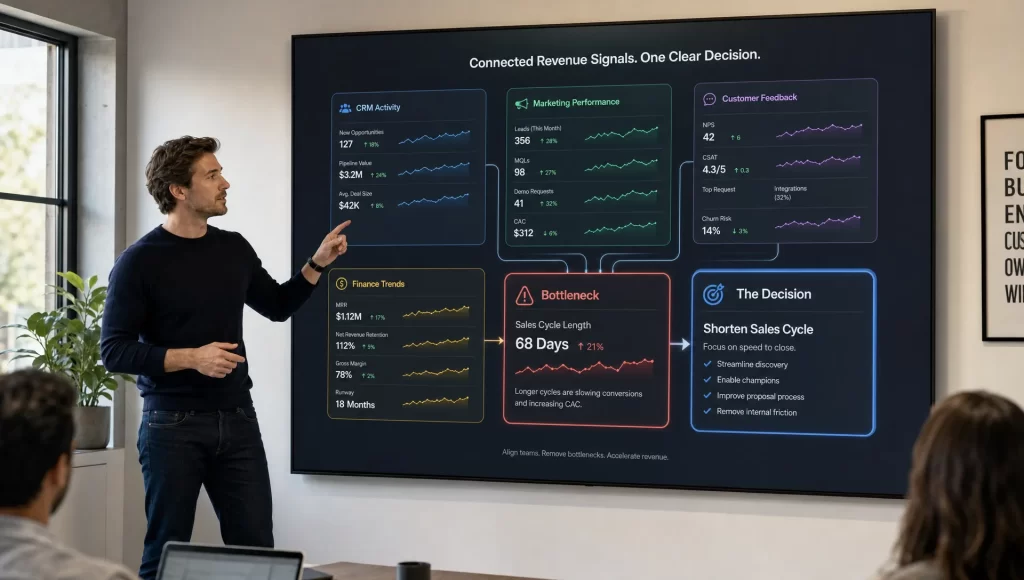
Every founder-led B2B company eventually collects more numbers than it can use.
There are CRM dashboards, marketing reports, sales activity trackers, finance exports, attribution models, call recordings, customer health scores, and AI-generated summaries. Yet the founder still ends the leadership meeting asking the same question: "So what do we actually do next?"
That gap is where growth stalls.
More data can make a business feel more sophisticated, but it does not automatically make the next move clearer. In B2B growth, strategic insight beats more data because it turns scattered evidence into a sharper commercial decision. Data tells you what happened. Strategic insight tells you what matters, why it matters, and what should change.
For founder-led companies between roughly $3M and $25M in revenue, this distinction is not academic. It is often the difference between scaling a repeatable revenue engine and adding another layer of reporting to a system that is already underperforming.
What strategic insight actually means
Strategic insight is not a clever observation, a dashboard screenshot, or a consultant’s polished slide. It is a commercially useful interpretation of evidence that changes the decision you make.
A strong strategic insight usually combines five inputs:
- Quantitative data from sales, marketing, finance, customer success, and operations.
- Qualitative evidence from sales calls, customer interviews, lost-deal reviews, and frontline team feedback.
- Market context, including buyer behavior, category maturity, regulation, competition, and budget cycles.
- Internal operating reality, such as team capability, founder involvement, process maturity, and capacity.
- Commercial judgment about where effort will create the highest return.
That last part matters. Insight requires judgment. It is not simply "the data says X." In founder-led B2B, the most useful insights often come from combining founder intuition with structured commercial evidence. If the founder’s instincts stay trapped in their head, the business depends on individual brilliance. If those instincts are translated into a revenue system, the company can scale more predictably. That is why sustainable growth often begins by understanding what really drives business growth in founder-led B2B rather than chasing isolated metrics.
Data is abundant. Useful interpretation is scarce.
The modern B2B company rarely suffers from having no data. It suffers from having too many disconnected signals.
Marketing tracks traffic, conversions, email engagement, content performance, paid spend, and lead sources. Sales tracks pipeline, activity, close rates, stage conversion, deal velocity, and forecast categories. Customer success tracks retention, expansion, satisfaction, usage, onboarding, and support tickets. Finance tracks margin, cash, revenue recognition, collections, and cost to serve.
Each function can be "right" inside its own reporting lane while the company still makes the wrong growth decision.
For example, marketing may report that lead volume is up. Sales may report that lead quality is down. Finance may report that customer acquisition cost is rising. Customer success may report that newer customers are harder to onboard. The data points are all valid, but the strategic question is bigger: are you attracting the wrong segment, selling the wrong promise, onboarding the wrong way, or expanding into the wrong market too early?
That is not a reporting problem. It is an insight problem.
Harvard Business Review’s classic work on competing on analytics made the case that data creates advantage when it is embedded into how the business competes and operates. The same principle applies today, even with far more advanced tools. Analytics only improves growth when it changes decisions, priorities, and execution.
Why more data often makes B2B growth harder
The promise of more data is clarity. The reality is often more debate.
In founder-led B2B companies, the leadership team may add dashboards because the business feels complex. But if the underlying revenue system is not clearly understood, more dashboards can simply create more angles from which to argue.
Data describes symptoms, not the real constraint
A declining win rate is data. It does not tell you whether the problem is poor qualification, weak sales messaging, discount pressure, competitor repositioning, product gaps, or a buying committee that has changed.
A longer sales cycle is data. It does not tell you whether buyers are more risk-averse, your champion lacks executive access, your proposal process is slow, or your target segment no longer sees the problem as urgent.
This is why growth strategy should begin with the real bottleneck. If you misdiagnose the constraint, every extra report sends you deeper into the wrong fix. A business with a positioning problem does not need more SDR activity. A business with weak follow-up does not need more ad spend. A business with poor retention does not need a bigger top-of-funnel until it knows why customers churn.
The better question is not "What does the dashboard say?" It is "What is the revenue constraint this data is pointing toward?" For a deeper operating approach, it helps to build strategy around your real revenue constraint rather than the loudest symptom.
Data can reward visible metrics over causal metrics
B2B teams often over-focus on metrics that are easy to count. Website visits, form fills, email opens, demo bookings, call volume, and proposals sent are visible. They are useful, but they are not always causal.
A team can increase sales activity while conversion quality gets worse. Marketing can increase MQLs while pipeline value stays flat. A founder can hire more salespeople while the company still lacks a repeatable sales motion.
Strategic insight asks whether the metric is connected to the economic outcome that matters. In B2B growth, the best metrics are not always the most visible. They are the ones that explain movement in revenue quality, sales efficiency, customer fit, margin, retention, and expansion potential.
Data often arrives without context
Most dashboards strip away the story behind the numbers. They show the deal moved stages, but not the political tension inside the buyer’s organization. They show churn, but not the expectation mismatch created during the sales process. They show low conversion, but not the recurring objection prospects raise on calls.
This is especially dangerous when CRM hygiene is inconsistent. A dashboard built on incomplete stage updates, vague loss reasons, and inconsistent lead source attribution may look precise without being reliable. The result is false confidence.
Strategic insight brings the context back in. It connects the number to the behavior behind it.
Data, analysis, and insight are not the same thing
Many teams confuse reporting with insight. The distinction is simple but important.
| Layer | What it tells you | Common B2B mistake | Better strategic question |
|---|---|---|---|
| Data | What happened | Treating raw numbers as the answer | Is this data accurate, relevant, and segmented correctly? |
| Reporting | How performance is trending | Reviewing dashboards without changing decisions | Which trend actually affects revenue quality? |
| Analysis | What patterns appear | Stopping at correlation | What explains the pattern and what else could be true? |
| Strategic insight | What decision should change | Failing to translate learning into action | What should we stop, start, narrow, or sequence differently? |
A founder does not need fewer facts. They need a better path from fact to decision.
A simple example: "We need more leads"
One of the most common growth assumptions in B2B is that the business needs more leads. Sometimes it does. Often, that conclusion is premature.
Imagine a company with flat revenue for three quarters. The dashboard shows lead volume has declined by 18%. The obvious answer is to increase demand generation. Spend more on paid channels. Publish more content. Hire another SDR. Add another outbound tool.
But a deeper review shows something different. The best-fit segment still converts well, has shorter sales cycles, and expands after onboarding. The weaker segment consumes most SDR time, asks for discounts, takes longer to close, and churns faster. Marketing has been optimizing for volume because the company never redefined ICP after expanding into a new market.
The strategic insight is not "lead volume is down." The insight is: "We are under-investing in the segment that produces profitable growth and over-investing in a segment that creates activity without quality revenue."
That insight changes the decision. The company may need sharper ICP rules, different messaging, a stricter qualification process, better account selection, and a narrower outbound motion. More leads would not solve the problem. Better commercial focus would.

Where strategic insight creates the biggest growth advantage
Strategic insight matters most when the company must make trade-offs. Founder-led B2B businesses cannot do everything at once. They have limited leadership bandwidth, limited cash, limited management depth, and often too much founder dependency in sales or key accounts.
Insight helps decide where the next dollar, hire, process change, or leadership focus should go.
Choosing the right market segment
Most B2B companies have more than one possible customer profile. The question is not just who can buy. It is who should buy first, who buys fastest, who retains longest, who expands, who has a painful enough problem, and who fits the delivery model.
Data may show revenue by segment. Strategic insight explains which segment deserves disproportionate focus.
A $5M company trying to sell to too many segments at once will often create complexity faster than revenue. A sharper segment choice can improve messaging, sales training, customer proof, onboarding, pricing, and product roadmap decisions.
Improving sales productivity
If sales productivity is weak, more data might show activity gaps, stage leakage, or low conversion. But insight identifies the cause.
Is the team spending time on poor-fit accounts? Are reps unable to create urgency? Is the founder still closing the complex deals because the sales narrative has not been codified? Is pricing creating friction? Are proposals too bespoke? Is sales leadership coaching the right behaviors?
The answer determines the fix. Training, process, ICP discipline, offer design, and leadership cadence are different interventions. Without insight, companies often choose the most familiar remedy rather than the most effective one.
Deciding when to use AI
AI can process huge amounts of information, summarize calls, identify patterns, segment accounts, and help surface pipeline risks. But AI does not remove the need for strategic judgment. It magnifies the quality of the questions you ask.
If you ask AI to optimize a broken sales process, it may help you do the wrong thing faster. If you feed it poor CRM data, vague definitions, and unclear commercial priorities, it may produce polished noise.
Used correctly, AI can accelerate the path from data to insight. It can help leadership teams spot patterns earlier and make more consistent commercial decisions. The key is connecting AI to the revenue questions that matter, which is why AI business intelligence improves commercial decisions when it is designed around decision-making, not just reporting.
How to turn data into strategic insight
The process does not need to be complicated. It does need to be disciplined.
Start with the decision, not the dashboard
Before reviewing reports, define the decision the business needs to make. Should we hire another salesperson? Should we narrow the ICP? Should we enter a new market? Should we change pricing? Should we invest in outbound, partnerships, paid acquisition, or customer expansion?
A clear decision filters the data. Without that filter, leadership teams drift into performance theater, reviewing numbers because the numbers exist.
Segment before you average
Averages hide the truth. Blended win rate, blended CAC, blended sales cycle, and blended churn can conceal the difference between a high-quality customer segment and a low-quality one.
Segment by customer profile, deal size, industry, source, sales motion, geography, product line, and use case where relevant. The goal is not to create endless slices. The goal is to separate profitable patterns from misleading averages.
Averages answer "How are we doing?" Segments answer "Where is growth actually working?"
Pair numbers with frontline evidence
Quantitative data tells you where to look. Qualitative evidence tells you what to listen for.
Lost-deal reviews, sales call recordings, customer interviews, onboarding feedback, and renewal conversations often reveal the cause behind the metric. If win rates are falling, listen to the objections. If onboarding is slow, review what was promised during sales. If expansion is weak, ask whether customers ever reached the outcome they bought.
The most powerful insights often appear when the boardroom and the frontline look at the same problem together.
Force the "so what" and the "now what"
Every analysis should end with two questions: "So what?" and "Now what?"
"So what?" identifies the meaning. "Now what?" defines the action. If a report does not change a decision, priority, owner, sequence, or test, it is not yet insight.
A useful insight should be specific enough to guide action. For example, "Our enterprise pipeline is weak" is too vague. "Enterprise opportunities sourced through partner referrals convert 2.3 times better than cold outbound because they enter with executive trust, so we should shift Q3 outbound capacity toward partner-sourced target accounts" is much closer to a strategic insight.
Only use numbers that your own data can support. The point is not to invent precision. The point is to make the reasoning testable.
Signs your company has a data problem disguised as a strategy problem
Some leadership teams think they need better reporting when they actually need better commercial diagnosis. Watch for these patterns:
- Every meeting ends with a request for another report, but few decisions change.
- Teams argue over attribution more than customer behavior.
- KPIs improve while revenue quality does not.
- Sales, marketing, and customer success each have their own version of the truth.
- The founder still has to interpret what the data means before anyone acts.
- The company keeps adding tools without simplifying the operating model.
- Strategy changes based on the most recent anecdote or the loudest department.
None of these mean data is useless. They mean the business lacks a strong enough insight layer between information and action.
The operating rhythm that makes insight repeatable
Strategic insight should not depend on a quarterly offsite or a founder’s late-night realization. It should become part of the revenue operating rhythm.
A practical cadence might include a weekly revenue decision meeting, a monthly constraint review, and a quarterly market recalibration. The weekly meeting focuses on active decisions and execution blockers. The monthly review asks whether the current growth constraint has shifted. The quarterly recalibration tests whether market assumptions, ICP, positioning, and competitive dynamics still hold.
The discipline is not in meeting more often. It is in making each meeting decision-led.
| Cadence | Purpose | Key question |
|---|---|---|
| Weekly revenue decision meeting | Resolve active blockers and execution priorities | What decision must be made this week to protect momentum? |
| Monthly constraint review | Identify the main bottleneck in the revenue system | What is now limiting growth most? |
| Quarterly market recalibration | Re-test market, ICP, offer, and competitive assumptions | What has changed outside the business that should change our strategy? |
This is how insight becomes operational. The company stops treating strategy as a document and starts treating it as a decision system.
More data is useful only when it sharpens judgment
The best B2B growth companies are not anti-data. They are anti-noise.
They measure what matters, question what looks obvious, segment before they average, listen to customers, and translate learning into action. They do not use data to avoid judgment. They use data to improve judgment.
For founder-led B2B companies, this is especially important because the founder is often the original source of strategic insight. They know the market, the customer, the offer, and the sales conversation at a level no dashboard can fully capture. The challenge is to turn that implicit judgment into a system the team can use without waiting for the founder to interpret every signal.
That is the real advantage of strategic insight. It does not simply explain the past. It improves the next decision.
Frequently Asked Questions
What is strategic insight in B2B growth? Strategic insight is the interpretation of data, customer evidence, market context, and commercial judgment that leads to a better growth decision. It explains what matters, why it matters, and what action should change.
Why is more data not enough to grow a B2B company? More data can show symptoms, but it does not automatically reveal the root cause of stalled growth. Without interpretation, teams may optimize visible metrics while missing the real constraint in the revenue system.
How is strategic insight different from business intelligence? Business intelligence organizes and visualizes information. Strategic insight uses that information to make better choices about markets, customers, sales motions, pricing, hiring, and investment priorities.
Can AI create strategic insight? AI can help surface patterns, summarize evidence, and accelerate analysis, but it still needs clear commercial questions, reliable data, and human judgment. AI is most valuable when it supports decision-making rather than simply producing more reports.
How much data does a founder-led B2B company need? Enough to make the next important decision with confidence. The goal is not maximum data. The goal is relevant, accurate, segmented information that helps identify the real revenue constraint and the best next move.
Turn your data into revenue decisions
If your team has dashboards but not direction, the next step is not another reporting layer. It is a sharper commercial diagnosis.
Billionaires in Boxers helps founder-led B2B companies use PE-grade diagnostics, AI systems, and fractional CRO support to identify the real revenue constraint and build a practical path to scalable growth. If you want more than data, start with the insight that tells you what to do next.
