
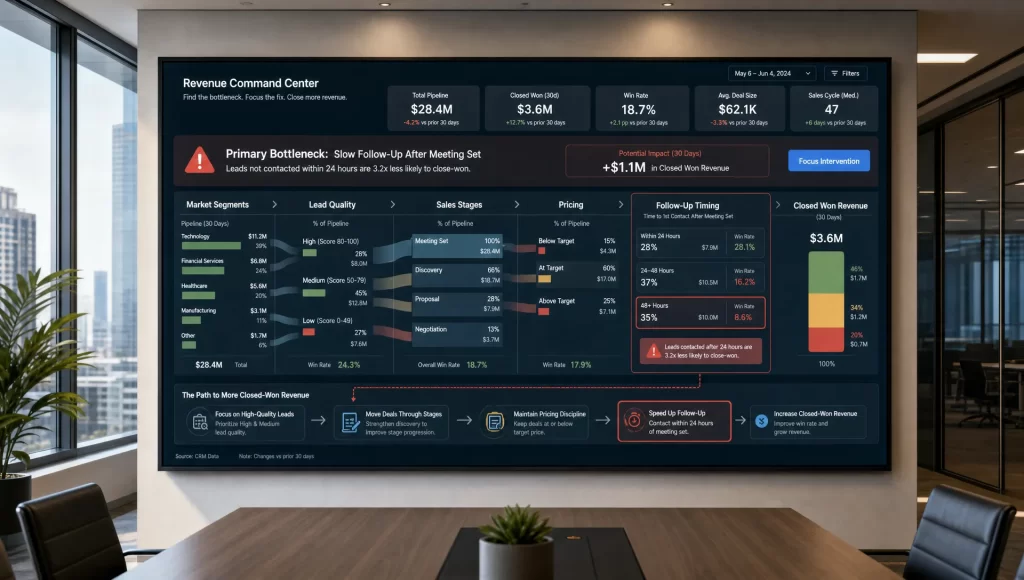
Sales and marketing consulting services should not be judged by how many campaigns launch, how many workshops happen, or how polished the new playbook looks. They should be judged by whether revenue moves in a way the business can measure, repeat, and scale.
For founder-led B2B companies, that distinction matters. At $3M to $25M in revenue, growth problems are rarely isolated to “not enough leads” or “the sales team needs more training.” The real constraint is usually somewhere across the revenue system: positioning, targeting, pipeline quality, sales execution, pricing, handoffs, follow-up, CRM discipline, or leadership cadence.
The best sales and marketing consulting services drive ROI because they connect those pieces. They do not treat marketing as a lead factory and sales as a closing department. They engineer the entire path from market selection to closed-won revenue.
What ROI-driven sales and marketing consulting really means
ROI-driven consulting starts with one principle: every recommendation must connect to a commercial outcome.
That sounds obvious, but many engagements skip it. A consultant may redesign a website, rebuild paid ads, write email sequences, train sales reps, or implement a CRM without first proving that those activities address the highest-value revenue constraint.
A better engagement begins by asking questions like these:
- Where is revenue leaking today?
- Which segment has the highest conversion potential and margin profile?
- What prevents qualified buyers from entering the pipeline?
- Where do deals slow down, discount, or die?
- What repeatable system would reduce founder dependency?
The goal is not to “do marketing” or “improve sales” in the abstract. The goal is to identify the highest-impact intervention and execute it with enough discipline that the result shows up in pipeline, conversion, average contract value, sales cycle, retention, expansion, or margin.
That is why ROI-driven consulting often looks less glamorous than a big brand campaign. It may involve tightening the ICP, rewriting the offer narrative, improving qualification, fixing sales stages, building better follow-up logic, or giving the founder a cleaner revenue operating rhythm. Those moves are not always flashy, but they often create revenue faster than another top-of-funnel experiment.
Why sales and marketing ROI breaks in founder-led B2B companies
Founder-led B2B companies often grow through force of personality, referrals, reputation, and founder involvement in key deals. That can work well in the early stages. It becomes a constraint when the company needs consistent pipeline and predictable close rates without the founder personally pushing every opportunity forward.
At this stage, sales and marketing problems tend to blur together. Marketing may be generating leads, but sales says they are low quality. Sales may be closing some deals, but only when the founder joins. Messaging may sound impressive, but buyers do not immediately understand the specific pain solved. The CRM may contain data, but leadership cannot use it to make confident decisions.
Modern B2B buying makes this harder. Gartner’s research on the B2B buying journey shows that buying groups are complex, information-rich, and nonlinear. Buyers compare vendors, build internal consensus, revisit requirements, and consume information before ever speaking to sales.
That means sales and marketing cannot operate as separate functions. Marketing has to shape demand, educate buying committees, and create sales-ready conversations. Sales has to feed market intelligence back into messaging, offers, objections, and content. Leadership has to measure the full system, not just departmental activity.
When ROI breaks, it is usually because the company is optimizing one part of the system while another part remains weak.
The sales and marketing consulting services most likely to drive ROI
Not every consulting service creates ROI at the same speed. Some services create clarity, some create capability, and some create direct revenue lift. The right mix depends on the company’s constraint, but the following services tend to matter most for founder-led B2B growth.
Revenue diagnostic and constraint mapping
A revenue diagnostic should come before major execution. It establishes where the business is actually stuck.
This includes reviewing pipeline sources, conversion rates, sales cycle length, win/loss patterns, pricing behavior, handoffs, CRM accuracy, customer segments, and founder involvement. The output should not be a vague strategy deck. It should be a prioritized, costed roadmap that shows which interventions are likely to create ROI first.
If you are comparing options, this is closely related to understanding which consulting services create ROI first, because the sequence of work can matter as much as the work itself.
ICP, positioning, and offer clarity
Many B2B companies do not have a lead problem. They have a relevance problem.
If the ideal customer profile is too broad, marketing wastes budget attracting prospects who were never likely to buy. If positioning is generic, strong-fit buyers do not see why the company is different. If the offer is difficult to understand, sales has to spend too much time explaining before it can sell.
Consulting that sharpens ICP, messaging, and offer architecture can improve ROI across the whole funnel. Paid media performs better. Outbound gets clearer. Website conversion improves. Sales calls become more direct. Referral partners know who to send.
Pipeline generation strategy
Pipeline generation consulting should not simply pick a channel and start spending. It should define the right motion for the market, buyer, price point, and sales capacity.
For some companies, the answer may be account-based outbound. For others, it may be partner-led growth, founder-led content, paid search, events, referral systems, or vertical-specific campaigns. The channel matters, but the strategy behind it matters more.
A good consultant will connect pipeline generation to sales readiness. A campaign that creates demand but overwhelms the sales team, attracts the wrong accounts, or lacks follow-up discipline will not produce strong ROI.
For a deeper look at the marketing side of this equation, Billionaires in Boxers has covered how marketing consulting services can support sales growth when they are designed around revenue rather than isolated campaign activity.
Sales process optimization
Sales optimization is often one of the fastest routes to ROI because it works with demand the company already has.
This may include improving discovery, qualification, objection handling, proposal structure, follow-up, deal review, sales stages, or negotiation discipline. In founder-led companies, it often includes extracting what the founder does intuitively and turning it into a repeatable sales system the team can use.
Small improvements can be meaningful. If the company already has a healthy opportunity flow, even a modest lift in win rate, average deal size, or sales cycle speed can produce significant incremental revenue.
Revenue operations and AI systems
Revenue operations supports ROI by making the system visible and manageable. Without accurate data, leadership cannot see which channels produce quality pipeline, which reps need support, which deals are stuck, or which interventions are working.
RevOps work may include CRM cleanup, sales stage design, dashboarding, attribution logic, handoff processes, forecasting, and reporting cadence. AI systems can support this by helping with lead research, account prioritization, call analysis, content workflows, follow-up drafts, or internal knowledge retrieval.
The key is to avoid technology theater. Tools only create ROI when they reinforce a clear revenue process.
Market expansion and growth architecture
Once the core motion works, consulting can help identify the next growth lane. This might mean expanding into a new vertical, targeting larger accounts, refining partner channels, building a land-and-expand motion, or repositioning around a more valuable problem.
Market expansion has strong upside, but it can also dilute focus. ROI-focused consulting should validate the expansion path before the company commits major budget or team capacity.
| Consulting focus | Best ROI lever | What to measure |
|---|---|---|
| Revenue diagnostic | Prioritization and focus | Revenue leaks found, intervention roadmap, expected impact |
| ICP and positioning | Better-fit demand | Conversion rate, qualified pipeline, sales feedback |
| Pipeline generation | More sales-ready opportunities | Opportunity creation, cost per opportunity, pipeline value |
| Sales optimization | Higher conversion from existing demand | Win rate, sales cycle, average deal size |
| RevOps and AI systems | Better visibility and execution | Forecast accuracy, CRM hygiene, response speed |
| Market expansion | New scalable growth lanes | Segment conversion, margin, payback period |

How to calculate ROI before hiring a consultant
Before hiring any sales and marketing consultant, establish the commercial baseline. Without a baseline, every result becomes debatable.
At minimum, track current monthly qualified pipeline, opportunity-to-close rate, average contract value, gross margin, sales cycle length, customer acquisition cost, and revenue generated by source. If those numbers are incomplete, the first consulting milestone may be to clean up measurement.
A simple ROI formula is:
Consulting ROI = Incremental gross profit attributable to the work ÷ total consulting and implementation cost
Gross profit is a better measure than revenue alone because some growth is expensive or low-margin. A campaign that adds revenue but requires heavy discounting, high servicing costs, or excessive sales effort may look good at the top line while weakening the business.
Here is a practical example. Suppose a B2B company spends $40,000 on consulting and implementation. Over the next two quarters, the work contributes to $180,000 in new annualized revenue at a 60% gross margin. That creates $108,000 in gross profit. The ROI would be 2.7x before accounting for any ongoing benefits.
Of course, attribution is never perfect. Markets change, sales teams improve, and existing deals may close regardless. That is why ROI should be evaluated through leading and lagging indicators. Leading indicators show whether the system is improving before revenue fully lands. Lagging indicators confirm whether the improvements translated into commercial results.
Useful leading indicators include qualified opportunity rate, meeting-to-opportunity conversion, sales response time, proposal acceptance rate, stage progression, and buyer engagement. Useful lagging indicators include closed-won revenue, gross margin, win rate, sales cycle, expansion revenue, and payback period.
What a good engagement should include
A strong sales and marketing consulting engagement should feel structured, commercial, and accountable. It should not begin with a prepackaged set of tactics. It should begin with diagnosis, then move into execution against the highest-value constraints.
The strongest engagements usually include these components:
- A clear diagnostic phase that identifies revenue leaks and growth constraints.
- A prioritized roadmap that distinguishes quick wins from structural fixes.
- Sales and marketing alignment around ICP, messaging, offers, and handoffs.
- Implementation support, not just advice.
- A leadership cadence for reviewing metrics, decisions, and blockers.
- Enablement that leaves the company with better systems after the consultant exits.
This is also where a consulting partner’s operating experience matters. A company at $5M does not need the same playbook as a company at $50M. Founder-led teams need practical changes that fit their stage, capacity, and cash flow. They also need help deciding what not to do, because focus is often the fastest path to ROI.
If the business lacks clarity on where revenue is leaking, a structured revenue audit can be a useful first step before committing to a broader transformation.
Warning signs that consulting will not drive ROI
Some consulting engagements look professional but are unlikely to create measurable revenue lift. The warning signs usually appear early in the sales process.
Be cautious if a consultant leads with a channel before diagnosing the business. “You need paid ads,” “you need outbound,” or “you need a rebrand” may be true, but only after the constraint is understood.
Be equally cautious if the proposal is activity-heavy but commercially vague. Deliverables such as workshops, slide decks, content calendars, automation flows, or training sessions are only valuable if they connect to revenue outcomes.
Other red flags include:
- No baseline metrics before work begins.
- No connection between marketing activity and sales conversion.
- No plan for adoption by the internal team.
- No prioritization based on cost, speed, and expected return.
- No willingness to challenge the founder’s assumptions.
- No measurable definition of success.
A good consultant should be comfortable saying, “This is not the first thing I would fix.” That kind of restraint is often a sign they are thinking like an operator, not a vendor trying to sell the largest possible scope.
Choosing the right services for your stage
The right sales and marketing consulting services depend on the maturity of the revenue engine.
A company around $3M to $7M often needs founder knowledge converted into repeatable messaging, sales process, and pipeline discipline. The ROI opportunity is usually in reducing dependence on referrals and founder-led closing.
A company around $7M to $15M may need stronger management systems. At this stage, the business often has sales and marketing activity, but the pieces are not yet producing predictable growth. ROI may come from better qualification, vertical focus, sales enablement, CRM discipline, and leadership cadence.
A company around $15M to $25M may need scalable architecture. The focus often shifts to market expansion, team structure, RevOps, AI-assisted workflows, offer segmentation, and reducing complexity as the company grows.
These ranges are not rigid. The real question is simpler: which constraint, if fixed, would create the most profitable revenue fastest?
Frequently Asked Questions
What are sales and marketing consulting services? Sales and marketing consulting services help companies improve how they attract, convert, and retain customers. In B2B, this often includes positioning, pipeline generation, sales process optimization, revenue operations, customer segmentation, and go-to-market strategy.
How do sales and marketing consultants drive ROI? They drive ROI by finding the highest-value revenue constraint and fixing it in a measurable way. That may mean improving lead quality, increasing win rates, shortening the sales cycle, raising average deal value, improving follow-up, or creating better visibility across the revenue system.
Should a company hire a sales consultant or a marketing consultant first? It depends on the constraint. If there is strong demand but poor conversion, sales optimization may create ROI first. If the sales team lacks enough qualified opportunities, marketing and pipeline strategy may come first. If the source of the problem is unclear, start with a revenue diagnostic.
How long does it take to see ROI from consulting? Some improvements, such as better qualification, follow-up, or proposal discipline, can show leading indicators within weeks. Revenue impact usually depends on sales cycle length. Complex B2B companies should evaluate both early pipeline metrics and closed-won results over time.
What makes consulting fail to produce ROI? Consulting fails when it focuses on activity instead of constraints, when recommendations are not implemented, when sales and marketing remain disconnected, or when success is not measured against a commercial baseline.
Build a revenue system where sales and marketing compound
Sales and marketing consulting services drive ROI when they are built around the full revenue system, not isolated tactics. For founder-led B2B companies, the opportunity is often to turn founder intuition into a scalable operating model that improves pipeline, conversion, visibility, and growth decisions.
Billionaires in Boxers works with founder-led B2B businesses through PE-grade diagnostics, AI systems, and fractional CRO support designed to engineer scalable growth. If your company is generating revenue but wants a clearer path to profitable acceleration, start with the Revenue Acceleration Diagnostic and identify the interventions most likely to move revenue first.
