
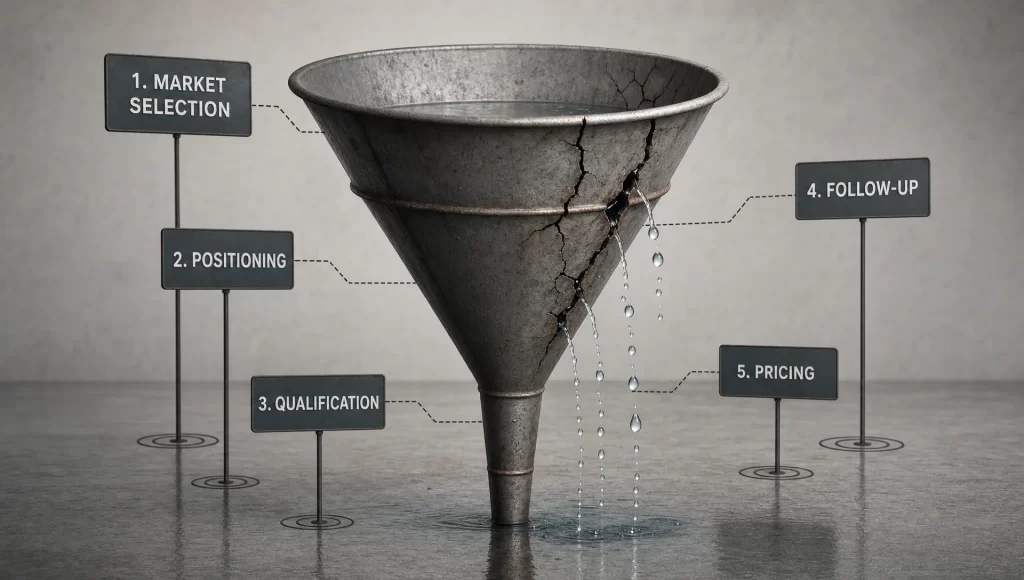
Most founder-led B2B companies hire a marketing consultant because something feels too slow: not enough leads, inconsistent pipeline, weak conversion, or too much dependence on the founder to close deals.
But the visible marketing symptom is rarely the whole problem.
A good business marketing consultant should not simply add campaigns, rewrite a few landing pages, or recommend the channel they already know how to sell. Their real job is to find and fix the constraints that stop market attention from turning into qualified pipeline, sales momentum, and scalable revenue.
For companies around $3M to $25M in revenue, that distinction matters. At this stage, growth is often no longer blocked by effort. It is blocked by unclear focus, inconsistent messaging, weak handoffs, poor commercial data, or a sales process that still relies too heavily on founder instinct.
Start with the revenue constraint, not the marketing wish list
The first thing a consultant should fix is the diagnosis.
If they start with channel recommendations before understanding the revenue system, they are guessing. A better consultant will ask where revenue is actually leaking: market selection, positioning, offer clarity, conversion, sales qualification, follow-up, pricing, or customer expansion.
That is especially important in modern B2B buying. Gartner’s B2B buying journey research has shown that buyers spend much of their journey researching independently, comparing options, and building internal consensus before they speak with suppliers. If your positioning is vague, your proof is thin, or your buying path is confusing, prospects may disqualify you before your sales team ever gets a chance.
So the starting point is not, “How do we get more traffic?” It is, “What is preventing the right companies from understanding, trusting, and buying from us?”
Fix 1: ICP focus and market selection
Many founder-led companies grow through referrals, relationships, and opportunistic wins. That can work beautifully in the early years. But as the business scales, the same pattern can create a scattered customer base, unclear messaging, and unpredictable acquisition.
A business marketing consultant should sharpen the ideal customer profile, not as a theoretical persona exercise, but as a commercial filter. The right ICP should tell the company where to focus, what to say, which proof to use, which deals to decline, and which channels are worth funding.
The consultant should look at real revenue data, not just leadership opinions. Which segments have the highest win rates? Which deals close fastest? Which customers expand? Which industries understand the problem without heavy education? Which deals consume delivery capacity without producing margin?
| Symptom | Likely issue | What the consultant should fix |
|---|---|---|
| Plenty of leads, few qualified opportunities | ICP is too broad | Define tighter segment criteria and disqualification rules |
| Long sales cycles with low urgency | Target market lacks a trigger event | Identify buying moments, pain intensity, and timing signals |
| Founder customizes every pitch | Use cases are unclear | Package repeatable problems, outcomes, and proof points |
| Sales wins on relationship, not differentiation | Positioning is weak | Clarify why this company, why now, and why this solution |
| Marketing performs in one segment but not another | Market focus is diluted | Prioritize the highest-converting segment before scaling spend |
The uncomfortable part is that good ICP work usually narrows the market before it expands it. That is not a weakness. It is how a company creates repeatability.
Fix 2: Positioning that makes sales easier
Positioning is not a tagline. It is the answer to four questions your buyer is already asking:
Why should we care? Why should we act now? Why should we trust you? Why should we choose you over the alternative?
If those answers are unclear, marketing creates attention but sales has to rebuild the argument from scratch on every call. That slows revenue, weakens conversion, and keeps the founder trapped in key deals.
A strong consultant should interview customers, lost prospects, salespeople, and delivery leaders to understand how the market describes the problem. Then they should translate that into practical commercial assets: website messaging, sales narratives, outbound angles, case study structure, landing pages, and objection-handling content.
This is where marketing becomes a sales multiplier. The message should not simply sound polished. It should make the prospect feel understood, make the cost of inaction obvious, and make the next step feel low-risk.
If you want a broader view of this principle, the same logic applies when a marketing consultant fixes pipeline, not just ads: the real work is connecting marketing decisions to sales outcomes.
Fix 3: Offer clarity and the conversion path
Sometimes marketing looks weak because the offer is hard to buy.
This is common in expert-led, technical, or consultative B2B companies. The company knows it creates value, but the buyer cannot quickly understand what is being offered, what happens next, what risk is involved, or what success looks like.
A consultant should examine the offer through the buyer’s lens. Is the entry point clear? Is the scope easy to understand? Is the promised outcome specific enough? Is there proof that reduces perceived risk? Does the call to action match the buyer’s level of readiness?
For many B2B companies, the problem is not that prospects are uninterested. It is that the path from interest to sales conversation is too vague.
A consultant should help answer:
- What is the first meaningful step a buyer can take without overcommitting?
- What evidence does the buyer need before involving other stakeholders?
- What objections or risks should be addressed before the sales call?
This might result in a better diagnostic offer, a clearer consultation flow, a stronger case study library, a pricing conversation framework, or a more useful demo structure. The point is not to make marketing louder. It is to make buying easier.
Fix 4: Pipeline quality, not lead volume
Lead volume is one of the easiest numbers to inflate and one of the easiest numbers to misread.
A consultant who celebrates more leads without inspecting quality can make the revenue problem worse. Sales gets busier, conversion drops, trust between teams erodes, and leadership loses confidence in marketing.
A serious business marketing consultant should build a source-to-revenue view of pipeline. That means looking beyond form fills and clicks into qualified opportunities, stage progression, deal size, sales cycle length, close rate, and reasons for loss.
Marketing should know which sources produce real conversations, which conversations become opportunities, and which opportunities become profitable customers. If that data is missing or unreliable, fixing measurement becomes part of the marketing work.
Fix 5: The sales handoff and enablement system
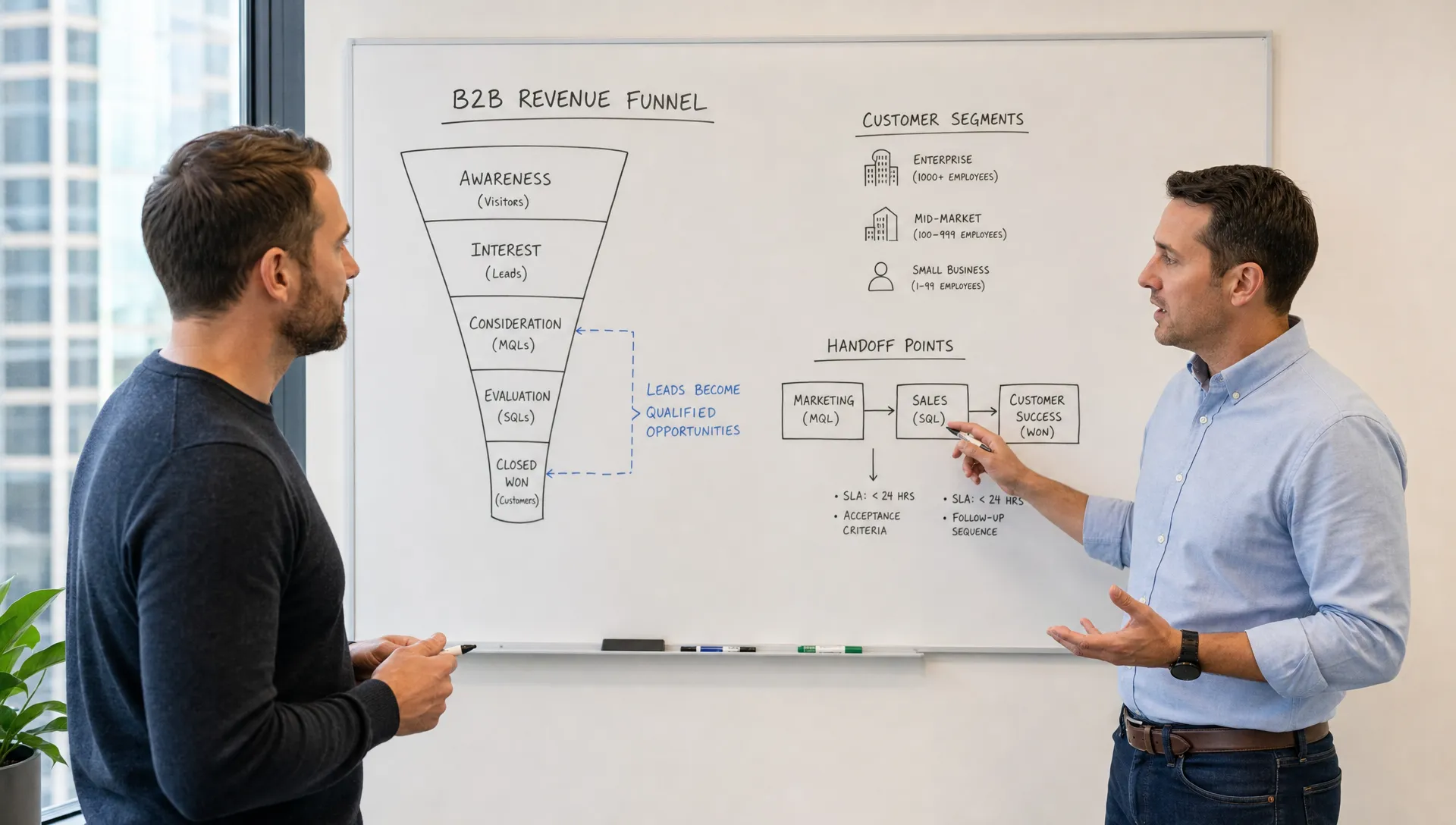
In founder-led B2B companies, sales and marketing problems often hide in the handoff.
Marketing may believe it is sending qualified leads. Sales may believe those leads are weak. The founder may believe both teams are missing the point because the best deals still require founder involvement.
A consultant should make the handoff explicit. What qualifies a lead? What context should sales receive? How quickly should follow-up happen? What messaging was the prospect exposed to before the call? What objections should the salesperson expect? What content should be used after the first conversation?
This is not just process hygiene. It affects revenue velocity.
Sales enablement should also capture the founder’s best thinking. Many founders have powerful pattern recognition: they know which pain points matter, which objections are fake, and which buyer signals indicate urgency. But if that knowledge stays in the founder’s head, the company cannot scale the sales motion.
A consultant should turn that tribal knowledge into repeatable assets: discovery questions, qualification criteria, proposal language, objection responses, proof points, and follow-up sequences.
Fix 6: Measurement that shows cause and effect
Weak marketing reporting focuses on activity. Strong marketing reporting explains movement.
A consultant should not drown the founder in dashboards. They should build a simple operating scorecard that helps leadership make better decisions. The goal is to understand what is working, what is stuck, and what should change next.
| Area | Weak reporting | Useful reporting |
|---|---|---|
| Website | Traffic and page views | Visitor-to-conversation conversion by segment or intent |
| Paid campaigns | Cost per click | Cost per qualified opportunity and pipeline value influenced |
| Content | Posts published | Content that supports sales conversations and reduces objections |
| Open rates | Replies, booked meetings, reactivated opportunities, and deal influence | |
| Sales handoff | Leads passed to sales | Speed-to-lead, acceptance rate, conversion to opportunity |
| Pipeline | Total lead count | Qualified pipeline, stage movement, close rate, and loss reasons |
This does not require perfect attribution. In complex B2B sales, attribution will always have limits. But leadership still needs a clear enough view to decide whether the constraint is demand creation, qualification, conversion, sales execution, or offer-market fit.
If the numbers are messy, start by running a revenue audit to locate the leaks before adding more activity.
Fix 7: The operating cadence for revenue improvement
A strategy document does not fix marketing. An operating rhythm does.
Once the main constraints are identified, the consultant should help the company establish a cadence for testing, learning, and implementation. That usually means a small number of focused initiatives, clear ownership, and a weekly or biweekly review of evidence.
The best consultants avoid random acts of marketing. They do not launch a new campaign every time the founder has a new idea. They create a backlog of experiments, prioritize by revenue impact, and define what success or failure will mean before the work begins.
A practical first 90 days might look like this:
| Timeframe | Main focus | Expected output |
|---|---|---|
| Days 1 to 30 | Diagnose constraints | ICP clarity, revenue leak map, messaging gaps, pipeline baseline |
| Days 31 to 60 | Fix conversion foundations | Positioning updates, sales enablement assets, offer and CTA improvements |
| Days 61 to 90 | Scale what shows signal | Channel tests, reporting cadence, handoff process, prioritized growth plan |
The exact sequence depends on the business. But the principle is consistent: diagnose before scaling, fix the bottleneck before adding spend, and use evidence rather than opinion to decide what comes next.
What a consultant should not fix first
Not every visible marketing issue deserves immediate attention.
A new logo will not fix weak market selection. More LinkedIn posts will not fix a confusing offer. Paid ads will not rescue poor differentiation. CRM automation will not help if the sales stages are meaningless. A rebrand will not solve a founder bottleneck in enterprise deals.
This is where experienced consultants earn trust. They are willing to tell the founder that the requested fix is not the real fix.
Sometimes the highest-value recommendation is to stop doing something: stop targeting three unrelated markets, stop pushing unqualified leads to sales, stop creating content with no commercial role, stop spending on campaigns before the message is proven.
How to know you hired the right business marketing consultant
The right consultant will feel commercial, not cosmetic.
They will ask for CRM data, sales calls, customer interviews, lost-deal feedback, pricing context, and margin realities. They will care about the sales process as much as the website. They will challenge assumptions about the ICP. They will connect marketing activity to qualified pipeline and revenue, not just visibility.
Most importantly, they will prioritize.
Founder-led companies rarely suffer from a shortage of ideas. They suffer from too many disconnected initiatives competing for attention. A strong consultant creates focus, sequences the work, and fixes the constraint that matters now.
That is what a business marketing consultant should actually fix: the revenue system around marketing, so demand can become pipeline and pipeline can become scalable growth.
Frequently Asked Questions
What does a business marketing consultant do? A business marketing consultant helps a company improve how it attracts, converts, and supports the right customers. In B2B, the role should include ICP focus, positioning, offer clarity, pipeline quality, sales handoff, and revenue measurement, not just campaign execution.
How is a business marketing consultant different from a marketing agency? An agency often executes a specific channel, such as ads, SEO, content, or email. A consultant should diagnose the commercial constraint first, then decide which channels, messages, processes, or sales enablement fixes are actually needed.
When should a founder-led B2B company hire one? It is usually time when referrals are no longer enough, pipeline is inconsistent, the founder is still needed to close too many deals, marketing activity is increasing without revenue movement, or the company is entering a new market and needs sharper positioning.
Should a consultant manage ads or content? Sometimes, but execution should come after diagnosis. Ads and content can work well when the ICP, message, offer, conversion path, and sales follow-up are clear. Without those foundations, more execution often creates more noise.
How quickly should marketing consulting show results? Some fixes, such as clearer messaging, better qualification, and improved sales follow-up, can create signal within weeks. Larger changes, such as market repositioning or channel development, usually take longer. The consultant should define leading indicators early so progress is visible before closed revenue fully materializes.
Diagnose before you scale
If your B2B company is growing, but pipeline still feels inconsistent, the answer may not be more marketing activity. It may be a revenue constraint that has not been properly diagnosed.
Billionaires in Boxers works with founder-led B2B companies to identify revenue leaks, build sharper growth systems, and support execution through PE-grade diagnostics, AI systems, and fractional CRO support. If you are doing $3M to $25M in revenue and want to know what to fix first, start with the constraint, not the campaign.
