
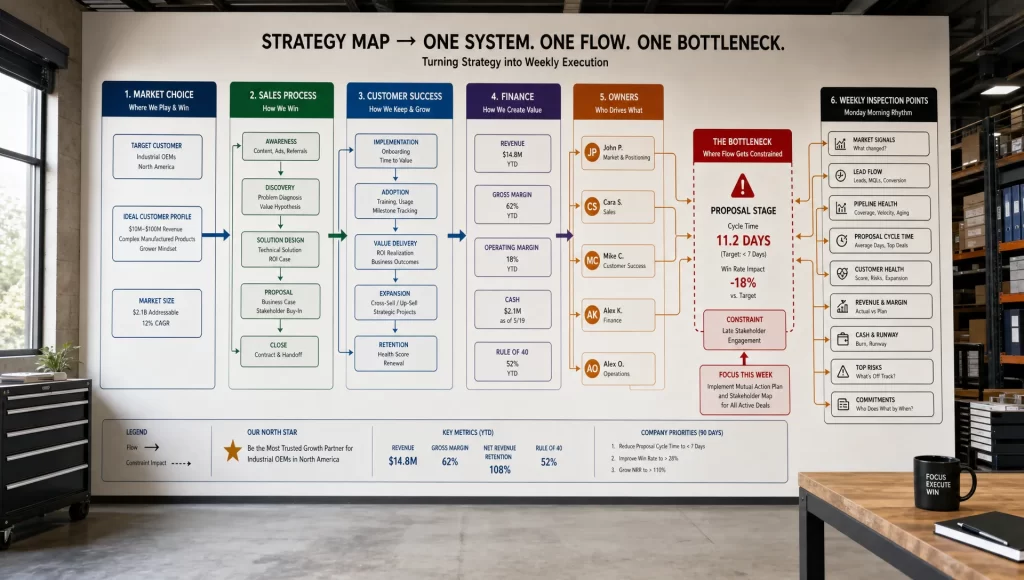
Corporate strategy consulting is only valuable when it changes what the company does on Monday morning.
For founder-led B2B companies, the problem is rarely a lack of ideas. The founder can usually explain the market, the product, the customer pain, and the opportunity in sharp detail. The execution gap appears when that insight has to move through sales, marketing, customer success, finance, operations, and management meetings without losing force.
That is where traditional strategy work often breaks down. A polished deck may define the market, size the opportunity, and describe a growth ambition, but it does not necessarily improve pipeline quality, win rates, sales cycle speed, expansion revenue, or leadership accountability.
Execution-focused corporate strategy consulting is different. It turns strategic choices into a revenue operating system: where to play, how to win, what to stop doing, what to fund, who owns each move, and how progress will be inspected.
Why execution is the real strategy test
A strategy is not executable just because it is logical. It becomes executable when the organization can translate it into decisions, workflows, management cadence, talent allocation, and measurable revenue movement.
This matters because founder-led B2B companies between roughly $3M and $25M in revenue are often stuck between two operating models. They are too complex for founder instinct alone, but not yet mature enough for enterprise-style planning rituals. The founder still carries much of the market knowledge. The team is growing. Processes exist, but they may be inconsistent. Data is available, but not always trusted. Managers are capable, but not always aligned around the same commercial priorities.
Harvard Business Review's research on strategy execution has long highlighted that execution failures often come from weak coordination, unclear priorities, and poor adaptation, not simply bad strategy. In mid-market B2B companies, those issues show up quickly as missed forecasts, reactive hiring, inconsistent sales behavior, and strategic projects that compete for the same leadership attention.
Common signs of an execution gap include:
- Sales, marketing, and customer success each interpreting the strategy differently.
- Revenue targets being clear, while the path to reach them is vague.
- Expansion initiatives starting before the core sales motion is stable.
- Leadership meetings reviewing activity instead of making decisions.
- CRM, reporting, and AI tools existing outside a unified operating rhythm.
If the strategy cannot be observed in the calendar, the pipeline, the budget, the sales process, and the management meeting, it is still mostly theory.
What execution-focused corporate strategy consulting should change
The role of corporate strategy consulting is not just to help a company think better. It should help the company operate better. That means moving from analysis to implementation design.
A useful way to evaluate the difference is to compare traditional strategy outputs with execution-led strategy outputs.
| Consulting focus | Traditional output | Execution-focused output |
|---|---|---|
| Market opportunity | Market map and growth thesis | Prioritized segments, entry sequence, and resourcing tradeoffs |
| Revenue growth | Target revenue number | Specific levers across pipeline, conversion, deal size, retention, and expansion |
| Sales strategy | Recommendations for improvement | Sales process changes, owner accountability, enablement needs, and inspection cadence |
| Marketing strategy | Campaign or channel ideas | ICP clarity, messaging, conversion path, and sales alignment |
| Operating model | Org chart suggestions | Decision rights, meeting rhythm, capacity model, and performance metrics |
| Technology and AI | Tool recommendations | Systems tied to workflows, data quality, and management usage |
The difference is practical. A traditional recommendation might say the company should move upmarket. An execution-focused recommendation defines which accounts qualify, which use cases justify the move, what changes in pricing and sales motion, which proof points must be built, how many qualified opportunities are required, what training sellers need, and when leadership will decide whether to continue, pause, or adjust.
That level of specificity is what separates strategy from aspiration.
Start with the revenue constraint, not the ambition
Many strategy projects begin with the question: How do we grow faster? Better projects begin with: What is currently constraining growth?
The answer is not always obvious. A company with weak pipeline may actually have a positioning problem. A company with poor close rates may have a qualification problem. A company expanding into new markets may be compensating for weak penetration in its best existing segment. A founder blaming sales talent may actually have an unclear ICP, a broken handoff, or a pricing model that creates friction.
This is why business strategy consulting fails without diagnosis so often. Jumping to the intervention before isolating the constraint creates activity, not progress.
A proper diagnostic should look across the full revenue system. It should examine customer segments, win and loss patterns, average contract value, sales cycle length, lead sources, conversion rates, discounting behavior, retention, expansion, sales capacity, management cadence, and the founder's role in key deals. It should also test whether the current strategy is understood the same way by leadership, managers, and customer-facing teams.
The goal is not to collect data for the sake of analysis. The goal is to identify the few constraints that matter most, then sequence the work so the company does not overwhelm itself with too many initiatives.
For example, if the biggest constraint is poor conversion from qualified opportunity to closed won, hiring more SDRs may simply push more low-quality demand into a weak sales process. If the constraint is founder dependency in late-stage deals, rebranding will not solve it. If the constraint is unclear target market selection, adding AI tools to the sales stack may create more noise, not more revenue.
Good corporate strategy consulting forces these tradeoffs into the open.
Turn strategy into a costed intervention roadmap
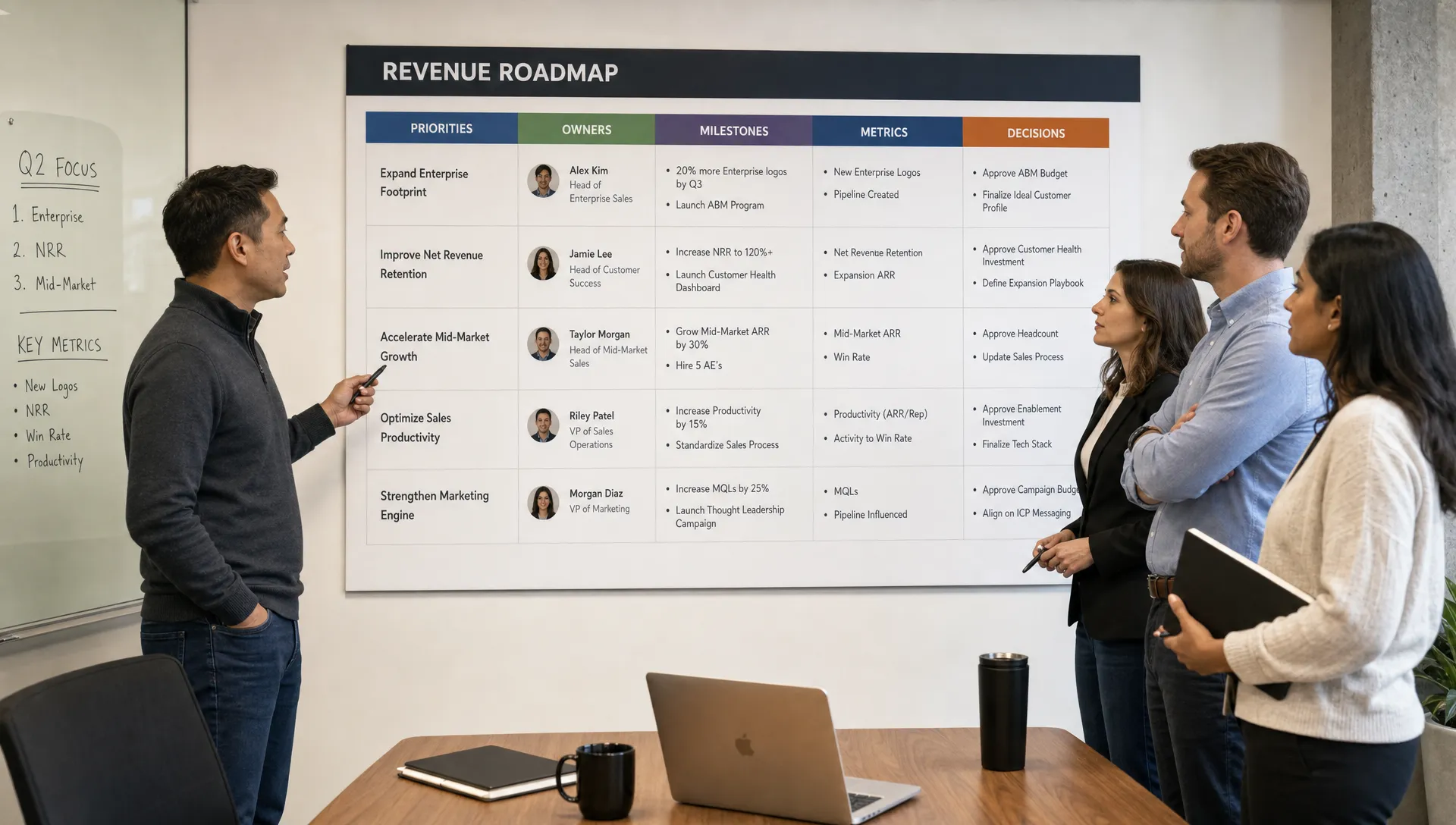
Execution improves when the strategy is translated into a costed roadmap. Not a vague list of initiatives. Not a brainstorm. A roadmap that shows what will change, who owns it, what it costs, what capacity it requires, what metrics will move, and when leadership will inspect progress.
This matters in founder-led companies because resources are limited. Every strategic initiative competes with live selling, customer delivery, product work, hiring, and founder attention. If the roadmap ignores capacity, it will fail even if the strategy is right.
A strong execution roadmap usually contains the following elements.
| Roadmap element | Why it matters for execution |
|---|---|
| Strategic thesis | Defines the growth bet and prevents scattered priorities |
| Constraint diagnosis | Shows why these interventions matter now |
| Initiative sequence | Prevents the team from trying to fix everything at once |
| Cost and capacity estimate | Makes tradeoffs visible before work begins |
| Named owner | Creates accountability beyond the founder |
| Leading indicators | Shows whether execution is improving before revenue fully catches up |
| Review cadence | Keeps decisions moving and prevents drift |
| Stop list | Frees time, budget, and attention from lower-value work |
The stop list is especially important. Strategy is not only about choosing what to do. It is also about choosing what the business will no longer fund, chase, tolerate, or measure.
For a founder-led B2B company, that could mean stopping pursuit of unprofitable segments, pausing a market expansion until the core sales motion is stable, reducing custom work that hurts margin, or removing vanity metrics from leadership meetings.
Build the operating mechanisms that make strategy stick
A strategy becomes real through operating mechanisms. These are the routines, systems, and decision points that keep the company aligned after the consulting engagement begins.
The first mechanism is decision rights. If every meaningful revenue decision still returns to the founder, execution speed will remain limited. A consultant should help clarify which decisions belong to the founder, which belong to functional leaders, and which require cross-functional debate. This is not bureaucracy. It is how the company scales judgment.
The second mechanism is a revenue operating cadence. Weekly and monthly meetings should not exist to recite updates. They should be designed to surface constraints, inspect leading indicators, resolve blockers, and make decisions. A good cadence connects strategy to pipeline, hiring, messaging, customer feedback, delivery capacity, and cash.
The third mechanism is management-quality data. Many B2B companies have CRM data, marketing dashboards, finance reports, and customer success notes, but no single view of what is actually happening across the revenue engine. Better reporting does not mean more dashboards. It means fewer, better metrics that leaders trust and use.
AI can help, but only when it is connected to the strategy. AI systems buildouts may support account research, call summarization, sales enablement, workflow automation, or management reporting. But tools should not lead the strategy. They should reduce friction in the operating model the company has already chosen.
The fourth mechanism is behavioral reinforcement. If the company says it wants to focus on a tighter ICP, but celebrates every large unqualified opportunity, sellers will follow the incentive. If leadership says expansion revenue matters, but customer success is measured only on retention tasks, the behavior will not change. Execution requires alignment between stated priorities, metrics, incentives, coaching, and inspection.
How to know whether a consulting firm will improve execution
Before hiring a corporate strategy consulting partner, look for evidence that the firm can move beyond recommendations. The best consultants are comfortable with diagnosis, sequencing, operating cadence, and commercial accountability. They should be able to explain how their work will change decisions inside the business, not just what their final presentation will contain.
Useful evaluation questions include:
- What diagnostic work happens before recommendations are made?
- How will the engagement identify the highest-leverage revenue constraint?
- What will be delivered besides a slide deck?
- Who inside the company will own each intervention?
- How will progress be measured before lagging revenue results appear?
- What happens if the data contradicts the initial growth hypothesis?
- Can the consultant support execution through sales optimization, market expansion planning, or fractional revenue leadership if needed?
If the answers are vague, the engagement may produce clarity without momentum. If the consultant talks only about frameworks, workshops, or benchmarking, press harder on implementation. Founder-led companies do not need more abstract strategy. They need better revenue decisions, faster learning loops, and a system that keeps execution moving.
For a deeper evaluation lens, this guide on how to choose a strategy consulting firm that delivers outlines what to look for when measurable growth matters more than polished advice.
Why founder-led B2B companies need a different consulting model
Large enterprises often have mature planning teams, functional depth, established reporting, and enough managerial bandwidth to absorb complex strategy programs. Founder-led B2B companies operate differently.
The founder is often still the best salesperson, the sharpest product strategist, and the person with the strongest customer intuition. That is an advantage, but it is also a constraint. As the company grows, the founder's implicit strategy must become an explicit operating system other leaders can run.
This requires a consulting model that respects speed and commercial reality. It must be comfortable with imperfect data, live revenue pressure, lean management teams, and the need for quick intervention. It must also avoid common corporate strategy mistakes that slow mid-market growth, such as treating revenue targets as strategy, expanding too broadly, or copying enterprise planning rituals before the business has the operating maturity to use them.
For founder-led B2B, the best strategy work usually improves execution in a few concrete areas:
- Sharper ICP and segment prioritization.
- More disciplined sales process and qualification.
- Clearer positioning and market narrative.
- Better handoff between marketing, sales, and customer success.
- More reliable forecast and pipeline inspection.
- Focused market expansion instead of opportunistic expansion.
- Reduced founder dependency in day-to-day revenue execution.
The common thread is not complexity. It is clarity that changes behavior.
What improved execution should look like
When corporate strategy consulting works, the company feels different within weeks, not years.
Leadership conversations become more focused. The team has fewer priorities, but each priority has a clearer owner. Sales meetings shift from anecdotal updates to pipeline quality, deal progression, and constraint removal. Marketing stops generating activity in isolation and becomes more tightly connected to the sales motion. Customer feedback flows back into positioning, product decisions, and expansion strategy. The founder spends less time translating the strategy repeatedly and more time making the highest-value decisions.
Revenue may take time to fully reflect the change, especially in longer sales cycles. But leading indicators should move earlier. The company should see better qualification, clearer messaging, faster decision-making, cleaner data, stronger accountability, and less confusion about what matters most.
That is the standard. Corporate strategy consulting should not merely describe a better future. It should build the operating path to reach it.
Frequently Asked Questions
What is corporate strategy consulting? Corporate strategy consulting helps a company make major decisions about markets, growth priorities, competitive positioning, resource allocation, and operating model. Execution-focused consulting goes further by turning those decisions into owners, systems, metrics, and management cadence.
How is corporate strategy consulting different from business coaching? Business coaching often focuses on the founder or leadership team's thinking and behavior. Corporate strategy consulting typically works across the business system, including market choices, revenue model, sales strategy, operating structure, and execution roadmap.
Why do strategy consulting projects fail to improve execution? They fail when they jump to recommendations without diagnosing the real constraint, produce too many initiatives, ignore capacity, or leave the company without a practical operating cadence. A strong strategy must be connected to how people sell, manage, decide, and measure progress.
What should a founder-led B2B company expect from an execution-focused engagement? Expect a diagnosis of the current revenue engine, a clear growth thesis, a prioritized and costed roadmap, named owners, leading indicators, and support translating strategy into sales, marketing, customer success, and leadership routines.
When should a company consider corporate strategy consulting? It is most useful when growth has slowed, the founder is still central to too many revenue decisions, expansion opportunities are unclear, sales and marketing are misaligned, or the business needs a more scalable path from strategy to execution.
Turn strategy into revenue execution
If your company has ambition but execution feels slower than it should, the issue may not be effort. It may be the revenue system around the strategy.
Billionaires in Boxers helps founder-led B2B companies at $3M to $25M revenue use PE-grade diagnostics, AI systems buildouts, sales optimization strategy, market expansion planning, and fractional CRO support to engineer more scalable growth.
Explore the Revenue Acceleration Diagnostic if you want corporate strategy consulting that identifies the real constraint, prioritizes the right interventions, and turns the roadmap into execution.
