
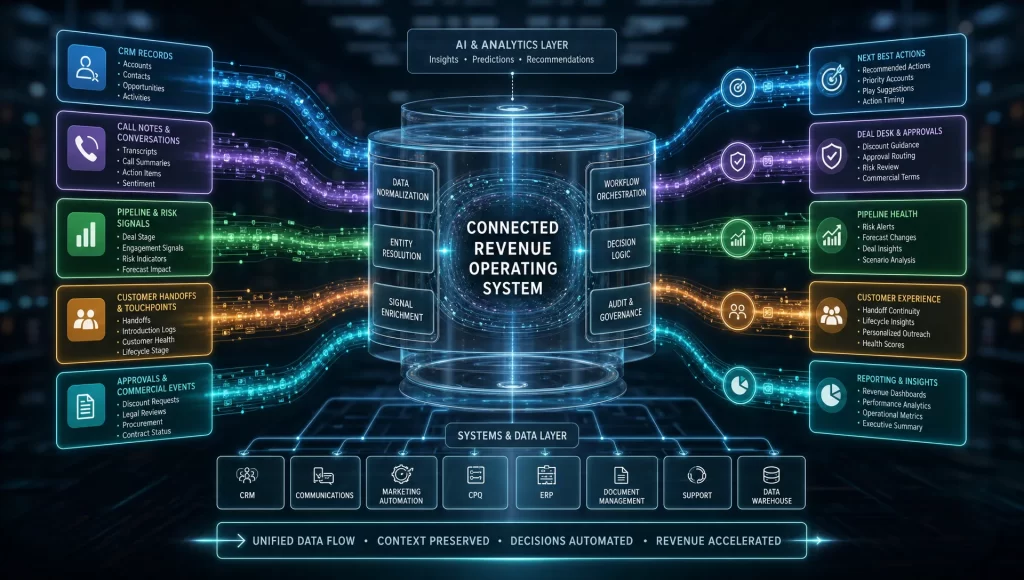
AI is no longer a novelty inside revenue teams. Most founder-led B2B companies already have a few AI tools somewhere in the stack: call summaries, prospecting assistants, content generators, CRM enrichment, forecasting overlays, or chat-based research. The problem is that scattered tools rarely create scalable Revenue Ops.
Scalable Revenue Ops requires infrastructure. That means the data, workflows, governance, automation, and human decision rights that allow AI to improve commercial execution repeatedly, not just occasionally.
For founder-operators between roughly $3M and $25M in revenue, this distinction matters. At this stage, growth is often constrained less by ambition and more by operating drag: inconsistent qualification, founder-dependent sales judgment, unreliable CRM data, slow proposal cycles, weak handoffs, and forecasts that depend on who is feeling optimistic that week.
AI infrastructure solutions solve a different problem than AI apps. They create the commercial operating layer that lets your team capture knowledge, route decisions, prioritize work, and improve revenue performance without adding unnecessary management complexity.
What AI infrastructure means in Revenue Ops
In enterprise technology, “AI infrastructure” often refers to cloud compute, data pipelines, model hosting, and security architecture. Those components matter, but for Revenue Ops leaders and founder-operators, the more practical question is this: what infrastructure makes AI useful inside the revenue engine?
In a B2B revenue context, AI infrastructure includes:
- Clean, structured commercial data that AI can interpret reliably.
- Standard definitions for lifecycle stages, pipeline quality, ICP fit, churn risk, and expansion potential.
- Integrated workflows across marketing, sales, customer success, delivery, and finance.
- A knowledge layer that contains playbooks, messaging, case studies, objections, pricing logic, and qualification rules.
- Governance that determines when AI can recommend, draft, automate, or require human approval.
- Operating rhythms that turn AI outputs into decisions, coaching, interventions, and measurable improvements.
This is the difference between “we use AI” and “AI improves how we run revenue.”
A sales rep using AI to draft an email may save 10 minutes. A revenue team using AI infrastructure to identify best-fit accounts, flag stalled deals, recommend next actions, support proposal quality, and improve forecasting discipline can create compounding operational leverage.
Why Revenue Ops breaks as growth accelerates
Founder-led B2B companies often grow through force of will. The founder knows the market, understands the buyer, senses deal quality, and can rescue key opportunities. Early revenue is built on judgment, urgency, and personal involvement.
That works until the company needs to scale beyond the founder’s bandwidth.
At that point, Revenue Ops usually starts to strain in predictable ways. The CRM contains activity, but not enough truth. Marketing generates leads, but sales debates fit. Sales commits deals, but delivery discovers mismatched expectations. Customer success sees expansion potential, but nobody operationalizes it. Finance wants better forecasts, but the pipeline is full of subjective confidence.
AI does not automatically fix this. In fact, AI can amplify the mess if the underlying system is weak. If the CRM is inconsistent, AI will confidently summarize inconsistent data. If qualification criteria are unclear, AI will accelerate poor prioritization. If handoffs are undocumented, AI will produce polished confusion.
That is why the infrastructure layer comes first.
For a broader view of where AI can create practical commercial lift, Billionaires in Boxers has also outlined artificial intelligence solutions that improve Revenue Ops. This article goes one layer deeper: what must be in place so those solutions actually scale.
The core layers of AI infrastructure solutions
Effective AI infrastructure for Revenue Ops is not one platform. It is a connected set of capabilities that allows commercial teams to make better decisions faster and with less friction.
| Infrastructure layer | What it does | Revenue impact |
|---|---|---|
| Revenue data foundation | Standardizes CRM, marketing, sales, customer, and finance data | Improves prioritization, reporting, and forecast confidence |
| Workflow orchestration | Defines triggers, stage movement, ownership, and handoffs | Reduces delays, missed follow-ups, and operational ambiguity |
| Intelligence layer | Uses AI to score, summarize, recommend, classify, and detect patterns | Helps teams focus on the right accounts, deals, and risks |
| Knowledge layer | Centralizes playbooks, messaging, objection handling, case studies, and qualification logic | Makes expertise repeatable across the team |
| Governance layer | Sets rules for data access, approvals, validation, risk, and human oversight | Protects quality, trust, and compliance |
| Operating cadence | Embeds AI outputs into weekly revenue meetings, coaching, pipeline reviews, and planning | Turns insights into accountable action |
The strongest systems connect these layers. A lead score alone is not infrastructure. A score that triggers routing, prompts a tailored outreach sequence, updates the CRM, alerts the right owner, supports the rep with relevant proof points, and feeds conversion data back into the model starts to become infrastructure.
Build around revenue decisions, not AI features
One of the most common mistakes companies make is starting with the AI feature instead of the revenue decision.
A founder might ask, “Can we use AI for forecasting?” That is a valid question, but a better one is, “What decisions do we need to make earlier and more accurately to improve cash, capacity, and growth?”
AI infrastructure should be designed around the decisions that move revenue. For most founder-led B2B companies, the high-leverage decisions include:
- Which accounts should sales prioritize this week?
- Which opportunities are real, stuck, inflated, or at risk?
- Which message should be used for this buyer, segment, or trigger event?
- Which customers show signs of churn, expansion, or delivery risk?
- Which constraints are slowing growth: demand, conversion, sales capacity, pricing, delivery, retention, or leadership cadence?
When you design around decisions, AI becomes operational rather than decorative. It has a job. It supports a workflow. It is measured against business outcomes.
This also prevents “AI theater,” where a company has impressive tools but no meaningful change in win rates, cycle time, forecast reliability, or founder leverage.
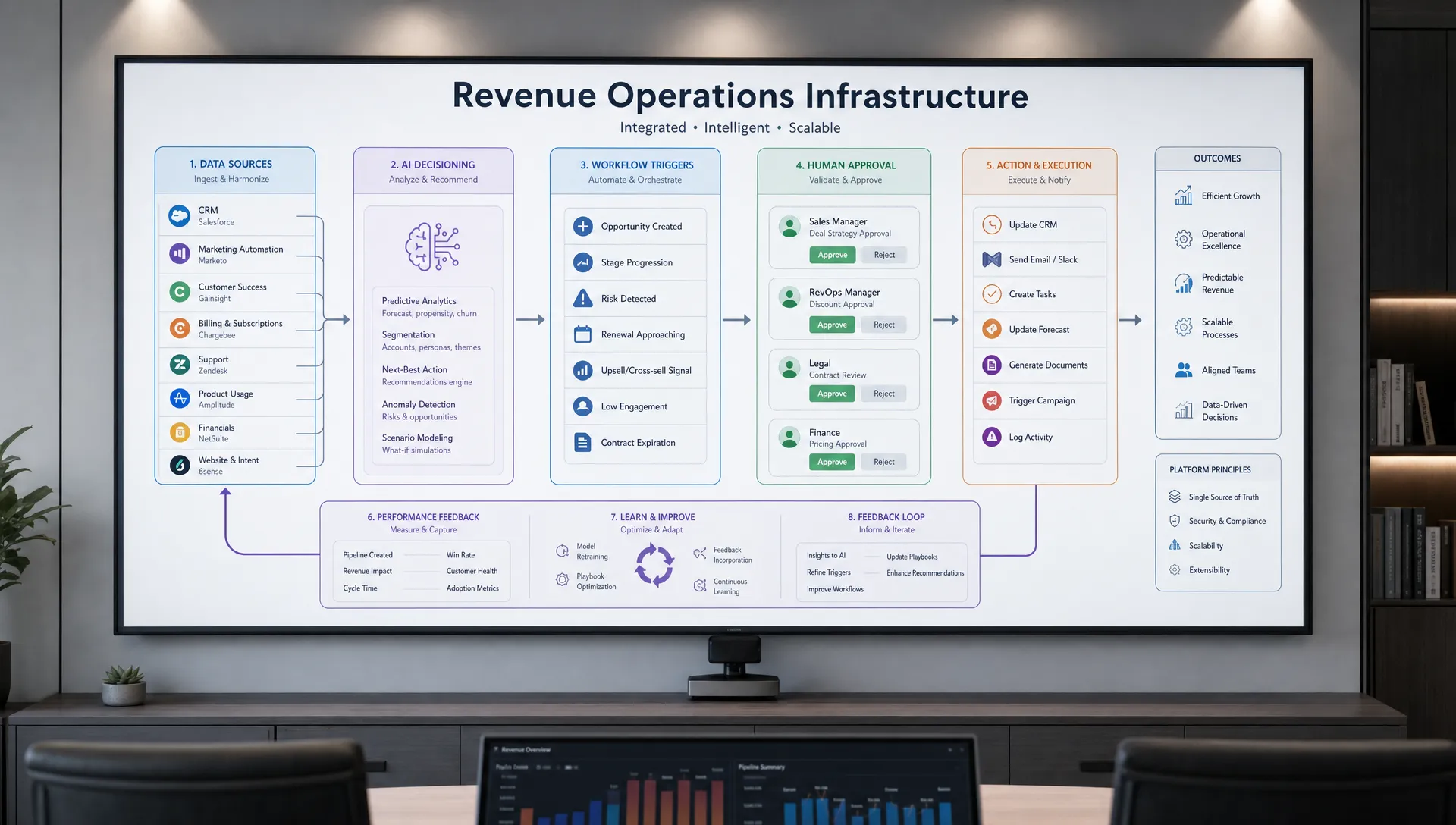
A practical architecture for scalable Revenue Ops
A useful AI infrastructure blueprint does not need to be overbuilt. In fact, for mid-market founder-led companies, the goal is usually to simplify commercial execution, not create a fragile enterprise architecture.
The architecture should start with the revenue model and work backward.
Diagnose the commercial constraint
Before building AI workflows, identify the main constraint in the revenue engine. Is the company struggling with lead quality, sales conversion, deal velocity, pricing discipline, onboarding, retention, expansion, or leadership visibility?
This diagnostic step matters because the best AI infrastructure is constraint-specific. A company with weak qualification needs different infrastructure than one with strong sales but poor delivery handoffs. A business with long enterprise cycles needs different signals than one with high-velocity transactional deals.
Normalize the revenue language
AI needs definitions. Humans do too.
Before automation, establish clear definitions for ICP, lead source, lifecycle stage, opportunity stage, next step, close date, deal risk, customer health, expansion readiness, and forecast category. These definitions should be simple enough for the team to use consistently.
Without this shared language, AI outputs become hard to trust. A “qualified opportunity” may mean one thing to the founder, another to sales, and another to finance. Infrastructure removes that ambiguity.
Connect the systems that shape revenue
Most Revenue Ops friction lives between tools. CRM, marketing automation, sales engagement, call recording, proposal software, billing, customer success, and project management systems all contain fragments of the revenue truth.
AI infrastructure does not require every system to be replaced. It does require a clear source of truth and sensible integrations. The goal is to ensure that important signals are not trapped in silos.
For example, if delivery delays often predict churn, that signal needs to reach customer success and leadership before renewal risk becomes obvious. If sales calls reveal recurring pricing objections, that insight should inform messaging, qualification, and packaging discussions.
Capture frontline judgment
The founder, senior sellers, delivery leads, and customer success managers often hold the most valuable commercial intelligence. AI infrastructure should capture that judgment and turn it into repeatable guidance.
This may include call review patterns, deal inspection criteria, objection libraries, qualification red flags, industry-specific proof points, and “what good looks like” examples. Once captured, AI can help distribute that judgment across the team through prompts, recommendations, checklists, and coaching workflows.
Put humans in the right approval loops
The point of AI infrastructure is not to remove judgment. It is to place judgment where it creates the most value.
AI can draft, summarize, classify, compare, and recommend. Humans should approve high-stakes decisions, such as pricing exceptions, strategic account messaging, forecast commitments, contract risk, and customer escalation plans.
This is also where governance becomes essential. The NIST AI Risk Management Framework emphasizes trustworthy AI through governance, measurement, management, and mapping of risk. Revenue teams do not need to turn this into bureaucracy, but they do need clear rules for data access, accuracy checks, and accountability.
Where AI infrastructure creates the most leverage
AI infrastructure solutions are most valuable when they remove recurring commercial drag. The goal is not to automate every task. The goal is to make the most important revenue work easier to execute consistently.
Sales prioritization and qualification
AI can help identify which accounts and opportunities deserve attention, but only if it has access to meaningful signals. These signals might include firmographics, engagement behavior, buying committee activity, pain indicators, past win patterns, deal stage movement, and rep notes.
With the right infrastructure, AI can support account prioritization, flag weak-fit opportunities, suggest discovery questions, and surface relevant case studies or proof points. This helps sellers spend less time guessing and more time progressing the right deals.
Pipeline inspection and forecasting
Forecasting breaks down when pipeline reviews rely on optimism instead of evidence. AI can assist by comparing opportunity data against historical patterns, identifying missing next steps, detecting stage stagnation, and highlighting deals where close dates or probabilities look unrealistic.
The real value comes when these insights are embedded into the forecast process. AI should support better management conversations, not simply produce another dashboard.
For companies looking to connect sales execution with delivery and forecasting, the related concept of AI systems that strengthen sales, delivery, and forecasting is especially relevant.
Proposal and content quality
Many B2B companies lose time and margin because proposals are reinvented from scratch. AI can accelerate proposal drafting, but infrastructure determines whether the output is accurate, differentiated, and commercially sound.
A strong knowledge layer gives AI approved messaging, pricing logic, scope boundaries, case studies, implementation assumptions, and risk language. This reduces the chance of a seller creating a polished proposal that delivery cannot profitably fulfill.
Customer handoffs and expansion
Revenue Ops does not stop when a deal closes. In founder-led B2B companies, growth often leaks during the transition from sales to delivery or customer success.
AI infrastructure can summarize sales context, extract promised outcomes, identify stakeholder priorities, flag delivery risks, and create customer success prompts. Over time, it can also help detect expansion potential based on usage, engagement, outcomes, support requests, and executive alignment.
Leadership visibility
Founders do not need more dashboards. They need better visibility into what is changing, where risk is emerging, and which interventions matter.
AI infrastructure can support weekly leadership rhythms by summarizing pipeline movement, surfacing risks, comparing performance across segments, and identifying bottlenecks. The best systems help leaders ask better questions sooner.
A mature version of this can start to resemble an AI operating system for a B2B company, where strategy, workflows, data, and accountability are connected rather than scattered across tools.
Build, buy, or partner: choosing the right path
There is no single correct way to implement AI infrastructure. The right path depends on team capability, system maturity, budget, urgency, and risk tolerance.
| Approach | Best fit | Watch out for |
|---|---|---|
| Buy point solutions | Teams with clear workflow gaps and strong internal ownership | Tool sprawl, weak integration, and low adoption |
| Build internally | Companies with technical resources and differentiated processes | Slow implementation and unclear commercial ownership |
| Partner with specialists | Founder-led teams that need speed, diagnosis, and execution support | Choosing partners who overbuild technology without fixing revenue constraints |
| Hybrid model | Companies that need custom workflows on top of existing tools | Requires disciplined architecture and governance |
For many founder-led B2B companies, a hybrid model is the most practical. Keep the tools that already work, fix the data and process gaps, then build AI-enabled workflows around the highest-value revenue decisions.
The most important thing is not whether the infrastructure is custom or off-the-shelf. The most important thing is whether it changes how the company prioritizes, sells, forecasts, delivers, and learns.
Common mistakes to avoid
AI infrastructure can create meaningful leverage, but it can also become expensive noise if implemented poorly.
The first mistake is automating before simplifying. If a workflow is confusing, AI will not make it strategic. It will make the confusion faster.
The second mistake is ignoring CRM truth. AI recommendations are only as reliable as the data and definitions beneath them. If reps do not trust the CRM, they will not trust AI built on top of it.
The third mistake is treating AI as a software project instead of a revenue operating model. Technology matters, but adoption happens through management cadence, incentives, coaching, and accountability.
The fourth mistake is skipping governance. Customer data, prospect data, pricing information, call transcripts, and commercial strategy should not be handled casually. Even practical AI deployments need access controls, approved use cases, review processes, and clear ownership.
The fifth mistake is measuring activity instead of outcomes. AI should not be judged by how many summaries it creates or prompts it runs. It should be evaluated by whether it improves conversion, cycle time, forecast quality, customer retention, margin discipline, or founder leverage.
What good can look like in 90 days
A scalable AI infrastructure roadmap does not need to begin with a massive transformation. A focused 90-day implementation can create a strong foundation if it is tied to a real revenue constraint.
| Timeframe | Focus | Practical output |
|---|---|---|
| Days 1 to 15 | Diagnose the revenue constraint and map current workflows | Clear priority use case, data gaps, ownership model, and success metrics |
| Days 16 to 30 | Standardize definitions and clean critical data fields | Shared revenue taxonomy and improved source-of-truth reliability |
| Days 31 to 60 | Build one or two AI-enabled workflows | Prioritization, deal inspection, handoff, proposal, or customer risk workflow |
| Days 61 to 90 | Embed into operating cadence | Weekly reviews, adoption tracking, feedback loops, and refinement plan |
The best first use case is usually narrow, visible, and tied to a commercial outcome. For example, improving deal inspection quality for late-stage pipeline may be more valuable than launching AI across every sales activity. Reducing handoff errors between sales and delivery may create more leverage than experimenting with generic content generation.
Once the first workflow proves useful, the infrastructure can expand. The company can add more signals, improve playbooks, connect more systems, and extend AI support across additional stages of the customer journey.
The real goal: scalable judgment
AI infrastructure solutions are not about replacing the founder’s commercial instincts. They are about making the best judgment in the company more visible, repeatable, and scalable.
In a founder-led B2B business, the founder often sees patterns before anyone else: which buyers are serious, which deals are risky, which promises will strain delivery, which segments are worth pursuing, and which growth ideas are distractions. The challenge is that this judgment is usually trapped in the founder’s head.
Good AI infrastructure helps extract that judgment, combine it with operational data, and embed it into daily revenue workflows. That is how AI becomes a growth system rather than another tool subscription.
For companies that want to scale Revenue Ops, the question is no longer, “Should we use AI?” The better question is, “What infrastructure do we need so AI can improve the way revenue decisions are made every week?”
Frequently Asked Questions
What are AI infrastructure solutions for Revenue Ops? AI infrastructure solutions for Revenue Ops are the data, workflows, integrations, governance, knowledge assets, and operating rhythms that allow AI to support repeatable revenue decisions across marketing, sales, customer success, delivery, and leadership.
How are AI infrastructure solutions different from AI sales tools? AI sales tools usually solve a specific task, such as drafting emails or summarizing calls. AI infrastructure connects tools, data, rules, and workflows so AI can improve the broader revenue operating model.
Does a founder-led B2B company need a data warehouse before using AI? Not always. Some companies benefit from a warehouse, but many should start by cleaning critical CRM fields, standardizing definitions, and connecting the systems that influence revenue decisions. The infrastructure should match the maturity of the business.
Which Revenue Ops workflow should be automated first? Start with the workflow closest to the current growth constraint. Common first choices include lead qualification, account prioritization, deal inspection, proposal support, sales-to-delivery handoffs, customer risk detection, and forecast review.
How should companies manage AI risk in Revenue Ops? Companies should define approved use cases, protect sensitive data, control access, validate AI outputs, keep humans in high-stakes approval loops, and review performance regularly. Governance should be practical, visible, and tied to commercial accountability.
Build AI infrastructure around the revenue constraint
If AI is not changing how your team prioritizes accounts, inspects pipeline, converts opportunities, protects delivery, or forecasts growth, the issue may not be the tool. It may be the infrastructure underneath it.
Billionaires in Boxers helps founder-led B2B companies diagnose revenue constraints and build practical systems for scalable growth, including PE-grade diagnostics, AI systems buildouts, and fractional CRO support. If your revenue engine is ready for a more disciplined operating model, explore how Billionaires in Boxers approaches revenue acceleration for founder-operators.
