
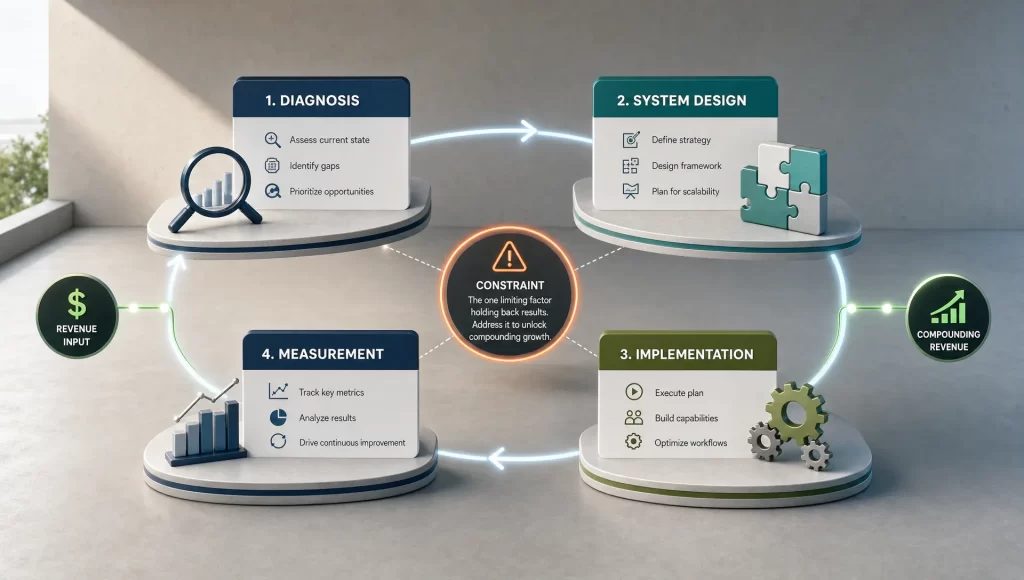
Most consulting is sold as expertise: a workshop, a strategy deck, a roadmap, a set of recommendations. That can be valuable, but it often creates a linear engagement. The consultant delivers, the client implements what they can, and momentum fades once the project ends.
A consulting business model built for recurring growth works differently. It is designed to compound revenue outcomes over time, not simply deliver advice in a fixed window. The goal is to turn expertise into a repeatable operating mechanism: diagnose the real constraint, install the right revenue systems, measure leading indicators, and keep improving the commercial engine until growth becomes less dependent on founder effort.
For founder-led B2B companies, this distinction matters. At $3M to $25M in revenue, the business is usually past product-market fit, but not yet fully systemized. Growth often still relies on the founder's network, judgment, and deal-closing ability. A recurring-growth consulting model helps convert that founder-led motion into a scalable revenue architecture.
What makes a consulting business model recurring?
Recurring does not just mean billing monthly. A retainer without measurable progress is still just a subscription to meetings. A true recurring-growth model has three characteristics:
- It solves an ongoing business constraint, not a one-time task.
- It creates assets, systems, and decision rhythms that improve over time.
- It connects consulting activity to commercial metrics such as qualified pipeline, win rate, sales cycle, retention, expansion, and founder leverage.
This is why the model is especially relevant to revenue acceleration. Revenue is not a single department problem. It is the result of positioning, offer design, demand generation, sales process, pricing, customer success, and leadership cadence working together. If one link is weak, the whole system underperforms.
A recurring consulting business model gives the client a way to keep improving that system without hiring every senior revenue role full time before the business is ready.
| Traditional consulting model | Recurring-growth consulting model |
|---|---|
| Starts with a requested solution | Starts with diagnosis of the constraint |
| Delivers advice or a project | Builds systems, assets, and operating cadence |
| Measures outputs such as decks or workshops | Measures revenue movement and leading indicators |
| Engagement ends when the scope ends | Engagement renews when the growth loop keeps compounding |
| Consultant acts as outside expert | Consultant acts as strategic operator and capability builder |
The first rule: diagnose before prescribing
The fastest way to waste consulting spend is to buy the wrong solution for the wrong problem.
A founder may think they need more leads when the real issue is poor qualification. They may think the sales team needs training when the offer is unclear. They may believe the market is saturated when the company is actually selling into the wrong segment. These are expensive mistakes because they produce activity without leverage.
A recurring-growth model should begin with a structured diagnostic. The diagnostic should identify where revenue is leaking, where growth is constrained, and which interventions are likely to create the fastest economic impact.
That does not mean analysis paralysis. In a strong model, diagnosis is practical and commercial. It should clarify questions such as:
- Which customer segments produce the best margin, retention, and speed to close?
- Where does pipeline stall, from lead source to closed revenue?
- Which sales behaviors are repeatable, and which depend on founder intuition?
- Does the company have a clear expansion path inside existing accounts?
- Which systems, data, or AI workflows would reduce manual drag?
This is also where many strategy engagements fail. If the consultant jumps straight to a campaign, a rebrand, a hiring plan, or a sales playbook before isolating the real bottleneck, the work may look impressive but miss the constraint. For a deeper look at that failure pattern, Billionaires in Boxers has covered why business strategy consulting fails without diagnosis.
Productize the entry point, customize the intervention
A scalable consulting business model needs repeatability, but repeatability should not mean generic advice.
The best structure is often a productized entry point followed by a customized growth roadmap. The entry point creates consistency in how the consultant assesses the business. The roadmap creates specificity in what the client should do next.
For example, a revenue acceleration diagnostic can use a consistent methodology to evaluate market focus, sales process, conversion rates, commercial leadership, systems, and growth opportunities. But the resulting plan should be tailored to the company's stage, team, margin profile, sales cycle, buyer type, and expansion potential.
This structure benefits both sides. The client gets clarity before committing to a larger engagement. The consultant avoids writing custom proposals based on incomplete information. Most importantly, the work begins with evidence rather than assumptions.
Productization also makes delivery easier to improve over time. When a firm runs the same diagnostic pattern across multiple companies, it can sharpen its benchmarks, questions, implementation playbooks, and intervention sequencing. That creates stronger outcomes without forcing every engagement to start from a blank page.
Build systems, not dependency
The recurring-growth model should never turn the consultant into a permanent crutch. The aim is to help the business become more capable, more measurable, and less reliant on heroic founder effort.
That means the engagement should create assets the company can keep using. These might include a sharper ideal customer profile, a segment-specific offer structure, a sales qualification framework, a forecast rhythm, an AI-assisted research workflow, a customer expansion motion, or a management cadence for revenue decisions.
The exact assets will vary by company. The principle does not: recurring growth comes from systems that keep producing value after the consultant leaves the room.
This is particularly important in professional services, agencies, consultancies, and B2B service firms where growth often comes from reputation, referrals, and founder relationships. Those are valuable, but they are not enough to scale predictably. If your firm needs a broader view of how these systems fit together, this guide on growth systems for professional services firms maps the major components.
The operating cadence is where growth compounds
Recurring growth is not created by a strategy document. It is created by a cadence of decisions, tests, measurement, and accountability.
In practice, a recurring consulting business model often includes an operating rhythm such as monthly revenue reviews, weekly sales pipeline inspection, quarterly market expansion planning, or leadership working sessions focused on specific revenue constraints. The cadence matters because B2B growth is dynamic. Markets shift, sales cycles move, competitors react, and internal capacity changes.
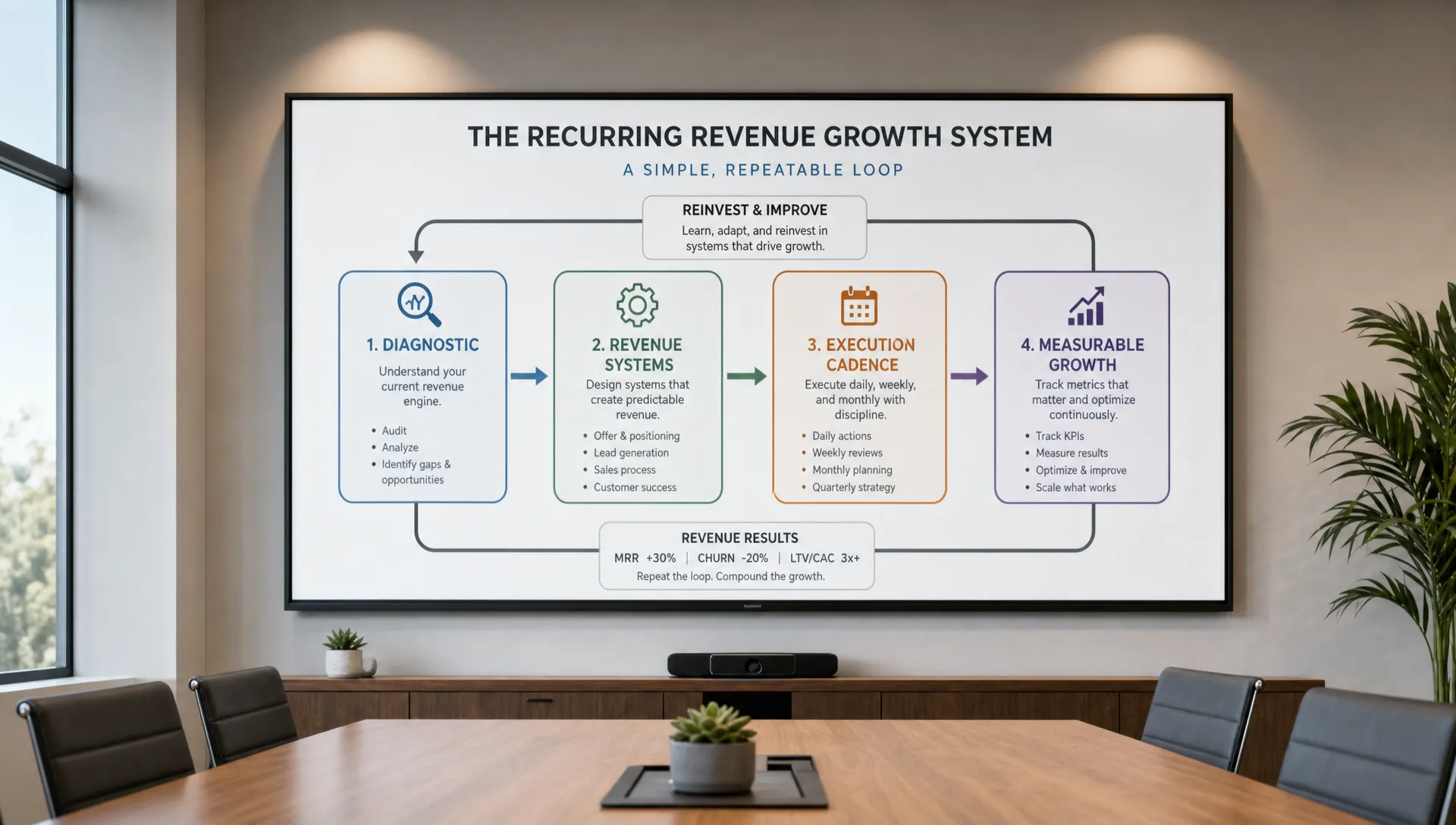
A strong cadence forces the business to ask better questions every month:
- Are we creating enough qualified pipeline from the right segments?
- Are deals progressing for clear reasons, or are we relying on hope?
- Are sales conversations exposing offer, pricing, or positioning issues?
- Are customers expanding, renewing, and referring at the rate we expected?
- What should leadership stop doing because it is not moving revenue?
This is where fractional CRO support can be useful for founder-led companies. Many businesses need senior revenue leadership before they can justify or attract a full-time chief revenue officer. A fractional model can bring executive-level revenue focus into the business while the internal team builds capability.
Commercial models that support recurring growth
Not every consulting pricing model supports recurring growth equally. Hourly work can be useful for narrow expertise, but it rarely aligns well with strategic revenue outcomes. Fixed projects can create momentum, but they often end before the company has embedded the change. Retainers can work well, but only if they are tied to a clear operating rhythm and measurable priorities.
The right commercial model depends on the type of problem, the maturity of the client, and the level of implementation support required.
| Model | Best fit | Risk to manage |
|---|---|---|
| Hourly advisory | Narrow expert input or short decision support | Incentivizes time, not transformation |
| Fixed project | Defined deliverable such as a diagnostic, playbook, or market plan | May stop before adoption is complete |
| Monthly retainer | Ongoing optimization, leadership support, and accountability | Can become vague if metrics are not clear |
| Fractional executive | Companies needing senior revenue leadership without a full-time hire | Scope must be focused to avoid role confusion |
| Diagnostic plus implementation | Founder-led companies that need clarity first, then execution support | Requires discipline to prioritize the roadmap |
For recurring growth, the most effective structure is often a sequence: diagnose, prioritize, implement, measure, optimize. The client does not buy endless consulting. They buy a disciplined path from constraint to capability.
Where AI fits in the consulting business model
AI has made the consulting business model more powerful, but also more dangerous when used without discipline.
Used poorly, AI produces faster noise: more generic content, more automated outreach, more dashboards, and more reports that do not change decisions. Used well, AI compresses manual work and strengthens the revenue system.
In a recurring-growth model, AI should support specific commercial workflows. It can help with market research, account prioritization, call analysis, proposal drafting, CRM hygiene, customer segmentation, competitive monitoring, and leadership reporting. But AI should not be layered on top of a broken process. If the sales stages are unclear, the data is unreliable, or the offer is poorly defined, automation will simply scale the confusion.
The right sequence is simple: clarify the process first, then use AI to make the process faster, sharper, and easier to manage.
For founder-led B2B companies, this matters because time is the scarcest resource. AI systems can reduce founder bottlenecks when they are designed around real workflows, not novelty. The consulting partner's job is to determine where AI creates leverage and where human judgment still matters.
Metrics that keep recurring growth honest
A recurring consulting engagement needs metrics that show whether the business is becoming healthier. Revenue is the ultimate lagging indicator, but it is not enough on its own. By the time revenue changes, the underlying behaviors have already been happening for months.
Good consulting models track both leading and lagging indicators.
| Metric | What it reveals | Why it matters |
|---|---|---|
| Qualified pipeline created | Whether demand is coming from the right buyers | Prevents growth from depending on low-fit opportunities |
| Lead to opportunity conversion | Whether positioning and qualification are working | Shows if marketing and sales are aligned |
| Win rate | Whether the offer, proof, and sales execution are strong | Improves revenue without increasing lead volume |
| Sales cycle length | Whether buyers understand urgency and value | Frees capacity and improves forecast quality |
| Average contract value | Whether the company is selling the right scope to the right segment | Supports margin and growth efficiency |
| Expansion or renewal rate | Whether customers keep finding value | Makes growth less dependent on new acquisition |
| Founder involvement in deals | Whether the sales motion is scalable | Reduces key-person risk and leadership drag |
The point is not to track everything. The point is to track the few measures that expose the current constraint. If the business has plenty of qualified pipeline but low win rates, the engagement should focus on conversion. If win rates are strong but deal flow is inconsistent, the focus may shift to market focus and demand generation. If growth is strong but the founder must touch every major deal, the priority may be sales leadership, enablement, and delegation.
Why founder-led B2B companies need a different model
Founder-led companies are not smaller versions of enterprise corporations. They have different constraints.
The founder often carries the market insight, the best sales stories, the strongest relationships, and the deepest product knowledge. That creates speed in the early stages, but it becomes a ceiling later. Every major opportunity waits for the founder. Every pricing exception runs through the founder. Every strategic decision depends on the founder's memory rather than a system.
A recurring-growth consulting model should transfer that insight into the business. It should help turn founder judgment into sales messaging, qualification criteria, pricing logic, playbooks, customer expansion paths, and leadership dashboards.
This is not about removing the founder from growth. It is about making the founder's contribution more strategic. The founder should spend less time rescuing deals and more time shaping the market, strengthening the offer, developing leaders, and making high-quality decisions.
If founder dependency is already limiting scale, the next step is to identify where the dependency shows up first. This article on how to sustain growth without founder dependency explores that transition in more detail.
How to tell if a consulting model is built for recurring growth
Before hiring a consultant or redesigning a consulting offer, look at the model behind the work. The model will tell you whether the engagement is likely to compound or fade.
A recurring-growth model should make the following things clear:
- The first step is diagnostic, not a prepackaged solution.
- The engagement connects to measurable revenue constraints.
- The consultant can explain what will be systemized inside the business.
- There is an operating cadence for decisions, not just deliverables.
- AI, tools, and dashboards are tied to workflows, not sold as standalone fixes.
- The model reduces founder dependency over time.
- Renewal is based on progress, priorities, and economic logic.
If those elements are missing, the engagement may still be useful, but it is less likely to create recurring growth. It may solve a short-term problem without improving the company's ability to grow again next quarter.
The model is the strategy
A consulting business model is not just how a consultant gets paid. It shapes the kind of value the client receives.
If the model rewards hours, the client gets activity. If it rewards deliverables, the client gets outputs. If it is built around recurring growth, the client gets a system for improving revenue performance over time.
For founder-led B2B companies, that shift is significant. Growth becomes less about pushing harder and more about installing the right commercial architecture. The business learns where revenue comes from, where it leaks, and which interventions create leverage. The founder gains a clearer view of what to fix first, what to delegate, and what to stop doing.
That is the consulting model worth paying for: not advice alone, but a recurring mechanism for sharper decisions, stronger systems, and more scalable growth.
Frequently Asked Questions
What is a consulting business model built for recurring growth? It is a model where consulting support is structured to create ongoing revenue improvement through diagnosis, system building, operating cadence, and measurable optimization. It goes beyond one-time advice or project delivery.
How is this different from a monthly retainer? A retainer is only a billing structure. A recurring-growth model ties ongoing work to specific revenue constraints, decision rhythms, and performance metrics. The value comes from compounding improvement, not simply continued access to a consultant.
Is this model only for consulting firms? No. It is useful for any founder-led B2B company evaluating consulting support, especially companies that need scalable revenue systems, stronger sales execution, market expansion planning, or reduced founder dependency.
Where should a company start? Start with a diagnostic. Before investing in campaigns, tools, hiring, or sales training, identify the real constraint in the revenue system. That makes every later intervention more focused and easier to measure.
How does AI change the consulting business model? AI can increase leverage by speeding up research, analysis, reporting, sales support, and workflow execution. But it works best after the company has clarified its process, data, and commercial priorities.
Build a revenue model that compounds
If your company is growing but still depends too heavily on founder effort, disconnected sales activity, or inconsistent pipeline, the issue may not be effort. It may be architecture.
Billionaires in Boxers helps founder-led B2B companies use PE-grade diagnostics, AI systems, and fractional CRO support to engineer scalable revenue growth. If you want a clearer view of your growth constraints and a practical path to recurring revenue improvement, start with a revenue acceleration conversation.
