

At a certain stage, founder-led B2B growth starts to feel strangely contradictory. The company is bigger. The team is stronger. The offer is proven. Yet more deals, decisions, pricing calls, escalations, and strategic questions still seem to land on the founder's desk.
That is not just a time-management problem. It is usually a revenue architecture problem.
The founder became the growth engine because they carried the original market insight, customer relationships, product judgment, and commercial instincts. That is normal in the early stages. But once a B2B company reaches meaningful scale, especially from $3M to $25M in revenue, the same founder involvement that once created momentum can become the constraint that slows the company down.
Revenue architecture removes founder bottlenecks by turning founder intuition into a commercial system. Instead of relying on the founder to decide who to sell to, how to position the offer, how to qualify deals, how to handle objections, and when to escalate, the business gets a repeatable operating model for revenue.
The goal is not to make the founder irrelevant. The goal is to stop making the founder the only reliable path to revenue.
The founder bottleneck is a system design problem
A founder bottleneck is not the same as founder involvement. Strong founder involvement can be a competitive advantage when it is focused on strategy, category insight, key relationships, and high-leverage decisions.
The bottleneck appears when revenue cannot move without the founder's direct input.
Common signs include the founder being needed to qualify important opportunities, rescue late-stage deals, approve pricing, interpret the market, smooth delivery issues, or explain the company's value better than anyone else. The team may be capable, motivated, and experienced, but if the operating logic lives mostly in the founder's head, they will keep returning to the founder for direction.
That creates a hidden ceiling. Growth requires more volume, but more volume creates more founder involvement. The company hires people, adds tools, launches campaigns, and increases meetings, but the founder's calendar becomes the real capacity limit.
Noam Wasserman's classic work on the founder's dilemma frames one of the central tensions of entrepreneurship as control versus growth. In revenue, that tension shows up very practically. If the founder keeps control of too many revenue decisions, growth becomes harder to scale. If the founder hands off too quickly without architecture, quality drops and the founder gets pulled back in.
Revenue architecture solves the middle problem. It gives the business enough structure to scale without losing the founder's best thinking.
What revenue architecture changes
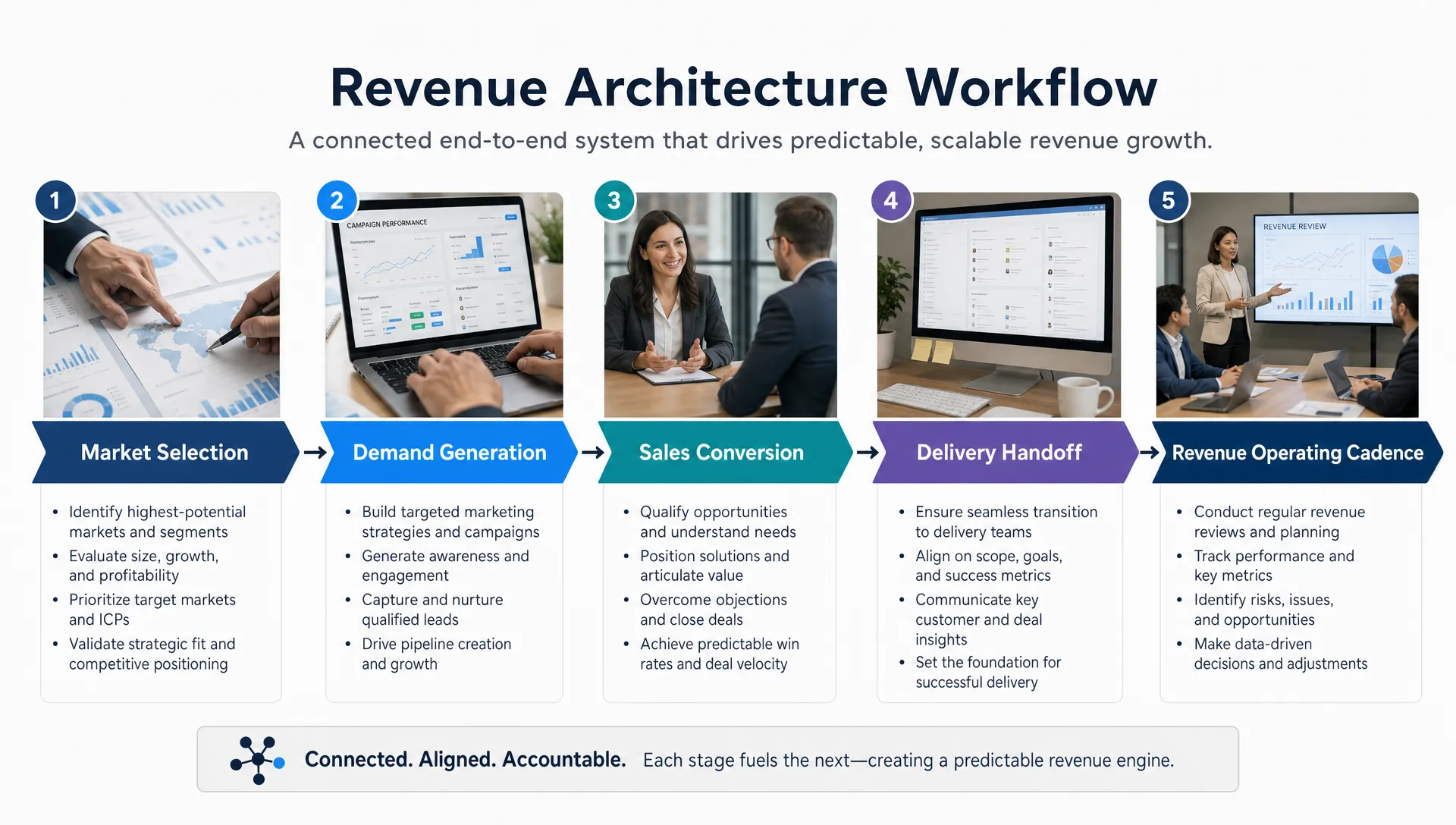
Revenue architecture is the design of how a company selects markets, creates demand, converts opportunities, retains customers, expands accounts, and makes commercial decisions.
It is not a sales script. It is not a CRM cleanup project. It is not a marketing campaign calendar. Those can all be useful, but only after the underlying architecture is clear.
A strong revenue architecture answers five practical questions:
- Who are we built to win with, and who should we stop chasing?
- What problem do we solve in a way the market already values?
- How do we create reliable demand beyond the founder's network?
- How do we convert revenue without the founder carrying every deal?
- How do we make decisions using a cadence, data, and clear ownership?
For a broader explanation of the concept, Billionaires in Boxers describes revenue architecture for B2B founders as the commercial system that lets a company generate, convert, and retain revenue without depending on the founder at every step.
The important phrase is system. Founder bottlenecks are rarely removed by one hire, one dashboard, or one campaign. They are removed when the business has a designed way to make revenue happen repeatedly.
Where founder bottlenecks really show up
Founder dependency often looks like a sales problem from the outside. In reality, it tends to spread across the entire revenue system.
| Revenue area | Founder-dependent version | Revenue architecture version |
|---|---|---|
| Market focus | The founder knows which opportunities are worth pursuing | ICP, segment priorities, and disqualification rules guide the team |
| Pipeline | New opportunities rely heavily on referrals and founder relationships | Demand is built through defined channels, messaging, and proof assets |
| Sales conversion | The founder joins calls to diagnose, reframe, and close | Sales process, discovery logic, and deal stages make conversion repeatable |
| Pricing | The founder customizes scope and price deal by deal | Pricing guardrails and offer boundaries reduce ad hoc decisions |
| Delivery handoff | The founder reassures clients and fixes expectation gaps | Implementation promises, success criteria, and handoffs are standardized |
| Revenue decisions | The founder reads the room and decides what matters | Metrics, cadence, and ownership create a shared operating rhythm |
If several of these feel familiar, the issue may be broader than workload. It may be the kind of founder dependency that keeps B2B revenue stuck even when demand exists and the team is working hard.
Revenue architecture moves market selection out of the founder's head
One of the most expensive founder bottlenecks is unclear market selection.
In founder-led B2B companies, the founder often knows instinctively which prospects are a good fit. They can hear a few details and sense whether the buyer has urgency, budget, authority, strategic alignment, and a problem the company can solve profitably.
The team may not have that same pattern recognition. So they pursue too many marginal opportunities, over-serve weak-fit buyers, or ask the founder to judge every edge case.
Revenue architecture turns that judgment into explicit market rules. It defines the ideal customer profile, priority segments, qualification thresholds, strategic exclusions, and the commercial reasons behind them. This matters because scaling is not just about getting more leads. It is about getting more of the right opportunities into a system that can win them without founder heroics.
When market selection is clear, the founder no longer has to personally inspect every opportunity. Sales and marketing can make faster decisions. Delivery can anticipate common needs. Product or service teams can refine the offer around repeatable demand instead of constantly adapting to one-off requests.
Just as importantly, the business gains permission to say no. Many founder bottlenecks are created by interesting but non-repeatable deals that require special attention. Revenue architecture protects the company from confusing revenue with scalable revenue.
It turns founder-led selling into team-led conversion
Founders are often the best salespeople in their own companies, but not always because they are better at sales technique. They are better because they understand the market, the buyer's real pain, the product or service, the trade-offs, and the history behind the offer.
That depth lets them do things a normal sales process cannot easily do. They can reframe the problem live. They can connect a buyer's vague symptoms to a strategic cost. They can adjust the commercial structure without losing margin. They can use founder credibility to create trust.
The problem is that none of this scales if it remains personal intuition.
Revenue architecture turns founder-led selling into team-led conversion by building the missing commercial assets around the sales team. That can include discovery frameworks, qualification criteria, stage exit requirements, objection handling, business case logic, proposal standards, pricing guardrails, and deal review rhythms.
The aim is not to replace human judgment with rigid scripts. B2B sales still requires judgment. The aim is to make the founder's judgment teachable, inspectable, and usable by others.
A useful test is simple: if a salesperson loses a deal, can the company identify whether the issue was fit, message, discovery, urgency, proof, price, process, or competition? If the answer is mostly guesswork, the founder will keep being dragged into deals because no one can see where the system is breaking.
Revenue architecture makes the sales system visible enough to improve.
It creates a revenue operating cadence
Founder bottlenecks get worse when every decision feels urgent and every meeting becomes a reset.
Without a revenue operating cadence, the founder becomes the company's real-time routing system. Marketing asks which message to prioritize. Sales asks which deals matter. Delivery asks what was promised. Finance asks whether the forecast is real. Leadership asks what to fix next.
Revenue architecture creates a cadence for those decisions so they happen at the right altitude.
A practical cadence might include weekly pipeline reviews, monthly segment performance reviews, quarterly offer and channel reviews, and a recurring forum for customer feedback patterns. The exact rhythm depends on the company, but the principle is consistent: decisions should not depend on catching the founder at the right moment.
This is why diagnosis matters before acceleration. If the company does not know whether the current constraint is market focus, offer clarity, lead quality, sales conversion, onboarding, retention, or expansion, it will likely apply the wrong fix. Billionaires in Boxers explains this principle in its article on why revenue architecture should come before acceleration.
It transfers authority from the founder to the company
In many founder-led B2B companies, buyers trust the founder more than they trust the company. That is understandable. The founder may be the clearest communicator, the strongest authority, and the person who best explains why the company's approach works.
But if buyer confidence depends on founder presence, the company has not yet institutionalized its authority.
Revenue architecture helps transfer trust from the individual to the business. It does this by making the company's point of view, proof, methodology, and customer outcomes visible before the founder enters the room.
That can include stronger case studies, sharper diagnostic tools, clearer commercial narratives, better onboarding materials, more consistent proposals, and a defined methodology for delivering results. These assets allow the team to communicate the company's expertise without constantly borrowing the founder's credibility.
This does not mean the founder never appears in the sales process. In some strategic deals, founder involvement can still be valuable. The difference is that the founder becomes a high-leverage asset, not the default mechanism for creating trust.
A company becomes easier to scale when buyers believe in the system, not just the person who started it.
It makes AI and automation useful instead of noisy
Many founder-led companies try to solve bottlenecks with technology. They add CRM automation, AI prospecting, call summaries, proposal tools, lead scoring, or reporting dashboards.
Those tools can help, but only if the revenue architecture is already clear enough to automate.
If the company has a vague ICP, inconsistent qualification, unclear messaging, and no agreed sales stages, AI will simply accelerate confusion. It may create more activity, more content, more outreach, and more data, but not necessarily better revenue decisions.
With architecture in place, AI systems become more useful. They can support account research, summarize sales calls against defined criteria, flag missing qualification data, help draft proposals within approved boundaries, identify patterns in lost deals, or assist with customer expansion signals.
The key is that AI should reinforce the revenue system, not substitute for one. A founder bottleneck is not removed by adding automation to unclear judgment. It is removed by clarifying the judgment first, then using systems to distribute it.
The founder's role after the bottleneck is removed
Removing founder bottlenecks does not mean the founder steps away from revenue. It means the founder's role changes.
| Old founder role | New founder role |
|---|---|
| Approves most proposals | Sets pricing principles and reviews exceptions |
| Joins important calls by default | Joins only strategically selected opportunities |
| Creates pipeline through personal relationships | Shapes the market narrative and partnership strategy |
| Fixes recurring delivery issues | Reviews patterns and improves the operating model |
| Makes decisions from memory | Uses a revenue cadence with shared data and ownership |
This shift can be psychologically difficult. Founders are often rewarded for being close to every customer, every deal, and every important decision. Letting go can feel like lowering standards.
But good revenue architecture does not lower standards. It preserves standards by making them transferable.
The founder's highest-value work becomes designing the commercial system, developing leadership, sharpening strategic choices, and intervening only where their involvement creates disproportionate value.
That is how a founder-led company starts to become a founder-shaped company. The founder's insight remains embedded in the business, but the business no longer has to wait for the founder to act.
How to start building revenue architecture without slowing growth
The safest way to remove founder bottlenecks is not to disappear from the revenue process overnight. That usually creates confusion, missed context, and lower conversion.
A better approach is to identify where founder involvement is most frequent, then turn that area into a repeatable part of the revenue system.
Start by mapping the current revenue path from first market signal to renewal or expansion. Note every point where the founder gets involved. Then ask whether the founder is adding strategic value or compensating for a missing system.
The difference matters. If the founder joins a complex enterprise conversation because the relationship is strategically important, that may be good leverage. If the founder joins because the team cannot explain the offer clearly, that is an architecture gap.
From there, focus on a small number of high-impact moves:
- Map the founder's recurring decisions and document the criteria behind them.
- Define the ICP and disqualification rules so the team can stop chasing weak-fit deals.
- Standardize discovery, proposal, and pricing logic before adding more pipeline volume.
- Create a weekly revenue cadence that separates deal issues from system issues.
- Test the new architecture in one segment before rolling it across the entire business.
The first objective is not perfection. It is to build enough structure that the next layer of growth does not create the next layer of founder dependency.
Common mistakes that keep founder bottlenecks alive
The first mistake is hiring ahead of architecture. A new sales leader, marketer, or revenue operator can add value, but if the business has not clarified its market, offer, sales logic, and decision rights, the new hire inherits ambiguity. The founder then becomes the interpreter of everything the architecture should have made clear.
The second mistake is documenting activities instead of judgment. A playbook that says send this email or book this meeting is not enough. The real leverage comes from documenting how the company makes trade-offs, qualifies buyers, frames value, protects margin, and decides what not to pursue.
The third mistake is removing the founder too fast. Founder withdrawal without system design often damages conversion and morale. The better path is staged removal, where the founder first codifies, then delegates, then reviews by exception.
The fourth mistake is measuring only top-line revenue. A business can grow while becoming more founder-dependent. Better indicators include the percentage of deals closed without founder involvement, forecast accuracy without founder correction, proposal approval exceptions, time spent in escalations, and revenue by repeatable segment.
Revenue architecture is working when the company can grow while reducing the number of decisions that require founder intervention.
Frequently Asked Questions
What is revenue architecture in simple terms? Revenue architecture is the operating design for how a business creates, converts, and retains revenue. It defines the market focus, offer, demand channels, sales process, handoffs, metrics, and decision rights that make revenue repeatable.
How does revenue architecture remove founder bottlenecks? It turns the founder's tacit judgment into explicit systems. Instead of relying on the founder to qualify opportunities, explain value, approve pricing, or resolve commercial ambiguity, the team gets rules, assets, cadence, and ownership.
Does revenue architecture mean the founder stops selling? No. It means the founder stops being required for every important sale. The founder can still support strategic opportunities, shape the narrative, and advise on complex deals, but the default revenue motion should not depend on founder presence.
Can a founder-led B2B company build revenue architecture before hiring a CRO? Yes. In many cases, it should. Hiring a CRO or sales leader into an unclear revenue system can create frustration for both sides. Architecture gives future revenue leaders a clearer system to operate and improve.
How long does it take to reduce founder dependency in revenue? It depends on the complexity of the business and the severity of the bottleneck. Some improvements can happen quickly, such as clearer qualification and pricing rules. Deeper changes, such as team-led conversion and operating cadence, usually require consistent implementation over several cycles.
Ready to remove the founder bottleneck?
If your B2B company is growing but too much revenue still depends on your judgment, relationships, or calendar, the next fix may not be another campaign or another hire. It may be a clearer revenue architecture.
Billionaires in Boxers works with founder-led B2B businesses from $3M to $25M in revenue using PE-grade diagnostics, AI systems, and fractional CRO support. The Revenue Acceleration Diagnostic starts from $5K and is designed to identify the real constraint, clarify the architecture gaps, and produce a costed intervention roadmap.
When the founder stops being the bottleneck, the business does not lose its edge. It finally learns how to scale it.
