
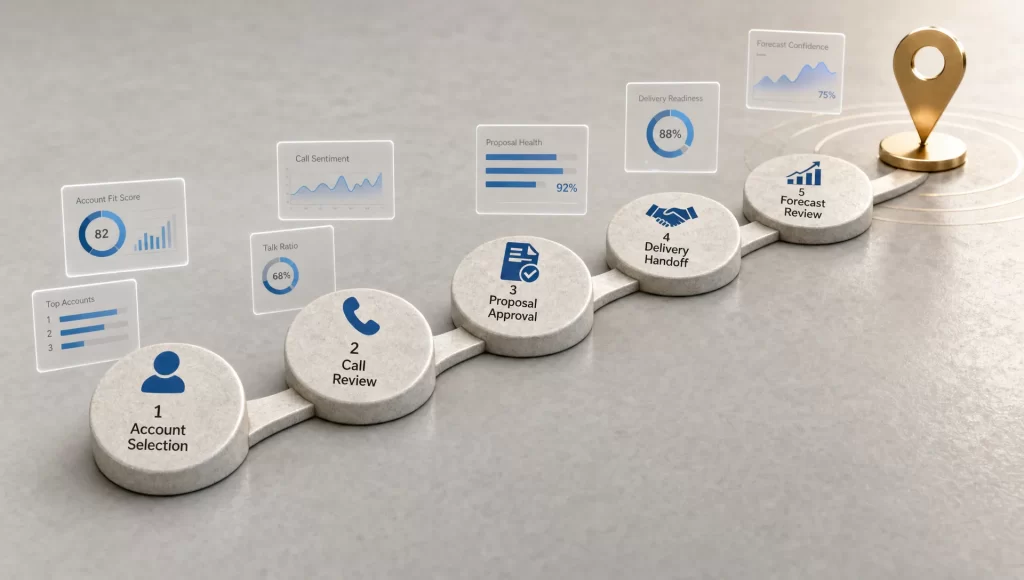
Most B2B founders do not need another AI tool. They need a sharper revenue system.
That distinction matters. A tool helps one person complete one task faster. An AI system changes how the business makes a repeated commercial decision, captures context, routes work and improves execution over time.
For a founder-led B2B company, especially one in the $3M to $25M revenue range, the best AI systems are not novelty projects. They sit close to revenue. They improve how the company chooses accounts, qualifies deals, prepares for calls, writes proposals, protects delivery margin, forecasts pipeline and identifies expansion opportunities.
McKinsey’s 2024 Global Survey on AI found that generative AI adoption had accelerated sharply, but adoption alone does not create advantage. The advantage comes when AI is embedded into the operating rhythm of the business.
Below are the AI systems examples every B2B founder should understand, not because you should build all of them at once, but because they reveal where AI can create measurable leverage in a founder-led revenue engine.
What makes something an AI system, not just an AI tool?
An AI system has five parts working together:
- A recurring business decision or workflow
- A defined data source, such as CRM notes, call transcripts, support tickets or financial data
- A set of rules, prompts, models or decision logic
- A human owner who reviews, approves or acts
- A feedback loop that improves the next decision
A standalone AI tool might summarize a sales call. An AI sales system uses the call summary to update qualification, flag deal risk, suggest follow-up, enrich the CRM, notify the right manager and improve the forecast.
That is why the best AI investments start with operating design, not software selection. If you want a broader strategic view, Billionaires in Boxers has a useful companion piece on what an AI operating system should do for a B2B company.
The AI systems examples that matter most in B2B
The table below gives a quick view before we go deeper into each system.
| AI system example | Commercial question it answers | Common data inputs | Revenue impact |
|---|---|---|---|
| ICP and account prioritization | Which accounts deserve focus now? | CRM, firmographics, win-loss data, website intent | Better targeting and higher conversion |
| Demand signal monitoring | Which prospects are showing buying signals? | LinkedIn, job posts, news, review sites, website visits | More timely outbound and pipeline creation |
| Qualification and deal coaching | Is this deal real, winnable and worth pursuing? | Calls, emails, CRM stages, qualification notes | Better sales execution and less wasted effort |
| Proposal and business case generation | How do we make the value case clearer? | Discovery notes, pricing logic, case studies, templates | Higher proposal quality and faster sales cycles |
| Forecast and pipeline risk | What will actually close and why? | CRM history, stage aging, next steps, rep activity | More accurate leadership decisions |
| Handoff and onboarding | What must delivery know to succeed? | Sales notes, contracts, scope, kickoff data | Cleaner delivery and stronger retention |
| Margin and scope control | Where are we leaking profit after the sale? | Timesheets, tickets, project notes, change requests | Better gross margin and fewer surprises |
| Expansion intelligence | Which customers are ready for more value? | Usage, support, QBRs, tickets, outcomes | More expansion revenue and lower churn |
| Founder decision system | Which decisions should stop living in the founder’s head? | Meeting notes, strategy docs, approvals, exceptions | Less founder bottleneck and better delegation |
| Market expansion analysis | Which segment, vertical or geography should we enter next? | CRM, TAM data, competitors, margins, win rates | Smarter growth bets with less guesswork |
1. ICP and account prioritization system
Most founder-led B2B companies carry too much ambiguity in their ideal customer profile. The founder knows a good-fit customer when they see one, but that judgment has not been translated into a repeatable scoring system for sales and marketing.
An AI-powered ICP system helps codify that judgment. It can analyze won deals, lost deals, sales cycle length, deal size, margin, retention history and qualitative notes to identify which accounts are genuinely attractive.
The system does not just say, “Target SaaS companies with 100 to 500 employees.” That is too generic. A better system might identify patterns such as companies hiring a VP Sales, expanding into a new region, replacing a legacy platform, raising capital or showing operational strain that your solution solves.
The founder benefit is focus. Instead of debating which accounts “feel” right, the team works from a shared account priority model. Marketing knows who to attract. Sales knows who to pursue. Leadership can see whether pipeline quality is improving or merely growing.
2. Demand signal monitoring system
Many B2B buying windows are triggered by change. A company hires a new executive, opens a new office, receives funding, launches a new product, misses a compliance deadline or starts recruiting for a role that implies a capability gap.
A demand signal monitoring system watches for those changes and translates them into commercial action.
For example, a cybersecurity firm might monitor hiring activity around compliance and IT leadership. A B2B services firm might track companies expanding into new markets. A vertical SaaS company might watch for regulatory changes affecting its target industry.
The AI layer can categorize signals, score urgency, match them to your ICP and suggest messaging angles. A human still decides how to act, but the team is no longer relying on random prospecting lists or stale databases.
This is especially useful when outbound performance has declined. The problem is often not that outbound is dead. The problem is that the timing and relevance are weak. AI helps identify why this account, why this problem and why now.
3. Qualification and deal coaching system
Sales teams often confuse activity with progress. A prospect takes meetings, asks for a proposal and says the budget is “being discussed,” but no one has confirmed pain severity, decision process, urgency, economic buyer access or competitive position.
An AI qualification system reviews call transcripts, emails and CRM data to flag missing information. It can compare the deal against your qualification standard, surface risks and recommend the next best question.
For example, after a discovery call, the system might flag:
- No confirmed decision date
- No quantified cost of the problem
- Champion has influence but no budget authority
- Competitor mentioned but not explored
- Next step is vague and buyer-owned urgency is weak
That does not replace sales management. It makes sales management more consistent. The founder or CRO can coach the same judgment across the team instead of reviewing every opportunity manually.
This is one of the areas where AI can create fast leverage because it sits directly inside the sales rhythm. For a deeper look at this category, see how AI systems can strengthen sales, delivery and forecasting.
4. Proposal and business case generation system
Proposal writing is one of the highest-leverage but most inconsistent workflows in B2B sales. The best proposals connect the buyer’s problem to a commercial outcome, make the buying case easy to defend internally and reduce perceived risk.
Too many proposals are repackaged capability decks. They explain what the vendor does, but they do not show why the buyer should act now.
An AI proposal system can convert discovery notes, stakeholder priorities, scope requirements, pricing logic and proof points into a stronger first draft. More importantly, it can enforce a better structure.
A useful proposal system should help answer:
- What problem did the buyer explicitly acknowledge?
- What is the cost of inaction?
- Which stakeholders care and why?
- What outcomes will define success?
- What risks might block approval?
- Which case study or proof point is most relevant?
The human salesperson should still review the narrative and commercial terms. AI should not invent client facts, discounts or commitments. But it can dramatically reduce the blank-page problem and improve consistency across the team.
5. Forecast and pipeline risk system
A founder does not need a prettier pipeline dashboard. They need to know what is likely to close, what is slipping, what is inflated and where leadership intervention is required.
An AI forecast system can inspect opportunity history, stage aging, meeting cadence, stakeholder engagement, next-step quality, email momentum and rep behavior. It can then flag risk patterns that are easy to miss in a manual pipeline review.
For example, two deals might both be listed at 70 percent probability. One has a confirmed executive meeting, a clear business case and procurement steps mapped. The other has not had buyer engagement in three weeks, but the rep has not updated the close date. Traditional CRM reporting treats them similarly. A good AI risk system does not.
The system should not be positioned as an oracle. It should be treated as a second set of eyes that forces better commercial inspection. The output is not “the model says this will close.” The output is “these assumptions need to be challenged before the forecast is trusted.”
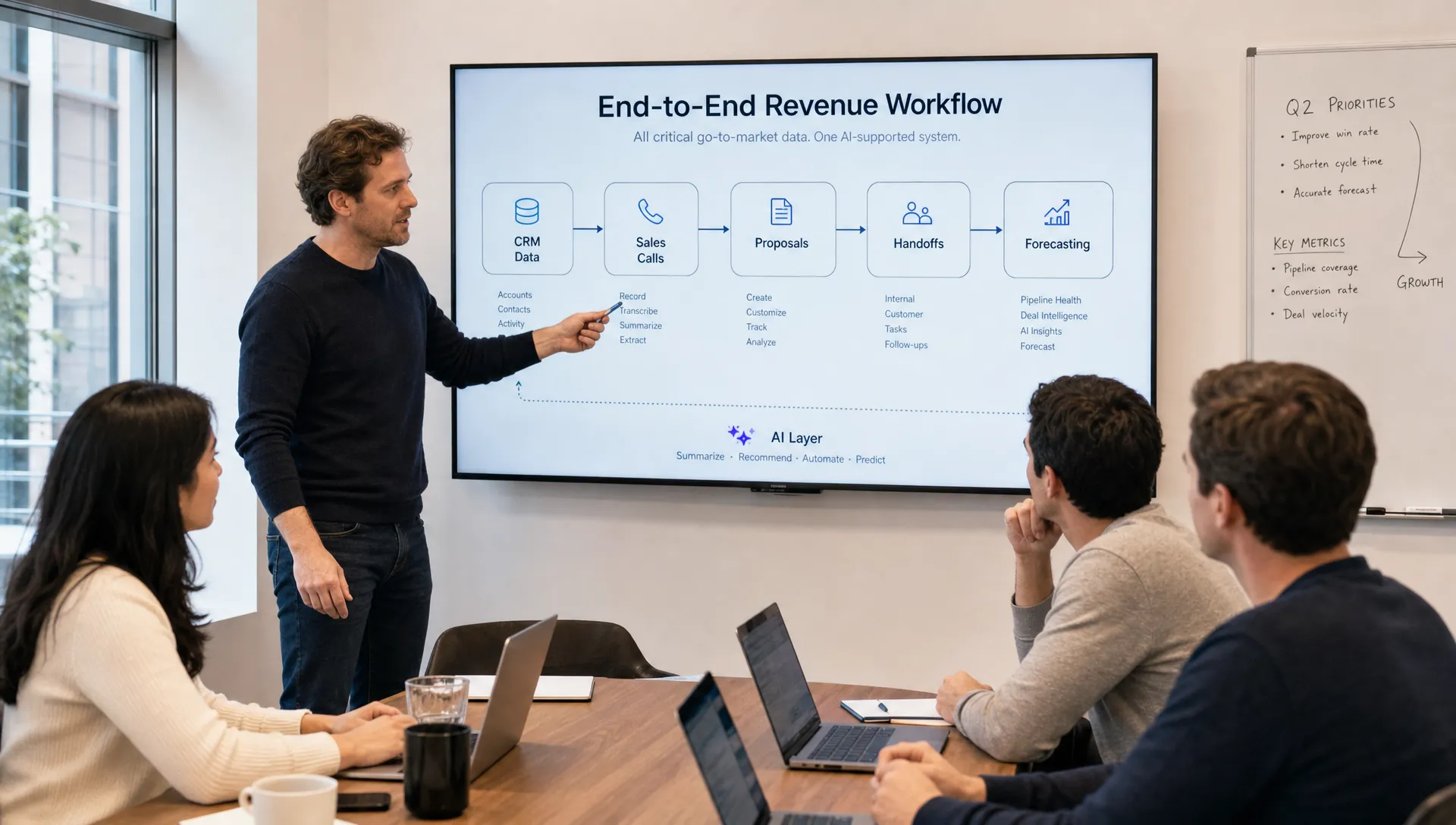
6. Customer handoff and onboarding system
Revenue is not created only when the contract is signed. In many B2B companies, revenue is lost during handoff.
Sales knows the buyer’s pain, urgency, politics and success criteria. Delivery receives a contract, a short internal note and a rushed kickoff meeting. The customer then has to repeat what they already explained. Expectations drift. Scope gets blurry. The first 30 days become reactive.
An AI handoff system solves this by turning sales context into a structured delivery brief. It can summarize the buyer’s goals, stakeholders, promised outcomes, known risks, implementation constraints and open questions.
The best version also creates a kickoff agenda and flags anything that needs confirmation before work starts. This protects delivery quality and helps the customer feel understood from day one.
For founder-led companies, this system is often underrated. Founders tend to focus AI on new sales, but retention and delivery consistency are critical once the business is scaling beyond founder control.
7. Margin and scope creep detection system
Many B2B companies grow revenue while quietly damaging margin. This is common in services, implementation-heavy SaaS, agencies, consultancies, managed services and complex solution providers.
An AI margin and scope system looks for signals that delivery effort is drifting beyond the commercial agreement. It can analyze project notes, support tickets, time entries, Slack or Teams messages, change requests and customer sentiment.
The system might flag that a customer has requested work outside scope three times in two weeks, that delivery hours are trending above budget or that unresolved issues are threatening renewal risk.
This is not about policing the team. It is about making hidden delivery economics visible before they become a margin problem or customer issue.
Founders often have strong instincts about which customers are becoming expensive to serve. AI helps turn that instinct into an earlier warning system that account management, delivery and finance can all use.
8. Expansion and retention intelligence system
Expansion revenue is usually easier to win than new logos, but only if the company can identify the right moment and the right reason to expand.
An AI expansion system analyzes customer usage, business outcomes, support history, meeting notes, stakeholder changes, renewal dates and product adoption. It then identifies accounts that may be ready for upsell, cross-sell or executive attention.
For example, a customer might be a strong expansion candidate because usage is growing across teams, support sentiment is positive and a new executive has joined with a mandate aligned to your value proposition. Another customer might look large on paper but show declining engagement and unresolved issues, making retention the priority.
This helps account teams avoid generic “checking in” conversations. Instead, they can bring a specific value hypothesis to the customer: “We noticed adoption has expanded in the operations team. There may be a case for rolling this into the regional teams, provided we can prove the same cycle-time reduction.”
The value is not just more expansion. It is better customer timing.
9. Founder decision and delegation system
In founder-led companies, the founder is often the hidden operating system. They approve discounts, shape enterprise deals, rescue complex customers, decide which markets matter and interpret ambiguous signals.
That works until growth turns the founder into the bottleneck.
An AI founder decision system captures the logic behind repeated founder decisions. It can analyze meeting notes, Slack threads, CRM exceptions, pricing approvals and strategy documents to identify patterns.
The goal is not to remove the founder from the business. It is to document and distribute their judgment.
For example, if the founder consistently rejects low-margin custom work unless it opens a strategic vertical, that rule should not remain tribal knowledge. If the founder prioritizes deals with a specific operational pain because retention is higher, that should become part of qualification. If certain discount requests are acceptable only when contract length increases, that logic should be explicit.
This is where AI becomes an operating leverage tool, not just a productivity assistant. It helps the company scale judgment. Billionaires in Boxers explores this further in the article on AI integrated workflows that remove founder bottlenecks.
10. Market expansion analysis system
Market expansion is one of the most expensive decisions a B2B founder can make. A new vertical, geography, buyer persona or product line can unlock growth, but it can also distract the team and dilute positioning.
An AI market expansion system helps evaluate expansion options using internal and external data. It can compare win rates by segment, average deal size, sales cycle length, gross margin, churn, competitive intensity, implementation complexity and customer proof.
The output should be a decision brief, not a magic answer. A strong brief might show that one vertical has a larger market but weak proof, while another has a smaller market with stronger win rates, faster sales cycles and better retention.
For a founder, the value is disciplined comparison. AI can help reduce emotional decision-making and make expansion bets more evidence-based.
How to choose which AI system to build first
The wrong first AI system creates noise. The right first system makes a repeated revenue decision faster, clearer or more profitable.
Use four filters before building anything.
| Filter | Good sign | Warning sign |
|---|---|---|
| Revenue proximity | The system affects pipeline, conversion, retention, margin or expansion | The system mainly saves admin time with no clear revenue link |
| Decision frequency | The workflow happens weekly or daily | The workflow happens rarely or only for edge cases |
| Data availability | The company already has useful CRM, call, support or financial data | The needed data is missing, messy or not captured at all |
| Clear ownership | A leader will use the output in a real operating cadence | No one owns the workflow after the build |
For many founder-led B2B companies, the best first system is usually one of three options: qualification and deal coaching, proposal generation or forecast risk. These are close to revenue, easy to embed into existing sales rhythms and visible enough for leadership to inspect.
If the company has delivery margin pressure, start with handoff or scope creep detection. If new-logo growth is strong but retention is weak, start with onboarding or expansion intelligence. If the founder is still approving too many decisions, start by codifying founder judgment.
Implementation principles that keep AI systems useful
AI systems fail when they are built as side projects. They succeed when they become part of how the company runs.
Start with the decision, not the model. The question is not “Which AI platform should we buy?” The question is “Which decision do we need to improve, and what information would improve it?”
Keep humans in the loop for judgment-heavy moments. Pricing exceptions, customer commitments, forecast calls, hiring decisions and expansion strategy should not be fully automated. AI should prepare, challenge and structure the decision.
Define what the system is not allowed to do. It should not invent customer facts, fabricate case studies, approve discounts, change contract language or send sensitive communications without review. The NIST AI Risk Management Framework is a useful reference for thinking about governance, reliability and accountability.
Measure operational adoption, not just technical completion. A system is not finished when it works in a demo. It is working when managers use it in pipeline reviews, reps use it before calls, delivery teams rely on it during handoff or leadership uses it to make resourcing decisions.
Build feedback into the workflow. If the system scores a deal as high risk and the deal closes, capture why. If it recommends a next step that does not work, refine the logic. AI systems become more valuable when the company treats them as learning infrastructure.
Common mistakes founders make with AI systems
The first mistake is automating a broken process. If qualification is unclear, AI will scale unclear qualification. If CRM stages are political fiction, AI will generate cleaner-looking fiction.
The second mistake is chasing general productivity instead of revenue leverage. Summaries, drafts and chatbots can help, but they rarely transform growth on their own. The biggest gains come when AI improves a commercial decision the business already struggles to make consistently.
The third mistake is separating AI from management cadence. If the system’s output is not used in weekly sales meetings, customer reviews, delivery reviews or leadership planning, it becomes another abandoned dashboard.
The fourth mistake is expecting AI to replace founder judgment before that judgment has been defined. AI cannot scale what the company has not clarified. Founders need to translate their commercial instincts into rules, examples, deal patterns and exceptions.
Frequently Asked Questions
What are AI systems examples in B2B? Common AI systems examples in B2B include ICP scoring, demand signal monitoring, deal coaching, proposal generation, forecast risk analysis, customer handoff, scope creep detection, expansion intelligence and founder decision systems.
How is an AI system different from automation? Automation completes a defined task. An AI system supports a recurring business decision by combining data, rules, context, workflow ownership and feedback. The best systems improve judgment, not just speed.
Which AI system should a B2B founder build first? Start with the system closest to your biggest revenue constraint. If pipeline quality is weak, build ICP or qualification support. If deals stall, build proposal or deal coaching. If delivery is chaotic, build handoff or margin protection.
Do AI systems need perfect data to work? No, but they do need usable data. Call transcripts, CRM notes, customer tickets and financial records are often enough to begin. Poor data quality should shape the scope of the first system, not stop the work completely.
Can AI systems replace a sales leader or CRO? No. AI can improve inspection, preparation, consistency and decision support, but it does not replace commercial leadership. In founder-led B2B companies, AI works best when paired with strong operating cadence and clear accountability.
Turning AI examples into a revenue system
The point of studying AI systems examples is not to build a catalog of clever use cases. It is to identify where your company is leaking growth through inconsistent decisions, weak handoffs, founder bottlenecks or poor visibility.
For founder-led B2B companies, AI should help answer practical revenue questions: Which accounts should we pursue? Which deals are real? Which proposals need a stronger business case? Which customers are at risk? Which expansion bets deserve resources?
If those questions are still being answered through founder memory, spreadsheet archaeology or rep optimism, the opportunity is not just AI adoption. It is revenue acceleration.
Billionaires in Boxers works with founder-led B2B companies to diagnose revenue constraints, design AI-supported operating systems and build costed intervention roadmaps for scalable growth. The right AI system should not make the business feel more complex. It should make the next right commercial move harder to miss.
