
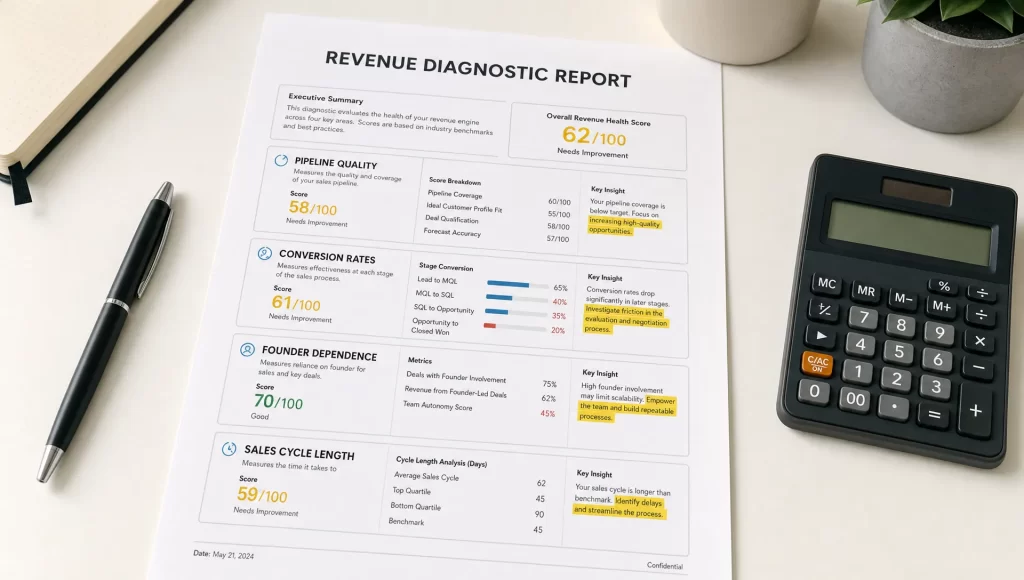
For a founder-led B2B company, sales problems rarely look like sales problems at first.
A founder sees stalled pipeline, inconsistent reps, soft forecasts, slow enterprise deals, too many “good conversations” that do not convert or a team that needs constant founder intervention to close. The default response is often to hire a B2B sales consulting firm for advice: improve discovery, tighten the deck, train the reps, install a new cadence.
Those things can help. They are not enough.
The real value of B2B sales consulting is not another set of recommendations. It is the ability to diagnose what is constraining revenue, redesign the system around that constraint and help the company install a way of selling that works without the founder carrying every serious deal.
For companies between roughly $3M and $25M in revenue, this distinction matters. At that stage, growth is often too complex for founder instinct alone, but the business may not yet need or afford a full executive revenue bench. The consultant’s job is to bridge that gap with commercial clarity, operating discipline and execution support.
Why advice alone fails in founder-led B2B sales
Most founders already have access to advice. They can find sales frameworks, scripts, playbooks, CRM templates, sales podcasts and AI-generated sequences in minutes. The problem is rarely a lack of generic sales ideas.
The problem is that generic sales advice does not know your market, your average contract value, your buying committee, your current conversion rates, your founder dependence or your team’s actual behavior under pressure.
A consultant who only gives advice often leaves behind three problems.
First, the advice may be directionally correct but commercially unprioritized. “Improve outbound” sounds sensible, but if the real constraint is weak positioning or poor qualification, more outbound only creates more low-quality pipeline.
Second, the advice may not survive contact with the team. A new discovery methodology means little if managers do not inspect calls, CRM fields do not reflect the process and compensation rewards activity rather than qualified progression.
Third, the advice can create more work for the founder. Many consulting engagements produce a list of recommendations that the founder must translate into projects, assign to the team, cost, sequence and enforce. That is not leverage. It is homework.
Good sales consulting should reduce ambiguity, not add to it.
The first deliverable: a commercial diagnostic, not a sales opinion
B2B sales consulting should begin with diagnosis. Before changing scripts, hiring reps or buying tools, the consultant should identify where revenue is actually leaking.
That diagnostic should look across the full commercial system, not only the sales team. Sales performance is shaped by market focus, offer clarity, lead quality, pricing, conversion rates, sales cycle length, customer expansion and leadership cadence.
A useful diagnostic answers questions such as:
- Which segment produces the best win rates, sales velocity and gross margin?
- Where do deals stall, disappear or require founder rescue?
- Are reps losing because of skill, process, market fit, pricing or poor qualification?
- Is the company trying to sell too many offers to too many buyer types?
- Which revenue motion should be scaled, repaired or stopped?
This is where many founder-led companies find the uncomfortable truth: the visible sales issue is a symptom. A weak close rate may be caused by a poorly defined ICP. Low rep productivity may be caused by founder-created exceptions. Pipeline inconsistency may be caused by marketing and sales chasing different buyers.
If the issue extends across sales and marketing, a broader view of sales and marketing consulting services that drive ROI may be more useful than treating sales in isolation.
The second deliverable: a sales thesis the team can act on
After diagnosis, a consultant should convert findings into a clear sales thesis. This is the commercial argument for where growth will come from and how the company should pursue it.
A strong sales thesis is specific. It does not say, “We need better enterprise sales.” It says which segment deserves focus, what pain is urgent enough to fund, which buyer has authority, why the company should win and what sales motion fits the economics of the deal.
For example, a founder-led B2B company might discover that its best growth path is not hiring more account executives. It may need to narrow its ICP, increase deal qualification standards, shift founder time toward strategic accounts, rebuild its outbound messaging around a sharper business problem or create an expansion motion inside existing customers.
The sales thesis should also expose what the company will stop doing. Scaling sales requires focus. If every vertical, persona and use case remains equally important, the team will continue spreading effort across too many weak opportunities.
A useful sales thesis gives leadership a decision-making filter. When a new lead source, market segment or hire is proposed, the question becomes simple: does this support the chosen growth motion or distract from it?
The third deliverable: pipeline math and economic reality
Many sales plans fail because they are built around ambition rather than arithmetic.
A consultant should translate the growth target into pipeline math. That means working backward from revenue goals into the required qualified pipeline, win rates, sales cycle assumptions, average contract value, ramp time and rep capacity.
This is not spreadsheet theater. It is how leadership sees whether the current plan is plausible.
| Question | Why it matters |
|---|---|
| How much qualified pipeline is needed? | Shows whether the company has enough real opportunity to hit the target |
| What conversion rates are assumed? | Reveals whether the plan depends on unrealistic improvement |
| How long is the actual sales cycle? | Prevents late recognition that pipeline will not convert in time |
| What can each rep reasonably carry? | Protects the company from overhiring or under-supporting the team |
| Which deals need founder involvement? | Identifies where the company is not yet scalable |
This kind of math changes the conversation. Instead of asking whether the team “feels good” about the quarter, leadership can inspect whether the inputs support the number.
It also helps founders make better investment decisions. If the model shows that the company cannot hit its target without improved win rates, then hiring more reps may be premature. If the model shows strong conversion but insufficient pipeline, demand generation or outbound capacity may be the priority.
The fourth deliverable: a sales process that matches the buyer journey
A sales process is not a set of CRM stages with optimistic names. It is the operating model for how buyers move from problem awareness to commercial decision.
Gartner has written extensively about the complexity of modern B2B buying, including the reality that buying groups spend much of the journey outside direct supplier conversations. Its research on the B2B buying journey is a useful reminder that sales teams cannot rely only on rep charisma and late-stage persuasion.
A consultant should help design a process that reflects how your buyers actually buy. That includes entry criteria for each stage, exit criteria, buyer evidence, decision roles, mutual commitments and deal risks.
The difference is practical. A weak process says a deal is in “proposal” because a rep sent pricing. A stronger process asks whether the economic buyer agrees there is a business case, whether procurement requirements are known, whether the timeline is tied to an event and whether the buyer has confirmed the decision path.
For founder-led companies, this is often the point where sales becomes more scalable. When opportunity stages are based on buyer evidence rather than rep optimism, managers can coach earlier, forecasts become less fictional and founders can stop being pulled into every deal at the moment it starts to wobble.

The fifth deliverable: practical assets the team will actually use
Sales consulting should leave behind usable assets, not just frameworks. These assets should help reps execute the chosen sales motion consistently.
Depending on the diagnosis, the right assets might include:
- ICP and disqualification criteria that prevent wasted pipeline
- Discovery guides tied to business impact, not surface-level pain
- Qualification standards that managers can inspect
- Objection handling based on real deal loss patterns
- Deal review templates for complex opportunities
- Messaging by persona, industry or trigger event
- Mutual action plan templates for larger deals
- Forecasting rules that reduce sandbagging and optimism
The test is whether these assets change behavior. A 40-page sales playbook that nobody opens is less valuable than a two-page discovery guide that managers use every week.
The consultant should also adapt assets to the team’s maturity. A founder-led company with three sellers does not need the same level of process complexity as a 40-person revenue organization. Too little structure creates chaos, but too much structure slows the team down and encourages compliance theater.
The sixth deliverable: management cadence and accountability
Sales performance improves when the operating cadence changes. This is where many consulting engagements either create lasting value or fade out.
A consultant should help install the meetings, metrics and inspection points that keep the sales system working. That may include pipeline reviews, forecast calls, deal strategy sessions, rep scorecards, activity quality reviews and leadership dashboards.
The cadence should answer three questions each week:
- Are we creating enough qualified opportunity?
- Are the right deals progressing for the right reasons?
- Are managers improving rep behavior or only reporting numbers?
This is especially important in founder-led businesses, where the founder often acts as head of sales, chief deal strategist and escalation point. That pattern works in the early years because founder conviction is powerful. It breaks as the company scales because founder time becomes the constraint.
A proper operating cadence transfers judgment from the founder’s head into the company’s management system. It does not remove the founder from sales completely, but it makes founder involvement more intentional.
The seventh deliverable: technology and AI that support the motion
Sales technology should not be the strategy. It should reinforce the strategy.
Many B2B companies have a CRM, sequencing tool, call recording platform and reporting layer, yet still lack a coherent revenue system. The tools exist, but the data is messy, the stages are subjective and managers do not trust the reports.
A sales consultant should clarify what technology needs to do for the business. That can include better CRM architecture, cleaner pipeline definitions, AI-assisted research, account prioritization, call review workflows, outbound personalization or automated handoffs between marketing, sales and customer success.
The key is to avoid tool-first thinking. AI systems and sales automation can create leverage, but only after the company knows which buyers it wants, which signals matter and what good sales execution looks like. Otherwise automation simply scales noise.
For founder-led B2B companies, this is an area where outside support can be valuable because the goal is not more dashboards. The goal is a commercial system that makes better decisions faster.
The eighth deliverable: a costed roadmap with sequencing
Advice becomes useful when it is turned into an executable roadmap. That roadmap should show what to fix, in what order, at what cost and with what expected impact.
Not every sales problem should be solved at once. A company may need to fix qualification before hiring. It may need to sharpen positioning before outbound. It may need to rebuild management cadence before adding a new territory. The sequence matters because founder-led teams have limited bandwidth.
A strong roadmap should separate quick wins from structural work. Quick wins might include tightening stage exit criteria, improving discovery questions or removing obvious low-fit segments from active pursuit. Structural work might include redesigning the sales motion, rebuilding compensation, creating a new enterprise process or installing a fractional CRO layer.
This is the difference between a consulting deck and a revenue acceleration plan. The founder should leave knowing what will happen next, who owns it, what resources are required and which numbers will prove progress.
If the company’s issue is broader than sales execution, it may be worth comparing this with what a strategic advisor should deliver beyond advice, since some revenue constraints require strategic judgment rather than sales process improvement alone.
What great B2B sales consulting should not do
The easiest way to spot weak sales consulting is to look for premature certainty. If a consultant recommends hiring, training, outbound or a new CRM before understanding the revenue system, the engagement is already at risk.
Be cautious when the consultant’s answer is always the same regardless of company stage, market or sales motion. A high-volume SMB motion, a complex enterprise sale and a channel-led expansion strategy require different systems.
Also be cautious of engagements that over-index on motivation. Sales energy matters, but founder-led B2B growth is not usually unlocked by pep talks. It is unlocked by sharper market focus, better qualification, stronger management, cleaner data and more disciplined execution.
A good consultant will be willing to say uncomfortable things. That may include telling the founder that the current target market is too broad, the team is not ready for more headcount, the forecast is inflated or the founder is unintentionally creating sales dependency.
How to evaluate a B2B sales consulting engagement
Before hiring a consultant, founders should ask what will be different after 30, 60 and 90 days. The answer should be concrete.
By 30 days, you should expect diagnosis, clarity on constraints and an initial view of the commercial priorities. By 60 days, you should see process changes, sharper pipeline inspection, improved qualification and practical sales assets in use. By 90 days, the company should have a clearer operating cadence, better visibility into the forecast and a sequenced roadmap for the next stage of growth.
Not every metric will move immediately, especially in longer-cycle B2B sales. But leading indicators should change. The team should be pursuing better-fit opportunities, managers should be coaching against clear standards and the founder should have more confidence in what the pipeline actually means.
If you are unsure whether you need a consultant, advisor or fractional executive, this breakdown of business advisor or consultant options for founders can help clarify the right type of support.
What this means for founder-led B2B companies
The right B2B sales consulting engagement should create leverage for the founder. It should not merely validate what leadership already suspects or hand over a generic sales playbook.
At its best, it delivers four outcomes.
It makes the revenue constraint visible. It converts growth ambition into commercial math. It installs a sales system that managers can run. It gives the founder a costed roadmap for moving from founder-led selling toward scalable revenue execution.
That is the standard founders should expect. Advice is cheap. A working revenue system is what creates enterprise value.
Frequently Asked Questions
What does B2B sales consulting usually include? B2B sales consulting can include sales diagnostics, pipeline analysis, sales process design, management cadence, sales playbooks, CRM improvement, rep coaching and go-to-market recommendations. The best engagements connect these activities to a measurable revenue constraint.
When should a founder-led company hire a B2B sales consultant? A founder-led company should consider outside sales support when growth depends too heavily on the founder, forecasts are unreliable, reps are inconsistent, pipeline quality is unclear or revenue has stalled despite market demand.
Is sales training the same as sales consulting? No. Sales training focuses on improving rep skills. Sales consulting should diagnose the commercial system, identify what is blocking revenue and help install the process, tools, management cadence and assets required to scale.
How long does it take to see results from sales consulting? Some leading indicators can improve within weeks, such as qualification quality, pipeline visibility and management discipline. Revenue impact depends on sales cycle length, deal complexity and how quickly the company implements the recommended changes.
What should a sales consultant deliver at the end of an engagement? A strong engagement should leave behind a clear diagnosis, sales thesis, pipeline model, practical sales assets, operating cadence, technology recommendations and a costed roadmap for continued execution.
Build a sales system that can scale beyond the founder
If your company has outgrown founder-led selling, the next step is not more generic advice. It is a clear diagnosis of the revenue constraint and a practical plan to remove it.
Billionaires in Boxers works with founder-led B2B companies at $3M to $25M in revenue through PE-grade diagnostics, AI systems and fractional CRO support. The Revenue Acceleration Diagnostic is built to identify what is slowing growth and turn that insight into a costed intervention roadmap.
Start with the Billionaires in Boxers revenue acceleration approach if you want sales consulting that is tied to execution, not just recommendations.
