
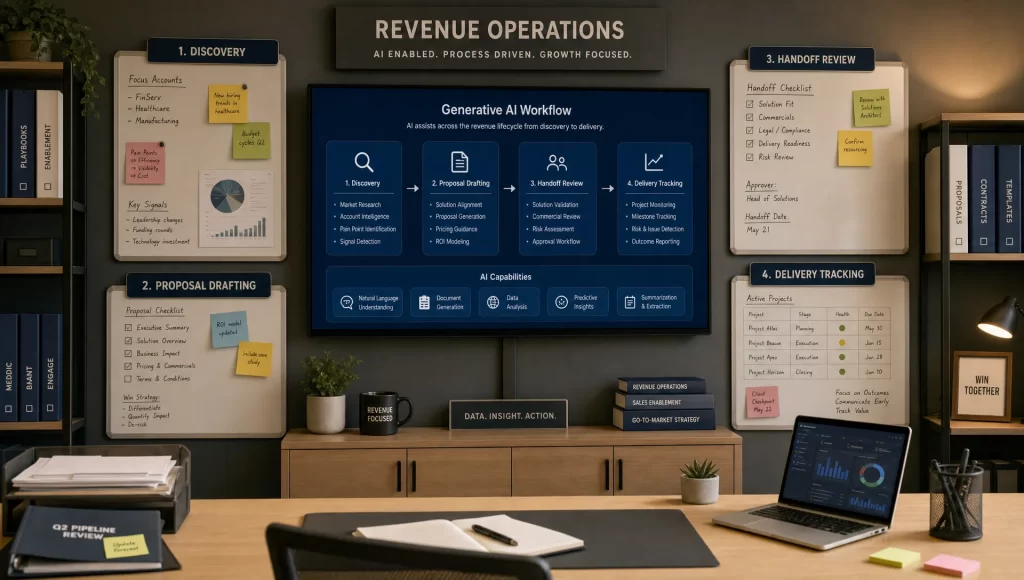
Generative AI becomes valuable in a founder-led B2B company when it improves the work that creates revenue, not when it produces more text. For companies between $3M and $25M in revenue, the most common constraint is rarely effort. It is inconsistency: one rep qualifies well and another does not, one project lead captures the real delivery risk and another misses it, one founder can spot a bad-fit deal instantly but that judgment has not been encoded anywhere.
That is where generative AI systems matter. A prompt can draft an email. A system can connect deal context, customer history, delivery capacity, commercial rules and human approval into a repeatable workflow. The difference is not academic. It determines whether AI becomes another software subscription or a working layer in the revenue engine.
McKinsey's 2024 State of AI research reported that 65 percent of survey respondents said their organizations were regularly using generative AI, almost double the share from its prior survey. Adoption is no longer the hard part. The harder question for founder-led B2B companies is where generative AI should sit so it supports both sales execution and delivery quality without creating new risk.
What makes generative AI systems different from AI tools
Most teams start with tools because they are easy to test. Someone uses ChatGPT to draft follow-up emails. A sales leader asks an AI assistant to summarize discovery calls. A project manager uses AI to turn meeting notes into action items. These experiments can save time, but they often sit outside the operating rhythm of the business.
Generative AI systems are different because they are designed around a recurring commercial workflow. They have defined inputs, rules, outputs, owners, approvals and feedback loops. A strong system does not simply generate content. It helps the team make better decisions, take the next action faster and keep the promise made to the customer aligned with what the company can actually deliver.
For a broader view of how these systems fit across the revenue engine, the Billionaires in Boxers guide to AI systems that strengthen sales, delivery and forecasting is a useful companion. This article focuses specifically on the generative layer: the models, prompts, knowledge retrieval and review points that produce usable drafts, recommendations and summaries inside sales and delivery work.
A practical generative AI system usually includes:
- A clear job to be done: For example, improve discovery quality, produce better proposals or reduce delivery handoff gaps.
- Trusted knowledge sources: CRM data, call transcripts, proposals, delivery playbooks, case studies, pricing rules and customer success notes.
- Workflow triggers: Stage changes, completed calls, signed contracts, kickoff meetings, delivery milestones or renewal windows.
- Human checkpoints: Approval gates for pricing, scope, legal language, strategic accounts and customer-facing material.
- Measurement: Cycle time, conversion quality, delivery rework, margin protection and customer expansion signals.
That structure is what turns generative AI from a clever writing assistant into a revenue system.
Why sales and delivery should be designed together
Sales and delivery are often optimized separately. Sales wants speed, sharper messaging and higher close rates. Delivery wants cleaner scope, better expectations and fewer surprises after the contract is signed. Both are reasonable goals, but isolated AI implementation can pull them apart.
If sales uses generative AI to produce polished proposals without delivery constraints, the company may close work it cannot deliver profitably. If delivery uses AI only to summarize project updates, valuable customer insights may never flow back into sales, account expansion or positioning. Founder-led B2B businesses feel this strain early because much of the company's judgment still lives in the founder, head of sales or senior operators.
The better design question is: where does context need to move between sales and delivery? Once that question is answered, generative AI can support the handoff points that protect margin and customer trust.
Here is a simple way to map the highest-value systems.
| Generative AI system | Primary revenue job | Core inputs | Human checkpoint |
|---|---|---|---|
| Discovery intelligence | Improve qualification and need diagnosis | Call transcripts, CRM fields, ICP criteria, past wins and losses | Sales leader reviews deal quality on high-value opportunities |
| Proposal and scope assistant | Create clearer proposals faster | Discovery notes, pricing logic, case studies, delivery capacity and standard terms | Founder, CRO or delivery lead approves final scope |
| Sales-to-delivery handoff | Reduce missed context after close | Proposal, contract, sales notes, risks, stakeholders and commitments | Delivery owner confirms assumptions before kickoff |
| Delivery copilot | Support consistent execution | Playbooks, meeting notes, project plans, customer goals and issue logs | Project lead approves customer-facing updates |
| Expansion signal system | Surface renewal and upsell opportunities | Delivery outcomes, usage signals, feedback, support tickets and stakeholder changes | Account owner validates timing and commercial relevance |
Five generative AI systems that support sales and delivery
Discovery intelligence system
Discovery is where revenue quality begins. A generative AI system can review call transcripts, notes and CRM fields against the company's ideal customer profile. It can flag missing information, summarize buyer pain in the customer's language and identify risks such as unclear urgency, weak executive sponsorship or poor fit.
The value is not merely a cleaner call summary. The value is commercial judgment at scale. If the founder has a clear sense of which deals are worth pursuing, that logic can be turned into qualification prompts and review rubrics. Reps still own the relationship, but they receive sharper coaching at the moment it matters.
This is especially useful when the company is hiring its first sales team or moving beyond founder-led selling. The founder's pattern recognition cannot remain trapped in ad hoc Slack messages and deal reviews. Generative AI can help convert that pattern recognition into consistent deal inspection.
Proposal and scope assistant
Many B2B proposals fail in two directions. Some are too generic, which makes the buyer work too hard to understand value. Others are too customized, which creates delivery risk and margin leakage. A proposal system can help balance relevance and discipline.
The system should draw from approved case studies, service descriptions, commercial rules, implementation constraints and discovery notes. Its job is to draft a proposal that reflects the buyer's situation while staying inside the company's operating model. That includes clear outcomes, assumptions, exclusions, dependencies and next steps.
The approval gate matters. Generative AI should not invent pricing, promise custom deliverables or soften critical terms to make the proposal sound more persuasive. It should make the first draft stronger and faster, then route the material to the person accountable for commercial risk. For teams focused heavily on the sales side of this problem, the article on AI based solutions that strengthen sales execution goes deeper into qualification, follow-up and proposal quality.
Sales-to-delivery handoff system
The handoff from closed-won to kickoff is one of the most expensive places for context to disappear. Sales may know why the buyer chose the company, which stakeholders were skeptical, what outcomes were promised and where the risks sit. Delivery often receives the contract, a few notes and a calendar invite.
A generative AI handoff system can package the full commercial context into a usable delivery brief. It can summarize the customer's goals, decision process, promised outcomes, known constraints, stakeholder map, open risks and early success measures. It can also compare the final proposal against standard delivery playbooks to flag anything unusual.
This does not replace a live handoff meeting. It makes the meeting better. Instead of spending 45 minutes reconstructing history, the team can discuss assumptions, delivery risk and the first 30 days.

Delivery copilot system
Delivery quality depends on consistency. In many founder-led companies, senior people know how to run a great client engagement, but that knowledge has not been turned into a repeatable operating system. A delivery copilot can support project leads by drafting meeting agendas, converting call notes into action logs, comparing progress against playbooks and preparing customer update drafts.
The goal is not to automate the client relationship. Customers can tell when communication becomes generic. The goal is to reduce administrative drag so delivery leaders spend more time managing outcomes, risks and stakeholder alignment.
A good delivery copilot also protects the company from silent scope creep. If meeting notes repeatedly mention requests outside the agreed scope, the system can flag those patterns for review. If customer sentiment changes, it can prompt the account owner to investigate before the renewal is at risk.
Expansion signal system
Expansion is often treated as a sales activity, but the best expansion signals usually appear during delivery. A customer adds new stakeholders to meetings. A business unit asks for a related capability. A project sponsor mentions a board deadline. A delivery issue reveals a bigger strategic pain.
Generative AI can synthesize these signals across meeting notes, project updates, feedback forms and support tickets. It can suggest where the account owner should investigate potential expansion, renewal risk or referral opportunities. It should not auto-generate an upsell pitch and send it to the customer. Timing and trust matter too much.
The system's role is to make account intelligence visible. In many B2B companies, delivery teams see the opportunity first but do not have a consistent mechanism for passing it back to sales. Generative AI can create that mechanism without adding another heavy reporting process.
The architecture behind useful generative AI systems
A strong system begins with workflow design, not model selection. Choosing a large language model before clarifying the business process is like hiring a smart analyst without telling them what decision they support. The model may produce impressive output, but the business may not improve.
The architecture should answer four questions.
| Design question | Why it matters | Example |
|---|---|---|
| What decision or action should improve? | Prevents AI from becoming content generation with no revenue impact | Better qualification before proposal creation |
| Which knowledge sources are trusted? | Reduces hallucination and inconsistent guidance | Approved case studies, service definitions and CRM data |
| Where is human approval required? | Protects margin, compliance and customer trust | Pricing, scope, legal terms and strategic account messaging |
| How does the system learn? | Converts usage into better judgment over time | Win-loss feedback, delivery outcomes and renewal data |
The data layer does not need to be perfect to start, but it does need ownership. If CRM fields are unreliable, call transcripts are missing or delivery notes live in personal documents, generative AI will magnify the mess. This is why the operating foundation matters as much as the model. The guide to AI infrastructure solutions for scalable Revenue Ops covers the data, workflow and governance layers that make AI useful in day-to-day revenue operations.
Governance should be light enough to use and strong enough to prevent obvious mistakes. The NIST AI Risk Management Framework organizes AI risk work around governing, mapping, measuring and managing AI systems. For a commercial team, that translates into clear ownership, defined use cases, output review, data access controls and escalation rules when the system is uncertain.
What to measure before and after implementation
Generative AI systems should be judged by revenue and delivery outcomes, not novelty. A team can produce more emails, proposals and summaries while still losing the same deals or creating the same delivery problems. The right metrics depend on the workflow, but the principle is simple: measure the constraint the system was built to improve.
For sales, useful measures include speed to follow-up, discovery completeness, stage conversion, proposal turnaround time, quality of next steps and forecast accuracy. For delivery, useful measures include time from closed-won to kickoff, rework caused by unclear scope, number of unresolved action items, customer update consistency, gross margin protection and renewal risk visibility.
Do not measure everything at once. Pick one or two workflows where the commercial drag is obvious. Establish a baseline, build the system, then compare results across a defined period. Qualitative review also matters. Ask sales and delivery leaders whether the system improves judgment or simply adds another review step.
A practical 90-day rollout can look like this:
| Phase | Focus | Output |
|---|---|---|
| Days 1 to 15 | Diagnose the sales and delivery friction points | Prioritized use case and baseline metrics |
| Days 16 to 35 | Map the workflow and trusted knowledge sources | System design, approval rules and data requirements |
| Days 36 to 60 | Build the first working version | Draft outputs, human review loops and pilot team |
| Days 61 to 90 | Measure, refine and operationalize | Adoption rhythm, impact review and next use case decision |
This staged approach is slower than buying another AI tool, but it is much faster than repairing a scattered AI environment later.
Common mistakes that weaken generative AI systems
The first mistake is building around convenience rather than revenue impact. If the easiest use case is not tied to a real constraint, adoption may feel good and still change little. Founder-led B2B companies should start where judgment is scarce, handoffs are weak or delays directly affect revenue.
The second mistake is allowing AI output to bypass the people who carry commercial accountability. A proposal draft can be AI-assisted. A pricing decision should still belong to the accountable leader. A kickoff brief can be AI-generated. Delivery assumptions should still be confirmed by the project owner.
The third mistake is treating delivery data as an afterthought. Sales content improves when it reflects what customers actually experienced after buying. Delivery quality improves when it receives the full promise made during sales. Generative AI systems create leverage only when both sides contribute data back into the system.
The fourth mistake is expecting the model to fix unclear strategy. If the company does not know its ICP, service boundaries, pricing logic or delivery capacity, generative AI will produce confident ambiguity. It can scale judgment, but it cannot replace the need for judgment.
Frequently Asked Questions
What are generative AI systems in a B2B revenue context? Generative AI systems are structured workflows that use AI to create, summarize or recommend outputs inside sales and delivery processes. They combine trusted data, prompts, rules, human approvals and measurement rather than relying on one-off AI tool usage.
Where should a founder-led B2B company start with generative AI? Start with the workflow where inconsistency is costing revenue or margin. Common starting points include discovery quality, proposal creation, sales-to-delivery handoffs and delivery update consistency.
Can generative AI replace sales or delivery leaders? No. In a healthy system, generative AI supports leaders by preparing drafts, surfacing risks and organizing context. Accountable humans still own customer judgment, pricing, scope, strategic messaging and relationship management.
How do you reduce hallucination in generative AI systems? Use approved knowledge sources, restrict the system's task, require citations or references where practical, add human review gates and track output quality. The system should be designed to say when it lacks enough information.
How should success be measured? Measure the constraint the system was built to improve. For sales, that may be proposal turnaround time or qualification quality. For delivery, it may be kickoff speed, fewer handoff gaps or reduced scope rework.
Build generative AI around the revenue engine
Generative AI systems work best when they are designed around the way revenue is created, sold, handed off and delivered. The companies that get the most from AI are not necessarily the ones with the most tools. They are the ones that connect AI to repeatable commercial decisions and enforce the right human review at the right moment.
Billionaires in Boxers helps founder-led B2B companies apply PE-grade revenue acceleration methods, AI systems and fractional CRO support to sales optimization, market expansion and scalable delivery alignment. If your company is between $3M and $25M in revenue and you want to identify the highest-value AI and revenue interventions, explore the Revenue Acceleration Diagnostic.
