
Every week, I sit across from a founder who has spent five or six figures on technology and cannot explain what it has done for their revenue.
They have subscriptions. They have dashboards. They have tools they were told would change everything. And yet their pipeline looks exactly the same as it did 12 months ago.
The problem is not the technology. The problem is how they bought it. Most B2B AI strategy fails before it starts – not because the tools are bad, but because the thinking behind the purchase is broken.
I see the same three mistakes repeated across almost every growth-stage B2B business I work with. Here is what they are and what to do instead.
I recently sat down with Reka Janovszki, a recruitment and talent intelligence consultant, and we unpacked these exact patterns live. Watch the full conversation here:
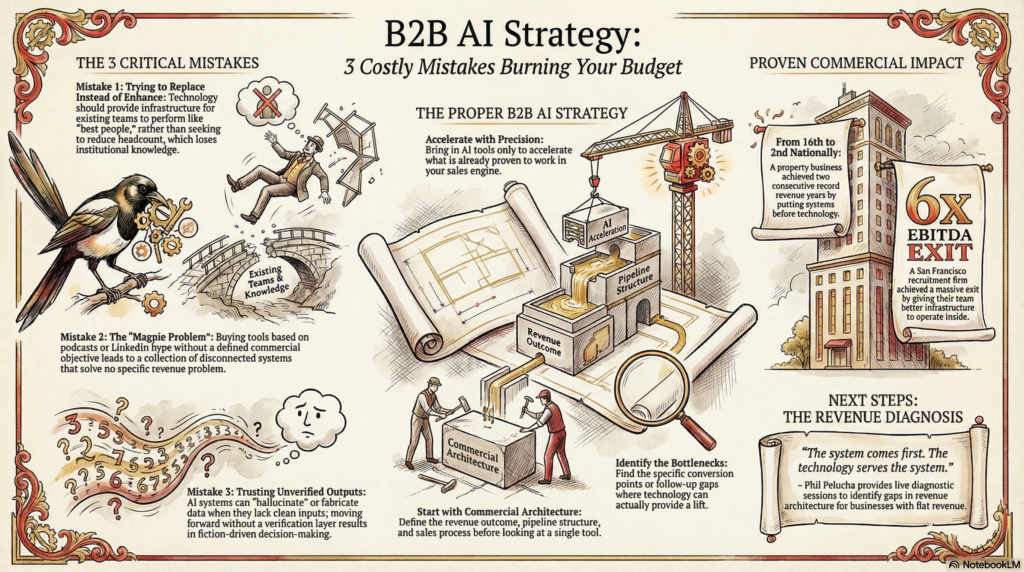
Mistake 1 – Trying to Replace People Instead of Enhancing Them
This is the most expensive mistake in B2B AI strategy, and it is everywhere.
A founder looks at their team, looks at the cost line, and thinks: if I bring in the right system, I can reduce headcount by 30%. That almost never works.
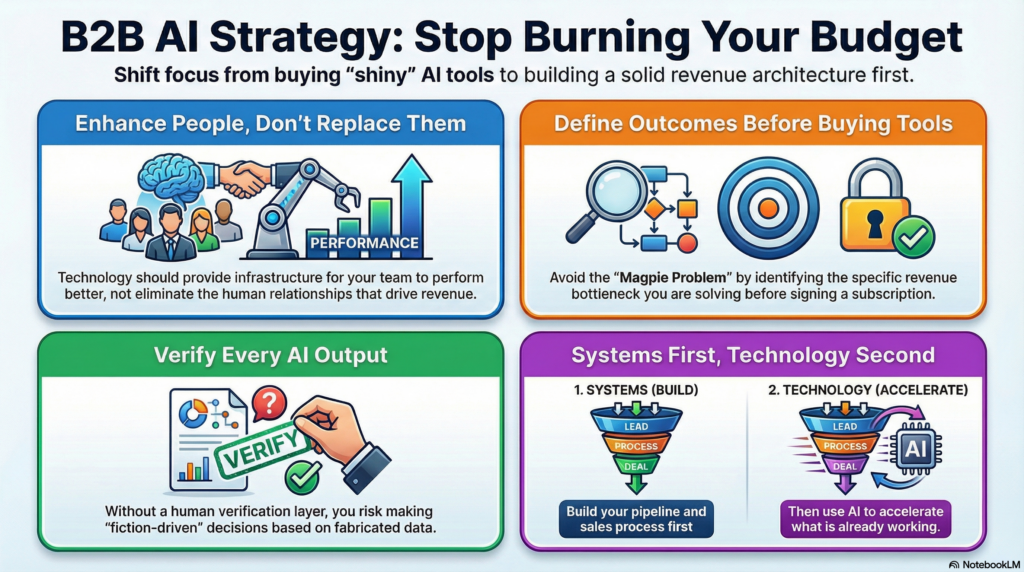
Technology is there to enhance the human experience, not replace it. The businesses I have worked with that have seen the biggest commercial returns — including one client in San Francisco who grew revenue 5x in six months — did not get there by removing people. They got there by giving their existing team better infrastructure to operate inside.
When you try to use technology to replace your team, you lose institutional knowledge. You lose the relationship capital that actually generates revenue. And you still end up with a system that needs a human to operate it properly.
The question should never be “who can I replace?” It should be “how do I make the people I already have perform like my best people?”
That shift in thinking is worth more than any tool you will ever purchase.
Mistake 2 – Buying Systems Without a Strategy
This is what I call The Magpie Problem.
A founder hears about a new platform on a podcast. A competitor mentions a tool at an event. Somebody on LinkedIn posts a case study about a system that “changed everything.”
So the founder buys it. Then they buy the next one. And the next one.
Before long, they have six different systems, none of which talk to each other, none of which are being used to their full capability, and nobody on the team who can explain what the original objective was.
They are acting like magpies; attracted to anything shiny, collecting tools with no coherent B2B AI strategy holding them together.
The missing piece is always the same: there was no commercial outcome defined before the first purchase was made. No clear answer to the question, “What specific revenue problem is this solving?”
Without that answer, every tool purchase is a gamble. And most of them do not pay off.
The businesses that get this right start with the revenue architecture — the pipeline structure, the conversion points, the offer positioning, the follow-up system — and only then identify where technology can accelerate what already works. They buy with precision, not enthusiasm.
Mistake 3 – Trusting Outputs You Have Not Verified
This one is quieter but arguably more dangerous.
I have seen founders present board-level reports built entirely on data their systems fabricated. Not because someone was dishonest; but because nobody checked whether the outputs were real.
Most businesses do not realise that many AI systems, when they do not have verified data to draw from, will fill in the gaps themselves. They will generate statistics. They will create figures. They will present fiction as fact and unless you have specifically built your data infrastructure to prevent that, you will not know it happened.
I use AI extensively across the investment portfolios I work with. It is powerful when the inputs are clean and the architecture is sound. But the principle is the same one it has always been: garbage in, garbage out.
If your B2B AI strategy does not include a verification layer — a system for checking that what comes out of the machine is actually grounded in real data — you are not making data-driven decisions. You are making fiction-driven decisions and calling them data.
That is a commercial risk most growth-stage businesses cannot afford.
What a Proper B2B AI Strategy Actually Looks Like
The founders who get this right do not start with technology. They start with commercial architecture.
They define the revenue outcome first. They build the pipeline structure, the sales process, the offer positioning, and the follow-up system. They identify the bottlenecks. And then only then they bring in the right tools to accelerate what is already working.
That is the approach I take with every business I work with. Whether it is a recruitment firm in San Francisco that went on to exit at 6x EBITDA, or a property business that moved from 16th to 2nd nationally with two consecutive record revenue years – the pattern is the same.
The system comes first. The technology serves the system. Not the other way round.
If your current approach is the opposite of that — if you have been collecting tools and hoping they form a strategy, you are not alone. But you are leaving revenue on the table.
The Revenue Diagnosis — Where This Gets Fixed
Every week, I run a live Revenue Diagnosis session for B2B founders who know something in their commercial infrastructure is not working but cannot pinpoint what it is.
It is not a webinar. It is not a pitch. It is a live diagnostic where I look at what you have built, identify the gaps in your revenue architecture, and tell you exactly what needs to change – whether that involves working with us or not.
If you have spent money on tools that have not moved your pipeline, or if your team is working harder than ever and revenue is still flat, that is a systems problem. And systems problems do not fix themselves.
Phil works with a small number of businesses at any time. If this is relevant to where you are right now, the conversation is worth having.
