

I have sat on both sides of this problem.
I grew and exited two recruitment firms, one in the US, one in the UK. In between, I went internal as a global talent director for a large corporate. I saw exactly what happens when you move from an external environment into an internal one.
Your knowledge stops updating.
Not because you are lazy. Not because you are not good at your job. But because the second you go internal, you are only learning from your own business. Everyone around you has the same information. The same assumptions. The same frame of reference.
And in a market that is moving this fast, that is how a B2B revenue plateau begins not with a bad quarter, but with a knowledge gap nobody notices building.
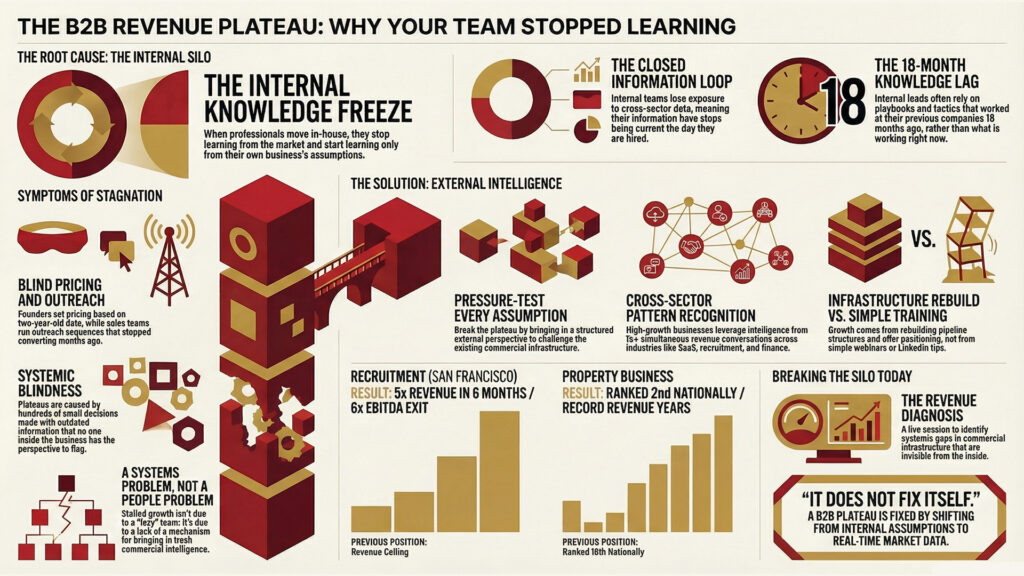
The Silo Problem Nobody Talks About
In the agency world whether that is recruitment, consulting, sales, or any professional services environment, you are constantly learning. From your teammates. From your clients. From competitors. From different sectors and industries.
Every conversation brings fresh data. Every engagement reveals what is working right now, not what worked 18 months ago.
But the moment a professional goes in-house, that information flow stops. They are no longer exposed to what is happening across the market. They are only exposed to what is happening inside their own four walls.
This is not a criticism. It is a structural reality. And it is one of the most underestimated causes of a B2B revenue plateau I see in the businesses that come through our Revenue Diagnosis sessions.
The internal team is not failing. They are operating on an information base that stopped being current the day they were hired.
Yesterday’s Tactics, Tomorrow’s Problems
Here is where it gets expensive.
A founder hires an internal sales lead or a revenue manager. That person brings in the playbook they used at their last company. For the first six months, it works well enough. But then the market shifts. Buyer behaviour changes. New channels emerge. Competitors adjust their positioning.
The internal hire does not see any of this. They are not in the rooms where those patterns are being discussed. They are not working across 10 or 15 different businesses simultaneously. They are not hearing the pain points from talent directors across different sectors the way an external partner would.
So they keep running the same playbook. And the founder keeps wondering why growth has stalled.
This is not a people problem. This is a systems problem. The business has no mechanism for bringing in fresh commercial intelligence. It is relying on a closed loop of internal knowledge, and that loop gets smaller every quarter.
I have seen this pattern in recruitment firms, SaaS businesses, professional services companies, and agencies. The industry does not matter. The dynamic is always the same. Internal teams inherit a fixed set of assumptions and rarely have the external exposure needed to challenge them.
The Real Cost of Operating in a Silo
When I was working internally as a talent director, I experienced this firsthand. Hiring managers would come to me frustrated that a role had been open for three weeks and ask what was taking so long.
As if recruitment was simply a matter of posting an advert and waiting for the right people to appear.
They had no visibility into the market dynamics, the skill shortages, the cultural factors driving candidate decisions, the competition from companies offering flexible working models. They could not see what I could see, because they had never been in the rooms where those conversations happened.
That same blindness exists in revenue teams across B2B businesses right now. Founders are setting pricing based on what they charged two years ago, not what the market will pay today. Sales teams are running outreach sequences that stopped working six months ago. Pipeline forecasts are built on conversion rates that no longer reflect reality.
And nobody inside the business has the external perspective to flag it.
This is how a B2B revenue plateau becomes permanent. Not through one bad decision, but through hundreds of small ones made with outdated information.
What Breaks the Silo
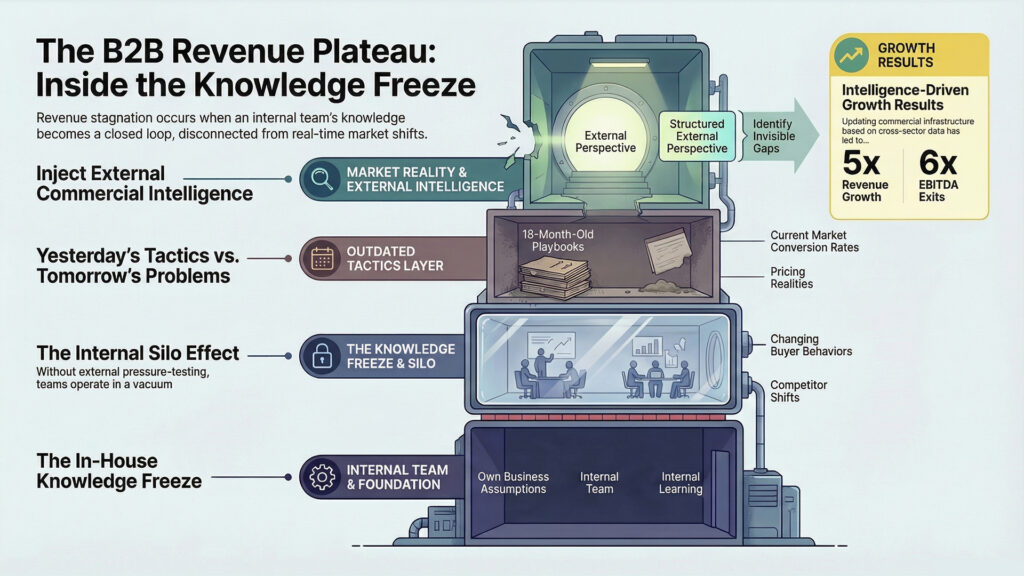
The businesses I work with that break through the plateau share one thing in common: they bring in external commercial intelligence before they try to fix anything internally.
Not a course. Not a webinar. Not a LinkedIn post with five tips. A structured external perspective that pressure-tests every assumption the business is operating on.
That is what I do at Billionaires in Boxers. I work across multiple sectors simultaneously; recruitment, SaaS, professional services, financial services, funded businesses. I see the patterns before they become obvious. I know what is working right now because I am inside 15 different revenue conversations every week, not one.
When a recruitment firm in San Francisco came to us, they had a competent internal team. Good people. Strong work ethic. But their revenue had hit a ceiling. We rebuilt the commercial infrastructure, the pipeline structure, the sales process, the offer positioning – using intelligence drawn from across the portfolio. The result was 5x revenue in six months. They exited at 6x EBITDA.
A property business came to us in a similar position. Talented internal team, but operating on a playbook that had not been updated in years. We installed a Phil-designed revenue architecture. They went from 16th to 2nd nationally and had two consecutive record revenue years.
The internal teams in both businesses were not the problem. The information those teams were working from was the problem.
The Question Most Founders Never Ask
When was the last time somebody from outside your business challenged your commercial assumptions?
Not a board member who sees the same reports you do. Not a mentor who gives you advice over coffee. Somebody who is actively working across your market and others, who sees real-time data on what is converting, what is failing, and what is about to change.
If the answer is “I can’t remember” – that is the gap.
A B2B revenue plateau is rarely caused by a lack of effort. It is almost always caused by a lack of external intelligence. Your team is working hard inside a system that was built on assumptions nobody has checked in months or years.
That is fixable. But it does not fix itself.
The Revenue Diagnosis — Get an External Perspective This Week
Every week, I run a live Revenue Diagnosis session for B2B founders who know revenue has stalled but cannot pinpoint why.
It is not a webinar. It is not a pitch. It is a live session where I look at your commercial infrastructure, identify where the gaps are, and tell you exactly what needs to change — whether that means working with us or not.
If your internal team is doing everything right and the numbers are still flat, the problem is almost certainly systemic. And you will not see it from the inside.
Phil works with a small number of businesses at any time. If this is relevant to where you are right now, the conversation is worth having.
Prefer to watch? Phil unpacked this exact silo problem in a recent conversation on the Recruitment Revolution
