
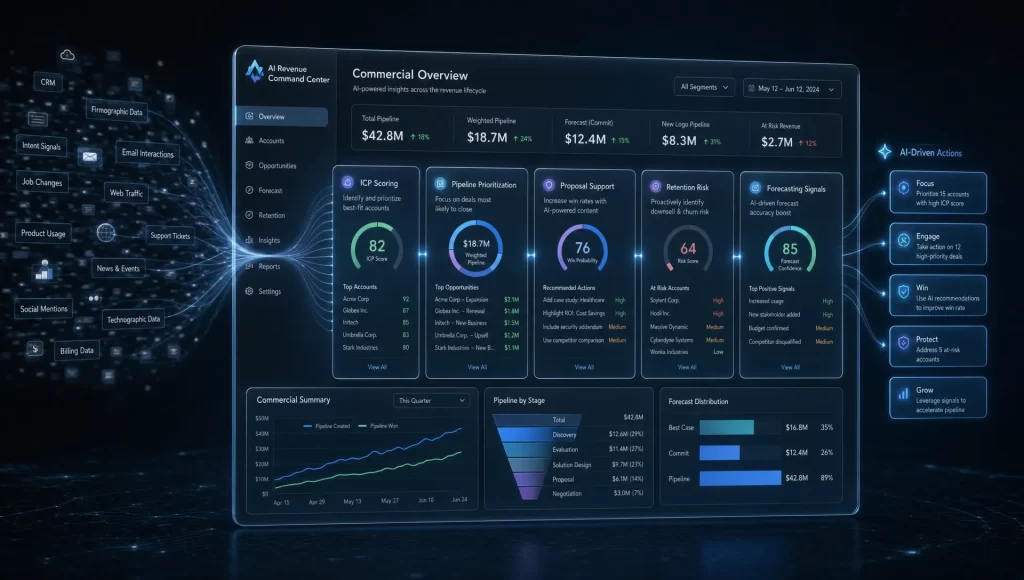
Artificial intelligence is no longer a novelty project for B2B companies. Most founders have tested AI copywriting, meeting notes, chatbots, or CRM assistants. The harder question is whether those experiments produce measurable revenue lift.
For founder-led B2B businesses, especially those between $3M and $25M in revenue, the best business applications of AI are not the flashiest. They are the ones that remove commercial drag, improve decision quality, increase sales capacity, and help the company learn faster than competitors.
That means AI should be judged like any other growth investment. Does it create more qualified pipeline? Does it improve conversion? Does it increase average contract value, retention, or margin? Does it help the founder get out of the critical path without quality dropping?
If the answer is not clear, the AI initiative is probably a productivity experiment, not a revenue growth system.
The revenue test for every AI use case
A useful AI application should connect to a specific constraint in the revenue engine. In founder-led B2B companies, revenue often stalls for predictable reasons: inconsistent lead quality, founder-dependent selling, slow follow-up, weak CRM hygiene, unclear positioning, poor forecast visibility, underused customer data, or delivery teams that do not feed expansion opportunities back into sales.
AI can help with all of those, but only when the workflow is designed around a commercial outcome. The tool itself is not the strategy. A large language model, CRM assistant, or analytics layer is valuable only if it changes what the team does next.
Before funding an AI project, ask four questions:
- What revenue metric should improve?
- Which team behavior must change for that metric to improve?
- What data, workflow, or decision bottleneck prevents that behavior today?
- How will AI reduce the bottleneck without adding operational complexity?
This framing keeps AI grounded. It also prevents the common trap of buying tools because they seem modern, then forcing the team to find a use for them later.
Public research from McKinsey has estimated generative AI could add trillions of dollars in annual economic value, with marketing and sales among the largest opportunity areas. But that value does not appear automatically. It is captured by companies that redesign workflows, improve decisions, and manage adoption with discipline.
Business applications of AI that can move the revenue line
The table below summarizes the highest-value business applications of AI for founder-led B2B companies. The key is to avoid treating these as isolated automations. Each one should be connected to a revenue metric and a management rhythm.
| AI application | Where it creates revenue lift | Metrics to watch | Common mistake |
|---|---|---|---|
| ICP and account selection | Focuses sales capacity on better-fit opportunities | Qualified pipeline, win rate, CAC payback | Scoring accounts without validating against closed-won data |
| Personalized demand creation | Improves relevance across outbound, content, and campaigns | Reply rate, meeting rate, opportunity creation | Producing more content without improving targeting |
| Pipeline prioritization | Helps reps and founders work the right deals at the right time | Stage conversion, sales cycle length, forecast accuracy | Treating AI scores as truth instead of decision support |
| Sales call intelligence | Improves coaching, qualification, and objection handling | Conversion by stage, ramp time, discount rate | Capturing transcripts but never changing behavior |
| Proposal and RFP support | Speeds up sales execution and improves consistency | Proposal turnaround time, close rate, ACV | Automating documents before clarifying the offer |
| Pricing and discount governance | Protects margin and improves deal quality | Gross margin, discount rate, ACV | Letting reps override pricing logic without feedback loops |
| Retention and expansion intelligence | Surfaces risk and growth signals inside accounts | Net revenue retention, expansion pipeline, churn | Looking only at product usage, not relationship and value signals |
| Forecasting and capacity planning | Improves management decisions and hiring timing | Forecast variance, utilization, cash confidence | Using AI forecasts without cleaning pipeline definitions |
1. ICP intelligence and account selection
One of the fastest ways AI can grow revenue is by improving focus. Many B2B companies do not have a demand problem as much as a targeting problem. Sales teams pursue too many accounts that look plausible but do not convert, do not expand, or consume too much delivery capacity.
AI can analyze patterns across closed-won, closed-lost, churned, and expanded accounts to identify the traits that actually correlate with revenue quality. Those traits may include industry, company size, tech stack, hiring activity, trigger events, geography, business model, regulatory pressure, or recent funding.
The output should not be a vague ideal customer profile slide. It should become an operating asset: account scoring, territory design, outbound prioritization, campaign segmentation, and qualification criteria.
For founder-led companies, this is especially important because the founder often has intuitive knowledge of good-fit customers that has never been converted into a repeatable system. AI can help codify that judgment, test it against data, and make it usable by the wider team.
2. Demand creation that uses AI for relevance, not volume
AI has made it easy to create more emails, posts, ads, landing pages, and sales assets. That is not automatically good. In many markets, buyers are already overwhelmed by generic AI-generated outreach.
The revenue-producing use case is not content volume. It is message-market fit at scale.
AI can help segment accounts by pain, buying trigger, maturity level, competitive context, and likely objections. It can turn sales call insights into campaign angles, convert customer language into better landing page copy, and help teams adapt messaging by vertical without rebuilding everything manually.
This also applies to credibility. If a company is entering a new category, selling into larger accounts, or trying to raise trust quickly, AI-assisted messaging should be paired with proof assets such as customer stories, benchmarks, analyst-style insights, and credible media presence. For some companies, a service offering press release distribution to premium media outlets can support that credibility layer when there is a genuinely newsworthy milestone to announce.
The goal is not to automate noise. It is to make every touchpoint feel more specific, more timely, and more relevant to the buyer’s commercial problem.
3. Pipeline prioritization and next-best-action workflows
A messy pipeline creates hidden revenue leakage. Reps spend time on low-probability deals. Good opportunities go stale. Managers inspect CRM fields instead of coaching. Founders get pulled into late-stage deals without a clear view of what is actually needed.
AI can reduce this drag by combining CRM data, engagement signals, call transcripts, proposal activity, buyer seniority, deal age, and historical conversion patterns. The system can then flag risk, recommend next steps, and highlight where human attention is most valuable.
For example, AI might identify that a deal has strong engagement but no economic buyer, or that a proposal was sent without a clear decision date, or that a late-stage opportunity resembles previously lost deals because procurement entered too early.
This is where AI moves beyond simple reporting. It becomes a management layer that helps the team act faster. If your revenue operation is slowed by poor visibility, weak CRM discipline, or inconsistent follow-up, this related breakdown of artificial intelligence solutions that improve revenue ops explains how AI can reduce friction across the commercial system.
4. Sales execution, coaching, and founder leverage
Founder-led sales often works brilliantly until it becomes the bottleneck. The founder knows how to diagnose, position, challenge, reframe, and close. The team, however, may only see fragments of that judgment.
AI can help convert high-performing sales behavior into repeatable coaching assets. Call intelligence tools can analyze discovery quality, objection patterns, talk ratios, competitor mentions, next steps, and qualification gaps. Generative AI can then help create follow-up emails, call summaries, mutual action plans, and coaching notes.
The revenue impact comes from standardization without sterilizing the sale. Reps still need judgment, empathy, and commercial skill. AI simply makes the feedback loop tighter and gives managers better evidence for coaching.
For companies trying to scale beyond founder-led selling, this matters because every percentage point of improvement in conversion compounds. Better discovery improves proposals. Better proposals improve close rates. Better qualification protects delivery capacity. Better coaching shortens ramp time for new hires.

5. Proposals, RFPs, and deal support
Proposal work is one of the most practical business applications of AI because it sits close to revenue and consumes expensive time. In many B2B companies, proposals are slow because knowledge is scattered across old decks, delivery notes, case studies, pricing sheets, and the founder’s head.
AI can help assemble first drafts, tailor language to the buyer’s industry, surface relevant proof points, create executive summaries, and check whether the proposal answers the actual business problem discussed in discovery.
But there is a warning: automating proposals before clarifying the offer can accelerate confusion. If positioning is vague, pricing is inconsistent, or scope boundaries are weak, AI will simply produce polished ambiguity faster.
The best implementation starts with a clean proposal architecture: problem, commercial impact, recommended solution, proof, implementation path, decision process, investment, and risks of inaction. AI then helps the team produce that structure faster and with fewer omissions.
6. Pricing, packaging, and discount control
AI can also support revenue growth by improving pricing discipline. Many founder-led B2B companies undercharge because pricing decisions are based on precedent, discomfort, or isolated deal pressure rather than value and market evidence.
AI can analyze closed-won and closed-lost data, discount patterns, segment performance, margin by customer type, proposal language, competitor mentions, and reasons for churn. This helps leadership see where pricing power exists, where packaging creates friction, and where discounting is masking weak qualification.
For example, if enterprise buyers consistently request security, onboarding, or integration support, that may indicate a packaging opportunity rather than a custom services burden. If small customers negotiate heavily and churn quickly, AI may reveal that they are not the right market segment for the current model.
The revenue lift comes from better packaging decisions, stronger margin control, and clearer rules of engagement for the sales team.
7. Retention and expansion intelligence
Revenue growth is not only a new logo problem. For many B2B companies, the highest-return AI applications sit inside the customer base.
AI can identify churn risk and expansion potential by combining usage data, support tickets, meeting notes, customer health scores, invoice history, stakeholder changes, NPS comments, QBR notes, and delivery milestones. It can summarize account context before renewal calls, recommend expansion plays, and flag accounts where value has not been clearly communicated.
This is particularly valuable when customer success is reactive. A founder or senior operator may know which accounts feel risky, but that intuition is not always visible to the wider team. AI can turn scattered signals into an account management rhythm.
Expansion intelligence is equally important. AI can identify customers with new hiring, new locations, new funding, increased usage, or unresolved adjacent problems. The sales team can then approach expansion with a relevant business case rather than a generic upsell.
8. Forecasting and commercial decision support
Forecasting is not just a finance exercise. It affects hiring, delivery planning, cash management, marketing investment, and founder confidence.
AI can improve forecasting by analyzing historical conversion rates, deal progression patterns, rep behavior, stage aging, engagement signals, seasonality, and slippage. It can also highlight why the forecast is fragile, not just what number is projected.
This is where AI business applications start to influence leadership decisions. Should the company hire another rep? Increase paid demand generation? Enter a new vertical? Expand delivery capacity? Tighten qualification? Pause a market experiment?
AI cannot make those decisions for the founder. But it can improve the quality, speed, and evidence base of the decision. For a deeper view on connecting AI to the full sales, delivery, and forecasting loop, see this article on AI systems that strengthen sales, delivery, and forecasting.
How to choose the right AI application first
Not every AI use case deserves immediate attention. The best first project is usually the one with high revenue proximity, manageable implementation complexity, and clear ownership.
Use this scorecard before committing budget:
| Selection factor | What to ask | Strong signal |
|---|---|---|
| Revenue proximity | Is this close to pipeline, conversion, ACV, retention, or margin? | The metric is already reviewed by leadership |
| Data readiness | Do we have usable inputs? | CRM, call, customer, or finance data exists and can be cleaned |
| Workflow ownership | Who will use and manage the system? | A clear owner can change team behavior |
| Adoption likelihood | Will this make daily work easier? | Users save time or make better decisions quickly |
| Feedback loop | Can we measure improvement within 30 to 90 days? | Baseline metrics are known |
| Strategic importance | Does this reduce a constraint on scale? | The founder or leadership team already feels the pain |
For many founder-led companies, the best starting point is not the most advanced AI model. It is the most expensive bottleneck. If the founder is still reviewing every proposal, start there. If reps are chasing weak deals, start with ICP and pipeline prioritization. If churn surprises the team, start with retention intelligence.
Mistakes that stop AI from growing revenue
AI initiatives usually fail for commercial reasons, not technical ones. The model may work, but the business does not change how it sells, manages, or decides.
The most common mistakes are:
- Automating a broken process instead of redesigning the workflow first.
- Buying disconnected tools without a revenue operating model.
- Treating AI outputs as truth rather than decision support.
- Measuring time saved but ignoring revenue impact.
- Letting every department experiment separately with no shared data architecture.
These mistakes create tool sprawl and executive frustration. They also make teams skeptical because AI feels like another layer of admin instead of a source of leverage. If you are planning a broader AI roadmap, this guide to costly B2B AI strategy mistakes is a useful companion.
A 90-day model for revenue-focused AI adoption
The safest way to implement AI is to start narrow, prove value, then expand. A practical 90-day approach works well for founder-led B2B companies.
Days 1 to 15: Diagnose the revenue constraint
Start with the commercial system, not the technology. Review pipeline quality, conversion rates, sales cycle length, proposal speed, discounting, churn, expansion, and forecast accuracy. Identify the constraint that, if improved, would most directly affect revenue.
Days 16 to 35: Map the workflow and data
Document how the work happens today. Who owns it? Where does information live? What decisions are made repeatedly? What slows the team down? What data is reliable, and what needs cleanup?
This step is where many AI projects are won or lost. If the workflow is unclear, the system will be unclear.
Days 36 to 65: Build a minimum viable AI system
Create the simplest system that can improve the target behavior. That may be a deal-risk assistant, proposal drafting workflow, account scoring model, renewal risk summary, or sales coaching loop.
Keep the first version practical. The goal is not perfection. The goal is to create a useful feedback loop between data, AI output, human judgment, and commercial action.
Days 66 to 90: Measure, coach, and scale
Compare the results against your baseline. Did proposal turnaround improve? Did reps act faster on high-priority opportunities? Did managers coach better? Did forecast confidence improve? Did the founder spend less time rescuing deals?
If the system changes behavior and improves a revenue metric, expand it. If it does not, refine the workflow before adding more technology.
Frequently Asked Questions
What are the best business applications of AI for B2B revenue growth? The strongest applications usually include ICP analysis, pipeline prioritization, sales coaching, proposal support, pricing intelligence, retention risk detection, expansion identification, and forecasting. The best choice depends on the company’s biggest revenue constraint.
Can AI replace salespeople in B2B companies? In complex B2B sales, AI is more useful as a force multiplier than a replacement. It can improve research, follow-up, coaching, prioritization, and proposal quality, but human judgment is still critical for trust, negotiation, diagnosis, and executive alignment.
How should a founder-led company start using AI? Start by diagnosing the revenue bottleneck. Then choose one workflow close to revenue, define the metric that should improve, build a narrow AI system, and measure behavior change over 30 to 90 days before expanding.
What AI use cases are least likely to grow revenue? Generic chatbots, mass content production, disconnected automation tools, and AI dashboards with no decision workflow often fail to create revenue impact. They may save time, but they do not necessarily improve pipeline, conversion, retention, or margin.
How do you measure AI ROI in revenue operations? Measure AI against commercial outcomes such as qualified pipeline, stage conversion, sales cycle length, proposal turnaround time, ACV, discount rate, forecast accuracy, churn, expansion revenue, and founder time removed from recurring sales tasks.
Turn AI into a revenue system, not another tool
The business applications of AI that actually grow revenue are not random automations. They are targeted interventions inside the revenue engine. They help the company focus on better accounts, sell with more consistency, protect margin, retain customers, and make faster commercial decisions.
For founder-led B2B companies, the opportunity is significant, but only if AI is tied to strategy, workflow, accountability, and measurable revenue outcomes.
Billionaires in Boxers helps founder-led B2B businesses use PE-grade diagnostics, AI systems, and fractional CRO support to engineer scalable growth. If your company is ready to identify the revenue constraints AI should solve first, a Revenue Acceleration Diagnostic can turn experimentation into a costed intervention roadmap.
