
Executive Summary
The recruitment industry is undergoing a rapid, measurable shift. Hiring decision-makers no longer buy on credentials, broad promises, or templated proposals alone; they choose partners who can show measurable outcomes, clear risk mitigation, and a market-specific value proposition.
For two decades many traditional recruitment offers have relied on vague positioning and generic claims. The predictable consequences include:
- Price competition
- Slow close cycles
- Poor conversion
- Constant client skepticism
- More retained searches going to large firms that articulate value clearly
OfferGPT is built to stop that slide.
Using two proprietary engines FactFinder OS and Market OS and intelligence synthesized from over 7,500 white papers from the top 15 global consulting firms, OfferGPT converts scattered recruiter messaging into clear, specialized, high-authority offers. These offers make the value tangible to companies, highlight the recruiter’s visible processes, and focus on outcomes that matter to hiring leaders.
This white paper examines:
- The structural weaknesses of traditional recruiting offers
- Why the modern market demands clarity, guarantees, and specificity
- How OfferGPT leverages billion-dollar consulting research to architect superior offers
- The business case: improved win-rate, faster conversions, and deeper client trust
- A detailed comparison: OfferGPT-built offers vs traditional ones
- A future outlook: where the recruitment market is headed and who will win
The Structural Weaknesses in Traditional Recruiting Offers
Most recruiting firms still present themselves with variations of the same generic narrative:
- “We provide high-quality candidates.”
- “We have a strong network.”
- “We work fast.”
- “We understand your industry.”
- “We offer contingency/retained/exclusive search.”
The problem isn’t the claims themselves; it’s that every recruiter in the market repeats the same claims. When every firm says “high-quality candidates” and “strong network,” hiring teams hear noise instead of differentiation.
Drawing on interview transcripts and market observation, traditional recruitment offers consistently show four structural weaknesses:
A) Vague Positioning
Many recruiters cannot succinctly answer the core buyer questions:
- Who exactly they serve (role, seniority, industry)
- What specific problem they solve for that client
- Why their process delivers better hiring outcomes than alternatives
- What measurable outcomes the company should expect (time-to-hire, shortlist quality, retention)
Clients respond to clarity; they reject vague narratives. A simple improvement: state the exact roles and outcomes you deliver in one sentence (example placeholder: “We deliver three VP-level engineering candidates in 30 days with a 90-day retention guarantee”).
B) Invisible Work
Recruiters perform dozens of valuable tasks that rarely appear in offers. Common unseen activities include:
- Screening (phone/video pre-screens)
- Referencing and credential checks
- Role-specific testing or technical vetting
- Qualification against the hiring brief
- Cultural-fit assessments and behavioral scoring
- Background and market-mapping analysis
When those tasks remain invisible, clients treat recruitment as an undifferentiated supplier activity any applicant or résumé-sender looks equivalent. Make this work visible: name your frameworks, list key checkpoints, and quantify the time and rigor you apply to screening and validation.
C) No Risk Mitigation
Traditional offers typically bury protections deep in terms and conditions. Guarantees, when present, are vague and inconsistently communicated, so they fail to reduce client risk.
Clients sign on uncertain about common failure modes:
- The hire fails within the probation period
- The candidate withdraws before start
- Timelines slip and hiring windows close
- The shortlist is low quality or poorly matched
Uncertainty reduces conversion and increases price sensitivity. Practical fix (placeholder): replace buried T&Cs with a clear, front-and-center guarantee for example, a defined replacement commitment and specific delivery thresholds that a client can read in one sentence.
D) Market-Generalized Messaging
Many offers aim at “all industries” or “all roles.”
That approach no longer works. Market OS data and buyer interviews indicate modern hiring leaders prefer hyper-specialized partners with insights tailored to vertical, region, and growth stage: hyper-specialized partners with insights tailored to their vertical, region, and growth stage.
Generalist messaging fails to address specific talent bottlenecks, skill shortages, and role-based biases in sourcing. The remedy: pick your core hiring niches, name them on your offer, and present one market-specific pain point and the concrete steps you take to resolve it.
Why the Recruitment Market Can No Longer Support Generic Offers
Market signals and buyer interviews reveal three converging pressures that make generic recruitment offers obsolete. Together they increase expectations for evidence, niche expertise, and strategic value above and beyond candidate access.
A) Buyers Want Certainty, Not Hope
Hiring leaders are accountable for outcomes and are under constant pressure to reduce risk in the hiring process. They no longer accept vague assurances; they demand:
- Evidence (case examples, success metrics)
- Frameworks that show step-by-step execution
- Clear guarantees that mitigate common failure modes
- Operational systems they can audit and rely on
Buyers used to hear:
“We’ll try our best. Trust us.”
Now they expect:
“Here is the exact system, timeframe, metrics, and protections you will experience.”
Actionable edit suggestion (placeholder): insert an example guarantee sentence here e.g., “We deliver three vetted senior candidates within 30 days, or we replace them at no additional fee within 90 days.”
B) Talent Shortages Demand Precision
Across major regions, persistent talent shortages and shifting skill requirements make generalist approaches ineffective. Companies now expect recruiters to demonstrate deep, role-specific knowledge: which skills are scarce, how to source passive candidates, and how to reduce selection bias in the hiring process.
Practical implication: a recruiter who can show a repeatable hiring process for specific roles (for example: mid-market SaaS product managers or cloud security engineers) will outperform a generalist who markets to “all industries.”
C) AI Has Raised the Bar
AI and automation have commoditized basic sourcing and screening tasks. As technology handles volume work, value shifts to higher-order activities:
- Market and skill intelligence that informs hiring strategy
- Offer architecture designing proposals that align to buyer economics
- Risk reduction through transparent guarantees and delivery thresholds
- Insights that improve candidate fit and reduce bias
- Human judgment refined by data-driven evidence
- Strategic advisory that shapes hiring decisions, not just applications
In short: traditional recruitment offers that emphasize access to candidates are now table stakes. To win, recruiters must package evidence, systems, and niche expertise into offers that reduce hiring risk and speed decisions.
How OfferGPT Builds Offers Using Billion-Dollar Consulting Intelligence
OfferGPT constructs high-conversion offers by combining a provider-centric diagnostic with macro market intelligence. The result is a repeatable process that turns recruiter strengths and market demand into measurable, sellable offers.
A) FactFinder OS
FactFinder OS performs a structured analysis of your firm to reveal repeatable strengths and delivery assets. It examines:
- Your strengths (areas where you consistently outperform)
- Your delivery style and core processes
- Your past performance and case outcomes
- Your internal hiring/process workflows
- Your unique assets (networks, assessments, IP)
- Your interviewing and screening methods
- Your client-success patterns and retention signals
Output example (placeholder): a one-page profile that names your core niche, three signature processes, and two proven outcomes (e.g., time-to-hire and 6‑month retention rates). This creates a clear picture of who you are as a recruitment partner and what outcomes you reliably deliver.
B) Market OS
Market OS synthesizes large-scale consulting research and industry data to map demand and hiring constraints. Built from an analysis of 7,500 white papers across the top 15 global consulting firms, Market OS identifies:
- Market demands and priority hiring areas
- Skill gaps and in-demand competencies
- Role-level hiring needs and timelines
- Vertical-specific pain points and revenue inhibitors
- Talent bottlenecks and sourcing constraints
- Regional growth patterns and local labor dynamics
- Industry-specific KPIs that hiring decisions tie to
- Adjacent markets and white-space hiring opportunities
Output example (placeholder): three prioritized niche opportunities with the key skills, hiring windows, and why your firm can win those roles faster than competitors.
Note: confirm the white-paper sourcing and date range for Market OS before final publication (see fact-checking notes).
C) OfferGPT: The Conversion Engine
OfferGPT merges FactFinder OS and Market OS into a structured offer-creation workflow. The engine converts provider and market inputs into concrete sales assets:
- Core offers tailored to niche roles and buyer economics
- Market-specific pain statements that align to buyers’ KPIs
- Clearly defined outcomes (time-to-hire, shortlist quality, retention targets)
- High-value bonuses and delivery add-ons
- Plain-language guarantees that reduce perceived risk
- Success metrics and reporting cadences
- Timelines and delivery thresholds
- Risk protections framed as sales advantages
- “Why us” positioning statements that remove alternatives
Process at-a-glance: FactFinder → Market OS → OfferGPT outputs (offers, guarantees, timelines). Example placeholder: “We will present a market-specific package that commits to 3 vetted candidates in 30 days, with defined success metrics and a 90‑day replacement guarantee.”
The resulting offer reads like a concise strategy deck: structured, data-backed, and outcome-focused making it easier for hiring teams to decide and reducing the time spent in the sales process.
Traditional Recruiting Offers vs OfferGPT Engineered Offers
Below is a structured, consulting-style comparison that shows how OfferGPT-engineered offers outperform traditional recruitment proposals across five practical dimensions.
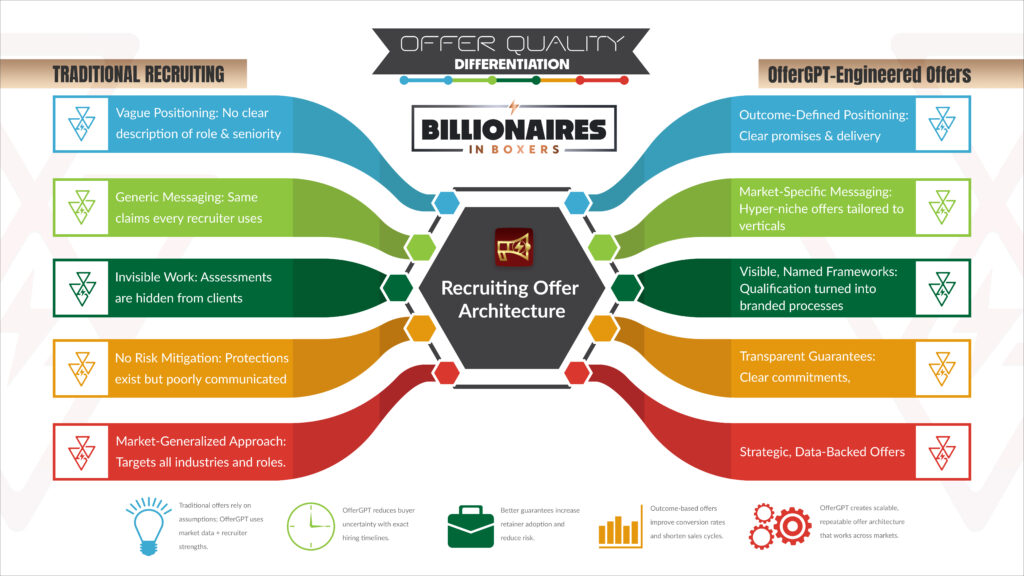
Dimension 1: Clarity of Value Proposition
| TRADITIONAL OFFER | OFFERGPT |
|---|---|
| Generic, broad, non-specific positioning | Outcome-defined specific hiring results are stated up front |
| Promise-driven language with little quantification | Pain-aligned ties to the buyer’s immediate KPIs |
| Hard for hiring teams to compare or differentiate | Market-specific targets a named niche, role, or region |
| Often omits clear hiring outcomes (time-to-hire, shortlist quality) | Measurable includes success metrics recruiters and companies can track |
| Leaves recruiters competing on price rather than value | Designed to reduce alternatives by clarifying the cost of inaction |
What success looks like: a client signs within X days because the offer states “3 senior candidates in 30 days with a 90‑day retention metric.”
Dimension 2: Visibility of Work
| TRADITIONAL OFFER | OFFERGPT |
|---|---|
| The client typically only sees the shortlist | Named frameworks (e.g., “3‑stage technical vet”) |
| Recruitment work appears invisible and indistinguishable. | Step-by-step checklists for each hiring stage |
| Pre-delivery systems that validate shortlist quality | |
| Quality controls (scoring, reference protocols) | |
| Post-placement follow-ups and measured touchpoints | |
This converts invisible labor into visible value the company can audit, improving recruiter credibility and reducing objections about screening or resumes.
Dimension 3: Risk Reduction
| TRADITIONAL OFFER | OFFERGPT |
|---|---|
| Guarantees, if present, are often buried in legal terms. | Replacement commitments stated in plain language |
| Unenforced they fail to change buyer behaviour. | Clear delivery timelines tied to penalties or bonuses |
| Success metrics that trigger remedial action | |
| Delivery thresholds (e.g., minimum shortlist quality) | |
| Bonus protections to align incentives | |
Risk becomes a sales advantage rather than a buried legal clause.Micro‑headline you can reuse: “Guarantee: 90‑day replacement or refund if retention metric not met.”
Dimension 4: Market Specialization
| TRADITIONAL OFFER | OFFERGPT |
|---|---|
| Broad positioning “we recruit for all industries”. | Your core niche (named role and industry) |
| Weakened perceived expertise for specific roles or regions. | Three adjacent high-value markets where your methods scale |
| Region-specific nuances and sourcing tactics | |
| Pain-aligned value propositions that address role-specific shortages | |
Result: higher win-rates and reduced buyer resistance because recruiters demonstrate role-level mastery.
Dimension 5: Sales Storytelling
| TRADITIONAL OFFER | OFFERGPT |
|---|---|
| Reactive, loose, and unstructured. | A coherent narrative that connects pain to outcome |
| Tends to describe services instead of persuading buyers. | Your “only logical choice” explanation (why this approach eliminates alternatives) |
| The cost of doing nothing, framed in hiring-impact terms | |
| The ROI of your system how faster, better hires improve company metrics | |
| Competitive differentiation backed by evidence | |
| Pain–solution alignment across sales and delivery |
When assembled, these elements remove friction in the hiring process and make the recruiter the preferred partner for companies focused on outcomes and efficiency.
The Business Impact: Why OfferGPT Outperforms Traditional Offer Creation
When recruitment teams replace generic proposals with OfferGPT-engineered offers, measurable business impacts follow. Below are the primary outcomes firms report or expect after implementing outcome-defined, market-specific offers (use baseline metrics to validate each claim for your firm).
1. Faster Close Rates
Clear, measurable offers reduce buyer uncertainty and accelerate decisions. Outcome formula (template): reduce time-to-sign by X days when offers state concrete timelines and guarantees. Practical KPI to track: average days-to-accept before vs. after OfferGPT.
2. Higher Retainer Adoption
Offers that demonstrate risk reduction and measurable outcomes shift clients from contingent to retained engagements. Outcome formula (template): convert Y% more clients to retainers by presenting guarantees and delivery thresholds. Track: retainer adoption rate and revenue per client.
3. Higher Lifetime Value
Market-specific messaging and consistent delivery increase client trust and repeat business. Outcome formula (template): increase client lifetime value by Z% through improved retention and cross-sell into adjacent hiring needs. Track: average client lifetime revenue and repeat-hire frequency.
4. Entry Into New Verticals
OfferGPT surfaces three adjacent, profitable markets and produces ready-to-sell offers for each. Outcome formula (template): generate N new vertical meetings per quarter and close M new clients in those verticals within 6 months. Track: meetings sourced, proposals submitted, and wins by vertical.
5. Risk as a Sales Weapon
When guarantees and visible processes are front-and-center, perceived hiring risk drops and conversion improves. Outcome formula (template): improve proposal conversion rate by P% after introducing plain-language guarantees (e.g., 90‑day replacement). Track: conversion rate and objections related to risk.
6. Increased Perceived Authority
Consulting-grade offer architecture and data-backed messaging elevate your perceived expertise among hiring teams. Outcome formula (template): increase initial meeting-to-proposal progression and shorten sales cycles as buyers view the firm as a strategic hiring partner. Track: progression rates and average sales cycle length.
Quick ROI worksheet (one row): Estimate current metric (e.g., close time, conversion), apply expected improvement percentage (from pilots or comparable cases), and calculate incremental revenue from faster hires, higher retainer rates, and expanded verticals.
To validate these outcomes for your firm, run a short pilot: measure baseline recruitment KPIs for one quarter, deploy OfferGPT for a matched set of roles, then compare results. For a guided pilot, book a Strategy Scan (see Next Step).
Why OfferGPT Becomes the Dominant Model for Modern Recruiters
The recruiting landscape is shifting toward a set of repeatable capabilities that favor firms able to combine data, process discipline, and market focus. Firms that adopt these capabilities will outcompete generalist providers and sustain profitable growth.
- Data-driven insights using market and candidate data to inform hiring strategy
- Precise messaging offers tailored to specific roles, regions, and pain points
- Outcome-based billing pricing and engagement models tied to measurable hiring results
- Specialized niches deep expertise in named sectors and role families
- Value-layered services bundled advisory, screening, and post-placement support
- Transparent processes auditable workflows that make invisible work visible
In this environment, generic recruiting offers can no longer sustain margins or differentiate a firm. The competitive edge belongs to organizations that act like strategic advisors: combining evidence, clear processes, and role-level specialization.
“Strategy consulting firms that happen to recruit,” not “Recruiters merely trying to look strategic.”
OfferGPT operationalises this transition by delivering the methods, templates, and evidence required to scale a consulting-grade recruiting approach quickly.
Capability checklist to operationalize OfferGPT:
- Data infrastructure: candidate and market data pipelines
- Defined processes: named frameworks and checklists for screening and delivery
- Sales enablement: market-specific offer templates and ROI narratives
- Guarantees and measurement: plain-language guarantees and success metrics
- Change management: training for recruiters to use data and follow new methods
Final Thoughts: The Industry Has Moved, Offers Must Evolve
The recruitment landscape has shifted: firms that cling to traditional recruitment offers will face mounting commercial pressure, while those that adopt outcome-driven, market-specific offers will capture disproportionate value.
Recruiters who continue using traditional offers risk:
- Decreased margins as competition forces price concessions
- More price shopping from buyers who cannot see differentiated value
- Lower client trust due to opaque processes and buried guarantees
- Fewer retained searches as clients favor firms with clear outcomes
- Longer sales cycles driven by buyer uncertainty
- Reduced relevancy in specialized hiring markets
By contrast, recruiters who adopt OfferGPT-style offers gain:
- A clear competitive edge grounded in measurable outcomes
- A consulting-grade positioning narrative that resonates with hiring teams
- Higher client confidence because processes and guarantees are transparent
- Faster conversions as buyers can evaluate offers against concrete metrics
- A distinct market presence in named niches and verticals
OfferGPT does more than update your offer it reshapes how companies perceive your competence, judgment, and value in the hiring process. The practical path forward is straightforward:
- Assess: run a quick FactFinder scan to identify your core niches and invisible processes.
- Pilot: deploy a single OfferGPT-built offer for a target role and measure baseline KPIs (time-to-sign, conversion, retainer uptake).
- Scale: standardize the winning offer templates, train recruiters on named processes, and publish guarantees and metrics.
These steps preserve candidate experience while focusing company communications on outcomes and evidence improving both hiring results and long-term client relationships.
Next Step: Deploy OfferGPT Inside Your Firm
If you want your offers to deliver measurable business results higher win-rates, less price resistance, clear market authority, and faster client decisions integrating OfferGPT is the practical next step.
Typical outcomes OfferGPT helps you achieve:
- Higher win-rates on targeted roles
- Less price resistance through visible guarantees and outcomes
- Clear market authority in named niches and verticals
- Faster client decisions because offers state exact timelines and metrics
- Entry into three new verticals with ready-to-sell offer packages
- A predictable flow of qualified meetings and proposals
- Differentiation that reduces direct competition and supports higher fees
Ready to see how OfferGPT performs for your company? Start with a low-effort, high-value engagement:
Book a Strategy Scan
30-minute Strategy Scan we review one hiring role, map your current process, and deliver a 1-page gap assessment plus a 90‑day pilot plan.
