

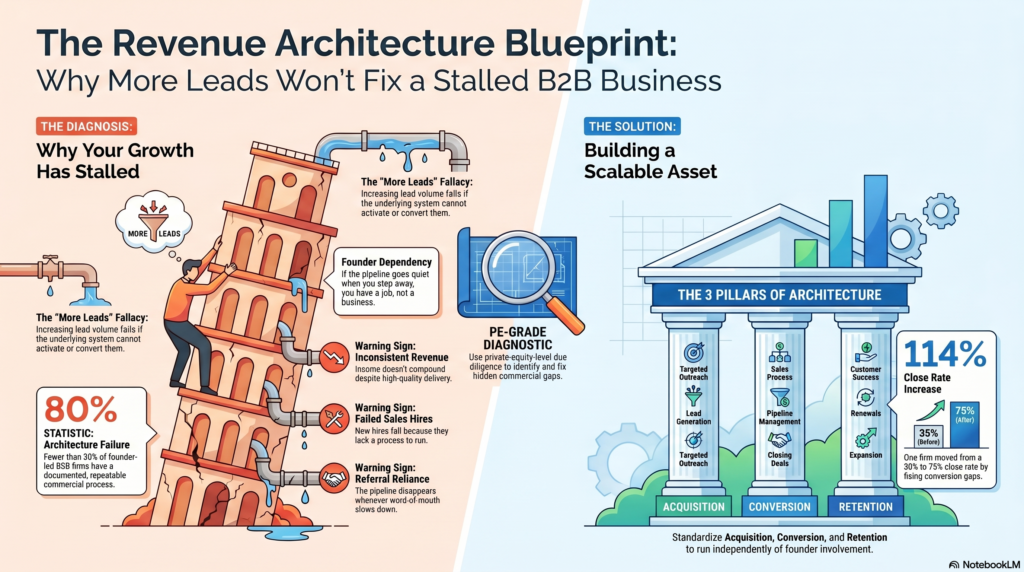
If your B2B revenue has stalled and you can’t work out why, the answer is probably not what you think. You don’t have a lead problem. What most founder-led businesses have is a revenue architecture problem: the commercial structure isn’t built to run without the founder holding it together.
Revenue architecture is how a business generates, converts, and keeps revenue without needing the founder in every conversation. Get it right and income compounds. Get it wrong and every month starts from scratch — regardless of how good the work is.
This post covers what revenue architecture actually means, how to spot whether your business needs it, and why fixing the structure matters more than adding more leads.
What is revenue architecture?
Revenue architecture is the commercial infrastructure of a business — the processes and sequencing that determine how revenue enters, converts, and scales without one person holding it all together. The practical test: if the founder stepped away for 90 days, would the revenue hold?
For most founder-led B2B businesses in the £1.5M–£10M range, the honest answer is no. Not because the business isn’t good, but because the commercial system was never built to run independently. Every deal still routes through the founder. Every pipeline depends on their relationships. Every conversion needs their presence in the room.
That’s not a lead problem. It’s a structural one.
The B2B GTM Benchmark Report 2025 found fewer than 20% of founder-led businesses at this revenue level have a documented, repeatable commercial process that doesn’t require the founder’s direct involvement. The rest are running on personal effort, and effort doesn’t scale past a certain point.
What is revenue architecture?
The B2B consulting industry has trained founders to believe inconsistent revenue means more leads are needed. More posts. A bigger list. Another agency.
This is almost always the wrong diagnosis.
Take a founder with a 40% close rate and 800 warm contacts in their database. That’s not a volume problem. It’s an activation problem. The pipeline exists. The contacts are there. But there’s no system for moving them, no reactivation sequence, nothing to convert what’s already in the room.
The same logic applies when a founder hires their first salesperson and gets nothing. The person isn’t the problem. The process they’ve been handed is.
Revenue architecture changes the question. Instead of asking how to get more leads, the right question is: where is commercial performance breaking down in the existing structure? Answer that and you can fix the problem precisely, rather than throwing budget at the symptom.
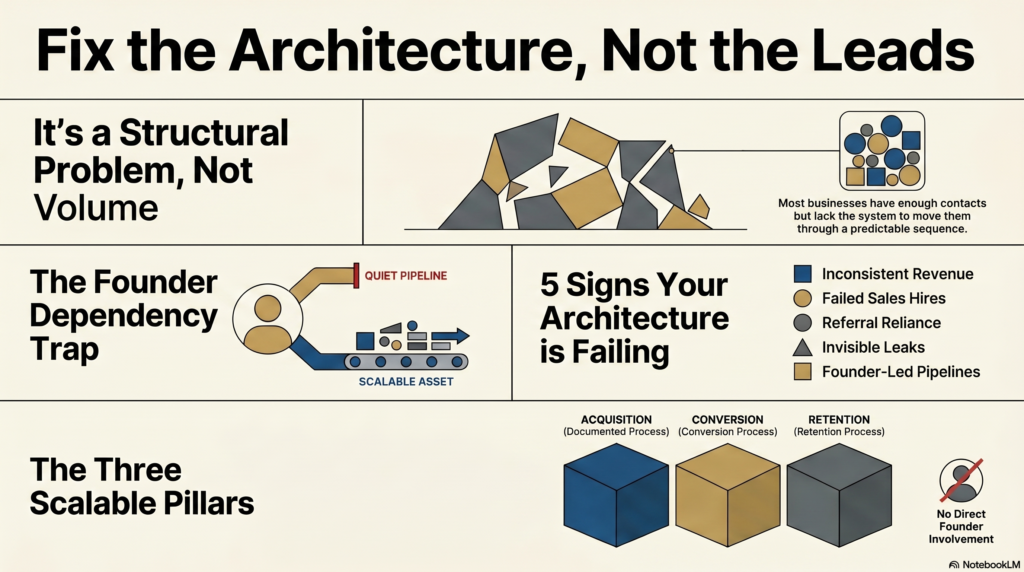
5 signs your B2B business has a revenue architecture problem
These patterns come up consistently across founder-led businesses at the £1.5M–£10M revenue level:
- Revenue is inconsistent month-to-month even when delivery is strong. Good delivery should convert into predictable income. If there’s a gap between the quality of the work and the consistency of what it earns, the acquisition architecture isn’t doing its job.
- You can’t step away without the pipeline going quiet. If your personal calendar is the only thing keeping commercial activity moving, the business is built around a person, not a process. That’s founder dependency, and it’s the most common revenue architecture failure.
- You’ve brought in sales or marketing help and seen little change. A new hire can’t fix a structural problem. If there’s no documented commercial process for them to run, the result is predictable.
- Your best clients all came through referrals, with nothing systematic behind it. Referrals are a quality signal, not a commercial architecture. When they slow, the pipeline goes with them.
- You know there’s money being left on the table but can’t locate the leak. The revenue should be there. The conversations are happening. But something in the process is losing deals that should close, and without a diagnostic, it stays invisible.
Three or more of these present at the same time almost always means the business has a structural commercial problem, not a marketing one.
Founder dependency: where most architecture problems start
Founder dependency is what happens when a business’s revenue is structurally tied to one person’s activity and relationships. It’s the most common revenue architecture failure, and it tends to be invisible until something external forces the issue: a platform algorithm changes, a key relationship goes cold, the founder gets ill and takes two weeks out.
When those things happen, revenue drops with no structural explanation. Because there wasn’t a structure. There was a person.
“The question isn’t whether you can run the business. It’s whether the business can run without you.” That’s the line that separates a scalable commercial asset from a well-paid job.
The fix isn’t hiring more people. It’s rebuilding the commercial flow so it runs through a repeatable system rather than through the founder. When that shift happens, revenue becomes consistent. It stops depending on whether the founder had a good week.
What revenue architecture looks like in practice
A B2B revenue architecture has three parts, each of which needs to work without the founder as the operational engine:
Acquisition. A documented process for identifying, warming, and converting ICP prospects that doesn’t rely on the founder’s personal network or constant presence. This includes having more than one lead source (not just LinkedIn), a reactivation sequence for existing databases, and a pipeline that doesn’t go cold when the founder is busy with delivery.
Conversion. A defined sales process that produces a consistent close rate regardless of who runs it. Sequenced follow-up, clear offer framing, and a qualification stage that filters the wrong buyers early.
Retention. The processes that keep clients, grow relationships, and produce referrals on purpose rather than by accident.
The PE-grade methodology behind BIB’s revenue architecture diagnostic examines all three areas. It’s the same commercial due diligence framework applied to acquisition targets valued at £25M–£50M, adapted for founder-led businesses at a fraction of the cost.
A B2B professional services firm that ran the diagnostic found three conversion gaps that weren’t visible internally. Within 60 days of fixing the commercial sequence, close rate moved from 35% to 75%.
Frequently asked questions
What is revenue architecture for a B2B business?
Revenue architecture is the set of commercial processes, acquisition systems, and conversion sequences that allow a B2B business to generate consistent revenue without the founder running every deal personally. For businesses in the £1.5M–£10M range, it’s what replaces effort-dependent income with a repeatable commercial structure.
How is revenue architecture different from lead generation?
Lead generation adds prospects to a pipeline. Revenue architecture determines what happens to them once they’re in it. Most founder-led businesses already have enough contacts and conversations to be growing faster than they are. The bottleneck is in the commercial process, not the volume of leads.
What does founder dependency mean in business?
Founder dependency is when a business’s revenue is structurally reliant on the founder’s personal effort, relationships, or presence in commercial conversations. It creates a ceiling that hiring more people won’t break, because without a documented process, new hires have nothing to run. It’s the most common root cause of revenue plateaus in founder-led B2B businesses.
How do I know if my business has a revenue architecture problem?
The clearest signs: revenue is inconsistent despite strong delivery, the pipeline goes quiet when the founder steps back, sales hires produce minimal results, most good clients came through referrals with no system behind them, and there’s a persistent sense that revenue should be higher than it is. Three or more of these together point to a structural commercial problem rather than a lead generation one.
What is the PE-grade revenue architecture diagnostic?
It’s a 45-page, evidence-based commercial diagnostic that applies the same due diligence framework PE firms use on acquisition targets, to founder-led businesses at the £1.5M–£10M revenue level. PE firms typically pay £15,000–£50,000 for this kind of assessment. BIB delivers it at £5,000 so founders can see the quality of output before committing to a full commercial engagement.
The next step
Revenue architecture isn’t a concept built for large companies. It’s the difference between a founder-led business that grows predictably and one that grows in bursts, stalls, and starts again.
If the patterns in this post sound familiar, another lead generation campaign won’t fix it. What’s needed is a diagnostic: a specific, evidence-based look at where the commercial architecture is breaking down and what to address first.
BIB’s revenue architecture diagnostic is a 45-page, PE-grade report at £5,000. The same rigour PE firms pay £15,000–£50,000 to access, priced at cost so founders experience the output before committing at full commercial rates.
