
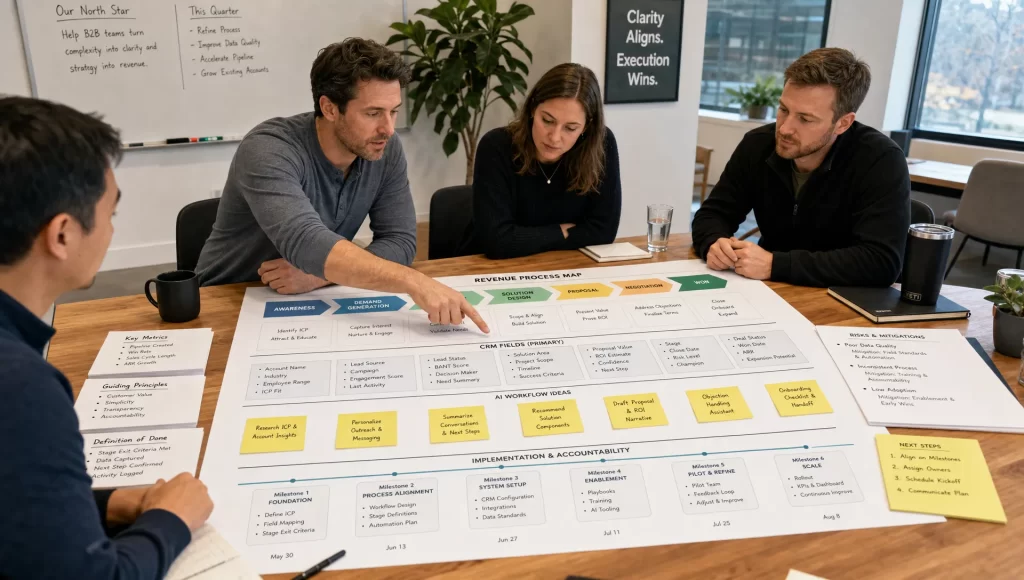
For founder-led B2B companies, the line between strategy and technology has almost disappeared. Your CRM is not just a database. Your quoting workflow is not just an operational detail. Your AI tools are not just productivity experiments. They shape how revenue is created, measured, and scaled.
That is why business and IT consulting can no longer sit in separate workstreams with separate priorities, separate vendors, and separate timelines. When they do, the business team designs a growth plan the systems cannot support, while the IT team implements tools that do not move the commercial numbers that matter.
The result is familiar: dashboards nobody trusts, sales processes nobody follows, automation that adds complexity, and strategic plans that stall somewhere between the boardroom and the CRM.
A shared roadmap changes the conversation. It connects market strategy, sales execution, data, systems, AI, and accountability into one sequence of revenue-critical decisions.
The old split between business and IT consulting is breaking growth
Traditional consulting models separated the commercial question from the technical question. Business consultants focused on positioning, markets, pricing, sales process, and operating models. IT consultants focused on software, integrations, data infrastructure, security, and implementation.
That division made sense when technology mainly supported the business. It makes far less sense when technology increasingly is the operating system of the business.
In a modern B2B revenue engine, almost every growth decision has a systems implication:
- Expanding into a new segment changes data requirements, routing logic, qualification criteria, and reporting.
- Improving win rate may require better CRM discipline, call intelligence, proposal workflows, and sales enablement systems.
- Shortening the sales cycle often depends on cleaner handoffs, faster approvals, better automation, and clearer deal-stage definitions.
- Introducing AI into sales or marketing depends on usable data, governance, workflow design, and adoption.
When these decisions are made separately, execution slows down. The business roadmap says one thing. The technology roadmap funds another. The founder is left mediating between strategy decks, platform limitations, and department-level priorities.
This is one reason digital transformation so often disappoints. McKinsey research on digital transformations has found that fewer than one-third succeed, with success depending heavily on leadership alignment, capability building, and clear execution practices. In other words, technology alone is not the transformation. The operating model around it is.
A shared roadmap starts with the revenue constraint
The best shared roadmap does not begin with software selection. It begins with diagnosis.
If revenue has stalled, the obvious symptom may be weak pipeline, inconsistent close rates, long sales cycles, poor handoffs, or underused systems. But the real constraint may sit somewhere else. It could be unclear ICP definition, low-quality demand, sales manager bandwidth, pricing misalignment, broken data, poor onboarding, or a CRM that reflects internal politics instead of the customer journey.
This is where business and IT consulting need to operate from the same fact base. Before recommending a new tool, a new sales playbook, or a new AI workflow, both sides need to agree on the bottleneck that matters most.
For founder-led companies, this diagnostic discipline is critical. As Billionaires in Boxers explains in its perspective on why business strategy consulting fails without diagnosis, jumping to solutions before identifying the true constraint usually creates more noise, not more revenue.
A shared roadmap should answer four questions before any implementation begins:
- What is the current revenue constraint?
- What commercial outcome must improve first?
- Which process, data, and technology changes are required to unlock that outcome?
- What should be sequenced now, later, or not at all?
This keeps the work focused on revenue acceleration rather than tool deployment or abstract transformation.
The difference between two roadmaps and one roadmap
When business and IT teams operate separately, each may be doing reasonable work. The problem is that the work is not integrated around a single commercial outcome.
| Area | Separate business and IT roadmaps | Shared revenue roadmap |
|---|---|---|
| Primary goal | Department-level improvement | Measurable revenue outcome |
| Starting point | Strategy brief or system request | Diagnosis of the real constraint |
| Technology role | Tool implementation | Revenue system enablement |
| Business role | Requirements and adoption | Ownership of operating model change |
| Success metric | Project delivered | Constraint removed or revenue metric improved |
| Common risk | Tools without behavior change | Clear sequencing and accountability |
The shared roadmap does not mean every stakeholder gets equal say on every decision. It means every major decision is connected to the same growth logic.
If the objective is to increase enterprise deal velocity, the roadmap should connect sales stages, qualification rules, approval workflows, enablement content, CRM fields, forecasting, data quality, and leadership cadence. If the objective is market expansion, the roadmap should connect segment strategy, account selection, campaign architecture, sales coverage, onboarding capacity, and reporting.
This is where a consulting partner must bridge strategy and execution. A roadmap that cannot be implemented is just a presentation. A system build that does not change revenue behavior is just overhead.
What belongs in a shared business and IT consulting roadmap
A useful shared roadmap is not a giant transformation document. It is a practical operating plan that shows what must change, why it matters, who owns it, and how it affects revenue.
Commercial outcomes
The roadmap should begin with the business outcome, not the software stack. Examples include improving qualified pipeline, increasing conversion, reducing sales cycle length, expanding into a higher-value segment, improving retention, or creating a more reliable forecast.
The more specific the outcome, the easier it becomes to decide which technology changes matter. A vague goal like improving sales productivity can justify almost anything. A sharper goal like reducing late-stage deal slippage by improving qualification, executive alignment, and proposal workflow creates a clearer path.
Revenue process design
Systems should reinforce the way revenue is supposed to work. That means the roadmap needs to define lifecycle stages, handoffs, qualification rules, pipeline governance, account ownership, and management rhythms.
This is often where founder-led companies find hidden friction. The team may have outgrown founder-led selling, but the CRM, reporting, sales meetings, and deal reviews still depend on tribal knowledge. In that environment, adding more technology rarely fixes the problem. The operating model must be redesigned first.
Billionaires in Boxers covers this broader revenue architecture challenge in its article on how a business consulting firm builds scalable revenue, especially for companies moving beyond ad hoc growth.
Data and reporting logic
A shared roadmap should define the data required to run the business, not just the data available in existing systems. This includes source definitions, pipeline stages, attribution logic, forecast categories, customer segments, and performance dashboards.
The goal is not more reports. The goal is better decisions.
If leadership meetings are dominated by arguments about whose number is right, the issue is not dashboard design. It is data governance, process compliance, and unclear definitions. Business and IT consultants need to solve that together, because data quality is both a technical and behavioral problem.
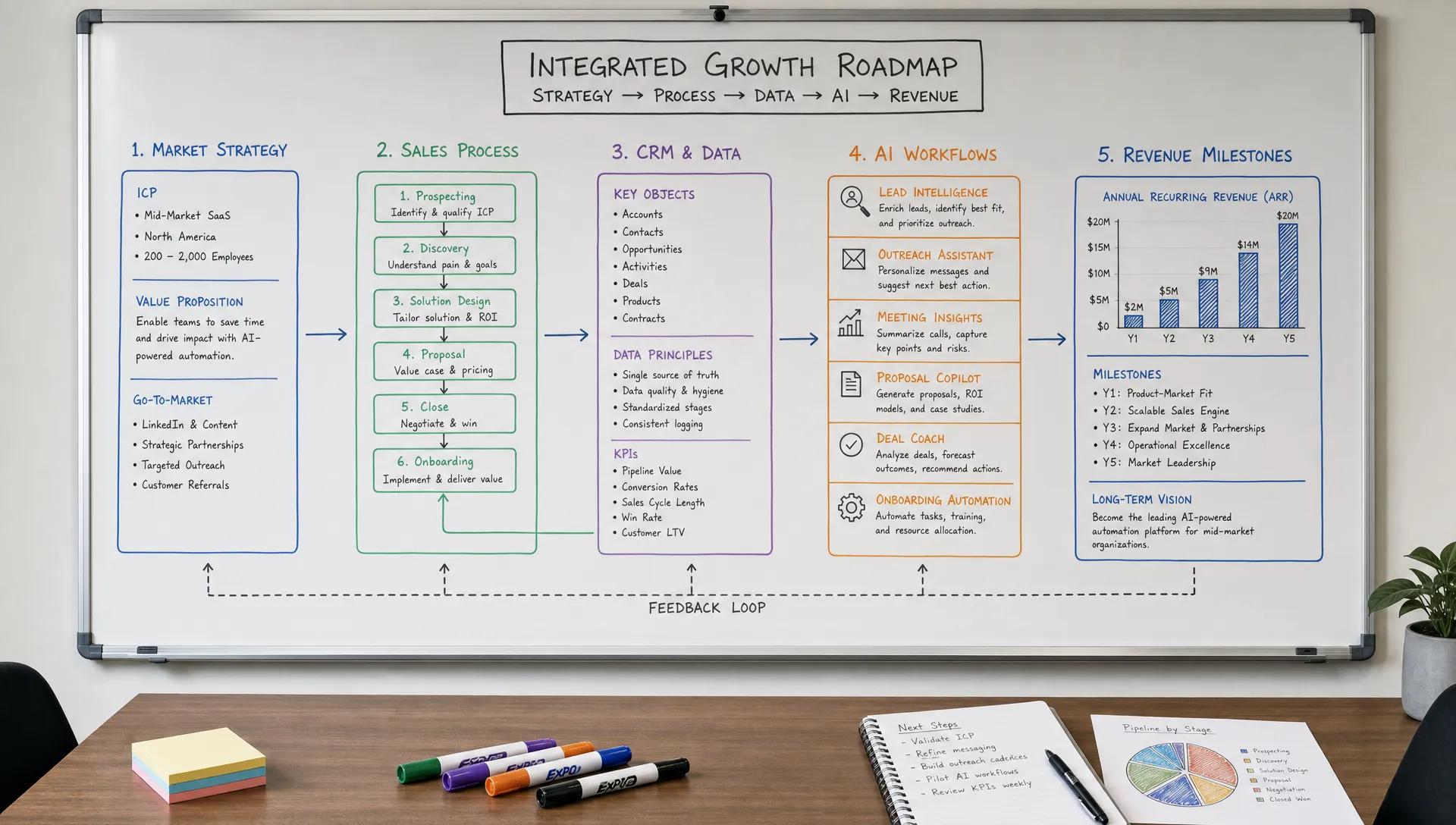
Technology and AI enablement
Only after the revenue process and data logic are clear should the roadmap define the technology layer. This may include CRM improvements, integrations, automation, analytics, AI-assisted workflows, or knowledge systems.
AI makes this alignment even more important. If a company automates a broken process, it scales the broken process. If it trains AI workflows on poor data, it generates poor recommendations faster. If it introduces AI without governance, it creates adoption risk and inconsistent outputs.
Used well, AI can reduce manual work, improve insight generation, support sales preparation, accelerate research, and help teams execute with more consistency. But it must be built around the commercial workflow, not dropped on top of it. For a deeper view of this shift, see the Billionaires in Boxers article on AI business systems that out-consult traditional consulting approaches.
Sequencing, cost, and ownership
The final part of the roadmap is sequencing. Not every fix should happen at once. In fact, trying to do everything at once is one of the fastest ways to create stalled transformation.
A strong roadmap separates quick wins from structural changes. It identifies dependencies. It makes costs visible. It assigns clear owners. It gives the founder a practical view of what will move revenue first and what must wait until the business is ready.
How to build one roadmap without creating a committee
A shared roadmap does not require endless alignment meetings. It requires a disciplined process and a small group of accountable decision-makers.
Start with a cross-functional diagnostic
The diagnostic should examine the full revenue system: market focus, offer, pipeline sources, sales process, conversion, systems, data, team structure, and leadership cadence. The purpose is to identify the constraint that, if fixed, would create the most leverage.
This prevents the classic failure mode where the business team asks for better reporting, IT improves dashboards, and nobody addresses the messy sales process producing unreliable data in the first place.
Translate the constraint into a business case
Once the constraint is clear, the next step is to quantify the commercial upside. If improving qualification could reduce wasted sales capacity, estimate the impact. If better handoffs could improve conversion, model the revenue implication. If market expansion requires new segmentation data, define the cost of not having it.
This business case becomes the filter for technology decisions. It helps prevent tool sprawl and keeps the roadmap tied to commercial outcomes.
Design the operating model before the system build
Before configuring software or deploying AI, define the behavior the system must support. Who updates what? When does a lead become sales-qualified? What must happen before a proposal is issued? What data is mandatory because it drives management decisions? What should be automated, and what requires human judgment?
This is where business consulting and IT consulting must work side by side. The operating model determines the system requirements. The system design reinforces the operating model.
Build in decision cadence
A roadmap is only useful if it survives contact with reality. Founder-led businesses move quickly. Priorities shift. New opportunities appear. Sales feedback exposes flawed assumptions.
The shared roadmap should include a decision cadence, usually monthly or quarterly, where leadership reviews progress against revenue outcomes, not just project tasks. The key questions are simple: Is the constraint moving? Are users adopting the change? Is the data improving? Are commercial metrics responding?
Warning signs your business and IT consulting efforts are disconnected
Many companies do not realize they have a two-roadmap problem until growth slows or implementation fatigue sets in. The symptoms are easy to spot once you know what to look for.
- The company invests in new tools, but sales leaders still manage from spreadsheets.
- Strategy meetings produce priorities that are not reflected in CRM workflows or dashboards.
- IT delivers projects on time, but revenue teams say the systems do not match how they sell.
- AI pilots look impressive in demos, but do not become part of daily execution.
- Leaders debate the accuracy of reports instead of making decisions from them.
- Multiple teams define pipeline, qualified leads, churn, or expansion differently.
These are not just operational annoyances. They are growth leaks. They slow decisions, reduce accountability, and make scaling more dependent on heroic effort from the founder or a few senior people.
The founder's role in keeping the roadmap commercial
In founder-led B2B companies, the founder often carries the original market insight, customer intuition, and urgency around growth. That is an advantage, but it can also become a bottleneck if every strategic and systems decision routes through the founder informally.
A shared roadmap helps move the business from founder instinct to repeatable revenue architecture.
The founder's role is not to specify every field, workflow, or integration. It is to keep the organization anchored to the commercial objective. Which market matters most? Which customer profile should the company prioritize? Which sales motion is most scalable? Which revenue constraint must be removed first?
Once those decisions are clear, business and IT consultants can translate them into process, systems, data, and execution plans.
For companies in the $3M to $25M range, this is often the inflection point. The business is too complex for informal systems, but not always ready for a full executive bench. A shared roadmap gives the team the structure to scale without burying the company in enterprise-grade bureaucracy.
FAQ
What is the main benefit of aligning business and IT consulting? The main benefit is execution clarity. Business strategy defines where growth should come from, while IT and systems design make that growth repeatable. When both share one roadmap, technology investments are tied directly to revenue outcomes.
Should the roadmap be owned by the business team or the IT team? It should be owned by the business outcome. In practice, the founder, revenue leader, operations lead, and technical owner should share accountability, with one executive sponsor responsible for final prioritization.
Is this only relevant for digital transformation projects? No. A shared roadmap is useful for CRM improvement, sales optimization, market expansion, AI adoption, reporting, customer onboarding, and any initiative where process and systems affect revenue performance.
How often should the roadmap be reviewed? Most founder-led B2B companies should review it monthly at the execution level and quarterly at the strategic level. The review should focus on whether the revenue constraint is improving, not just whether tasks are complete.
Can AI replace the need for business and IT consulting alignment? No. AI increases the need for alignment because it depends on clear workflows, good data, and well-defined business rules. Without those foundations, AI can accelerate confusion instead of performance.
One roadmap, one revenue system
Business and IT consulting must share one roadmap because growth is no longer separated from systems. Your strategy, CRM, data, AI workflows, sales process, and leadership cadence all shape the same revenue engine.
If those pieces are designed separately, the company pays for complexity. If they are designed together, the business gets leverage.
For founder-led B2B companies that need to move faster without guessing, Billionaires in Boxers helps connect diagnosis, revenue strategy, AI systems, and fractional CRO support into a practical acceleration plan. Start with the Revenue Acceleration Diagnostic to identify the real constraint and build a roadmap that ties technology decisions to commercial outcomes.
