
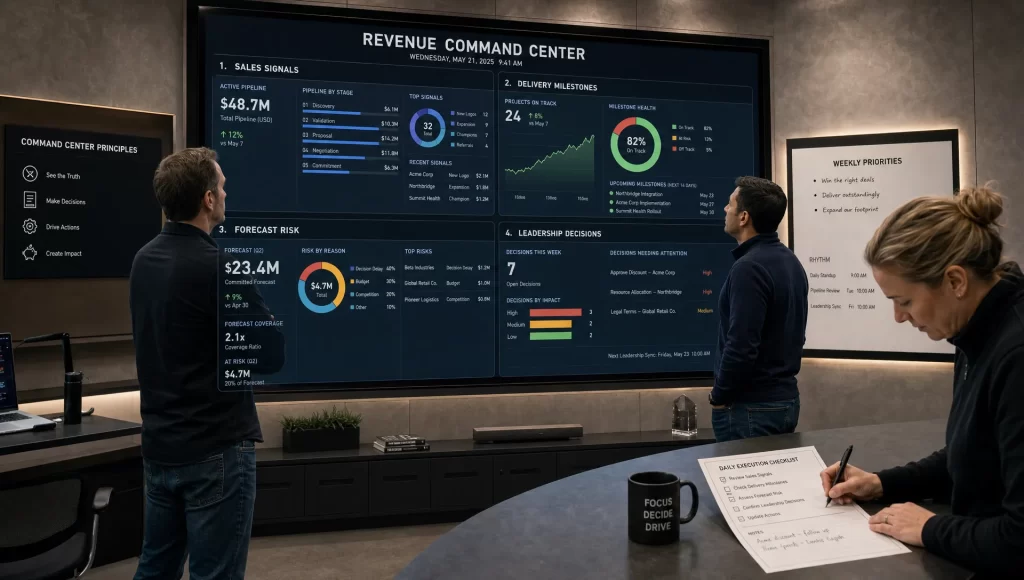
Founder-led B2B companies rarely stall because the founder forgot how to sell. They stall because the operating system around revenue cannot keep up with the complexity of the business.
Sales teams chase opportunities with uneven qualification. Delivery teams inherit promises they did not shape. Forecasts depend on gut feel, CRM optimism, and the founder’s ability to mentally reconcile every moving part. At $3M to $25M in revenue, that model becomes expensive.
This is where AI systems matter. Not AI as a shiny chatbot, and not AI as another tool that adds noise to the tech stack. The real value comes from connected systems that strengthen sales execution, delivery quality, and forecasting accuracy at the same time.
When designed well, AI systems help a founder-led company convert scattered commercial activity into a repeatable revenue engine.
What makes AI systems different from AI tools?
An AI tool performs a task. It drafts an email, summarizes a call, enriches a record, or scores a lead.
An AI system connects tasks into a workflow that improves decisions. It captures signals, applies rules, supports human judgment, triggers action, and feeds learning back into the business.
For a founder-led B2B company, that distinction is critical. A tool may save 10 minutes. A system can reduce dependency on the founder, improve management visibility, and make commercial execution more consistent across the team.
A practical AI system usually includes five components:
- A clear commercial objective, such as improving win rate, margin, retention, or forecast accuracy.
- A defined data model, including CRM fields, customer segments, buying stages, delivery milestones, and success indicators.
- Workflow automation that moves information between people, systems, and decision points.
- AI-assisted analysis that identifies patterns, risks, next actions, or exceptions.
- Human governance that keeps judgment, accountability, and customer nuance in the process.
The goal is not to replace operators. The goal is to make good operators more consistent and to remove the hidden friction that slows revenue growth.
Why sales, delivery, and forecasting must be connected
Many B2B companies treat sales, delivery, and forecasting as separate functions. Sales owns pipeline. Delivery owns fulfillment. Leadership owns the forecast.
That separation creates a dangerous problem: the forecast often reflects what sales thinks will close, not what the business can profitably win, deliver, retain, and expand.
In founder-led companies, the founder often becomes the bridge between those functions. They know which deals are real, which clients are risky, which delivery promises are stretching capacity, and which expansion opportunities are worth pursuing. But that knowledge sits in their head, not in the system.
AI systems are most useful when they turn that founder intuition into shared operating logic.
| Business symptom | Likely system gap | How AI systems help |
|---|---|---|
| Sales team chases low-fit opportunities | Weak ICP and qualification discipline | AI can compare deals against fit criteria, past win patterns, and disqualification rules |
| Delivery is surprised by what sales promised | Poor handoff and scope visibility | AI can summarize deal context, flag unusual commitments, and create structured onboarding notes |
| Forecast changes late in the month | CRM data is stale or subjective | AI can detect missing activity, stage drift, low buyer engagement, and risk signals |
| Founder is pulled into every deal review | Judgment is not codified | AI can prompt reps and managers with founder-approved questions, thresholds, and decision criteria |
| Growth creates margin pressure | Revenue and delivery capacity are disconnected | AI can surface delivery load, client risk, and profitability inputs before deals close |
This is why AI should not sit only with marketing, sales development, or CRM administration. The highest-leverage systems connect the full revenue path from market selection to closed-won delivery and renewal.
How AI systems strengthen sales
Sales execution improves when the team has sharper focus, cleaner data, and better decision support. AI systems can support all three.
The first sales use case is prioritization. In many founder-led B2B companies, reps spend too much time on accounts that are active but not attractive. An AI system can help score opportunities against ICP, buying signals, historic deal patterns, deal size, urgency, and strategic fit. That does not mean the system decides what to pursue. It means the team sees which opportunities deserve senior attention and which should be deprioritized.
The second use case is qualification. Strong founders often qualify instinctively. They hear a prospect’s language and quickly understand whether the pain is real, whether the buyer has authority, and whether the commercial case is urgent. AI systems can help turn that instinct into structured prompts, call review summaries, deal notes, and stage-entry criteria.
The third use case is sales consistency. AI can assist with follow-up drafting, proposal inputs, meeting summaries, objection patterns, and next-step reminders. These are not glamorous tasks, but they matter. A sales process breaks down when every rep interprets the methodology differently.
The fourth use case is CRM hygiene. Poor CRM quality is not just an admin issue. It corrupts the forecast, weakens coaching, and hides pipeline risk. AI can detect missing fields, stale opportunities, duplicate records, inconsistent stage movement, and deals with no recent buyer engagement.
This is closely related to the broader revenue operations role of AI. If your CRM and pipeline data are already creating friction, the article on artificial intelligence solutions that improve revenue ops explores that operational layer in more depth.
How AI systems strengthen delivery
Revenue acceleration is not only about closing more deals. It is about closing the right deals, delivering them profitably, and creating the conditions for retention and expansion.
This is where delivery often gets overlooked. A company can improve sales performance and still create operational strain if delivery does not have the right context early enough.
AI systems can strengthen delivery in several practical ways.
First, they can improve handoffs. Sales calls, proposals, emails, and CRM notes contain valuable context, but delivery teams often receive only a fraction of it. AI can summarize client goals, success criteria, risks, stakeholders, promised outcomes, and unusual commitments into a structured handoff format.
Second, AI can help identify delivery risk. If a new client has an aggressive timeline, unclear ownership, unusual customization needs, or a history of delayed decision-making during sales, those signals should not be discovered after kickoff. A system can flag them before delivery begins.
Third, AI can support knowledge reuse. Founder-led companies often solve similar client problems repeatedly, but the know-how remains scattered across decks, documents, Slack threads, calls, and individual memories. AI-assisted knowledge systems can help teams retrieve relevant playbooks, previous solutions, onboarding materials, and internal guidance faster.
Fourth, AI can connect delivery feedback back to sales. If certain segments routinely require more support, if specific promises reduce margin, or if certain customer types expand faster, the sales team needs to know. Delivery data should refine ICP, qualification, pricing, and forecasting.
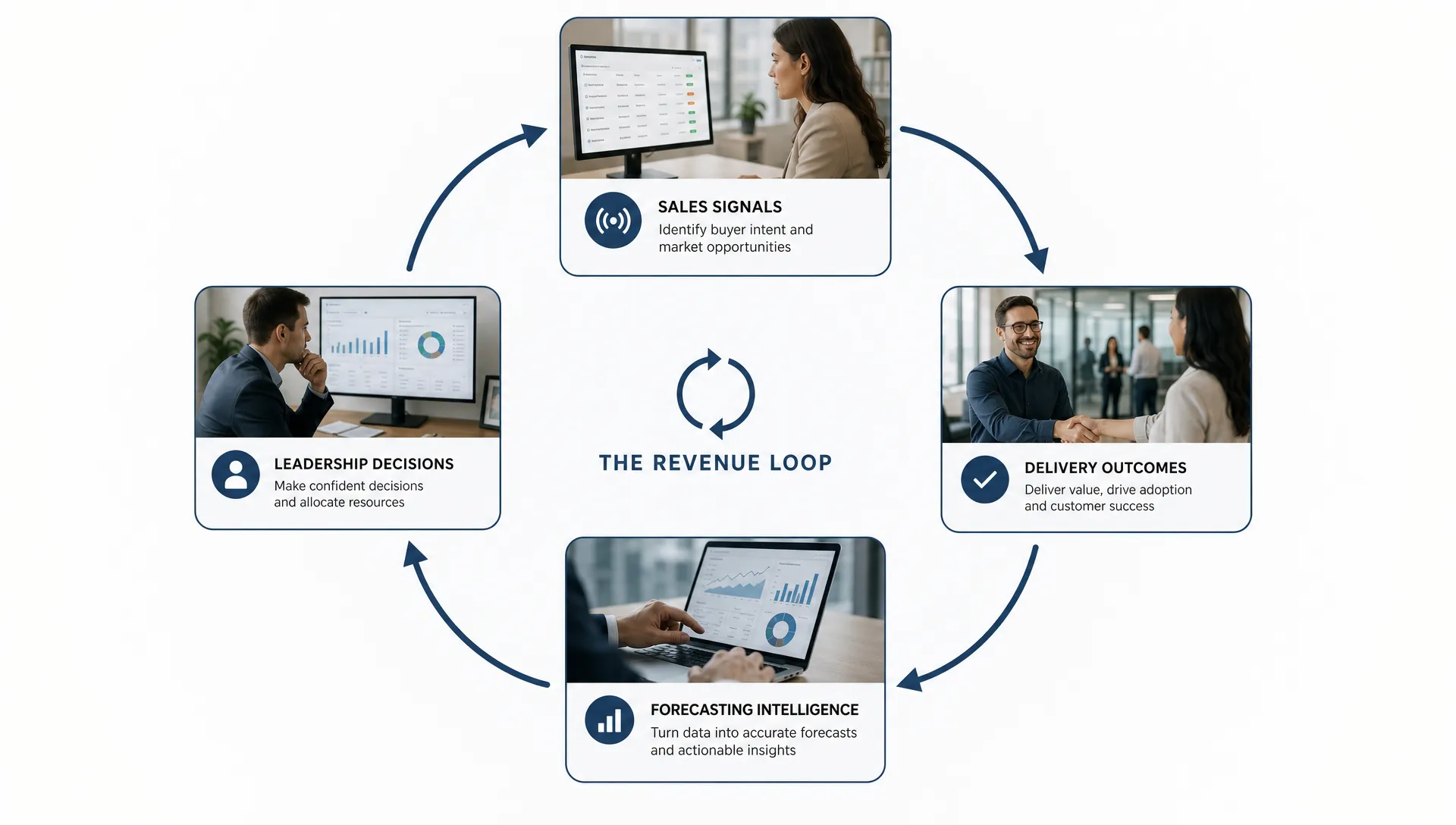
How AI systems strengthen forecasting
Forecasting is where weak systems become visible. If sales activity is inconsistent, CRM data is unreliable, delivery risk is hidden, and managers lack inspection discipline, the forecast becomes a narrative exercise.
AI can improve forecasting, but only if the underlying operating model is clear. It cannot rescue a company from vague stages, undefined exit criteria, or leadership that accepts optimistic updates without evidence.
The strongest AI-enabled forecasting systems combine quantitative signals with qualitative judgment.
Quantitative signals might include stage age, opportunity size, source, historic conversion rate, buyer engagement, meeting frequency, close-date changes, proposal status, and procurement steps. Qualitative signals might include executive alignment, problem urgency, competitive pressure, stakeholder consensus, delivery complexity, and risk of no decision.
AI helps by surfacing inconsistencies that humans miss. For example, it can flag a late-stage deal with no recent executive engagement, a close date that has moved three times, or a large opportunity that does not match previous win patterns. It can also compare current pipeline quality against historical performance, helping leaders understand whether the quarter is genuinely strong or just inflated.
McKinsey has estimated that generative AI could create trillions of dollars in annual economic value across business functions, with sales and marketing among the major areas of impact. But for mid-market B2B companies, the practical advantage is less about the headline number and more about sharper execution: fewer surprises, better inspection, and faster learning from real commercial data.
A good forecast is not a prediction made once a week. It is a living view of the revenue system.
The operating architecture of a useful AI revenue system
Before adding AI, founder-led companies need to define how revenue should actually work. Otherwise, AI accelerates confusion.
A practical architecture includes six layers.
- Strategy layer: Define the target market, ICP, value proposition, qualification logic, strategic segments, and growth priorities.
- Data layer: Standardize the CRM, delivery data, customer attributes, deal stages, activity capture, and outcome fields.
- Workflow layer: Map the handoffs between marketing, sales, delivery, customer success, finance, and leadership.
- AI intelligence layer: Use AI to summarize, score, classify, detect patterns, recommend next actions, and surface exceptions.
- Management cadence layer: Build AI outputs into pipeline reviews, delivery reviews, forecast calls, account planning, and leadership meetings.
- Governance layer: Decide who owns the system, who validates AI outputs, what data is trusted, and how decisions are audited.
This is the difference between automation and operating leverage. Automation makes a task faster. Operating leverage makes the business easier to scale.
For companies trying to reduce founder dependency, this connects directly to the role of AI integrated workflows that remove founder bottlenecks. The point is not to remove the founder’s judgment from the business. It is to stop making the founder the only place that judgment lives.
A 90-day implementation path for founder-led B2B teams
AI systems do not need to start as massive transformation programs. In fact, they usually work better when they begin with one commercial bottleneck and expand from there.
A founder-led B2B company can make meaningful progress in 90 days if the scope is tight and the business problem is clear.
| Phase | Focus | Practical output |
|---|---|---|
| Days 1 to 30 | Diagnose the revenue system | Map sales stages, delivery handoffs, forecast inputs, data gaps, and founder bottlenecks |
| Days 31 to 60 | Build one high-leverage workflow | Create an AI-supported process for qualification, handoff, forecast inspection, or customer risk |
| Days 61 to 90 | Embed into management cadence | Add the system to weekly reviews, define ownership, measure adoption, and refine prompts and rules |
The best first workflow depends on the company’s constraint.
If pipeline volume is high but win rate is low, start with AI-supported qualification and opportunity prioritization. If deals are closing but delivery is strained, start with sales-to-delivery handoff and risk flagging. If leadership is missing numbers, start with forecast hygiene and deal inspection.
The implementation should be judged by business outcomes, not AI novelty. Useful measures include cleaner CRM data, faster handoffs, reduced founder involvement in routine decisions, improved forecast confidence, shorter sales cycle, better gross margin protection, or stronger retention signals.
Common mistakes when building AI systems
The biggest mistake is starting with tools instead of commercial strategy. A founder buys software, asks the team to use it, and hopes productivity improves. That rarely creates durable change because the system has no operating logic.
The second mistake is trying to automate judgment too early. AI should support sales managers, delivery leaders, and founders with better evidence. It should not blindly approve deals, rewrite forecasts, or make customer promises without human validation.
The third mistake is ignoring data quality. AI systems are only as useful as the signals they can access. If CRM stages are vague, delivery outcomes are not captured, and customer data is incomplete, the system will produce confident but unreliable outputs.
The fourth mistake is building disconnected pilots. A sales AI pilot that does not feed forecasting or delivery may create local efficiency while leaving the broader revenue system unchanged.
The fifth mistake is failing to define ownership. AI systems need accountable operators. Someone must maintain rules, review outputs, monitor adoption, and ensure the system keeps matching the business strategy.
What good looks like
A strong AI revenue system feels less like a new software project and more like a better management rhythm.
Sales teams know which opportunities matter and why. Delivery teams receive better context before kickoff. Leaders see risk earlier. Forecast calls become evidence-based. The founder is still involved in high-value judgment, but no longer needed to manually connect every dot.
At that point, AI stops being a productivity accessory and becomes part of the company’s commercial infrastructure.
For many founder-led B2B companies, this is the real opportunity. Not replacing people. Not adding another dashboard. Not chasing every new AI trend.
The opportunity is to build an operating system that makes growth more visible, repeatable, and scalable. If you are thinking about the bigger architecture, this guide on what an AI operating system should do for a B2B company is a useful next layer.
Frequently Asked Questions
What are AI systems in a B2B revenue context? AI systems are connected workflows that use data, automation, and AI-assisted analysis to improve commercial decisions. In revenue teams, they can support sales prioritization, CRM hygiene, delivery handoffs, customer risk detection, and forecasting.
How are AI systems different from sales automation? Sales automation usually speeds up a specific task, such as sending emails or updating records. AI systems connect multiple tasks and decision points, helping teams identify patterns, surface risks, and improve execution across sales, delivery, and leadership.
Can AI improve forecasting accuracy? AI can improve forecasting by detecting stale deals, missing activity, stage drift, weak engagement, and patterns from historic performance. However, accurate forecasting still requires clean data, clear stage definitions, and disciplined human review.
Should founder-led companies build AI systems before hiring a CRO? It depends on the company’s stage and constraint. AI systems can help codify founder judgment and improve operating visibility before or alongside senior revenue leadership. They do not replace leadership accountability, but they can make a future CRO or fractional CRO more effective.
Where should a company start with AI systems? Start with the biggest revenue bottleneck. For some companies, that is qualification. For others, it is delivery handoff, forecast hygiene, or customer risk. The right first system should be tied to a measurable commercial outcome.
Build AI systems around the revenue constraint that matters most
AI systems create leverage only when they are connected to the commercial reality of the business. For founder-led B2B companies, that means diagnosing where sales, delivery, and forecasting are breaking down before adding more tools.
Billionaires in Boxers helps founder-led B2B businesses use PE-grade diagnostics, AI systems, and fractional CRO support to engineer scalable growth. If your company is between $3M and $25M in revenue and the founder is still the glue holding the revenue system together, a Revenue Acceleration Diagnostic can clarify the highest-value interventions and the operating roadmap to fix them.
Start with the constraint. Build the system around it. Then scale what works.
