
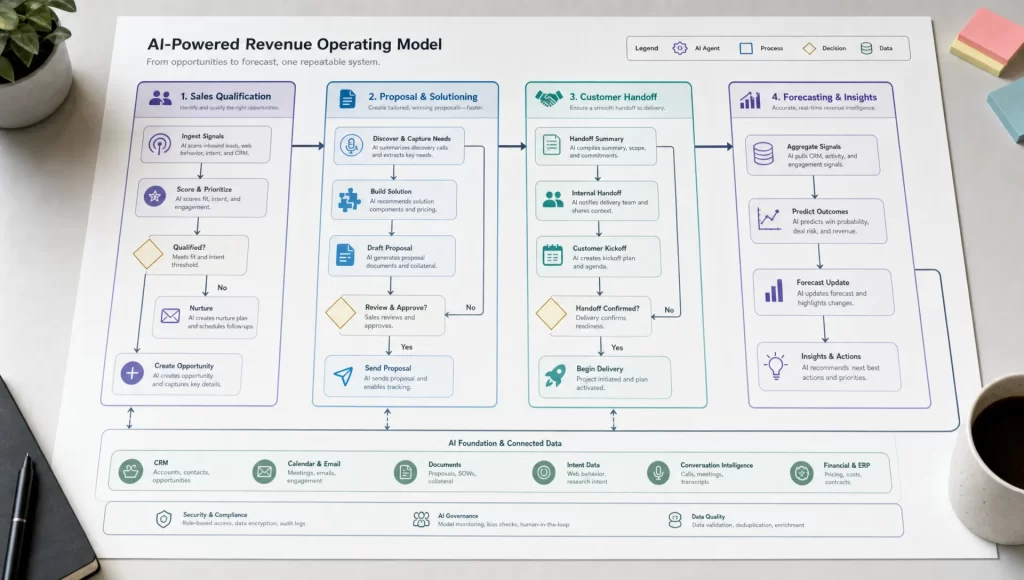
AI business solutions do not create scale by adding more software to an already noisy stack. They create scale by removing the constraints that keep revenue teams slow, inconsistent, and overly dependent on a few senior people.
For founder-led B2B companies, those constraints are usually not obvious at first. Revenue grows through founder energy, strong referrals, heroic delivery, and a handful of trusted operators who “just know how things work.” Then the company reaches a point where the same habits that created traction start limiting growth.
Pipeline reviews become opinion-led. Proposals require founder approval. CRM data is incomplete. Customer handoffs depend on memory. Hiring adds people, but not always output. Every department is busier, yet the business does not feel meaningfully more scalable.
That is where AI business solutions can become operational infrastructure, not a novelty. Used properly, AI turns scattered knowledge, manual workflows, and inconsistent decisions into repeatable systems that help the business move faster without sacrificing judgment.
The real bottleneck is rarely “not enough people”
When a B2B company hits a growth ceiling, the default answer is often headcount. More salespeople. More account managers. More ops support. More leadership layers.
Sometimes that is necessary. But many scaling companies do not have a capacity problem first. They have a flow problem.
Work gets stuck because decisions are unclear, information lives in too many places, and the founder or senior team is still acting as the company’s central processor. Adding people into that environment can actually increase drag because every new hire needs context, training, review, and escalation.
Common bottlenecks include:
- Sales teams wasting time on poor-fit accounts because ICP signals are not operationalized.
- Proposal cycles slowing down because pricing logic, objection handling, and case evidence are not codified.
- Forecasts shifting weekly because pipeline stages are subjective and CRM hygiene is weak.
- Delivery teams receiving incomplete context after the sale, creating rework and margin leakage.
- Leadership meetings focusing on anecdotes because commercial data is fragmented.
AI business solutions help when they are aimed at these constraints directly. The goal is not to automate for the sake of automation. The goal is to increase throughput across the revenue engine.
Why traditional systems break at scale
Most founder-led companies already have systems. They have a CRM, spreadsheets, call notes, sales decks, project management tools, reporting dashboards, SOPs, and Slack threads. The issue is that these systems often do not behave like one coherent operating model.
At a smaller size, this is tolerable. People can compensate with meetings, memory, and founder involvement. At $3M to $25M in revenue, those informal fixes start to fail.
The business needs decisions to be made consistently across more people, more customers, more opportunities, and more edge cases. Traditional systems struggle because they mostly store information. They do not always interpret it, connect it, or prompt action at the moment of need.
AI changes that equation when it is embedded into workflows. Instead of asking a person to remember every rule, search every document, review every call, and spot every risk, AI can surface the pattern and guide the next move.
This is why AI adoption has accelerated so quickly. McKinsey’s 2024 global AI survey found that 65% of respondents said their organizations were regularly using generative AI, nearly double the share from the previous survey. The opportunity is real, but the companies that benefit most are not just experimenting with tools. They are redesigning how work flows.
What effective AI business solutions actually do
The strongest AI business solutions perform three jobs at once: they capture knowledge, improve decisions, and accelerate execution.
Capturing knowledge means taking what currently lives in people’s heads and making it usable across the business. That includes sales heuristics, qualification logic, proposal standards, delivery expectations, competitive positioning, and customer risk indicators.
Improving decisions means using data and context to make better calls faster. AI can help prioritize accounts, flag pipeline risk, summarize customer signals, compare deal patterns, and identify where the team’s behavior differs from the company’s stated process.
Accelerating execution means reducing the manual work between decision and action. AI can draft first-pass follow-ups, structure account plans, prepare call briefs, summarize handoffs, generate meeting notes, and trigger workflows that move work forward.
The key is integration. A disconnected AI tool may save a few minutes. An integrated AI business solution removes the repeat bottleneck that slows the whole team.
If the founder is still the only person who can qualify strategic fit, approve pricing exceptions, interpret stalled deals, or diagnose delivery risk, the bottleneck remains. AI should help distribute that judgment safely through systems, not bypass it.
The bottleneck-to-solution map
The practical question is not “Where can we use AI?” It is “Where does revenue get stuck, and what kind of AI system would remove that constraint?”
| Bottleneck | What it looks like | AI business solution | Scaling impact |
|---|---|---|---|
| Founder-dependent sales judgment | Reps escalate deal strategy, pricing, and positioning decisions | AI-guided qualification, proposal prompts, objection libraries, and deal review summaries | More consistent sales execution without every deal needing founder input |
| Poor pipeline visibility | Forecast calls rely on rep opinion and incomplete CRM updates | AI-assisted CRM hygiene, risk scoring, stage validation, and next-step detection | Better forecasting and faster intervention on stalled deals |
| Slow proposal creation | Custom proposals take too long and vary in quality | AI-supported proposal assembly using approved messaging, case evidence, and commercial rules | Shorter sales cycles and stronger quality control |
| Weak customer handoffs | Delivery receives partial context after close | AI-generated handoff briefs from calls, CRM notes, scope, and success criteria | Less rework, clearer expectations, and improved margin protection |
| Leadership information overload | Data exists, but insight is scattered across tools | AI business intelligence summaries and exception reporting | Faster management decisions based on patterns, not anecdotes |
This map also shows why AI cannot be treated as an IT side project. The bottlenecks are commercial and operational. The solutions must be designed around revenue flow.
Where AI fixes bottlenecks first in founder-led B2B
Every company has a different constraint profile, but scaling B2B firms tend to see the fastest gains in a few areas.
Sales qualification and account prioritization
Many sales teams lose capacity before the first call because they are chasing accounts that should never have entered the pipeline. AI can help convert ICP theory into day-to-day selling behavior by analyzing firmographic signals, engagement patterns, buying triggers, deal history, and disqualification reasons.
The output is not simply a lead score. The more useful output is a clearer explanation of why an account deserves attention, what pain is likely present, what proof points matter, and what risk may derail the opportunity.
This gives reps better context before outreach and gives leaders a more objective way to inspect pipeline quality.
Deal review and sales coaching
In many founder-led companies, deal reviews become a recurring bottleneck because senior leaders must interpret messy CRM data, listen to call fragments, and ask the same questions repeatedly.
AI can summarize deal history, identify missing fields, compare the opportunity against qualification criteria, highlight objections, and suggest the next best management question. It can also detect whether a deal has real buyer urgency or is simply being kept alive by optimistic follow-up.
This does not replace sales leadership. It makes sales leadership more effective by reducing the time spent reconstructing basic facts.
For a deeper look at this founder-specific constraint, Billionaires in Boxers has also covered how AI integrated workflows reduce founder bottlenecks across revenue-critical processes.
Proposal and pricing consistency
Proposal creation is one of the most common hidden bottlenecks in B2B growth. It pulls senior people into document review, slows momentum after a strong sales call, and creates inconsistency in how value is framed.
AI can help by generating proposal drafts from approved inputs, matching use cases to relevant proof, checking whether the scope aligns with commercial rules, and flagging missing risk language. The important phrase is “approved inputs.” AI should not invent claims, pricing, or delivery promises. It should assemble and adapt what the business has already validated.
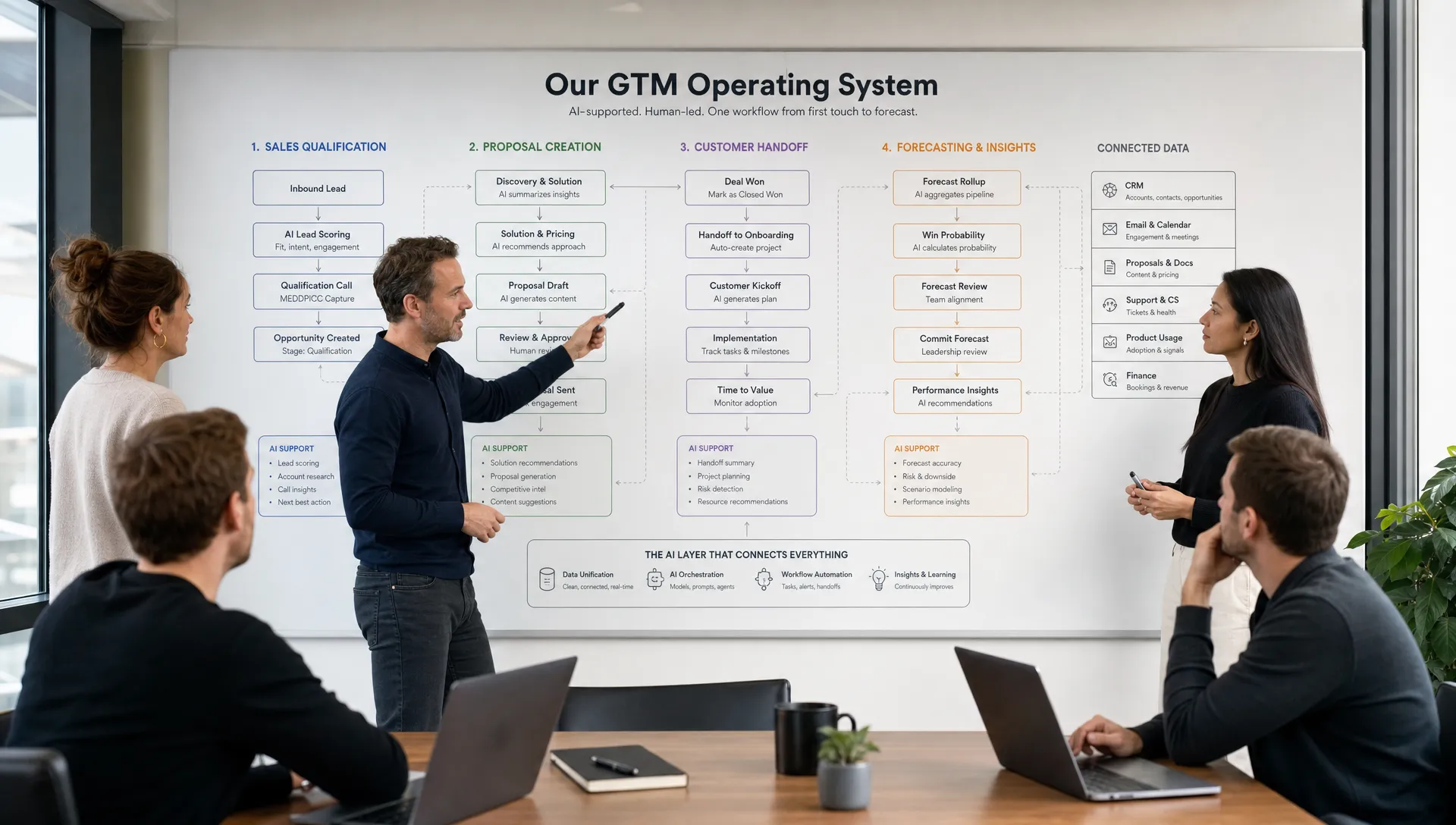
Customer handoffs and delivery readiness
Revenue bottlenecks do not end when the contract is signed. In many scaling companies, the sale-to-delivery handoff is where margin starts leaking.
AI can generate structured handoff briefs from sales conversations, CRM notes, signed scope, buyer goals, implementation risks, and success criteria. This gives delivery teams a cleaner starting point and reduces the need to rediscover context the customer already shared.
The commercial impact is often significant because smoother handoffs protect customer trust, reduce internal rework, and create a better foundation for expansion.
Forecasting and leadership visibility
Forecasting bottlenecks arise when leadership cannot trust the inputs. If pipeline stages mean different things to different reps, or next steps are vague, the forecast becomes a negotiation instead of a management tool.
AI can improve visibility by identifying stale opportunities, detecting stage inconsistencies, summarizing pipeline movement, and highlighting exceptions that deserve leadership attention. This is especially useful when paired with better revenue operations design, which is why the role of artificial intelligence solutions in revenue ops is becoming increasingly important for scaling B2B companies.
The mistake: automating broken processes
AI magnifies the system it is placed inside. If the process is strong, AI can make it faster and more consistent. If the process is confused, AI can spread the confusion faster.
That is why AI business solutions should start with diagnosis, not tool selection.
Before building or buying anything, leadership should answer several questions:
- Where does work repeatedly slow down?
- Which decisions still require founder or executive judgment?
- Which workflows create rework, customer friction, or missed revenue?
- Which data points are required for better decisions, and are they reliably captured?
- Which parts of the process should be standardized before they are automated?
This prevents the classic AI failure mode: a company buys a promising tool, runs a few impressive demos, then struggles to make it part of daily operating rhythm.
The better approach is to identify the constraint, redesign the workflow, define the decision rules, then embed AI where it removes friction.
How to scale AI without losing control
Founders are right to worry about uncontrolled AI adoption. A team using random tools, inconsistent prompts, and unapproved data sources can create risk. The answer is not to block AI. The answer is to govern it.
A scalable AI operating model should define where AI is allowed to assist, what data it can access, who reviews outputs, and which decisions remain human-owned. This is especially important in sales, pricing, legal, customer success, and delivery communication.
Good governance does not make AI slow. It makes AI usable.
In practice, scalable AI business solutions usually share four characteristics:
- They are tied to a measurable business bottleneck.
- They use approved knowledge sources and clean enough data.
- They sit inside the workflow where the team already works.
- They have clear human review points for high-stakes decisions.
That last point matters. AI should accelerate judgment, not hide accountability. The companies that win with AI are not the ones that remove humans from every process. They are the ones that stop wasting human expertise on repetitive reconstruction, formatting, searching, and administrative follow-up.
Build, buy, or redesign first?
Many teams jump straight to the build-versus-buy question. That is premature.
The first decision is whether the bottleneck is caused by missing technology, unclear process, poor data, weak accountability, or insufficient capacity. AI helps in different ways depending on the root cause.
| Root cause | What to fix first | Role of AI |
|---|---|---|
| Unclear process | Define stages, rules, owners, and standards | Reinforce the process and prompt the right actions |
| Poor data | Improve capture, structure, and CRM hygiene | Summarize, validate, and flag missing information |
| Founder dependency | Codify decision logic and approval thresholds | Distribute judgment through guided workflows |
| Manual admin | Identify repetitive work and handoff points | Draft, summarize, route, and update records |
| Weak management cadence | Clarify metrics and exception triggers | Surface risks and insights before meetings |
Sometimes the right answer is a lightweight workflow using existing tools. Sometimes it is a custom AI system. Sometimes it is a broader revenue operating model redesign. The mature move is to let the bottleneck determine the solution.
Billionaires in Boxers approaches this through PE-grade diagnostics, AI systems buildouts, and fractional CRO support for founder-led B2B businesses. The value is not just introducing AI. It is connecting AI to sales optimization, market expansion, and revenue systems that can scale.
Measuring whether AI is actually fixing the bottleneck
A useful AI implementation should change operational metrics, not just produce impressive outputs.
If AI is applied to sales qualification, you should expect cleaner pipeline composition, fewer poor-fit opportunities, or improved conversion from qualified stage to proposal. If AI is applied to proposals, you should see shorter turnaround time, higher consistency, or fewer senior review cycles. If AI is applied to forecasting, you should see better stage discipline and earlier risk detection.
Good measurement focuses on flow:
- Time from inquiry to qualified opportunity.
- Time from discovery to proposal.
- Percentage of deals with complete next steps and buyer evidence.
- Proposal revision cycles before send.
- Handoff completeness after close.
- Forecast accuracy by stage and segment.
These metrics reveal whether AI is removing friction or merely adding another layer of activity.
For more examples of commercially useful AI use cases, see this guide to business applications of AI that grow revenue.
Frequently Asked Questions
What are AI business solutions? AI business solutions are systems that use artificial intelligence to improve business workflows, decisions, and execution. In B2B revenue teams, they can support qualification, CRM hygiene, proposals, forecasting, customer handoffs, and leadership reporting.
How do AI business solutions fix bottlenecks? They fix bottlenecks by capturing repeatable knowledge, surfacing relevant context, reducing manual work, and guiding teams through consistent workflows. The best solutions target a specific constraint rather than adding generic automation.
Can AI replace a sales or operations leader? In most scaling B2B companies, AI should not replace leadership judgment. It should reduce the administrative and analytical burden around that judgment so leaders can spend more time coaching, deciding, and improving the system.
Where should a founder-led company start with AI? Start with the bottleneck that most limits revenue flow. For many founder-led companies, that is sales qualification, proposal turnaround, CRM reliability, delivery handoffs, or forecasting visibility.
Why do AI projects fail to scale? AI projects often fail when they begin with tools instead of diagnosis. If the process is unclear, the data is unreliable, or the workflow is not adopted by the team, AI remains a demo rather than an operating advantage.
Turn AI into a revenue operating advantage
AI business solutions fix bottlenecks at scale when they are designed around the way revenue actually moves through the company. The goal is not to chase every new tool. The goal is to remove the constraints that keep the business dependent on founder memory, senior heroics, manual admin, and inconsistent execution.
For founder-led B2B companies between $3M and $25M, that usually means starting with a clear diagnostic: where revenue gets stuck, what decisions are over-centralized, which workflows create drag, and what intervention will produce the fastest commercial lift.
Billionaires in Boxers helps founder-operators apply PE-grade revenue acceleration methods, AI systems, and fractional CRO support to build scalable growth engines. If your company is busy but not yet moving with the speed and clarity it should, the next step is not more activity. It is finding and fixing the bottleneck that matters most.
