
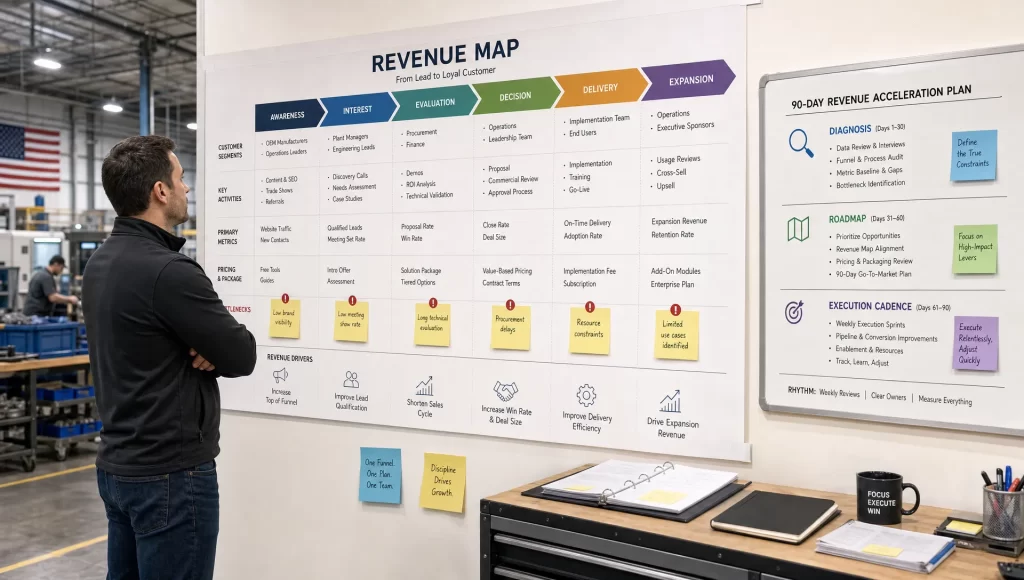
Hiring growth strategy consultants is easy. Getting value from them in the first 90 days is not.
For a founder-led B2B company, especially one between $3M and $25M in revenue, the first 90 days are usually the difference between useful revenue acceleration and expensive theater. The business has already found product-market fit. The founder has probably sold the first major customers. A team exists, but growth may now feel heavier than it should: pipeline is inconsistent, sales cycles are stretching, the founder is still pulled into too many deals, or the company is expanding into markets without a clear operating model.
That is where growth strategy consultants should earn their fee. Not by arriving with generic frameworks, and not by producing a deck that describes the business back to the team. Their job in the first 90 days is to diagnose the growth constraint, build a strategic thesis, prioritize revenue interventions, and install the operating cadence needed to execute.
The best consultants do not treat “growth” as a vague ambition. They translate it into a short list of measurable moves that the company can actually resource, test, and scale.
Why the first 90 days matter
The first 90 days create the fact base and momentum for everything that follows. If the consultant misreads the constraint early, the company can spend the next two quarters optimizing the wrong part of the system.
For example, a founder may believe the company has a lead generation problem because pipeline is thin. A good consultant may discover that the real issue is narrower: the company is pursuing too many customer segments, the best-fit accounts are not clearly defined, and the sales team is wasting time on prospects that were never likely to close. In that case, adding more campaigns will not fix the growth problem. It may simply add more noise.
This is why business strategy consulting often fails without diagnosis. Growth strategy consultants should not jump straight to tactics. They should first understand how revenue is actually created, where it leaks, and which bottleneck has the highest economic impact.
A strong 90-day engagement usually moves through three modes: diagnosis, design, and execution. The consultant starts by understanding the business, then sharpens the growth thesis, then helps the team put the first set of changes into motion.
| Timeline | Consultant focus | Founder role | Expected output |
|---|---|---|---|
| Days 1-15 | Build the revenue fact base | Share context, data, history, and strategic concerns | Baseline view of revenue performance and constraints |
| Days 16-30 | Identify the highest-leverage growth bottleneck | Validate realities behind the numbers | Growth constraint diagnosis and priority hypotheses |
| Days 31-60 | Design the strategic roadmap | Make trade-off decisions | Costed intervention plan and testable growth bets |
| Days 61-90 | Install execution cadence and run pilots | Assign ownership and remove friction | Operating rhythm, early wins, and scale plan |
Days 1-15: establish the revenue baseline
The first two weeks should be spent separating story from reality. Every founder has a narrative about why growth is slow or unpredictable. Some of that narrative will be right. Some of it will be incomplete. The consultant’s first job is to build an evidence-based view of the revenue engine.
That usually means reviewing sales data, CRM hygiene, pipeline stages, conversion rates, win-loss patterns, average contract value, sales cycle length, customer concentration, churn, expansion revenue, marketing performance, pricing, and the current operating cadence. In a founder-led B2B company, it also means understanding how much revenue still depends on founder involvement.
The consultant should speak with the founder, sales leaders, marketing leaders, delivery or customer success leaders, and a sample of customers. The goal is not to collect opinions for the sake of stakeholder engagement. The goal is to find the gap between what the company believes is happening and what the market, customers, and numbers reveal.
A useful early diagnostic should answer questions like these:
- Which customer segments are most profitable, fastest to close, and easiest to retain?
- Where does pipeline quality break down?
- Which parts of the sales process depend on the founder or one senior seller?
- Are deals being lost because of positioning, pricing, urgency, competition, risk, or poor qualification?
- Does the company have the management rhythm to execute growth initiatives consistently?
By the end of this stage, growth strategy consultants should be able to describe the business in operational terms. Not just “the company needs more pipeline,” but “the company wins most often in this segment, loses momentum after discovery, discounts heavily in procurement, and lacks a repeatable mechanism for turning customer proof into sales enablement.”
That level of specificity is where real strategy begins.
Days 16-30: isolate the growth constraint
Once the baseline is clear, the consultant should identify the constraint that most limits revenue growth. This is where average consultants and strong consultants separate.
Average consultants create a long list of improvement opportunities. Strong consultants rank them by economic impact, urgency, ease of implementation, and dependency. They understand that founder-led companies rarely suffer from a shortage of ideas. They suffer from too many unfocused initiatives competing for limited leadership attention.
Common constraints at this stage include poor ICP clarity, weak sales management cadence, unclear positioning, underpriced offers, inconsistent outbound, low conversion from qualified opportunity to close, founder-dependent selling, or expansion into markets before the core engine is repeatable.
The consultant should not just name the constraint. They should explain why it matters now, what evidence supports it, what it is costing the business, and what must change first.
For instance, if the company’s win rate is low because it is selling to too broad a market, the recommended fix may not be “train the sales team harder.” It may be to tighten the ICP, refocus messaging, rebuild qualification criteria, and stop pursuing low-fit opportunities. That can feel uncomfortable because it narrows activity. But strategic focus often increases revenue velocity by reducing wasted motion.
This is also the stage where the consultant should pressure-test the founder’s assumptions. A founder may want to expand into a new vertical, hire more reps, or increase ad spend. Those may be correct moves, but only if the core revenue system can support them. The consultant’s role is to bring discipline to those decisions.
If you are evaluating outside help, this is one of the key standards to use when you choose a strategy consulting firm that delivers. Ask how they diagnose constraints before recommending growth plays. If the answer is vague, expect vague outcomes.
Days 31-60: design the growth thesis and intervention roadmap
The next 30 days are about turning diagnosis into an executable growth strategy. This is not the same as writing a vision statement. A growth thesis should define where the company will focus, why that focus is economically attractive, what must change in the revenue system, and how progress will be measured.
For a founder-led B2B business, the roadmap should be practical. It should show which interventions happen first, who owns them, what they cost, what dependencies exist, and what leading indicators will prove whether the strategy is working.
At this point, growth strategy consultants may recommend changes across positioning, segmentation, sales process, offer structure, pricing, channel strategy, customer expansion, RevOps, marketing-to-sales handoff, or leadership cadence. The important point is not how many recommendations they make. It is whether the recommendations compound.
A strong roadmap does not scatter energy across ten disconnected projects. It sequences a few high-leverage moves so each one makes the next more effective.
| Growth intervention | Evidence it may be needed | What a 90-day test might prove |
|---|---|---|
| ICP refinement | High activity but low conversion | Better-fit opportunities move faster through the funnel |
| Sales process redesign | Deals stall after discovery | Clearer qualification and next steps improve stage progression |
| Positioning update | Prospects compare on price | More relevant messaging increases urgency and perceived value |
| Pricing or packaging review | Discounts are frequent or margins vary widely | Offer structure supports stronger deal economics |
| Founder sales extraction | Founder is required to close most key deals | Team can replicate parts of the founder’s sales motion |
| Market expansion planning | Growth depends on entering a new segment | New market can be tested without distracting the core business |
The best roadmap is costed. Founders need to know whether the plan requires new hires, fractional support, technology, data cleanup, enablement assets, campaign investment, or management time. A recommendation without resource implications is not yet a plan.
This is where firms focused on business consultancy services that move revenue fast tend to differ from traditional advisory models. The output should not be a theoretical strategy. It should be a prioritized sequence of interventions that can create measurable commercial movement.
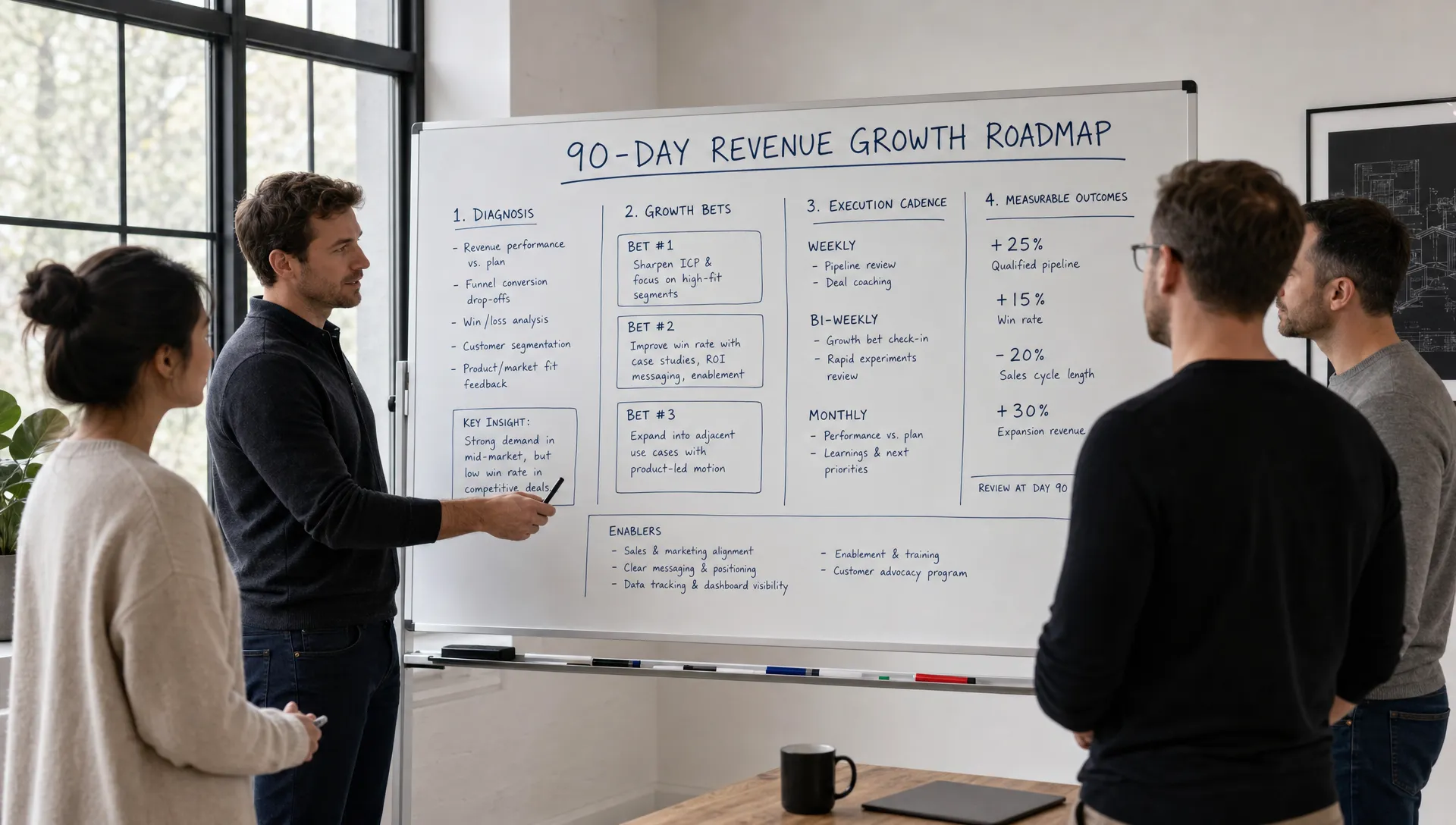
Days 61-90: move from recommendations to operating rhythm
The final third of the first 90 days is where the work becomes visible. A consultant who has diagnosed well and designed clearly should now help the team execute the first wave of changes.
This does not mean the consultant takes over the company. It means they help install a rhythm that makes execution harder to avoid. In many founder-led companies, strategy fails because leadership agrees on priorities in a meeting, then returns to old habits the next day. The consultant’s job is to create a simple operating system that keeps the team focused.
That may include a weekly revenue meeting, tighter pipeline reviews, defined stage exit criteria, new sales management routines, clearer handoffs between marketing and sales, customer proof assets, revised qualification questions, or early AI-assisted workflows for research, outreach, analysis, and enablement.
AI can be useful here, but only when it serves the strategy. Building AI systems before clarifying the revenue motion often accelerates confusion. Used properly, AI can help teams analyze customer data, improve sales preparation, personalize outreach, identify patterns in lost deals, and reduce manual administrative drag. But it should not replace the hard strategic choices around market, message, offer, and ownership.
By day 90, the company should feel different. Not transformed in a magical way, but more focused. Leadership should know what matters most. The sales team should understand which prospects deserve attention. Marketing should know which messages and segments support sales growth. The founder should have clearer visibility into what can scale without constant personal intervention.
What should be delivered by day 90
A good first 90 days produces tangible assets and operating changes. If all you have is a polished presentation, the engagement has probably underdelivered.
By day 90, growth strategy consultants should have delivered:
- A clear diagnosis of the primary revenue constraint and supporting evidence.
- A prioritized growth thesis that defines where the company should focus.
- A costed intervention roadmap with owners, timelines, and dependencies.
- A refined view of ICP, segmentation, and market opportunity.
- Specific recommendations for sales process, positioning, pricing, or expansion where relevant.
- A practical operating cadence for revenue accountability.
- Early tests or pilots that show whether the strategy is gaining traction.
- A decision framework for what to scale, stop, or revisit next.
The best consultants also create internal clarity. People should understand not just what the strategy is, but why certain opportunities are being ignored for now. That matters because growth strategy is as much about saying no as saying yes.
What the founder should expect to do
Founders sometimes hire consultants hoping to remove themselves from the hard parts of growth. In reality, the first 90 days require meaningful founder involvement. The consultant can bring structure, pattern recognition, analytical discipline, and execution support. But the founder still owns the ambition, trade-offs, and decisions.
The founder should expect to provide access to data, make time for candid conversations, involve the right leaders, and respond quickly when strategic choices are required. If the consultant uncovers that the company is chasing the wrong segment, tolerating poor sales discipline, or underpricing a valuable offer, the founder must be willing to confront it.
The founder should also protect the team from initiative overload. A strong consultant may identify many improvement opportunities, but leadership must commit to a narrow set of priorities. The question is not “what could we fix?” The question is “what must we fix first to unlock the next stage of growth?”
Red flags in the first 90 days
Not every consultant who talks about growth is equipped to accelerate it. Watch for signs that the engagement is drifting away from commercial impact.
Red flags include:
- The consultant recommends tactics before reviewing the revenue system.
- The work focuses on brand language but ignores pipeline, conversion, pricing, and sales execution.
- Every department receives a long task list, but no priorities are sequenced.
- The roadmap has no cost, owner, timeline, or leading indicators.
- The consultant avoids difficult trade-offs to keep everyone aligned.
- Meetings feel productive, but operating behavior does not change.
The first 90 days should create sharper decisions, not more abstract discussion. If the consultant cannot explain what has been learned, what constraint matters most, and what the company is doing differently because of it, the engagement is at risk.
How to measure whether the first 90 days worked
Some revenue outcomes take longer than 90 days to fully appear, especially in B2B companies with longer sales cycles. That does not mean the early work cannot be measured. The right metrics combine leading indicators, operational adoption, and early commercial movement.
| Measurement area | What to look for by day 90 |
|---|---|
| Strategic clarity | Leadership agrees on the priority market, constraint, and growth thesis |
| Pipeline quality | Better qualification criteria reduce low-fit opportunities |
| Sales execution | Stages, next steps, and deal reviews become more consistent |
| Founder leverage | More parts of the sales motion are documented or delegated |
| Market focus | Messaging and campaigns align to the highest-value segments |
| Operating cadence | Revenue meetings produce decisions, accountability, and follow-through |
| Early commercial signals | Improved conversion, deal progression, sales confidence, or expansion activity |
The point is not to claim that a consultant can solve every growth issue in 90 days. The point is that by day 90, the business should have a more accurate map, a smaller number of better priorities, and a rhythm for turning strategy into revenue progress.
Frequently Asked Questions
What do growth strategy consultants do first? They start by diagnosing the revenue system. That includes reviewing data, interviewing leaders and customers, analyzing pipeline quality, assessing sales execution, and identifying the constraint most responsible for slowing growth.
Should a growth strategy consultant deliver quick wins in 90 days? Yes, but quick wins should come from diagnosis, not guesswork. The first 90 days should usually produce sharper focus, improved operating cadence, and early tests that can create momentum without distracting the company from the larger growth strategy.
How are growth strategy consultants different from sales consultants? Sales consultants often focus mainly on sales process, training, pipeline management, or rep performance. Growth strategy consultants take a broader view of revenue, including market focus, positioning, pricing, expansion, sales execution, and the systems required to scale.
What should a founder prepare before hiring a growth strategy consultant? Founders should prepare revenue data, pipeline reports, customer insights, sales process documentation, pricing information, team structure, recent wins and losses, and a candid view of where growth feels stuck. The more transparent the inputs, the faster the diagnosis.
When should a founder-led B2B company hire growth strategy consultants? It usually makes sense when the company has traction but growth is becoming harder to manage. Common triggers include inconsistent pipeline, stalled sales productivity, market expansion decisions, founder-dependent selling, pricing uncertainty, or the need to professionalize revenue operations.
Build the first 90 days around revenue impact
The first 90 days with a growth strategy consultant should not feel like a research project. It should feel like a disciplined commercial reset.
For founder-led B2B companies, the real value comes from diagnosing the constraint, sequencing the right interventions, and building an operating rhythm that turns strategy into execution. That is the difference between advice and acceleration.
Billionaires in Boxers helps founder-led B2B businesses at $3M-$25M revenue apply PE-grade diagnostics, AI systems, and fractional CRO support to engineer scalable growth. If you want a clearer view of what is holding revenue back, the Revenue Acceleration Diagnostic is built to turn diagnosis into a costed intervention roadmap, with RAD available from $5K.
