
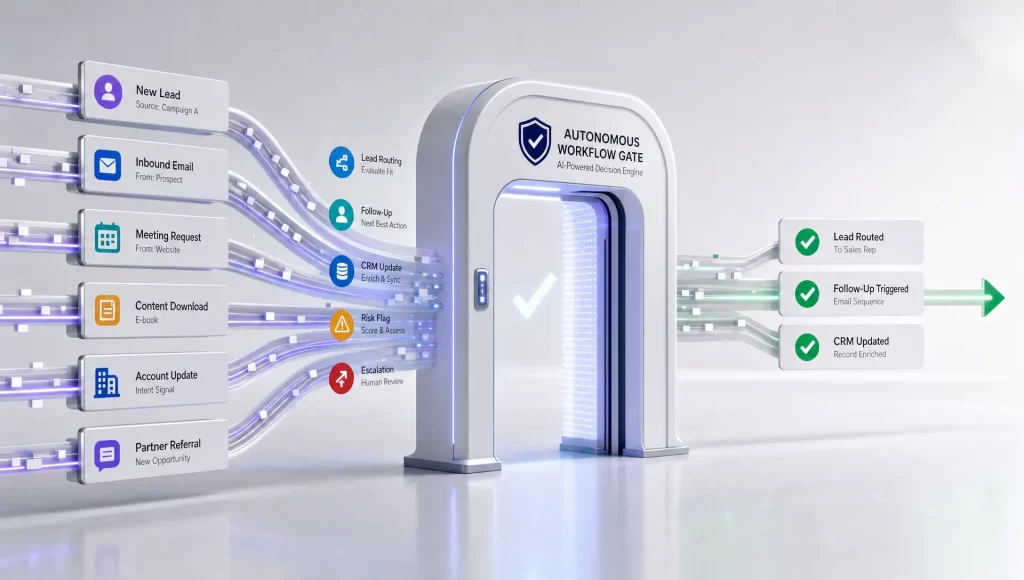
Most B2B teams are no longer asking whether AI can write an email, summarize a call, or generate a report. The sharper question is whether AI should be allowed to act without waiting for a human at every step.
That is where autonomous AI systems enter the conversation. For founder-led B2B companies, they can reduce commercial drag, improve speed, and give small teams more operating leverage. They can also create expensive chaos if they are deployed into unclear strategy, messy data, weak governance, or high-stakes workflows that still require human judgment.
The point is not to automate everything. The point is to decide where autonomy creates more revenue velocity than risk.
Autonomy is a delegation decision, not just an AI feature
An autonomous AI system is not simply a chatbot with access to your CRM. In a B2B context, it is a system that can interpret context, choose from a defined set of actions, use tools or data sources, and complete parts of a workflow with limited human intervention.
That might mean identifying stalled opportunities, enriching account data, routing a sales handoff, triggering a follow-up sequence, flagging forecast risk, or preparing a draft proposal based on approved inputs. The system is not replacing leadership judgment. It is taking over repeatable decisions and actions that slow the team down.
A useful way to think about autonomy is by levels:
| Level | What the system does | Example in a B2B revenue team |
|---|---|---|
| Assistant | Responds when asked | Summarizes a sales call or drafts an email |
| Guided workflow | Follows a predefined process | Creates CRM tasks after a demo is completed |
| Supervised autonomy | Acts within limits and escalates exceptions | Flags high-risk deals and recommends next actions |
| Bounded autonomy | Executes approved actions independently | Routes qualified inbound leads and launches approved follow-up |
| Open autonomy | Makes broad decisions without clear constraints | Changes pricing, messaging, or customer commitments without approval |
For most B2B teams, the practical opportunity sits in supervised and bounded autonomy. Open autonomy is rarely appropriate in revenue-critical environments, especially when pricing, legal terms, customer expectations, or strategic accounts are involved.
This is why autonomous AI should be part of an operating model, not a pile of disconnected tools. If you are still defining that architecture, it helps to clarify what an AI operating system should do for a B2B company before assigning AI more decision rights.
Why B2B teams are considering autonomous AI now
Founder-led B2B companies often hit the same growth ceiling. The founder still holds too much commercial context, sales managers spend too much time chasing updates, RevOps becomes reactive, and customer delivery depends on heroic coordination rather than a reliable system.
Autonomous AI systems are attractive because they promise leverage across those bottlenecks. Instead of hiring another coordinator, analyst, or sales ops resource, a team can use AI to handle repetitive execution and surface the exceptions that deserve human attention.
The strongest business case usually appears when three pressures show up at once:
- The company has enough demand, deals, or customers that manual coordination is slowing growth.
- The team has repeatable workflows, but execution quality varies by person.
- Leaders need faster visibility into what is happening across sales, delivery, and forecasting.
In that environment, autonomy can compress cycle time. It can also standardize the way good operators work, so best practices stop living only in the head of the founder, CRO, or top sales rep.
But AI autonomy does not create strategy. It amplifies the strategy and operating model you already have. If your ICP is vague, qualification criteria are inconsistent, or sales stages do not reflect reality, autonomous systems will simply execute bad logic faster.
When autonomous AI systems make sense
Autonomous AI systems make the most sense when the workflow is important, frequent, and structured enough to define clear decision boundaries. The goal is to remove human latency from actions that do not need deep judgment every time.
A good candidate workflow usually has five characteristics.
First, the process happens often. AI autonomy is most valuable in high-volume environments, such as lead routing, CRM hygiene, follow-up creation, renewal risk monitoring, or customer onboarding tasks. If a task happens twice a quarter, it may not justify system design effort.
Second, the decision logic is explicit. The team should be able to state the rules, thresholds, and exceptions. For example, if inbound leads from target accounts with a certain firmographic profile should be routed to a senior rep within five minutes, that is a clear rule. If a founder personally decides based on nuance, political context, and strategic timing, that should stay human-led.
Third, the cost of a wrong action is manageable. Autonomous follow-up reminders are low risk. Autonomous discount approval is not. Autonomous enrichment of account records may be acceptable. Autonomous changes to contract language are not, unless tightly controlled and reviewed.
Fourth, the data is reliable enough. AI can tolerate imperfect data, but it cannot compensate for a system of record that nobody trusts. If opportunity stages are stale, customer fields are inconsistent, or call notes are missing, autonomy will produce inconsistent outcomes.
Fifth, the workflow has a measurable commercial outcome. The best use cases connect directly to speed, conversion, retention, forecast accuracy, sales productivity, or customer experience. If you cannot define the metric, you probably cannot govern the system.
B2B use cases worth testing first
The best early use cases are not the flashiest. They are the places where smart people are wasting time on repeatable work that affects revenue.
| Use case | Good autonomy level | Why it works | Human guardrail |
|---|---|---|---|
| Inbound lead routing | Bounded autonomy | Rules are usually clear and speed matters | Escalate ambiguous accounts |
| CRM data cleanup | Supervised autonomy | Repetitive work with visible audit trails | Review bulk changes before commit |
| Deal risk alerts | Supervised autonomy | AI can detect inactivity, missing stakeholders, or stage drift | Manager decides intervention |
| Sales follow-up drafting | Assistant or supervised autonomy | Saves time while preserving rep judgment | Rep approves external message |
| Onboarding handoffs | Bounded autonomy | Checklists and data transfer can be standardized | Delivery lead reviews exceptions |
| Forecast anomaly detection | Supervised autonomy | AI can spot changes faster than manual inspection | Leadership owns forecast call |
Sales and RevOps teams often get value from AI that monitors the pipeline and flags what needs attention. Delivery teams benefit when AI turns closed-won details into structured handoff notes. Leadership benefits when AI identifies forecast movement before the weekly meeting.
The common thread is not replacement. It is compression. The system shortens the gap between signal and action. That is also the theme behind AI systems that strengthen sales, delivery, and forecasting, where the highest-value systems support execution across the whole revenue engine rather than one isolated task.

Where autonomous AI systems do not make sense yet
Autonomy is a poor fit when the company has not made the underlying commercial decisions. If leadership has not agreed on the ICP, sales process, qualification standards, pricing logic, or customer success model, AI has no stable operating rules.
It is also risky in workflows where a single mistake can damage trust. Examples include strategic enterprise negotiations, legal commitments, pricing exceptions, customer escalations, regulated data handling, and sensitive employee or customer communications.
A common mistake is using AI autonomy to avoid management work. If reps are not following the sales process, AI will not solve the accountability problem. If managers are not inspecting pipeline quality, AI alerts will become noise. If departments do not agree on handoff standards, AI will automate the disagreement.
This is one reason many AI projects disappoint. The company buys tools before it defines the commercial operating model. That pattern is covered in more depth in B2B AI strategy mistakes that burn budget, especially the risk of deploying disconnected systems without a clear revenue strategy.
Autonomous AI should not be used to hide process debt. It should be used after the process is clear enough to scale.
A readiness test for founder-led B2B teams
Before giving AI more autonomy, leaders should test readiness across three layers: commercial clarity, operational maturity, and technical control.
| Readiness area | Low readiness | High readiness |
|---|---|---|
| ICP and segmentation | Sales pursues too many account types | Target segments and fit criteria are clear |
| Sales process | Stages are subjective or outdated | Stages reflect real buyer progression |
| Data quality | CRM is incomplete or mistrusted | Core fields are maintained and inspected |
| Decision rights | Nobody knows what AI can decide | Clear rules define act, recommend, and escalate |
| Governance | No audit trail or owner | Actions are logged, reviewed, and improved |
| Metrics | Success is vague | Metrics connect to revenue, speed, or accuracy |
If readiness is low, start with AI assistance. Use AI to summarize, draft, research, and recommend. Keep humans in the approval loop.
If readiness is moderate, move into supervised autonomy. Let AI prepare actions, flag exceptions, and update low-risk records, but require review for customer-facing or revenue-sensitive decisions.
If readiness is high, bounded autonomy can make sense. This is where AI can execute approved actions inside defined thresholds, with monitoring and escalation rules in place.
For many companies between $3M and $25M in revenue, the biggest unlock is not full autonomy. It is moving from founder-dependent judgment to codified commercial logic that systems and teams can follow consistently.
How to implement autonomy without creating a black box
The safest path is progressive delegation. Do not start by asking where AI can replace people. Start by asking where the team loses speed, quality, or visibility because humans are stuck doing repeatable coordination work.
A practical rollout looks like this:
- Map the revenue bottleneck: Identify where delays, rework, missed follow-up, poor handoffs, or weak visibility are costing growth.
- Define the workflow outcome: Be specific about the metric, such as faster speed-to-lead, cleaner handoffs, higher follow-up compliance, or more accurate forecast inspection.
- Codify the decision rules: Write down what the system can do, what it can recommend, and what it must escalate.
- Start with human review: Run the system in recommendation mode before allowing it to execute actions automatically.
- Add logging and QA: Track what the system did, why it did it, and whether the outcome was accepted, corrected, or rejected.
- Expand only after proof: Increase autonomy when accuracy, adoption, and business impact are visible.
The key is to treat autonomy as an operating capability. It needs an owner, a feedback loop, and a commercial reason to exist. Without those, the system becomes another tool that creates more management work than it removes.
Governance: give AI a lane, not a blank check
The higher the autonomy, the stronger the governance needs to be. That does not mean slowing everything down with committees. It means giving the system a clear lane.
At minimum, every autonomous AI workflow should define three categories of action: what the system can do automatically, what it can recommend, and what it must escalate. For example, an AI system might automatically create internal tasks, recommend a follow-up email, and escalate any pricing question to a manager.
The NIST AI Risk Management Framework is useful here because it frames AI risk around governance, mapping, measuring, and managing. For B2B teams, that translates into practical questions: Who owns this workflow? What data does it use? What happens when it is wrong? How do we know whether it is improving performance?
Security also matters. If an autonomous system has access to CRM, email, documents, or customer data, leaders need controls around permissions, prompt injection, data leakage, and tool access. The OWASP Top 10 for Large Language Model Applications is a helpful reference for understanding common LLM risks.
Good governance does not kill autonomy. It makes autonomy safe enough to scale.
The leadership question: what should humans stop doing?
The best question for a founder or revenue leader is not, how much AI can we add? The better question is, what work should our best people stop doing because it does not require their judgment?
Sales reps should spend less time formatting notes and more time advancing deals. Managers should spend less time chasing CRM updates and more time coaching. Delivery leaders should spend less time reconstructing promises from sales calls and more time creating customer outcomes. Founders should spend less time being the routing mechanism for every decision and more time shaping strategy.
That is when autonomous AI systems make sense. They create leverage by taking repeatable execution off the critical path, while keeping human judgment where it matters most.
Frequently Asked Questions
What are autonomous AI systems in B2B? Autonomous AI systems are AI-enabled workflows that can take defined actions with limited human intervention. In B2B teams, they may route leads, update records, flag deal risk, prepare handoffs, or trigger approved internal processes.
When should a B2B company avoid autonomous AI? Avoid autonomy when strategy is unclear, data is unreliable, decision rules are subjective, or mistakes could create legal, financial, customer, or brand risk. Start with AI assistance before moving to supervised or bounded autonomy.
Do autonomous AI systems replace sales or RevOps people? They should not be designed primarily as replacements. The better use case is removing repetitive coordination work so sales, RevOps, delivery, and leadership teams can focus on judgment, relationships, and performance improvement.
How much autonomy should AI have in sales workflows? Most sales workflows should begin with recommendation or supervised autonomy. Let AI draft, prioritize, enrich, and flag, but keep humans involved in pricing, negotiation, strategic account decisions, and customer-facing commitments.
Does a company need perfect data before using autonomous AI? No, but it needs trusted core data and clear ownership. If CRM fields, sales stages, and customer records are unreliable, fix the most important data issues before giving AI permission to act.
Build autonomy around revenue, not hype
Autonomous AI systems can be powerful for B2B teams, but only when they are tied to a clear commercial operating model. The right starting point is not a tool demo. It is a diagnosis of where growth is slowing down, which decisions can be codified, and which interventions will create measurable revenue impact.
Billionaires in Boxers helps founder-led B2B companies build scalable growth systems through PE-grade diagnostics, AI systems buildouts, sales optimization, market expansion planning, and fractional CRO support. If you are evaluating where AI autonomy belongs in your revenue engine, start with a clearer view of the bottlenecks and the costed roadmap to remove them.
Explore how Billionaires in Boxers approaches revenue acceleration for founder-led B2B teams ready to scale with more discipline, leverage, and control.
