

At $3M to $25M in revenue, growth problems stop being isolated problems.
A weak quarter may look like a sales issue. A stretched founder may call it a hiring issue. A flat pipeline may trigger a campaign sprint. But at this stage, the real problem is usually architectural: the company has outgrown the informal growth system that got it here.
A strong revenue growth strategy for this stage does not start with more activity. It starts with sharper choices about where revenue should come from, which constraints must be removed first and how the company will make growth repeatable without the founder carrying every important deal.
For founder-led B2B companies, the $3M to $25M stage is where instinct has to become infrastructure.
Why the $3M to $25M stage is different
A company at $3M in revenue usually has proof. Customers buy, the offer solves a real problem and the founder has learned the market through hundreds of conversations.
By $10M or $15M, the company may have a sales team, a marketing function, account management and a leadership bench. Yet growth can still feel fragile because the system is often held together by founder memory, heroic execution and a handful of trusted people.
That creates a specific scaling problem. The business is no longer small enough to rely on the founder’s personal judgment in every commercial decision, but it is not yet mature enough to have enterprise-grade revenue architecture.
Generic growth advice tends to fail here because it assumes one of two things: either the company needs startup-style experimentation or enterprise-style process. Founder-led B2B companies in this band need something else. They need a commercial system that preserves the founder’s market insight while reducing founder dependency.
A useful revenue growth strategy at this stage should answer four questions:
- Where are we most likely to win profitable revenue?
- What is the main constraint stopping growth right now?
- Which revenue motions can scale beyond the founder?
- What operating cadence will keep the team focused long enough for the strategy to work?
If those questions are not answered clearly, the company often compensates with more channels, more hires, more tools and more meetings. Those moves may create motion, but not always momentum.
Start with the real revenue constraint
The most expensive mistake at this stage is building a strategy around the loudest symptom.
If pipeline is weak, the team assumes it needs more lead generation. If close rates fall, it assumes the sales team needs better training. If delivery is overloaded, it assumes operations is the bottleneck. Any of those may be true, but the symptom is not always the constraint.
A revenue growth strategy should begin by finding the limiting factor in the revenue system. Billionaires in Boxers has written more deeply about how to build a strategy around your real revenue constraint, and that principle matters most in the $3M to $25M stage because resources are too precious to spread across every possible improvement.
The constraint usually sits in one of several places:
| Symptom | Possible constraint | Strategic question |
|---|---|---|
| Plenty of leads, poor conversion | Weak qualification or unclear buying trigger | Are we attracting buyers with urgent, funded problems? |
| Founder closes most large deals | Sales motion depends on founder credibility | What part of the founder’s method needs to become a system? |
| Revenue grows but margin erodes | Offer design or delivery model is too custom | Which revenue is worth scaling? |
| High customer concentration | Market focus is too narrow or expansion is underbuilt | Where can we grow without adding unacceptable risk? |
| Sales team is busy but inconsistent | No shared sales process or decision criteria | What does good look like at each stage? |
| Marketing activity is high but pipeline is low | Messaging and channel fit are misaligned | Are we speaking to the right buyer at the right moment? |
This diagnostic step prevents the classic mid-market trap: trying to improve every function at once. A focused strategy might delay new campaigns because the offer needs tightening first. It might pause hiring because the sales process is not yet teachable. It might shift attention from acquisition to expansion because the fastest growth sits inside the current customer base.
The point is not to slow down. The point is to aim the next 90 days of effort at the constraint that actually governs revenue growth.
Turn founder instinct into revenue architecture
Most founder-led B2B companies have an invisible growth system before they have a documented one.
The founder knows which prospects are serious. They know which objections matter, when to push, when to walk away and how to frame the value of the offer. The problem is that much of this knowledge remains tacit. It lives in the founder’s head, in Slack threads, in call recordings or in the habits of a few senior people.
Revenue architecture is the work of making that system visible, transferable and measurable. It connects market selection, positioning, demand generation, sales conversion, customer success and revenue operations into one commercial operating model.
If that sounds heavier than a campaign plan, it is. But it is also what allows a company to scale without constantly rebuilding around personalities. For a deeper breakdown of this concept, the article on revenue architecture for B2B founders explains why many plateaus are caused by system design rather than effort.
At the $3M to $25M stage, revenue architecture does not need to be bureaucratic. It needs to be explicit. The team should be able to see who the best customers are, why they buy, how they enter the pipeline, what must happen to convert them and how the business expands the relationship after the first sale.
Without that clarity, growth depends on force. With it, growth becomes easier to manage.
Segment the market by profit, urgency and win probability
Many companies reach $3M to $25M by being opportunistic. That is not a criticism. Opportunism is often rational early on because the company is still learning where it fits.
At the next stage, however, the cost of unfocused revenue rises. A broad market creates diffuse messaging. Diffuse messaging creates weaker pipeline. Weak pipeline pushes the team to chase marginal deals. Marginal deals increase delivery complexity and distract the company from its best customers.
A serious revenue growth strategy requires a sharper view of market segments. The strongest segments usually meet three tests:
- Profitability: The customer type produces attractive gross margin, reasonable support load and a path to expansion.
- Urgency: The problem is painful enough that buyers act now rather than someday.
- Win probability: The company has a credible advantage in reaching, convincing and serving that buyer.
This is where many strategy documents get too abstract. They define a market by industry, company size or geography, then stop. A useful segmentation model goes further. It identifies the specific buying trigger that moves a prospect from interested to active.
For example, a cybersecurity provider may serve financial services, but the buying trigger might be an upcoming audit, a recent breach, a board mandate or a new regulatory requirement. A consulting firm may serve manufacturers, but the real trigger might be a stalled ERP implementation, margin pressure or a leadership transition.
The tighter the buying trigger, the easier it becomes to align messaging, sales plays and proof.
Build the offer around a narrow buying trigger
At this stage, the offer must do more than describe what the company sells. It must make the buyer’s decision easier.
A vague offer forces the sales team to translate value on every call. A custom offer creates delivery drag. A highly technical offer may impress internal stakeholders but fail to connect with the executive buyer’s business problem.
The goal is not to simplify the company’s capabilities into something basic. The goal is to package the first step in a way that matches how the buyer experiences urgency.
Strong B2B offers usually clarify five things:
- The problem the buyer already recognizes
- The outcome the buyer wants to create
- The cost of leaving the problem unsolved
- The proof that your team can solve it
- The first commitment required to start
That first commitment matters. In founder-led companies, the main offer often becomes too large, too custom or too dependent on a senior seller to explain. A diagnostic, assessment, pilot, workshop or scoped engagement can help buyers move forward when the problem is urgent but trust still needs to be built.
For Billionaires in Boxers, this is one reason a Revenue Acceleration Diagnostic exists as a defined entry point rather than a vague consulting conversation. The broader lesson applies across B2B: buyers move faster when the first step is concrete and tied to a commercial outcome.
Make sales repeatable before you make it bigger
Hiring more salespeople into an unclear system usually multiplies confusion.
A founder-led company may think it has a sales capacity problem when it really has a sales transfer problem. The founder can sell because they understand the market, the offer, the backstory, the delivery tradeoffs and the buyer psychology. A new salesperson does not have that context by default.
Before scaling headcount, the company should define the sales motion in operational terms. That means documenting more than stages in a CRM. It means clarifying entry criteria, exit criteria, buyer commitments, common objections, decision paths and the moments where technical or founder support should be involved.
The sales process should make the best version of the founder’s judgment easier for the team to use. It should also make poor-fit deals easier to reject.
Key sales questions include:
- What makes a lead sales-ready?
- Which buyer roles must be involved before proposal?
- What evidence confirms budget, urgency and decision process?
- Which objections indicate education is needed and which indicate poor fit?
- When should the founder support a deal, and when should the team proceed without them?
Once these questions are answered, sales leadership can coach against a standard. Marketing can generate demand for the right buying moments. Customer success can prepare for what was promised during the deal. Finance can forecast with more confidence.
Balance acquisition, expansion and retention
Companies in the $3M to $25M stage often over-focus on net new acquisition because it is the most visible growth lever. New logos matter, but sustainable revenue growth rarely comes from acquisition alone.
A stronger strategy considers three connected revenue motions: acquisition, expansion and retention.
| Revenue motion | What it improves | Common strategic moves |
|---|---|---|
| Acquisition | New customer revenue | Sharper ICP, stronger outbound plays, partner channels, improved conversion |
| Expansion | Revenue per account | Cross-sell, upsell, additional locations, broader stakeholder engagement |
| Retention | Revenue durability | Better onboarding, success milestones, executive business reviews, proactive risk management |
The right balance depends on the business model. A project-based services firm may need to create more recurring or follow-on revenue. A SaaS company may need to reduce churn before adding more demand. A B2B technology provider may need to land in one department, then expand into adjacent teams.
This is also where revenue quality matters. Not all growth is equal. Revenue that looks attractive on the top line can weaken the business if it creates delivery chaos, damages margin or distracts the team from a more profitable segment.
A practical strategy should define which revenue the company wants more of and which revenue it is willing to leave behind.
Install an operating cadence that protects the strategy
The best strategy will decay if the operating rhythm rewards reactivity.
In founder-led companies, urgency is often constant. A major prospect asks for something unusual. A large customer escalates an issue. A competitor launches a campaign. The founder has a new idea. Each event may deserve attention, but without a cadence the company drifts from the strategy one exception at a time.
A revenue growth strategy needs a management system. That does not mean endless meetings. It means a small number of recurring forums where the team reviews the right data, makes decisions and removes blockers.
A simple cadence can work well:
- Weekly revenue meeting: Review pipeline movement, deal quality, conversion risks and current constraints.
- Monthly growth review: Assess performance by segment, channel, offer and customer cohort.
- Quarterly strategy reset: Reconfirm the main constraint, adjust priorities and decide what to stop.
AI systems can support this cadence when the underlying strategy is clear. They can help summarize sales calls, surface recurring objections, improve research workflows, clean CRM data or speed up account planning. But AI should not be used to automate confusion. If the ICP is vague or the offer is unclear, automation simply spreads that weakness faster.
The highest value use of AI at this stage is usually not replacing the revenue team. It is codifying and amplifying the judgment that already exists in the business.
What the strategy should include
A revenue growth strategy for the $3M to $25M stage should be concrete enough for the leadership team to use every week. If it only lives in a slide deck, it is not finished.
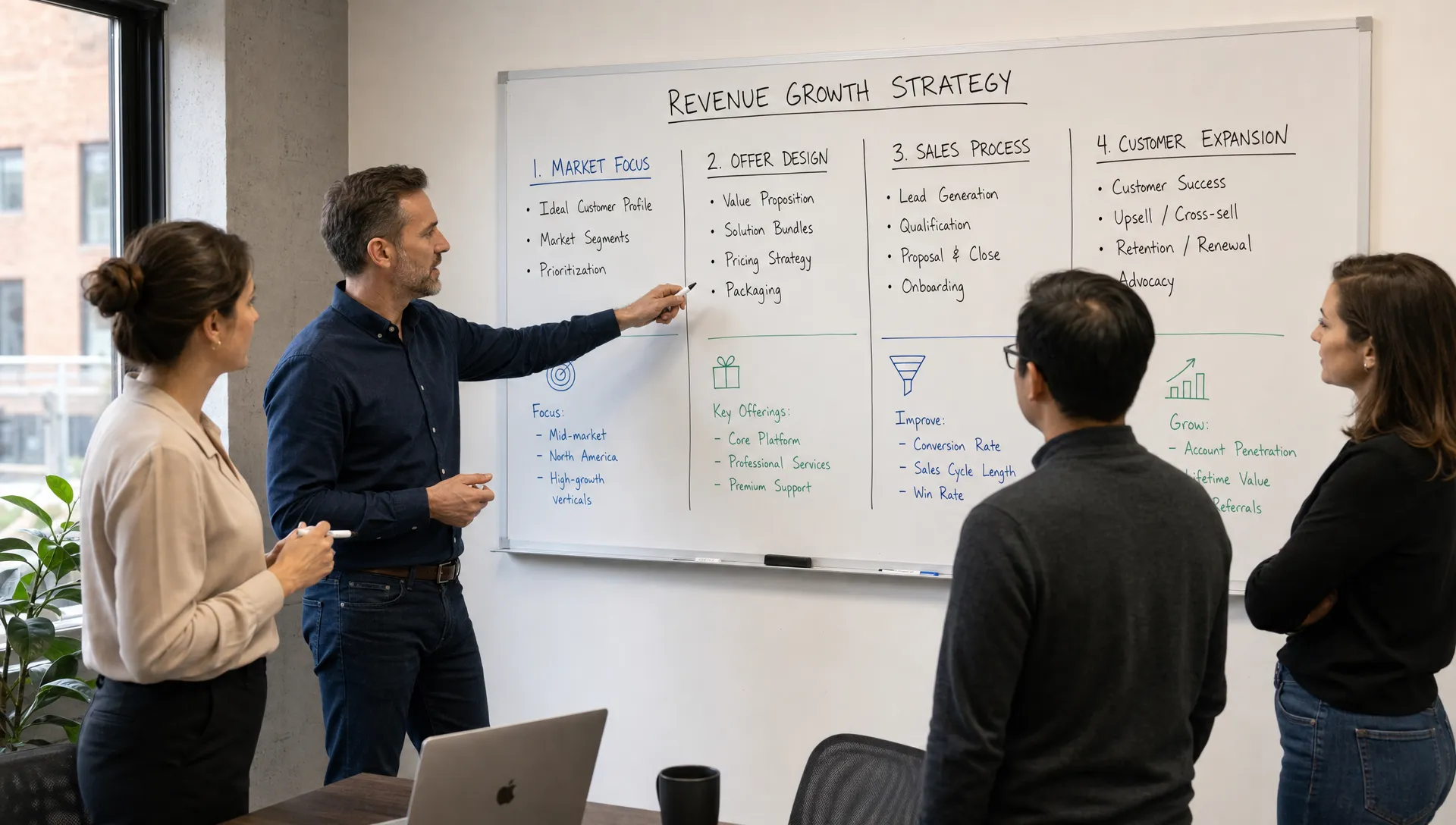
The strategy should include these core components:
- Strategic revenue objective: The specific growth outcome the company is pursuing, including revenue mix, margin expectations and time horizon.
- Market focus: The customer segments, buying triggers and use cases where the company has the strongest right to win.
- Offer architecture: The entry offer, core offer, expansion paths and proof needed to support the buying decision.
- Demand strategy: The channels and plays most likely to create qualified opportunities in the chosen market.
- Sales system: The stages, qualification rules, buyer commitments and coaching standards required for repeatable conversion.
- Customer growth plan: The retention, expansion and account development motions that increase revenue quality.
- Operating cadence: The meetings, metrics and decision rights that keep execution aligned.
This is not an annual planning exercise. It is a working model for how the company will create, convert and keep revenue.
A practical 90-day path
Ninety days is usually enough time to diagnose the constraint, design the strategy and begin execution without pretending that every problem can be solved at once.
| Phase | Focus | Key decisions | Outputs |
|---|---|---|---|
| Days 1 to 30 | Diagnose | Where is growth actually constrained? | Revenue system assessment, segment analysis, pipeline and customer review |
| Days 31 to 60 | Design | What choices will focus the company? | ICP refinement, offer architecture, sales process, priority growth plays |
| Days 61 to 90 | Deploy | How will the team execute and measure progress? | Operating cadence, scorecard, intervention roadmap, early implementation |
The first month should resist solution jumping. The second month should force tradeoffs. The third month should turn decisions into operating habits.
This is similar to how strong external operators approach the first quarter of a growth engagement. For a closer view of that process, see how growth strategy consultants work in the first 90 days with a founder-led B2B company.
Common mistakes to avoid
Treating revenue growth as a marketing problem. Marketing may be part of the solution, but weak growth can originate in segmentation, offer design, pricing, sales process, retention or leadership capacity. Diagnose before prescribing.
Hiring before the system is teachable. A senior sales hire can add value, but not if the company expects them to decode the founder’s instincts, rebuild the sales process and hit aggressive targets at the same time.
Chasing all revenue equally. At this stage, revenue quality matters. Some customers create strategic momentum. Others create complexity that slows the company down.
Confusing dashboards with control. Metrics are useful only when the team knows which decisions they inform. A smaller scorecard tied to the main revenue constraint is better than a large dashboard nobody uses.
Changing strategy too quickly. Founder-led companies often move fast, which is a strength. But revenue systems need enough time to produce signal. If the strategy changes every few weeks, the team never learns what is working.
Frequently Asked Questions
What is a revenue growth strategy? A revenue growth strategy is a focused plan for how a company will create, convert, retain and expand revenue. At the $3M to $25M stage, it should connect market focus, offer design, sales process, customer growth and operating cadence.
Why does the $3M to $25M stage need a different growth strategy? This stage is where founder-led execution starts to hit its limits. The company has proof and customers, but growth often depends too much on the founder, informal processes and opportunistic sales. The strategy must turn what works into a repeatable system.
Should we hire a VP of Sales or fractional CRO first? It depends on the constraint. If the sales motion is already clear and teachable, a full-time sales leader may make sense. If the system still needs diagnosis, design and operating discipline, fractional CRO support can help build the foundation before adding permanent headcount.
How long does it take to see results from a revenue growth strategy? Some improvements, such as qualification discipline or pipeline focus, can show early impact within weeks. Larger gains from positioning, offer architecture, retention or team capability usually require multiple quarters of consistent execution.
Where should AI fit into revenue growth? AI fits best after the company has clarified its market, offer and process. It can improve research, call analysis, CRM hygiene, account planning and workflow speed. It should support the revenue system, not replace strategic choices.
Build the revenue system for the next stage
The $3M to $25M stage rewards focus. The companies that scale well do not simply add more tactics. They identify the real constraint, choose the right market, sharpen the offer and build a revenue system the team can run without the founder in every critical moment.
If your founder-led B2B company has outgrown informal growth but is not yet ready for enterprise complexity, Billionaires in Boxers can help you diagnose the constraint and design the next stage of revenue architecture. Explore the PE-grade diagnostics, AI systems and fractional CRO support available through Billionaires in Boxers.
