
Founder-led B2B companies rarely suffer from a total lack of commercial judgment. They usually suffer from judgment trapped in too few heads.
The founder knows which prospects are worth bending the rules for. The best seller knows which late-stage objections are real risk and which are negotiation theater. Delivery can spot the customer who will churn before Sales notices the renewal date. Finance knows which deal shapes look profitable on paper but create cash strain later.
The problem is that this judgment does not always compound. It gets applied inconsistently, rewritten from memory and lost when people are busy, tired or absent. AI learning systems are useful because they can turn scattered commercial experience into an operating asset that improves over time.
Not by replacing human judgment. By giving it a memory, a feedback loop and a way to scale across the revenue engine.
What an AI learning system is in a commercial context
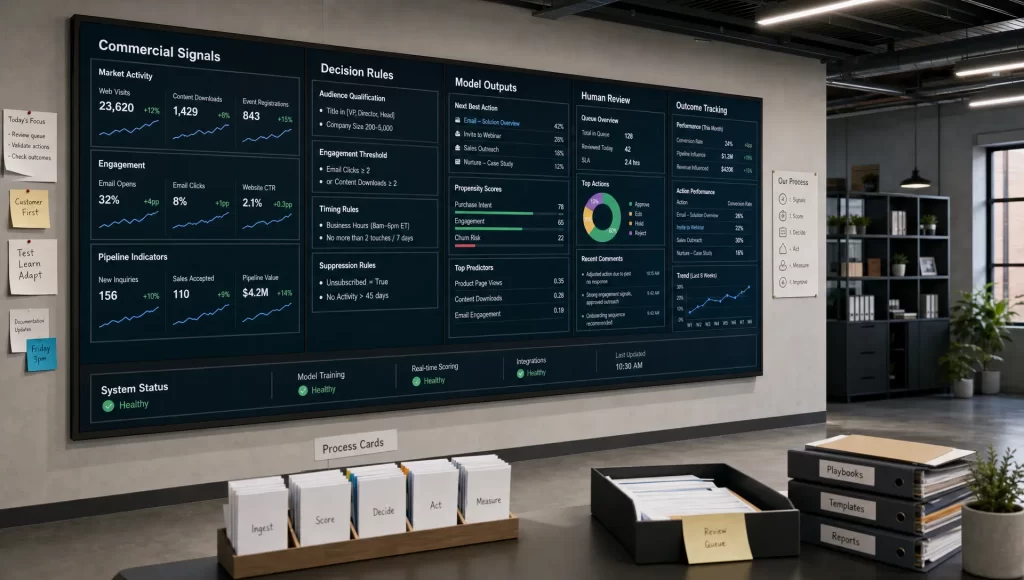
An AI learning system is a structured combination of data, rules, models, workflows and feedback loops that improves how a business makes decisions. In a B2B revenue context, that usually means improving decisions about markets, accounts, pipeline, pricing, sales execution, delivery risk and customer expansion.
This is different from a chatbot, a dashboard or an automation tool.
A chatbot answers questions. A dashboard reports what happened. An automation tool moves work from one place to another. An AI learning system captures what happened, compares it with what was expected, identifies patterns and helps the team make better calls next time.
For a founder-led B2B company, that distinction matters. The goal is not to make AI sound impressive. The goal is to improve the commercial decisions that determine revenue quality.
Those decisions include:
- Which accounts deserve senior attention
- Which opportunities should be disqualified early
- Which segments are becoming more expensive to win
- Which proposals are likely to create delivery drag
- Which customer signals should trigger expansion or retention action
- Which sales behaviors correlate with profitable growth
When AI learning systems work well, they do not just produce more activity. They help the company learn from commercial reality faster than the team could through meetings, anecdotes and lagging reports alone.
Why commercial judgment breaks as the company grows
In the early stages, commercial judgment is often founder-led by necessity. The founder sits in sales calls, reviews pricing, handles strategic customers and knows which promises the company can actually keep.
That works until the business reaches a level of complexity where the founder becomes the bottleneck. More reps, more segments, more customers, more delivery variables and more data make the old judgment model unstable.
The company starts seeing familiar symptoms. Forecasts become opinion contests. Qualification criteria exist but are interpreted differently. Reps discount for different reasons. Customer success escalates issues that Sales could have seen earlier. Leadership debates pipeline volume when the real issue is pipeline quality.
At that point, the business does not simply need more data. Most companies already have too much data distributed across CRM, calls, spreadsheets, proposals, customer systems and inboxes. The missing layer is learning.
A learning layer asks sharper questions:
- What did we believe would happen?
- What actually happened?
- Which signals predicted the gap?
- Which behaviors improved the outcome?
- What should change in our decision logic?
This is where AI becomes commercially useful. It can help identify patterns across messy, repeated decisions that humans struggle to compare at scale.
The commercial judgment loop: observe, decide, act, learn
The strongest AI learning systems are built around a simple operating loop.
| Stage | Commercial question | Example use |
|---|---|---|
| Observe | What signals are visible? | Deal stage behavior, call themes, pricing requests, stakeholder engagement, customer usage or delivery notes |
| Decide | What judgment should be applied? | Prioritize, disqualify, escalate, reprice, reshape scope or involve leadership |
| Act | What workflow should happen next? | Assign follow-up, revise proposal, trigger risk review, coach seller or create expansion motion |
| Learn | Did the action improve the outcome? | Compare win rate, margin, cycle time, churn risk, forecast accuracy or delivery cost |
This loop matters because AI systems that stop at observation become reporting tools. Systems that stop at action become automation. AI learning systems improve because they connect outcomes back to the decisions and signals that produced them.
For example, a company may discover that deals with high executive enthusiasm but weak operational sponsorship close quickly and churn early. That is a commercial judgment insight. The next version of the system can flag similar deals, prompt different discovery questions and require delivery validation before proposal.
The business has not just automated a task. It has improved judgment.
Where AI learning systems improve revenue decisions
AI learning systems create the most value where decisions are frequent, commercially meaningful and currently inconsistent. In founder-led B2B companies, five areas tend to matter most.
1. ICP and market selection
Many companies describe their ideal customer profile in static terms: industry, company size, geography, funding, headcount or technology stack. Those attributes help, but they rarely explain the full commercial reality.
A learning system can compare account characteristics with actual outcomes. It can look for patterns in win rate, sales cycle length, gross margin, retention, expansion and delivery complexity. Over time, the ICP becomes less of a positioning statement and more of a tested commercial hypothesis.
The result is better market focus. Leadership can distinguish between segments that produce revenue and segments that produce good-looking but low-quality demand.
2. Pipeline qualification
Qualification often degrades as teams grow. The framework may be sound, but sellers interpret it differently. One rep sees urgency. Another sees curiosity. One manager sees a strategic logo. Another sees a low-probability distraction.
AI learning systems can help by comparing deal signals with historical outcomes. They can surface patterns in call language, stakeholder participation, competitor mentions, budget evidence, legal friction and next-step quality.
This does not mean the system should make the decision alone. It means managers can coach from evidence rather than instinct alone. For a deeper view of codifying decision logic in B2B revenue teams, Billionaires in Boxers has covered how expert systems in AI improve B2B decisions.
3. Pricing and discount discipline
Pricing decisions expose weak commercial judgment quickly. A rep may discount to create momentum. A founder may approve exceptions to land a strategic account. A team may accept unfavorable terms because the logo looks valuable.
The real test is what happens after the contract is signed.
An AI learning system can connect pricing decisions to downstream outcomes such as onboarding effort, scope creep, margin leakage, renewal behavior and expansion probability. It can help leaders see which exceptions were genuinely strategic and which simply trained the market to negotiate harder.
That feedback is especially valuable because pricing mistakes often look like wins in the quarter they are made.
4. Forecasting and deal risk
Forecasting is not just a math problem. It is a judgment problem shaped by seller optimism, manager pressure, incomplete evidence and inconsistent stage definitions.
AI learning systems can improve forecast discipline by tracking the difference between forecast claims and actual outcomes. They can flag patterns such as late-stage deals with no recent buyer engagement, opportunities that move stages without new evidence or close dates that shift repeatedly without executive contact.
The key is not to shame sellers for uncertainty. The key is to make uncertainty visible earlier, so leadership can intervene while there is still time to change the outcome.

5. Retention and expansion judgment
Customer signals are often scattered across account management, delivery, support, product usage and executive relationships. A customer may look healthy in one system and risky in another.
AI learning systems can combine these signals to improve judgment about retention and expansion timing. They can help identify customers that need intervention, customers that are ready for a broader conversation and customers whose usage does not yet justify an expansion push.
This improves both growth and trust. Customers do not want to be sold to because a renewal date is approaching. They respond better when the commercial motion matches their actual business state.
What the system needs to learn from
AI learning systems are only as useful as the commercial evidence they can access. This does not mean every company needs a perfect data warehouse before it starts. It does mean the system needs enough reliable input to connect decisions with outcomes.
Useful inputs often include CRM history, call notes, proposal versions, pricing approvals, customer onboarding data, renewal outcomes, margin analysis, support themes and win-loss notes. The exact data mix depends on the business model.
A founder-led services business may care deeply about scope accuracy and delivery load. A B2B SaaS company may care more about activation, usage, expansion signals and retention cohorts. A technical product company may need to track buyer committee composition and implementation complexity.
The mistake is treating all revenue data as equal. Some data is noise. Some data is political. Some data is incomplete. The highest-value AI learning systems are designed around the few decisions that matter most, then trained to improve those decisions with better evidence.
If the underlying revenue operations are fragmented, it is often worth strengthening the operating layer first. The practical foundation for this is covered in more detail in AI infrastructure solutions for scalable revenue ops.
The judgment architecture: rules, models and human review
A commercial AI learning system should not be a black box that everyone blindly follows. In revenue work, judgment needs explainability because the stakes are too high for hidden logic.
The most useful architecture usually blends three components.
| Component | Role in the system | Commercial example |
|---|---|---|
| Rules | Encode known decision standards | Do not progress an enterprise deal without access to the economic buyer |
| Models | Detect patterns humans may miss | Deals with certain objection patterns and low stakeholder diversity have poor close rates |
| Human review | Apply context, ethics and strategy | Approve an exception for a strategically important customer despite short-term margin risk |
This blend matters because commercial judgment is not pure pattern recognition. Strategy sometimes requires breaking the pattern. A company may pursue a lower-margin beachhead account to enter a new vertical. It may accept a complex customer because the learning value is high. It may walk away from a profitable deal because the delivery risk would damage the team.
AI can inform those choices. It should not make them invisible.
The NIST AI Risk Management Framework is useful here because it emphasizes governance, measurement and management of AI risks. For B2B revenue systems, that translates into clear ownership, documented decision logic and regular review of how AI-supported recommendations affect customers, employees and commercial outcomes.
How learning systems change leadership behavior
The hidden value of AI learning systems is not only better recommendations. It is better leadership conversations.
Without a learning system, commercial meetings often drift into subjective debate. Sales says the pipeline is strong. Delivery says the pipeline is risky. Finance says discounts are undermining profitability. Customer success says the wrong customers are being sold.
With a learning system, the conversation becomes more specific. Leaders can examine which assumptions were wrong, which signals were ignored and which interventions worked. That creates a healthier operating rhythm.
For example, instead of asking, “Why did we miss the forecast?” the team can ask, “Which late-stage signals were present in deals that slipped, and did managers act on them?” Instead of asking, “Why is delivery overloaded?” the team can ask, “Which proposal patterns correlate with unplanned delivery hours?”
This is how companies build commercial judgment that survives scale. They stop relying on heroic interpretation and start institutionalizing what the business is learning.
Common mistakes when building AI learning systems
The most common mistake is starting with the tool rather than the decision. A company buys AI software, connects data sources and waits for insight. The system may generate summaries or alerts, but it does not improve judgment because nobody defined the judgment it was meant to improve.
Another mistake is measuring productivity instead of decision quality. Faster follow-up is useful, but it is not the same as better qualification. More activity is useful only if it moves the right opportunities forward and filters the wrong ones out.
A third mistake is letting AI reinforce existing bias. If historical data reflects bad targeting, weak qualification or excessive discounting, the system may learn from flawed patterns. Human review is needed to separate “what usually happened” from “what should happen next.”
Finally, many companies fail to close the feedback loop. They generate recommendations but do not track whether those recommendations improved outcomes. Without outcome review, the system becomes another layer of noise.
A practical build sequence for founder-led B2B companies
The best starting point is not a company-wide AI transformation. It is one high-value judgment loop.
Choose a commercial decision that happens often, affects revenue quality and currently depends too much on individual interpretation. Pipeline qualification, deal risk scoring, discount approval, renewal risk or ICP prioritization are good candidates.
Then define the decision standard. What would a strong commercial operator look for? What evidence matters? What should trigger escalation? What should disqualify the opportunity? What should be reviewed by a human?
Next, connect the minimum viable data. This may include CRM fields, call summaries, proposal metadata, customer notes and outcome data. The goal is not completeness. The goal is enough signal to start learning.
After that, put the system into the operating cadence. If the insight does not appear where decisions are made, it will not change behavior. A risk signal buried in a dashboard is weaker than a prompt inside the weekly pipeline review.
Finally, review outcomes on a fixed rhythm. Did the system help the team make better calls? Did managers override it? Were overrides right? Did win rates, margins, cycle times or retention indicators improve?
This is also where external help can be useful. Billionaires in Boxers works with founder-led B2B companies through PE-grade diagnostics, AI systems and fractional CRO support. The point is not to install AI for its own sake. It is to engineer better commercial decisions across the revenue system.
What better commercial judgment looks like
Better commercial judgment is visible in operating behavior before it shows up in lagging metrics.
Sales teams become more disciplined about evidence. Managers coach the few deal factors that actually change outcomes. Founders are pulled into fewer low-quality decisions. Pricing exceptions become more deliberate. Delivery risk is considered before the contract is signed. Forecast conversations become less performative and more diagnostic.
Over time, the revenue engine becomes easier to scale because the company is no longer asking every new hire to absorb founder judgment through osmosis. The system teaches, prompts and corrects. People still decide, but they decide with better context.
That is the real promise of AI learning systems. Not artificial confidence. Not automation theater. A commercial brain that gets sharper as the business encounters more markets, customers, deals and edge cases.
Frequently Asked Questions
What are AI learning systems in B2B revenue teams? AI learning systems are structured combinations of data, models, workflows and feedback loops that help a company improve commercial decisions over time. They learn from outcomes such as wins, losses, churn, margin, sales cycle length and expansion performance.
How are AI learning systems different from AI dashboards? Dashboards usually report what happened. AI learning systems connect what happened to prior signals and decisions, then use that feedback to improve future recommendations, prompts or workflows.
Can AI replace founder judgment in commercial decisions? It should not replace founder judgment in strategic decisions. The stronger use case is scaling the founder’s best judgment into repeatable decision logic, then improving that logic with real outcome data.
Where should a founder-led B2B company start? Start with one decision loop that affects revenue quality, such as pipeline qualification, discount approval, deal risk, ICP focus or renewal risk. Define the judgment standard before choosing the tool.
What data does an AI learning system need? It usually needs a mix of CRM data, sales activity, call notes, proposals, pricing decisions, customer success signals and outcome data. The exact inputs depend on the decision the system is designed to improve.
Build a revenue system that learns
If your company has enough data but still depends on a handful of people to interpret every commercial decision, the next constraint may be judgment infrastructure.
Billionaires in Boxers helps founder-led B2B businesses at $3M to $25M revenue diagnose revenue constraints, build AI systems and strengthen commercial execution with fractional CRO support. If you want to identify where better learning loops could improve sales, market expansion and revenue quality, start with the Revenue Acceleration Diagnostic.
