
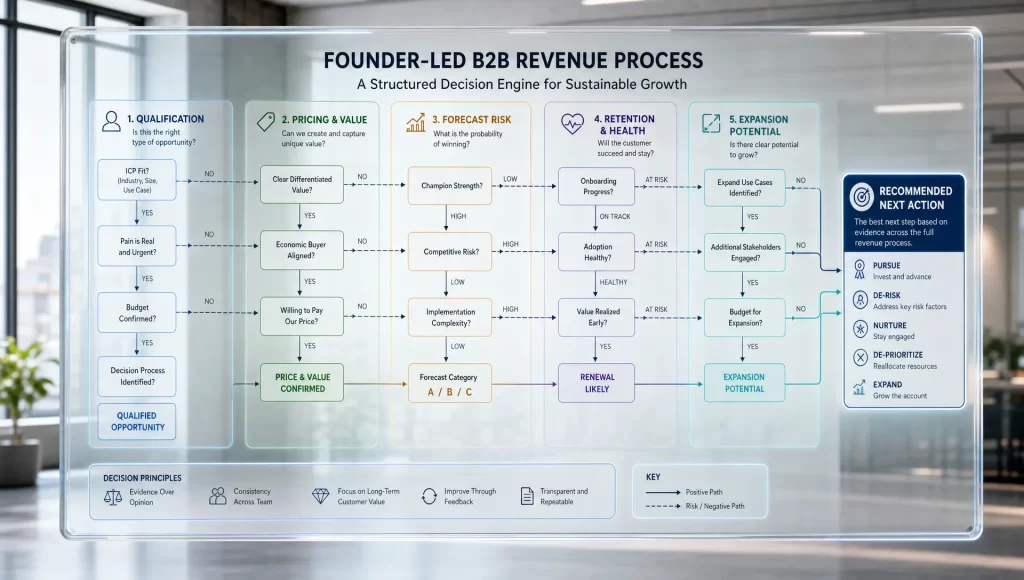
B2B decisions rarely fail because leaders lack intelligence. They fail because too much judgment lives in too few heads.
In a founder-led company, the founder often knows which accounts are worth pursuing, which deals are risky, which customers are likely to expand, and which sales activity is just noise. The problem is that this expertise does not always scale. As the company grows from $3M to $25M in revenue, decisions spread across sales, marketing, customer success, finance, and delivery. Without a shared decision model, each team starts interpreting the market differently.
That is where an expert system in AI becomes commercially useful.
Expert systems in AI help B2B companies capture specialized judgment, convert it into decision logic, and apply that logic consistently across workflows. Unlike a generic chatbot or standalone automation tool, an expert system is designed to make or support decisions in a specific domain. For founder-led B2B firms, that domain might be pipeline qualification, pricing, forecasting, market expansion, renewal risk, account prioritization, or sales process governance.
The goal is not to replace leadership judgment. The goal is to make the best judgment inside the company available at the point of decision, every time.
What Is an Expert System in AI?
An expert system is an AI-based decision support system that imitates the reasoning of a human expert in a defined field. It typically uses a knowledge base, a set of rules or decision logic, an inference engine, and an explanation layer to evaluate information and recommend an action.
IBM describes expert systems as AI programs that use knowledge and inference procedures to solve problems that would otherwise require human expertise. In practical business terms, that means the system applies structured know-how to real situations, such as whether a lead fits the ideal customer profile, whether a deal deserves executive involvement, or whether a customer account is showing signs of churn risk.
A simple expert system might say, “If the company is in our target vertical, has more than 200 employees, uses a competitor, and has an urgent compliance trigger, assign the opportunity to a senior seller.” A more advanced system might combine rules, CRM data, conversation intelligence, historical win rates, margin thresholds, and generative AI summaries to recommend the next best action.
The core components usually look like this:
| Component | What it does | B2B example |
|---|---|---|
| Knowledge base | Stores domain expertise, rules, definitions, and decision criteria | ICP criteria, discount rules, buying committee patterns |
| Inference engine | Applies logic to available data to reach a recommendation | Scores a deal as high, medium, or low priority |
| User interface | Lets humans interact with the system | CRM prompt, sales workspace, leadership dashboard |
| Explanation layer | Shows why the system made a recommendation | “Low confidence because no economic buyer is identified” |
| Feedback loop | Updates logic based on outcomes and expert review | Refines qualification criteria after analyzing lost deals |
This structure matters because most AI adoption in B2B fails when teams buy tools without first defining the commercial logic they want the tool to apply. An expert system forces the company to make its decision logic explicit.
Why B2B Decisions Break as Companies Scale
In the early stages of a founder-led B2B company, decision-making often feels fast. The founder knows the market intimately. Salespeople can ask leadership for judgment on complex deals. Delivery leaders can flag risks informally. Pricing exceptions get reviewed in real time.
That model works until volume increases.
More leads enter the funnel. More sellers interpret qualification differently. More customer segments appear. More delivery constraints affect what should be sold. More data accumulates, but not always in a form that improves decisions. Eventually, the company does not have one revenue model. It has several unofficial versions of the truth.
Common symptoms include:
- Sales accepts too many weak opportunities because qualification criteria are vague.
- Forecast meetings become opinion debates rather than risk reviews.
- Discounts are approved inconsistently because pricing logic is not codified.
- Marketing optimizes for lead volume while sales cares about account quality.
- Customer success reacts to churn signals too late because risk indicators are fragmented.
- Expansion decisions depend on account manager intuition rather than clear account evidence.
At this stage, the issue is not simply “we need more data.” Many B2B firms already have enough data to make better decisions. The harder problem is that data is not connected to expert reasoning.
That distinction is important. Dashboards show what happened. AI business intelligence can reveal patterns and commercial signals, as explored in this article on how AI business intelligence improves commercial decisions. Expert systems go one step further by helping teams decide what to do next based on those patterns.
How Expert Systems in AI Improve B2B Decisions
Expert systems improve decisions by reducing variation, surfacing hidden risk, and applying proven reasoning at scale. In B2B revenue environments, that usually creates value in five areas.
1. They Turn Founder Judgment Into Repeatable Logic
The founder often holds the most valuable commercial pattern recognition in the business. They know which prospects are serious, which use cases expand, which red flags matter, and which markets are distractions.
But if that judgment is not documented, it becomes a bottleneck.
An expert system helps extract that judgment and turn it into usable decision rules. For example, the system can define what a truly qualified enterprise opportunity looks like, how to identify urgency, when a technical evaluator matters, or what signals suggest a buyer has budget authority.
This does not mean every decision becomes rigid. Good expert systems allow for nuance. They can assign confidence levels, request missing information, and escalate edge cases to a human leader. The value is that the company no longer relies on every team member independently guessing how the founder would think.
2. They Improve Pipeline Qualification
Pipeline quality is one of the highest-leverage B2B decision areas because every bad opportunity consumes sales time, executive attention, solution design capacity, and forecast credibility.
An expert system can evaluate whether an opportunity matches the company’s ideal customer profile, has a painful enough business problem, includes the right stakeholders, fits delivery capabilities, and has a realistic path to close. Instead of leaving qualification to inconsistent rep judgment, the system gives teams a shared framework.
For example, an expert system might recommend:
| Opportunity signal | System interpretation | Suggested action |
|---|---|---|
| Strong ICP fit, urgent trigger, senior sponsor | High-priority opportunity | Assign senior sales support |
| Good logo, unclear pain, no timeline | Nurture or discovery required | Do not forecast yet |
| Poor segment fit, high customization request | Low-quality opportunity | Disqualify or route to partner |
| Existing customer, usage growth, new stakeholder | Expansion potential | Trigger account review |
The commercial impact is not just better conversion. It is better allocation of scarce attention.
3. They Make Forecasting Less Political
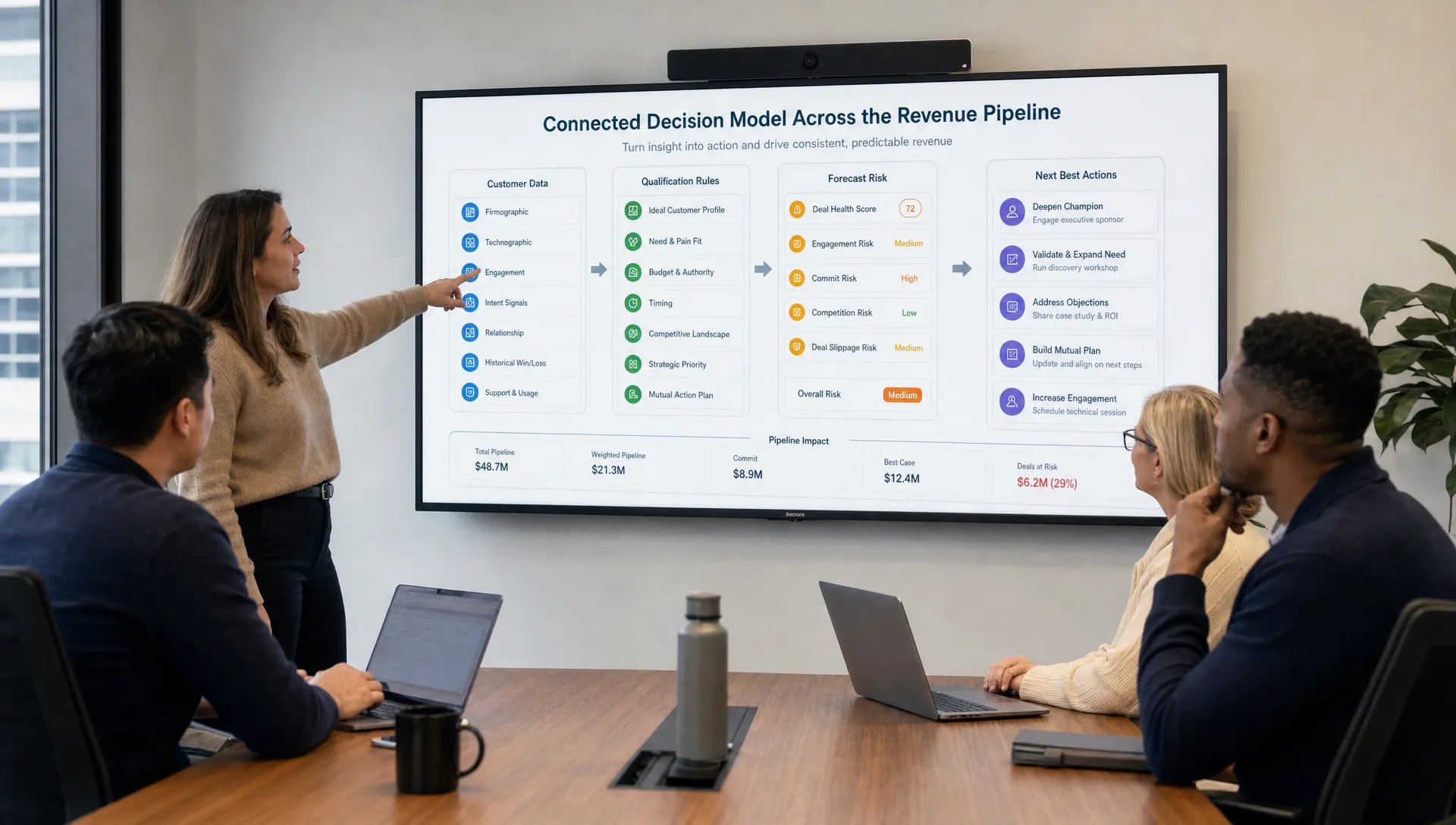
Forecasting becomes unreliable when it depends too heavily on seller optimism or leadership pressure. Expert systems improve forecasting by evaluating deal evidence against a consistent standard.
Instead of asking, “What does the rep think will close?” the system can ask better questions:
- Has the economic buyer been identified?
- Is there a confirmed business problem tied to financial impact?
- Has the customer agreed to a mutual action plan?
- Are legal, procurement, or security steps still unresolved?
- Is the close date based on buyer urgency or seller preference?
The system can then flag deals that are overstated, missing evidence, or moving backward. This helps leaders shift forecast conversations away from persuasion and toward risk removal.
It also improves coaching. If the same evidence gaps appear repeatedly, leadership can see whether the issue is sales skill, process design, messaging, pricing, or market fit.
4. They Support Better Pricing and Discount Decisions
Pricing decisions are often where growth companies leak margin. A seller wants to win the deal. A customer asks for a discount. A leader approves an exception because the logo looks attractive. Over time, the company trains the market to negotiate harder.
An expert system can help by applying pricing governance consistently. It can assess factors such as segment fit, contract length, implementation complexity, strategic value, margin impact, competitive pressure, and expansion potential.
The system does not need to ban discounts. It can distinguish between a commercially justified pricing decision and a reactive concession. For example, it might approve a discount if the customer commits to a multi-year term and reduced implementation scope, but require executive review if the deal has high service complexity and low expansion potential.
This improves decision speed while protecting margin discipline.
5. They Improve Customer Retention and Expansion Decisions
Expert systems are not only useful before the sale. They can also help post-sale teams identify risk and expansion potential earlier.
A retention-focused expert system might combine product usage, support tickets, executive engagement, implementation milestones, payment behavior, sentiment from customer calls, and renewal timing. It can then classify accounts by risk level and recommend intervention.
An expansion-focused system might look for different signals, such as increased usage, new departments engaging, new regulatory pressure, recent funding, leadership changes, or repeated requests for adjacent capabilities.
The advantage is that customer success no longer treats every account the same. Leaders can focus senior attention where it has the highest probability of protecting or growing revenue.
Expert Systems vs. Generative AI: Why the Difference Matters
Many leaders now associate AI with generative tools that write emails, summarize calls, or draft proposals. Those use cases can be valuable, but they are not the same as expert systems.
Generative AI produces content. Expert systems support decisions.
A generative AI tool might summarize a sales call. An expert system can evaluate that summary against qualification criteria and flag that the opportunity lacks budget confirmation. A generative tool might draft a proposal. An expert system can check whether the proposed scope aligns with margin rules and delivery capacity.
In modern B2B environments, the strongest approach is often hybrid. Generative AI handles unstructured information, such as call transcripts, emails, notes, and documents. The expert system applies structured commercial logic to that information. Together, they create a decision layer that is more useful than either capability alone.
This is why expert systems often belong inside a broader revenue operating model rather than sitting as isolated tools. If you are thinking about the bigger architecture, this breakdown of what an AI operating system should do for a B2B company explains how strategy, data, workflows, and accountability can connect.
Where Expert Systems Create the Most Value in Founder-Led B2B
Not every decision deserves an expert system. The best candidates are decisions that are frequent, commercially meaningful, data-informed, and currently inconsistent.
For founder-led B2B companies, the strongest starting points are usually:
- Lead and account qualification: Deciding which opportunities deserve sales attention.
- Deal risk assessment: Identifying missing evidence before a forecast is trusted.
- Pricing and discount governance: Protecting margin while keeping deals moving.
- Customer health classification: Prioritizing retention effort before renewal risk becomes obvious.
- Expansion prioritization: Identifying accounts with the strongest growth potential.
- Market entry decisions: Comparing segments, verticals, or geographies using shared criteria.
The key is to begin where bad decisions are already expensive. If weak qualification is wasting sales capacity, start there. If forecasting misses are disrupting hiring and cash planning, start there. If discounting is eroding profitability, start with pricing governance.
Expert systems work best when tied to a specific business decision, not a vague ambition to “use AI.”
A Practical Build Model for B2B Expert Systems
The mistake many companies make is starting with software before they understand the decision they want to improve. A better build model starts with the commercial question.
First, define the decision. For example: “Should this opportunity be accepted into pipeline?” or “Should this deal be included in the commit forecast?” The narrower the decision, the easier it is to design useful logic.
Second, identify the expert criteria. Interview the founder, sales leaders, top performers, delivery leaders, and customer success team. Look for the signals they already use, especially the ones that are not obvious in CRM fields.
Third, map the required data. Some data may already exist in CRM, product analytics, support systems, call transcripts, finance tools, or spreadsheets. Other data may need to be captured through better process design.
Fourth, design the decision rules. These might include hard rules, scoring models, confidence thresholds, escalation triggers, and exception paths. The system should not simply produce a score. It should explain what evidence influenced the recommendation.
Fifth, test against real historical decisions. Compare system recommendations with actual outcomes. Where did the system correctly identify risk? Where did it miss nuance? Where did human experts disagree?
Finally, operationalize the system inside the workflow. A recommendation that lives in a separate dashboard will often be ignored. A recommendation that appears during qualification, forecast review, pricing approval, or renewal planning is much more likely to change behavior.
This is where AI systems become practical revenue infrastructure. The article on AI systems that strengthen sales, delivery, and forecasting expands on how these systems can support execution across the commercial engine.
Governance: Keep Humans Accountable
Expert systems should improve human decisions, not create unaccountable automation.
This matters especially in B2B because commercial decisions involve context. A low-scoring opportunity might still be strategically important. A risky deal might be worth pursuing if it opens a new market. A discount might be acceptable if it secures a multi-year anchor customer.
The system should therefore make reasoning visible. It should show what it considered, what data was missing, and why it recommended a specific action. Leaders should be able to override recommendations, but overrides should be tracked so the business can learn from them.
NIST’s AI Risk Management Framework emphasizes the importance of mapping, measuring, managing, and governing AI risks. For B2B companies, that translates into practical habits: define who owns the decision logic, audit recommendations regularly, monitor bias or drift, and keep humans responsible for material commercial decisions.
Governance does not slow expert systems down. Done well, it makes them trustworthy enough to use.
Common Mistakes to Avoid
The biggest mistake is treating an expert system as a magic answer machine. If the underlying expertise is unclear, the data is unreliable, or the workflow is broken, AI will not fix the decision. It may simply automate confusion.
A second mistake is overbuilding too early. A simple rules-based system that improves qualification can create more value than an elaborate AI project that never reaches the sales floor.
A third mistake is ignoring the people who will use it. Sales, marketing, finance, delivery, and customer success need to understand how the system works and why it helps them. If users see it as surveillance or bureaucracy, adoption will suffer.
A fourth mistake is letting the logic go stale. Markets change. Competitors change. Buyer behavior changes. Delivery capacity changes. Expert systems need ongoing review so that yesterday’s winning rules do not become tomorrow’s growth constraint.
The Strategic Payoff: Better Decisions at Revenue Speed
The most valuable B2B companies do not just have better data. They have better decision systems.
Expert systems in AI help founder-led companies scale the judgment that made them successful in the first place. They reduce dependency on informal founder intervention, give teams consistent commercial logic, and help leaders allocate attention where it has the greatest revenue impact.
For a $3M to $25M B2B company, this can change the operating rhythm of the business. Qualification becomes sharper. Forecasting becomes more evidence-based. Pricing becomes more disciplined. Customer risk becomes more visible. Expansion decisions become less random.
Most importantly, the company gets faster without becoming reckless.
Frequently Asked Questions
What is an expert system in AI? An expert system in AI is a decision support system that uses domain knowledge, rules, data, and inference logic to make or recommend decisions that would normally require human expertise.
How are expert systems different from generative AI? Generative AI creates or summarizes content, while expert systems apply structured reasoning to support decisions. In B2B, they often work together when generative AI extracts insights from unstructured data and the expert system applies commercial logic.
Where should a B2B company use an expert system first? Start with a decision that is frequent, expensive when wrong, and currently inconsistent. Common starting points include opportunity qualification, forecast risk, pricing approvals, churn risk, and expansion prioritization.
Do expert systems replace managers or sales leaders? No. The best expert systems make human judgment more consistent and scalable. Leaders should still own strategic decisions, review exceptions, and update the logic as the market changes.
Can small and mid-sized B2B companies use expert systems? Yes. A company does not need enterprise-scale infrastructure to benefit. Many firms can start with a focused decision model, clear rules, better data capture, and workflow integration before expanding into more advanced AI systems.
Build AI Decision Systems Around Revenue, Not Hype
If your B2B company is growing but decisions still depend on founder memory, spreadsheet debates, or inconsistent team judgment, expert systems can become a powerful operating advantage.
Billionaires in Boxers helps founder-led B2B companies engineer scalable growth through PE-grade diagnostics, AI systems, and fractional CRO support. If you want to identify where better decision systems could unlock revenue, margin, and focus, explore the Revenue Acceleration Diagnostic and start turning expert judgment into a scalable commercial asset.
