

Scaling a founder-led B2B company is not the same game as starting one.
In the early years, growth often comes from founder force. You spot demand before others see it. You sell with conviction. You bend the offer around important accounts. You make decisions faster than a larger competitor can schedule the meeting.
That entrepreneurial advantage is real. But once the business reaches the $3M to $25M range, the same strengths can become constraints. The founder becomes the best salesperson, the most trusted strategist, the escalation point for clients, and the default decision-maker for every new opportunity.
This is where entrepreneurial strategy has to evolve. It can no longer be a loose mix of ambition, instinct, and hustle. It must become a clear operating logic for where the company will play, how it will win, and what systems must exist so growth does not depend on heroic founder involvement.
For founders ready to scale, strategy is not about sounding sophisticated. It is about making the business easier to grow.
What entrepreneurial strategy really means at the scale stage
Entrepreneurial strategy is the set of choices that turns founder insight into repeatable growth. It connects market focus, offer design, sales execution, leadership structure, and resource allocation into one coherent direction.
At the start, strategy may be simple: find urgent pain, win customers, deliver well, survive. At the scale stage, the questions become more demanding:
- Which customers should we pursue because they create the best economics and strongest strategic position?
- Which offers should we standardize, package, or retire?
- Which sales motion can work without the founder personally pushing every major deal forward?
- Which bottleneck, if removed, would unlock the next stage of revenue?
- Which capabilities must be built before we expand into new markets, verticals, or channels?
The mistake many founders make is treating strategy as a planning exercise. In a scaling company, strategy is an execution filter. It tells the team what to prioritize, what to ignore, what to measure, and what not to customize.
McKinsey’s work on the ten rules of growth makes a similar point: growth is not just aspiration. It requires granular choices, resource commitment, and disciplined execution.
The first shift: from opportunity chasing to market selection
Founders are often opportunity-rich and strategy-poor. That is not an insult. It is usually why the company exists in the first place. The founder saw possibilities, said yes before the playbook was perfect, and created momentum.
But scaling punishes indiscriminate opportunity. A company trying to serve too many segments, use cases, and buyer types eventually pays for it in longer sales cycles, inconsistent messaging, difficult onboarding, delivery complexity, and weak margins.
A scalable entrepreneurial strategy starts by defining the market you can win repeatedly. That means going deeper than a broad ideal customer profile. You need to know the trigger events, buying committees, pain intensity, budget logic, objections, competitive alternatives, and success criteria that make one segment more attractive than another.
A useful test is simple: if two capable salespeople cannot explain your best-fit customer in the same language, the strategy is not yet operational.
Strong market selection should clarify:
- The customer segment where your proof is strongest
- The problem you solve with the clearest economic value
- The buying situation where urgency is highest
- The competitor or status quo you replace most effectively
- The delivery conditions that create profitable outcomes
This is where many founder-led companies discover that growth is not blocked by lack of demand. It is blocked by lack of focus. More pipeline from the wrong market only creates more noise.
The second shift: from founder-led selling to a revenue system
Founder-led selling is powerful because the founder can compress trust. They understand the market, the customer pain, the product nuance, and the commercial stakes. They can diagnose, persuade, reframe, and negotiate in real time.
The problem is that founder-led selling does not automatically become a scalable sales motion. Hiring salespeople into an undocumented founder sales process often leads to disappointment. The founder assumes the salesperson lacks ability. The salesperson feels they were hired into a system that only works when the founder is in the room.
The real issue is usually translation. The founder’s instincts have not been turned into revenue architecture.
A scalable revenue system defines how leads are generated, qualified, advanced, closed, onboarded, expanded, and measured. It captures the commercial logic behind the founder’s best deals and makes it usable by other people.
This is closely tied to what really drives business growth in founder-led B2B, which is not raw activity, but the conversion of founder intuition into a repeatable revenue engine.
| Scaling symptom | Likely strategic issue | Better strategic response |
|---|---|---|
| Pipeline is growing but close rates are falling | Poor-fit demand is entering the funnel | Tighten ICP, qualification, and messaging |
| Founder is pulled into most late-stage deals | Sales process depends on founder credibility | Document discovery, proof, objection handling, and decision criteria |
| Delivery quality varies by client | Offers are too customized | Standardize core outcomes and implementation paths |
| Team is busy but revenue is unpredictable | Activity is not tied to a clear revenue model | Install pipeline cadence, conversion metrics, and accountability |
| Expansion stalls after first sale | Customer value is not mapped beyond onboarding | Build retention, expansion, and account development motions |
The point is not to remove the founder from growth entirely. The point is to stop making the founder the mechanism that holds growth together.
The third shift: from goals to constraints
Most strategic planning starts with targets. Founders set a revenue goal, then work backward into hiring, marketing, sales, and delivery plans.
That can be useful, but it is incomplete. A scaling company does not grow because the target is ambitious. It grows when the highest-leverage constraint is identified and removed.
For one company, the constraint may be weak positioning. For another, it may be inconsistent sales management. Another may have strong demand but poor conversion. Another may be able to sell, but delivery cannot absorb volume without senior people stepping in.
Entrepreneurial strategy becomes far more effective when the founder asks, “What is the one constraint currently limiting the next stage of revenue?”
That question changes the quality of decisions. Instead of launching five initiatives at once, the team focuses on the bottleneck with the highest revenue impact. Instead of copying what a larger company does, the founder funds the intervention most relevant to the business now.
If the founder is still the central dependency across sales, strategy, and client confidence, the issue is not effort. It is architecture. That pattern is explored in more depth in how to scale a B2B business without becoming the ceiling.
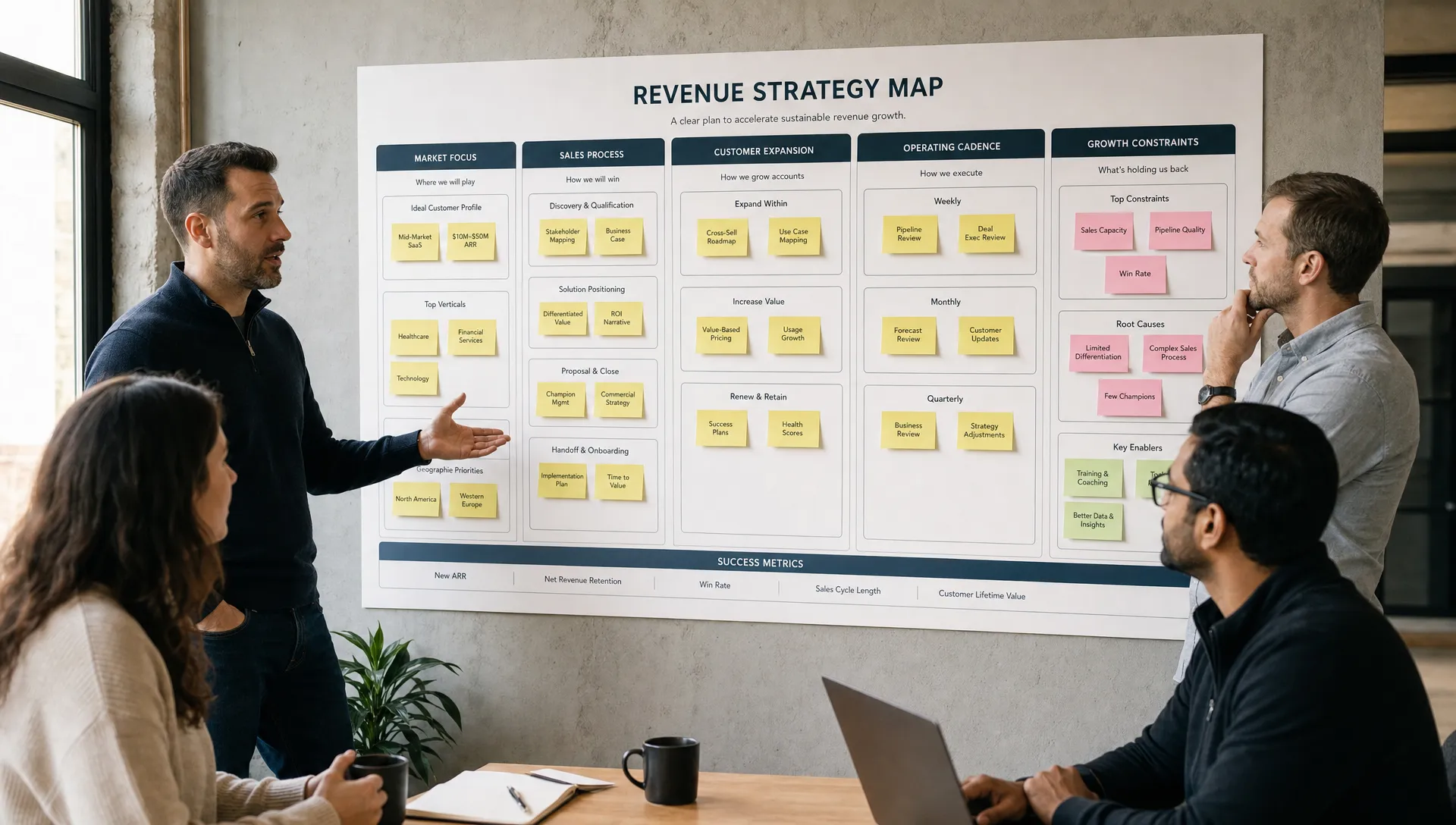
A practical 90-day entrepreneurial strategy sprint
Founders do not need a year-long strategy project to create clarity. In many $3M to $25M B2B companies, the highest-value work can begin with a focused 90-day sprint.
The goal is not to solve every problem. The goal is to identify the revenue constraint, sharpen the strategic choices, and install enough operating rhythm to prove whether the new direction is working.
| Sprint phase | Strategic focus | Output |
|---|---|---|
| Days 1 to 15 | Diagnose the real constraint | Revenue audit, funnel analysis, founder dependency map, customer and deal pattern review |
| Days 16 to 30 | Refine market and offer choices | Clear ICP, priority segments, messaging themes, offer architecture, disqualification criteria |
| Days 31 to 60 | Rebuild the revenue motion | Sales process, qualification rules, pipeline stages, discovery framework, proof assets, follow-up cadence |
| Days 61 to 90 | Install operating discipline | Weekly revenue rhythm, metrics dashboard, owner accountability, intervention roadmap, decision cadence |
This kind of sprint works because it respects the reality of founder-led companies. You cannot pause the business for abstract strategy work. The strategy has to be built around live deals, active customers, current team capability, and actual market feedback.
The best 90-day strategy work produces both clarity and movement. By the end, the founder should know which market to prioritize, which sales motion to reinforce, which hires are actually needed, which systems should be built, and which distractions should be removed.
The fourth shift: from founder control to leadership leverage
Noam Wasserman’s well-known research on founder dilemmas, discussed in Harvard Business Review, highlights a tension many founders eventually face: the choices that preserve control are not always the choices that maximize enterprise value.
That does not mean founders should recklessly hand over the business. It means scale requires a more intentional leadership model.
At the scale stage, the founder’s role should move from constant intervention to strategic leverage. That means fewer ad hoc decisions and more clear principles. Fewer heroic saves and more capable owners. Fewer founder-only relationships and more institutional trust.
A founder ready to scale should define decision rights across the revenue organization. Who owns pipeline quality? Who owns pricing discipline? Who owns retention signals? Who owns market feedback? Who decides when an opportunity is off-strategy?
Without this clarity, every department eventually routes uncertainty back to the founder. The team may be competent, but the operating model teaches them to wait.
Entrepreneurial strategy should therefore include leadership architecture, not just market ambition. The company needs a rhythm for making decisions, reviewing performance, learning from the market, and reallocating resources.
Strategic mistakes founders make when they are ready to scale
The scale stage is dangerous because the company has enough success to justify confidence, but not always enough system maturity to support the next level.
One common mistake is hiring senior leaders before defining the system they are supposed to run. A VP of Sales, Head of Marketing, or COO cannot compensate for unclear positioning, inconsistent qualification, or an offer that changes shape for every client. Senior talent performs best when the strategic logic is explicit.
Another mistake is expanding into new markets before winning the current one predictably. Expansion feels strategic, but it can become an expensive way to avoid fixing core revenue mechanics. If the company cannot repeatedly win in its strongest segment, a new segment usually adds complexity rather than scale.
A third mistake is treating AI as a shortcut instead of an accelerator. AI systems can improve research, personalization, workflow, reporting, and decision support. But AI will not rescue a vague ICP, a weak offer, or a sales process nobody follows. The strategic sequence matters: clarify the revenue logic first, then build AI systems around it.
Finally, founders often confuse being busy with being strategic. More campaigns, more hires, more partnerships, and more meetings can create the feeling of progress while the core constraint remains untouched.
Good entrepreneurial strategy is often subtractive. It removes markets, offers, channels, habits, and assumptions that dilute growth.
How to know your strategy is ready for scale
A scale-ready strategy is not perfect. It is clear enough to guide decisions and strong enough to survive delegation.
You know your entrepreneurial strategy is maturing when your team can make better decisions without waiting for founder interpretation. Sales knows which opportunities to pursue. Marketing knows which pains to amplify. Delivery knows which outcomes must be standardized. Leadership knows which metrics matter and which issues require escalation.
The simplest test is this: can the business grow because of the system, not in spite of it?
If the answer is yes, the founder can shift from being the company’s growth engine to being its strategic architect. That is when scale becomes more than a revenue target. It becomes an operating reality.
Frequently Asked Questions
What is entrepreneurial strategy for a scaling founder? Entrepreneurial strategy is the set of commercial and operational choices that turns founder instinct into repeatable growth. It defines where the company will compete, how it will win, which customers matter most, and what systems are needed to scale beyond the founder.
How is entrepreneurial strategy different from a business plan? A business plan often documents goals, assumptions, financial projections, and activities. Entrepreneurial strategy is more practical at the scale stage because it acts as a decision filter. It tells the team what to prioritize, what to stop doing, and how to convert market opportunity into scalable revenue.
When should a founder revisit strategy? A founder should revisit strategy when growth becomes inconsistent, the sales process depends too heavily on the founder, margins weaken, delivery complexity rises, or new hires struggle to replicate the founder’s results. These are signs that the business has outgrown informal operating logic.
Should founders hire a consultant, advisor, or fractional CRO to help with strategy? It depends on the constraint. If the issue is diagnosis, a strategic consultant may help. If the issue is ongoing revenue leadership, a fractional CRO may be more appropriate. Founders comparing support models can use this guide on choosing a business advisor or consultant to frame the decision.
Turn strategy into scalable revenue
If your company has traction but growth still depends too much on founder judgment, relationships, or intervention, the next move is not more hustle. It is a sharper revenue strategy and a system built to execute it.
Billionaires in Boxers helps founder-led B2B companies at the $3M to $25M stage diagnose revenue constraints, design scalable growth systems, and build a costed intervention roadmap through PE-grade diagnostics, AI systems, and fractional CRO support.
If you are ready to turn entrepreneurial strategy into a repeatable revenue engine, start with Billionaires in Boxers.
